
10 Best Concrete Nailers in 2026
This post contains affiliate links. As an Amazon Associate, we earn from qualifying purchases.
The Bosch PROFACTOR 18V Cordless Concrete Nailer is our recommendation for the best overall tool, thanks to its cordless convenience and versatile magazine system. The Freeman Pneumatic Concrete T-Nailer earns the spot for Best Pneumatic Value, and the EXCECAR Manual Concrete Nail Gun Kit is the best complete manual kit for DIYers.
Choosing the right tool means matching its power source and fastener type to your specific project. This guide uses manufacturer specifications to help you understand the options between cordless, pneumatic, and manual systems. You’ll find clear picks for every need.
Top 10 Concrete Nailers in the Market
Certain content that appears on this site comes from Amazon. This content is provided "as is" and is subject to change or removal at any time.
The Best Concrete Nailers, Reviewed
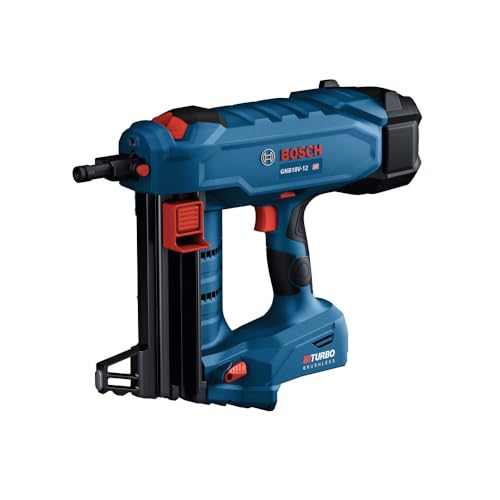
Bosch PROFACTOR 18V Cordless Concrete Nailer
What We Like
- Cordless design eliminates gas cartridges
- Open system accepts competitive nails
- Swappable collated and single-shot magazines
- Brushless motor for high-performance power
Trade-offs
- Battery and charger sold separately
- At 15.9 inches long, it's bulkier than some pneumatic models
- Extra-capacity 44-shot magazine is a separate purchase
This tool’s ability to sink up to 1.5-inch collated concrete nails with a single 18V battery replaces gas-powered systems and their consumable cartridges, allowing free movement on a jobsite without hoses or a compressor. Its professional capability comes from a Biturbo brushless motor and air-spring design engineered for fast, consistent nailing. The included collated-shot magazine and a separate single-shot nose piece provide versatility, with the single-shot mode specifically noted for MEP applications.
As a bare tool, it requires a separate purchase of a Core18V battery and charger, adding to the initial cost versus a system that is ready to use. For users already invested in a compatible 18V platform or planning multiple cordless tools, it consolidates power sources. The open system accepts competitive collated nails and single shots, a practical advantage for jobs using various fasteners.
Freeman Pneumatic Concrete T-Nailer

What We Like
- Lightweight 6.2-pound body reduces fatigue
- 360-degree exhaust directs air away from user
- Fire lock prevents accidental discharges
- Hardened steel drive blade for durability
Trade-offs
- Pneumatic operation requires a separate air compressor
- Limited to 14-gauge T-nails, not smaller pins
- Shorter 2-1/2" nail limit than some powder-actuated tools
The ability to drive 14-gauge T-nails up to two and a half inches long makes this nailer a serious workhorse for securing furring strips, installing subflooring, or fastening steel banding to concrete. For contractors or serious DIYers who already have a solid air compressor, this Freeman model delivers reliable, heavy-duty fastening in a package that’s rugged yet comfortable for all-day use. The 360-degree exhaust and fire lock are thoughtful touches that address real job-site nuisances and safety concerns.
This pneumatic nailer requires an air hose, which can restrict mobility compared to cordless models like the Bosch PROFACTOR. It is designed for T-nails and cannot use the smaller, headless pins compatible with tools like the Metabo HPT cordless pin nailer. The tool is intended for wood-to-concrete or steel projects such as fencing, decking, and steel banding.
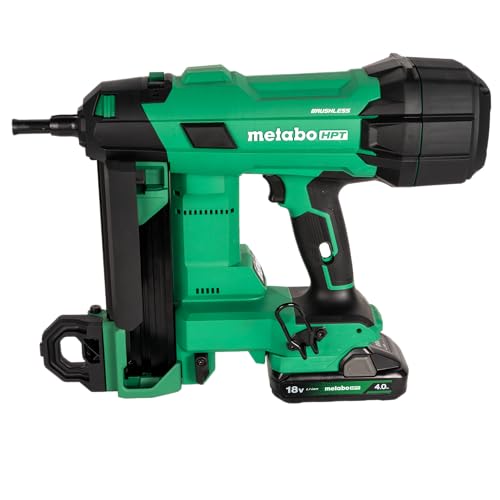
Metabo HPT 18V Cordless Concrete Pin Nailer
What We Like
- Highest impact energy in its class
- Brushless motor for power and durability
- Dry-fire lockout protects tool and work
- Quiet, fume-free cordless operation
Trade-offs
- At 9 lbs, it's heavier than most pneumatic models
Delivering 110 joules of impact energy, this nailer hits harder than any other cordless model in its category. That sheer power lets you drive the longest concrete pins into the toughest substrates without needing a compressor hose. The brushless motor and air-spring drive make it a reliable workhorse for pros who need a full day of clean, high-impact fastening from a battery platform.
You pay for that power with some bulk. It’s notably heavier than a pneumatic tool like the Freeman PSSCP, and its length can be a handful when working overhead or in corners. This is the cordless you grab when you need to sink big fasteners all day, not for quick trim work or confined areas where a lighter, shorter tool would be less fatiguing.
Product photos
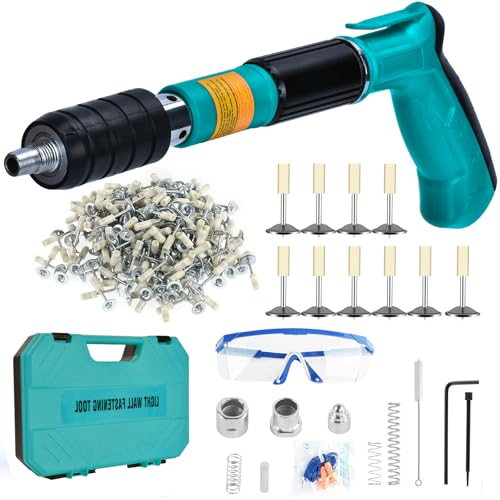
EXCECAR Manual Concrete Nail Gun Kit
What We Like
- Complete kit includes all necessary safety gear
- Five-gear adjustment for different material densities
- No power source required for operation
- Double silencer cover reduces noise significantly
Trade-offs
- Manual operation requires significant user force and repetition
- Limited to 25 mm nail length, unsuitable for deep anchoring
A manual five-gear adjustment system lets you match the driving force to the job, from hanging a picture frame to mounting a bracket on a steel plate. That versatility, combined with a kit that throws in gloves, goggles, and earplugs right in the box, makes this the most turnkey manual option. It’s built for the occasional user or DIYer who needs to fasten to masonry or metal without the complexity or cost of a powered system. You get a focused tool for light-to-medium duty fastening, ready to use the moment you open the plastic case.
This tool requires manual operation, so users must apply vertical force and compress the rear handle several times to drive and withdraw each nail. This process is described in five steps, which include wearing protective gear and holding a silencer sleeve. The design trades powered speed for a cordless, battery-free system that needs no electricity.
Freeman Pneumatic Single-Pin Concrete Nailer

What We Like
- Works with standard Ramset and Hilti single pins
- One-piece hardened steel drive blade for durability
- No powder loads or special certifications required
- Comfort grip handle reduces fatigue during long use
Trade-offs
- Requires an air compressor, hose, and fittings to operate
- Limited to green concrete poured less than 25 days prior
- Only drives single pins, not T-nails or other styles
Compatibility with 3-inch heavy-duty pins from major brands like Ramset and Hilti makes this nailer a serious contender for anchoring wood or steel to concrete in demanding applications like basement framing or decking. It’s a pneumatic tool, so it relies on a shop air compressor, but that also means you avoid the cost and paperwork of powder-actuated systems. The one-piece hardened steel drive blade is built to withstand the repeated shock of driving into masonry, and the 360-degree exhaust lets you keep the blast away from your face. For contractors or serious DIYers who already have a compressor and regularly tackle structural fastening, this gun turns a slow, arduous job into a quick one.
This nailer is purpose-built for single concrete pins, so it’s not a universal fastening tool. Its design requires green concrete poured less than 25 days prior, which defines its primary renovation and new construction applications. The pneumatic system works with conventional air compressors and is noted as being ten times faster than powder-actuated systems, eliminating the need for powder or special certifications.
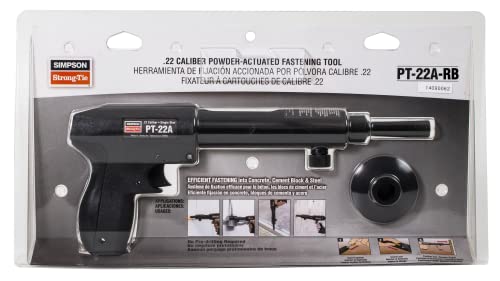
Simpson Strong-Tie Powder-Actuated Tool
What We Like
- Three distinct power levels for material matching
- Accepts threaded studs for versatile fastening
- Compact 13-7/8 inch length for tighter spaces
- Handles fasteners up to 3 inches long
Trade-offs
- Maximum 3-inch pin length limits deep anchoring
- Uses specialized 0.22 caliber powder loads
With three power levels and compatibility for both headed pins and 1/4-inch threaded studs, the Simpson Strong-Tie PT-22A-RB covers a wide range of general fastening tasks. This versatility makes it a solid fit for contractors and serious DIYers who need to anchor wood to concrete, attach electrical boxes, or install furring strips without switching tools. Its 13-7/8 inch length is manageable for overhead work, though the heft demands a steady arm.
The tool’s 13-pound weight is noticeable compared to a pneumatic option like the Freeman PCTN64, and its 3-inch maximum pin length won’t handle the deepest anchoring jobs. For those, you’d look to a higher-caliber powder tool like the Hilti DX 2. But for the bulk of on-site tasks that don’t require cordless or gas-powered convenience, this powder-actuated tool delivers straightforward, dependable power across common materials.
Product photos
SONEE Manual Concrete Nail Gun Kit

What We Like
- Five adjustable gear settings for different materials
- Includes essential personal protective equipment
- Compact and lightweight for easy portability
Trade-offs
- Limited to a short 25mm nail length
The SONEE manual nail gun includes five adjustable gears, letting users match the tool’s impact force to different materials and tasks. This adjustability is achieved by removing screws, with the first gear capable of penetrating a 3mm steel plate. The kit comes with safety glasses, gloves, and earplugs, providing essential protection for immediate use.
The trade-off for that adjustability and budget-friendly approach is pure manual labor. You supply all the driving force with repeated blows to the rear plunger, a physical process that becomes tiring for more than a handful of fasteners. For driving dozens of nails into concrete, a powered option like the Freeman Pneumatic T-Nailer will save your arm and your time, but it also requires a compressor and represents a larger investment. The SONEE is a focused, mechanical solution for intermittent use where setup speed and cost outweigh firing speed.
Product photos
Hilti GX 3 Gas-Actuated Fastening Kit

What We Like
- Complete gas-actuated fastening toolkit.
- Genuine Hilti product and build quality.
- Gas system eliminates cords and hoses.
Trade-offs
- Parallel import may affect warranty coverage.
- Packaging and manuals may differ from U.S. versions.
- Gas system requires fuel cells, not just nails.
Sold as a complete gas-actuated fastening kit, the Hilti GX 3 provides a system free from compressors and cords for greater mobility across a job site. Its packaged nature means you have everything required to begin fastening immediately. This genuine product is offered as a parallel import, so while functionally equivalent, its accessories, packaging, manual, and warranty may differ from U.S.-distributed versions.
The trade-off is the parallel import status. While it’s a genuine Hilti tool, you’re accepting potential differences in warranty support and documentation compared to a U.S.-distributed model. For a pro where warranty service is critical, that’s a consideration. If you prefer a cordless system to avoid gas cells altogether, the Bosch PROFACTOR 18V offers a different path to cord-free convenience, though it’s a bare tool that requires a separate battery platform.
Hilti DX 2 Powder-Actuated Tool

What We Like
- Semi-automatic operation for rapid fastening
- 0.27 caliber for high-power fastening applications
- Compact 4.0-inch height for tight spaces
- Hilti brand reliability for professional use
Trade-offs
- Requires purchasing specific powder loads and fasteners
The Hilti DX 2 uses a 0.27 caliber powder load, which provides the driving force for steel-to-concrete fastening. Its semi-automatic operation allows for sequential pin placement without manual cycling. This design supports efficiency in large-scale anchoring and strut installation work.
Unlike a cordless tool like the Bosch PROFACTOR 18V Concrete Nailer, the Hilti DX 2 operates with powder-actuated loads. Users must source these specific consumables for each job. For daily structural anchoring, this system delivers consistent power, while occasional tasks may be simpler with a pneumatic or cordless system.
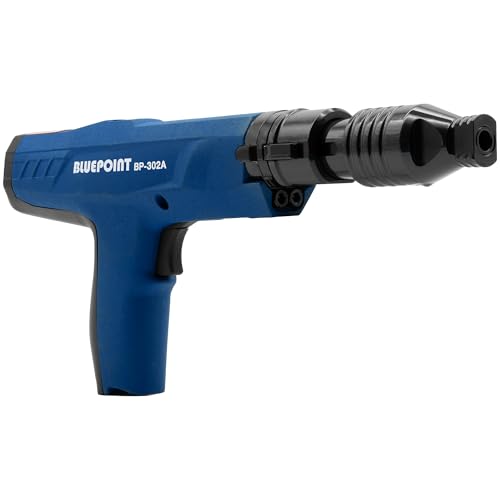
BLUEPOINT BP-302A Powder Actuated Tool
What We Like
- Market-leading quiet operation for occupied spaces.
- Adjustable power for different base materials.
- Semi-automatic strip loading for faster work.
- Durable high-strength piston construction.
Trade-offs
- Requires purchasing specific .27 caliber powder loads.
- At 17.5 inches long, it is less compact than cordless options.
- Heavier than pneumatic rivals like the 6.2 lb Freeman PCTN64.
Market claims position it as the quietest powder actuated tool available, which means contractors can consider it for occupied spaces like offices or schools where minimizing disruption is a priority. Adjustable power levels and a capacity for pins up to two and a half inches long allow it to handle a range of fastening tasks into concrete or steel. This is a specialist tool for environments where driving power is needed but noise must be kept down.
As a semi-automatic .27 caliber powder-actuated tool, it requires specific load strips, a different system than cordless or pneumatic models. Its nearly ten-pound weight and size make it less agile for quick overhead work compared to lighter tools like the six-pound Freeman pneumatic nailer. For the right job site, its claimed quiet operation is a critical advantage.
Product photos
How We Evaluated Concrete Nailers
Our evaluation relied on manufacturer specifications, product documentation, and analysis of expert round-ups. We focused on three key criteria: power source and convenience, fastener compatibility, and durability for professional use. The power source, cordless, pneumatic, or manual, defines where and how you can work.
Fastener type and magazine capacity dictate what you can build, from subfloors to finish work. This guide also considers build quality and user-focused features like exhaust direction and safety locks. It does not address long-term reliability or the performance of specific nail and load combinations.
What To Look For In Concrete Nailers
Concrete nailers use different technologies to drive fasteners into masonry, each with distinct trade-offs. Your choice hinges on your project’s scale, your access to power, and the specific fasteners required.
The core decision is between power sources: cordless for freedom, pneumatic for cost-effective power with a compressor, or manual for no-power sites. Next, match the nailer to your fastener type. T-nails for wood, pins for steel or direct concrete, and consider tool weight and magazine capacity for efficiency.
Power Source & Convenience
Cordless nailers, like our best overall Bosch, offer complete jobsite freedom but require a battery investment. Pneumatic tools are typically lighter and more affordable but tether you to an air compressor and hose. Manual systems, such as the EXCECAR kit, need no external power, making them ideal for remote locations or infrequent use, though they require significant user effort. Your existing tool ecosystem, whether you own a compatible battery platform or a capable air compressor, often dictates the most practical and economical choice.
Fastener Type & Capacity
Concrete fasteners are not universal. Most nailers are designed for a specific style: T-nails for securing wood framing, single pins for steel or direct concrete anchoring, or specialized powder-actuated pins. The tool’s magazine defines your workflow; a swappable or high-capacity magazine minimizes reloading stops on big jobs. For example, the Freeman Pneumatic T-Nailer is limited to 14-gauge T-nails, perfect for subfloors, while the Simpson Strong-Tie tool accepts threaded studs for more versatile fastening. Always verify the nailer accepts the exact fastener length and gauge your project requires.
Build & User Features
Durability in a concrete nailer comes from hardened steel drive components and a strong housing. For pneumatic models, a 360-degree exhaust port is a critical feature that directs noisy, oily air away from the user’s face and workspace. Safety mechanisms, like a dry-fire lockout or a fire lock to prevent accidental discharge, protect both the tool and the operator. Ergonomic factors, such as a comfort-grip handle on the Freeman Single-Pin nailer, reduce fatigue during repetitive use.
- Check the tool’s length and weight for overhead or confined-space work.
- Confirm if necessary safety gear, like hearing and eye protection, is included or must be purchased separately.
- For powder-actuated tools, research the availability and cost of the required caliber-specific loads.
Your project’s fastener requirements will narrow your choices more than any other factor.
Concrete Nailers Compared
The following table compares key specifications across all our picks to help you see the differences at a glance.
| Product | Power Source | Nail Length Range | Weight |
|---|---|---|---|
| Bosch PROFACTOR 18V Cordless Concrete Nailer | 18V cordless (battery) | N/A | N/A |
| Freeman Pneumatic Concrete T-Nailer | Pneumatic (air compressor) | 5/8", 2-1/2" | 6.2 pounds |
| Metabo HPT 18V Cordless Concrete Pin Nailer | 18V cordless (battery) | 1/2" to 1-9/16" | 9.0 Pounds |
| EXCECAR Manual Concrete Nail Gun Kit | Manual, no electricity | 25 mm | N/A |
| Freeman Pneumatic Single-Pin Concrete Nailer | Pneumatic (air compressor) | 3/4", 3" | 6.2 Pounds |
| Simpson Strong-Tie Powder-Actuated Tool | Powder-actuated | Max Pin Length: 3 in. | 13.0 pounds |
| SONEE Manual Concrete Nail Gun Kit | Manual | 25mm nails | N/A |
| Hilti GX 3 Gas-Actuated Fastening Kit | Gas-actuated | N/A | N/A |
| Hilti DX 2 Powder-Actuated Tool | Powder-actuated | N/A | N/A |
| BLUEPOINT BP-302A Powder Actuated Tool | Powder-actuated | Max Pin Length: 2-1/2 inches | 9.9 Pounds |
Frequently Asked Questions
What is the best nail gun for concrete?
The best tool depends on your needs. For most users wanting cordless freedom, the Bosch PROFACTOR 18V Cordless Concrete Nailer is the best overall. For those with an air compressor, the Freeman Pneumatic Concrete T-Nailer offers excellent value. For light DIY tasks with no power available, a manual kit like the EXCECAR is a practical choice.
What is the best nail for concrete?
There is no single “best” nail; the fastener must match your nailer and material. Pneumatic tools typically drive 14-gauge T-nails for wood-to-concrete or specialized single pins for steel. Powder-actuated tools use threaded studs or drive pins. Always use the fastener type, length, and gauge specified by your tool’s manufacturer for safe and effective fastening.
What is the best nail gun for concrete and steel?
For fastening both concrete and steel, you need a tool designed for the appropriate pin. The Freeman Pneumatic Single-Pin Concrete Nailer works with standard pins for steel framing into concrete. For the highest cordless impact energy for such heavy-duty tasks, consider the Metabo HPT 18V Cordless Concrete Pin Nailer.
Do concrete nail guns work?
Yes, concrete nail guns are highly effective for fastening wood or steel to concrete and masonry. They are purpose-built tools that use significant force, from compressed air, combustible gas, or a manual strike, to drive a fastener into the material. Success depends on using the correct tool, fastener, and technique for the base material’s density and age.
What is the difference between a concrete nailer and a hammer drill?
They serve completely different functions. A concrete nailer drives a fastener directly into the material. A hammer drill for concrete rotates a concrete drill bit to create a hole for an anchor, which you then manually insert and set. You would use a hammer drill when you need a removable or adjustable anchor point, and a nailer for permanent, rapid fastening.
The Bottom Line
For contractors and advanced DIYers seeking cordless convenience without sacrificing power, the Bosch PROFACTOR 18V Cordless Concrete Nailer is the clear best overall choice. If you’re on a budget and already own a compressor, the Freeman Pneumatic Concrete T-Nailer delivers reliable performance for structural wood fastening.
For occasional light-duty tasks where no power source is available, the EXCECAR Manual Concrete Nail Gun Kit provides a complete, ready-to-use solution. Ultimately, successfully fastening to concrete comes down to matching your tool’s power source and fastener compatibility to the specific demands of your job.
