
4 Best Air Compressors For Roofing in 2026
This post contains affiliate links. As an Amazon Associate, we earn from qualifying purchases.
The best air compressor for roofing is the Metabo HPT EC914S Pancake Air Compressor for its ability to run two nailers simultaneously with high 200 PSI pressure. For extended runtime on large jobs, consider the Klutch 29-Gallon, while the Mazot 10-Gallon is ideal for quiet residential work. Choosing the wrong compressor can stall your crew with slow tool recovery or limit your mobility on the roof. This guide uses manufacturer specs and contractor feedback to identify the key features that matter for roofing productivity.
Top 4 Air Compressors For Roofing in the Market
Certain content that appears on this site comes from Amazon. This content is provided "as is" and is subject to change or removal at any time.
The Best Air Compressors For Roofing, Reviewed
Metabo HPT EC914S Pancake Air Compressor

What We Like
- 200 PSI provides 25% more pressure than basic pancakes
- 4 CFM at 90 PSI can run multiple large nailers
- Can power two roofing nailers at once with no delay
Trade-offs
- 6-gallon tank requires more frequent refills than larger wheelbarrow units
Delivering 4 CFM at 90 PSI from a 6-gallon tank, this compressor has the muscle to keep a two-person roofing crew moving without downtime. It’s the pancake that acts like a bigger machine, driving nails flush with consistent pressure. That’s why it’s the top pick for roofers who need proven, portable power. The 200 PSI maximum gives you a healthy reserve for heavy-duty fastening, and the ability to run two roofing nailers simultaneously means your crew stays productive from ridge to eave.
The trade-off is the tank size. While its air delivery is strong, a 6-gallon tank will cycle more often on a big roof than a large stationary unit like the Klutch 29-gallon. For pure portability, a lighter pancake model exists, but you sacrifice significant power and multi-tool capability. This Metabo HPT finds the sweet spot. It offers enough air for professional work, is light enough to haul up a ladder, and has the durability that has made the brand a pro favorite for over a decade.
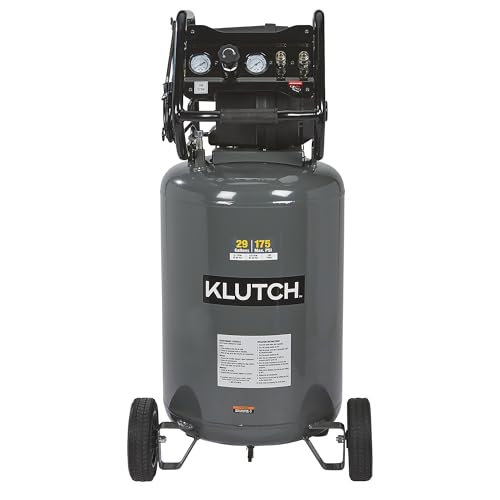
Klutch 29-Gallon Air Compressor
What We Like
- Large 29-gallon tank for extended run time
- Oil-free pump eliminates maintenance and spills
- Quick-connect coupler allows easy tool switching
- Large flat-free tires provide easy mobility
Trade-offs
- Weighs 127 pounds, requiring considerable effort to move
- Occupies significant floor space at 45.3 inches tall
- Recovery rate of 5.1 CFM may lag behind high-demand tools
A 29-gallon air tank is the key feature here, storing enough compressed air to run a roofing nailer for long stretches without the motor constantly cycling on. This makes the Klutch compressor a logical fit for a crew or a single roofer tackling large sections without interruption. The oil-free pump design is a practical choice for a jobsite, removing the worry of maintenance and potential oil contamination from your finish work.
The 29-gallon tank provides a substantial air reserve for continuous tool operation. This lets you run a nailer or spray gun longer without waiting for the pump to cycle. That capacity requires a sizable, floor-bound unit weighing 127 pounds, which you’ll wheel into position and leave there for the day. For large jobs where you can run long hose lines from a stable location, this setup is effective. For tasks needing frequent relocation or access to steep roofs, a lighter compressor like the 41-pound Metabo HPT pancake would be easier to move, though it holds less air.
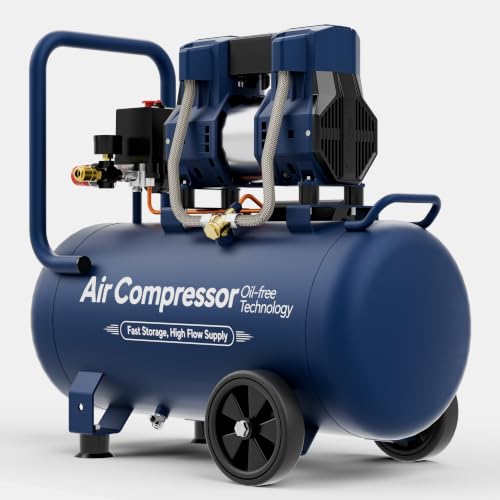
Mazot 10-Gallon Quiet Air Compressor
What We Like
- Fully enclosed housing for quiet operation
- High-efficiency cooling for fast recovery
- Oil-free pump for low maintenance
- Two-year warranty for peace of mind
Trade-offs
- At 25.6 inches tall, it is less portable than a pancake compressor
- 5.26 CFM may limit high-volume tools like roofing staplers
- Larger footprint than compact 6-gallon models
A 5.26 CFM delivery at 90 PSI paired with a high-efficiency cooling system means this compressor refills its 10-gallon tank quickly, letting you run a roofing nailer for longer stretches with fewer motor restarts. The fully enclosed noise-reduction housing is a major benefit for residential work, keeping the racket down in the neighborhood. This combination of steady air and quiet operation makes it a strong fit for roofers tackling larger sections of shingle work without the constant start-stop cycle of a smaller unit.
The trade-off for that quiet, stable air is portability. It’s notably taller and heavier than a pancake compressor like the Metabo HPT EC914S, so hauling it up a ladder onto a roof isn’t practical. You’ll be running a hose from the ground or a truck bed. For a crew that needs to move the compressor itself across the roof all day, a gas-powered wheelbarrow model like the Metabo HPT EC2610EA would be a more mobile, though much louder, alternative.
Product photos
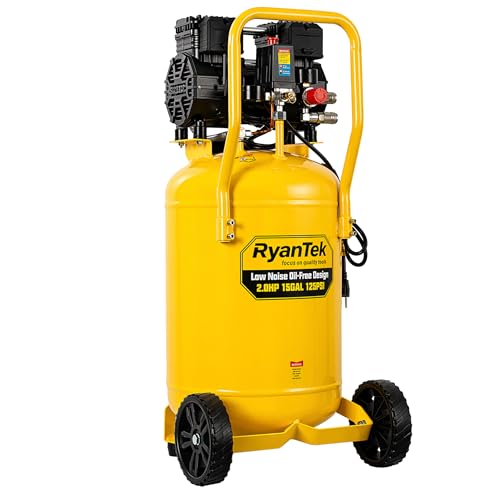
RyanTek 15-Gallon Air Compressor
What We Like
- Quiet 66 dBa operation for neighborhood-friendly use.
- Large 15-gallon tank reduces motor cycling frequency.
- Vertical, wheeled design saves space and aids mobility.
- Upward-facing gauge and side-mounted handle for protected controls.
Trade-offs
- At 68.3 lb, it's heavier than pancake compressors like the 30.8 lb CRAFTSMAN.
- 4.5 CFM may be insufficient for high-demand tools like framing nailers.
- Vertical tank's taller profile requires more headroom for transport.
A 15-gallon tank and 4.5 CFM at 90 PSI means you can run a roofing nailer all day with fewer annoying pauses for the motor to kick on. That’s the core appeal for a shingling job where constant air is key. It suits a roofer or serious DIYer who needs more air than a pancake compressor can provide but wants a quieter, oil-free unit that won’t disturb the whole block. The vertical footprint and integrated wheels make it relatively easy to maneuver around a job site or tuck into a corner of the garage.
The trade-off is portability. For pure roofing speed on a large crew, its airflow can’t match a larger, heavier unit like the Klutch 29-Gallon with its 5.1 CFM. But if your work blends roofing with finish work or spray painting, the RyanTek’s quiet operation and clean air make it a versatile shop compressor that just happens to excel on a roof.
Product photos
How We Evaluated Air Compressors For Roofing
Our evaluation is based on technical specifications, manufacturer documentation, and patterns in professional roofing contractor feedback. We prioritized criteria that directly impact a roofing crew’s efficiency: air delivery (CFM) to ensure nailers fire without delay, tank size and design for balancing runtime with portability, and overall jobsite durability. A research-based approach like this cannot replicate years of field use, but it effectively highlights which models are engineered for the specific demands of powering pneumatic roofing nailers.
What To Look For In Air Compressors For Roofing
The right compressor keeps your nailers firing without lag, matches your crew’s mobility needs, and withstands jobsite conditions. Your choice hinges on balancing air supply, tank capacity, and portability.
Look for a minimum of 4-6 CFM at 90 PSI per roofing nailer for steady operation. Tank size dictates runtime versus portability, while motor design (oil-free vs. Oil-lubricated) affects maintenance. Noise level and wheel design are critical for residential work and moving over shingles.
Air Delivery (CFM)
Cubic Feet per Minute (CFM) measures the compressor’s ability to supply air. A single roofing nailer typically requires 2-4 CFM at 90 PSI. To run two nailers continuously, you need at least 4-6 CFM. A higher CFM rating prevents “tool lag,” where nailers fire slowly because the compressor can’t recover air fast enough. This is especially important for larger crews or when using high-demand tools like roofing staplers alongside nailers.
Tank Size & Portability
Tank capacity determines how many nails you can drive before the motor must restart. A 6-gallon pancake compressor is highly portable but requires more frequent refills, making it best for agile crews. Larger 15- to 29-gallon tanks provide longer runtime but are heavier and harder to move onto a roof deck. Consider if you’ll station the compressor on the ground and run long hoses, or if you need to carry it up a ladder frequently.
Jobsite Durability & Design
Roofing jobs expose equipment to sun, dust, and vibration. Look for features like oil-free pumps that eliminate maintenance and prevent spills, protective cages or housings for the pump and controls, and large, flat-free tires for rolling over uneven ground. For residential work, a quieter compressor is a neighbor-friendly advantage that can help you secure more jobs in noise-sensitive areas.
- Check the unit’s weight and dimensions against your vehicle’s storage space.
- Ensure the air outlet and gauge are positioned to avoid damage during transport.
- Verify the power cord length or consider a generator for sites without electricity.
Match the compressor’s CFM output to the total demand of all tools you plan to run at once.
Air Compressors For Roofing Compared
The table below compares key specifications to help you see the trade-offs between portability, power, and runtime at a glance.
| Product | Max Pressure | Air Delivery @ 90 PSI | Tank Capacity | Weight |
|---|---|---|---|---|
| Metabo HPT EC914S Pancake Air Compressor | 200 PSI | 4 CFM | 6 gallons | 41.0 Pounds |
| Klutch 29-Gallon Air Compressor | 175 PSI | 5.1 CFM | 29 gallons | 127.0 pounds |
| Mazot 10-Gallon Quiet Air Compressor | 120 PSI | 5.26 CFM | N/A | N/A |
| RyanTek 15-Gallon Air Compressor | 125 PSI | 4.5 CFM | 15 gallons | 68.3 Pounds |
Frequently Asked Questions
What is the best air compressor for roofers?
The best overall compressor for most roofing crews is the Metabo HPT EC914S Pancake. It delivers 200 PSI maximum pressure and 4 CFM at 90 PSI, which is enough to reliably power two roofing nailers at once. Its compact, portable design also makes it easy to move around a job site. For very large crews or continuous commercial work, a gas-powered wheelbarrow compressor with higher CFM may be necessary.
What size air compressor do I need for roofing?
You need an air compressor that can deliver at least 4-6 CFM at 90 PSI to run one or two roofing nailers without delay. Tank size depends on your workflow: a 6-gallon pancake is highly portable but refills often, while a 15- to 29-gallon tank offers longer runtime for crews who can station the unit on the ground. A good rule is that a compressor in the 4-5 CFM range can generally support a 2-person crew.
What is the most reliable brand of air compressor?
While brand reputation is built over time, professional contractor feedback and expert round-ups consistently highlight models from brands like Metabo HPT, Makita, and Rolair for their durable construction and consistent performance in contractor-grade applications. Reliability for roofing specifically comes from a combination of a durable pump, sufficient CFM output, and a design that can handle daily jobsite transport and use.
Which brand of air compressor is the best?
There is no single “best” brand, as the ideal choice depends on your specific needs. For high-pressure, portable electric compressors, Metabo HPT’s “Tank” series is highly regarded. For ultra-quiet operation in residential settings, California Air Tools and some DeWalt models excel. For large-tank, stationary shop use, brands like Rolair and Ingersoll Rand are industry standards. The best brand for you is the one whose model specs align with your crew size and job requirements.
Should I get a cordless roofing nailer instead?
Cordless roofing nailers offer excellent mobility and eliminate the need to drag hoses and a compressor onto the roof, which can be a significant advantage for steep pitches or complex layouts. However, they require investment in a battery platform and have a higher per-tool cost. For crews already invested in air compressors for pneumatic tools, a pneumatic nailer paired with the right compressor is often the most cost-effective and high-performance solution for volume work.
The Bottom Line
For most professional roofing crews, the Metabo HPT EC914S Pancake Air Compressor is the best overall choice. It strikes the ideal balance between high-pressure output for running two nailers and a portable design that won’t slow you down. If you’re on a tight budget or primarily do solo work, a smaller, portable unit may suffice, while crews tackling large, continuous sections should look directly at the Klutch 29-Gallon for its extended runtime.
Ultimately, ensuring your compressor’s CFM rating meets or exceeds the total demand of your nailers is the single most important factor for maintaining job-site productivity.
