
Gas Powered Nail Gun Pros and Cons: How to Choose
This post contains affiliate links. As an Amazon Associate, we earn from qualifying purchases.
A gas-powered nail gun trades a compressor hose for a fuel cell and battery, delivering cordless power through an internal combustion motor. Its biggest pros are true portability and consistent power anywhere; its biggest cons are ongoing fuel costs, exhaust fumes, and a weight penalty over pneumatic tools. For most pros, that trade-off is worth it on large, remote sites. For most DIYers, it’s an expensive overcomplication.
That distinction between a pro’s daily driver and a DIYer’s occasional tool is the whole point. The cordless freedom is real, but the compromises are baked into the physics of the tool itself. You can’t separate the convenience from the combustion, which is central to any discussion of gas powered nail gun pros and cons.
What follows is a breakdown of how these tools actually work, what they cost to run, where they fail, and a direct comparison to the air-powered and battery-only tools you’re probably weighing them against, central to the gas powered nail gun pros and cons. By the end, you’ll know exactly which job site you’d reach for one on, and which one you wouldn’t.
Key Takeaways
- Gas nailers use a small internal combustion motor, not just a battery. This means they produce hot exhaust and carbon monoxide, requiring strict ventilation.
- The ongoing cost per nail is a real factor. A Paslode fuel cell drives about 1200–2500 nails, adding a per-nail fuel cost on top of battery costs.
- Altitude kills performance. Combustion engines lose power in thin air; Paslode warns of issues above 4000 feet for its finish nailer and above 6000 feet for its framing nailer, a non-issue for pneumatic tools.
- They are heavier than pneumatic equivalents.
- For consistent, high-volume work in a shop, a pneumatic nailer is cheaper and more reliable. For remote, no-power job sites, a gas gun is the only cordless option with pro-level power.
How a Gas-Powered Nail Gun Actually Works
Forget batteries and electric motors for a second. The core of a tool like the Paslode Cordless Finish nailer is an internal combustion linear motor. It’s a miniature, single-piston engine inside a tool body.
Unlike other power fastening tools, the Cordless Finish nailer is powered by an internal combustion linear motor. In simpler terms, your Cordless Finish nailer is powered by a motor similar to the one that powers an automobile. The Cordless Finish nailer ignites a fuel and air mixture to produce the energy to drive the motor, which in turn drives the fastener.
Here’s the sequence: you pull the trigger. A battery provides the spark. A metering valve injects a precise amount of liquid hydrocarbon fuel from a disposable cell into a combustion chamber. The spark ignites the mixture. The resulting micro-explosion drives a piston forward, slamming a nail into your workpiece. Then the piston retracts, and the cycle is ready to go again.
That’s why these tools have a distinct sound and feel, a sharp pop followed by a puff of warm exhaust, a key point in the gas powered nail gun pros and cons. It’s not just a tool; it’s a contained engine. This mechanism is why they deliver cordless power that can rival a pneumatic gun, but it’s also the source of their biggest drawbacks: heat, fumes, and mechanical complexity.
The Pros: Where a Gas Nailer Actually Wins
This isn’t about vague “convenience.” It’s about specific situations where the alternatives fail.
True Cordless Power with Pneumatic-Level Force. A battery-only brad nailer is fine for trim. A battery-only framing nailer often struggles with dense lumber or sinks nails inconsistently. The internal combustion motor in a gas nailer, like the Paslode CF325XP, delivers a reliable 2 to 3 nails per second with enough force to sink a 3-1/4″ nail into seasoned wood. You get that performance with no hose and no 120V outlet within 100 feet.
All-Day, Off-Grid Capability. The math is in the specs. A fully charged battery on a Paslode IM250 II provides energy for about 4000 fasteners. A single fuel cell drives about 2500 fasteners. Carry a couple of each, and you can frame a shed or side a house without hunting for power. This is the killer app for rooftop decking, remote fencing, or any jobsite where dragging a compressor and generator is a half-day setup.
Consistent Performance in Variable Conditions. While extreme cold requires warming the fuel cell (more on that later), a gas nailer isn’t bogged down by voltage drop like a pure battery tool. The power stroke comes from combustion, not a draining battery, so the last nail of the day drives as deep as the first, provided the fuel and spark are there.
The Cons: The Inescapable Trade-Offs
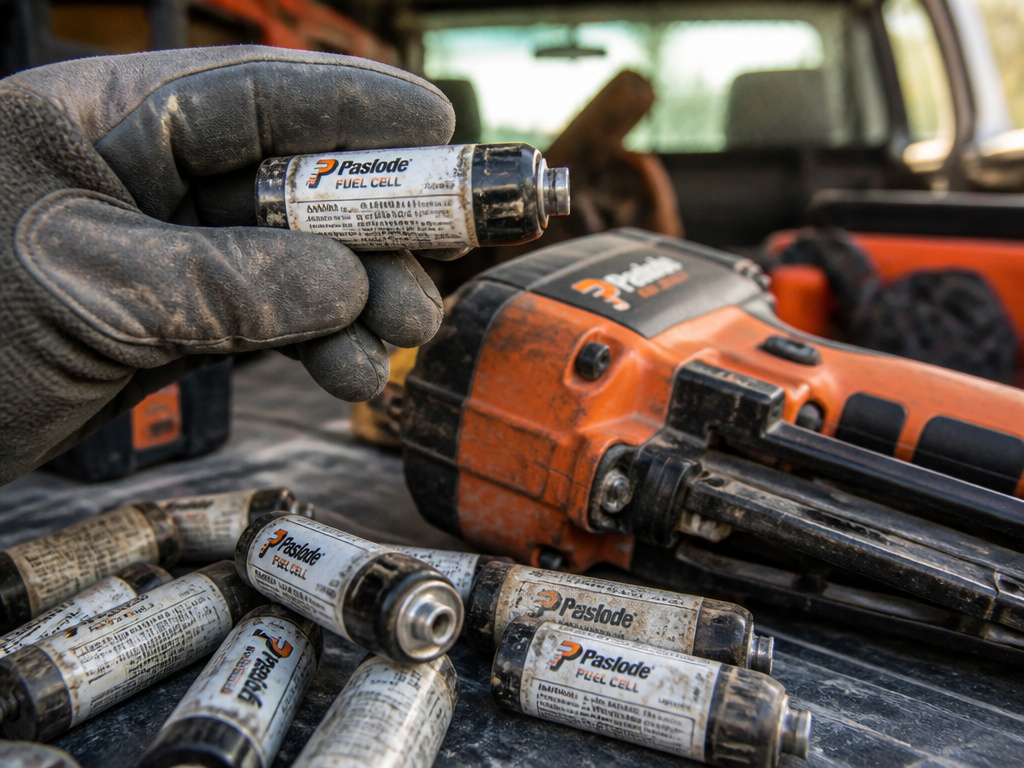
The cons aren’t minor annoyances. They’re direct consequences of the combustion engine you just bought.
Ongoing Consumable Cost. This is the big one everyone feels. You’re not just buying a tool; you’re buying into a fuel ecosystem. A Paslode fuel cell isn’t refillable. It’s good for roughly 1200 to 2500 nails, depending on the model. At about $5 per cell, that’s an added $0.02 to $0.04 per nail. For a small trim job, it’s negligible. For framing a house, it’s a line-item cost that doesn’t exist with a compressor you already own.
Where this goes sideways: Storing a fuel cell in a hot truck. Exposure to temperatures above 120°F (49°C) can cause the cell to burst. That’s a workshop fire hazard, not just a wasted $5.
Weight and Balance. That internal combustion engine has mass. A pneumatic framing nailer can clock in under 5 lbs. Overhead work or a full day of nailing ceiling joists? You’ll feel every extra pound by lunchtime.
Mandatory Maintenance and Cleaning. This isn’t a “maybe once a year” thing. The TOUA manual insists on daily cleaning of the magazine and feeder mechanism to prevent jams. Combustion creates carbon buildup. Fuel residue gums up the metering valve. Skip this, and the tool will misfire, jam, or simply stop working. A pneumatic nailer needs occasional oil; a gas nailer needs a disciplined cleaning ritual.
Safety and Operating Constraints You Can’t Ignore

This is a YMYL category for a reason. We’re talking about a combustion engine you hold in your hands.
Ventilation is essential. The manuals are unequivocal: “This tool must be operated only in a well-ventilated environment, because the tool exhausts carbon monoxide.” Using one in a closed garage, a basement, or even a tented porch is like running a lawnmower indoors. Dizziness and nausea are the warning signs; unconsciousness is the next step.
Combustible Environments Are Off-Limits. The tool produces hot exhaust and sparks. Paslode explicitly warns against use “in the presence of combustible materials, such as flammable chemicals, adhesives, gasoline, or solvents.” That rules out many renovation jobs near old finishes or in areas where volatile compounds are present.
Altitude and Temperature Limits. These aren’t theoretical. The thin air at high elevation affects combustion.
| Nailer Model | Altitude Advisory | Recommended Fix |
|---|---|---|
| Paslode Cordless Finish (IM250 II) | May lose power above 4000 ft | Use high-altitude metering valve (part #219247) |
| Paslode CF325XP Framing Nailer | May lose power above 6000 ft | Use high-altitude metering valve |
Cold weather is also a factor. The TOUA manual says to never store the tool or fuel cell in the cold and to warm them to room temperature before starting work. A cold fuel cell won’t vaporize properly, leading to weak drives or misfires.
Gas vs. Pneumatic vs. Battery-Only: The Real Comparison
We can ignore the marketing claims. Each type has a home, and pretending they’re interchangeable costs you money and frustration.
| Factor | Gas-Powered (e.g., Paslode) | Pneumatic (e.g., Campbell Hausfeld) | Battery-Only (e.g., Metabo HPT) |
|---|---|---|---|
| Power Source | Battery + Fuel Cell (Combustion) | Compressed Air (90-120 PSI) | Battery Only (18V-20V) |
| Max Portability | High (No hose, no cord) | Low (Hose & compressor required) | Highest (No hose, no fuel) |
| Cost Per Shot | $$ ($0.02-$0.04 for fuel) | $ (Pennies for air) | $ (Battery recharge) |
| Noise Level | Loud (Combustion pop + exhaust) | Very Loud (Compressor + exhaust) | Quiet (Electric motor hum) |
| Weight | Heavy (7-9 lbs) | Light (5-7 lbs) | Medium (6-8 lbs) |
| Ideal User | Pro on remote sites | Pro/DIYer with shop/compressor | DIYer / Pro doing finish work |
When Gas Wins: You’re a contractor building decks or fences where dragging a compressor is impossible. The jobsite has no power. You need framing power without a generator. The cordless vs pneumatic nail gun debate ends here, gas is your only cordless option with that much muscle.
When Pneumatic Wins: You work in a shop, a house with power, or a site where a compressor can be staged. You need the lightest, simplest, most reliable tool for high-volume nailing. The ongoing cost is virtually zero. For most types of nail guns used in bulk, air is still king.
When Battery-Only Wins: Your projects are smaller, like trim, cabinetry, or furniture. You value quiet operation and zero fumes (important for indoor work). You’re already invested in a cordless tool battery platform and want to add a nailer without a new ecosystem.
The Hidden Costs: A Real-World Breakdown
Talking about “ongoing cost” is vague. We will use actual numbers from the source material.
Fuel Cost Per Nail: A Paslode fuel cell for the IM250 II drives about 2500 fasteners, incurring a per-nail fuel cost. That seems tiny. But for the CF325XP, a cell drives about 1200 fasteners, incurring a higher per-nail fuel cost. Frame a wall with 500 nails? That’s a tangible fuel cost for one wall.
Battery Depreciation: A full charge of the 6V battery for the IM250 II provides energy for approximately 4000 fasteners. These batteries have a finite lifespan. When it dies, a replacement battery is an additional cost. That cost per nail creeps up over the years.
Maintenance Time: The 10-minute daily cleaning the TOUA manual demands adds up. The daily cleaning the TOUA manual demands adds significant maintenance time over a year. A pneumatic nailer requires less frequent maintenance.
The bottom line? For a DIYer who might drive 1000 nails a year, the fuel cost is a non-issue. For a pro driving 50,000 nails a year, the annual fuel cell cost is significant.
Long-Term Reliability and Common Failure Points
What breaks? And how does it compare to the simpler alternatives?
Gas nailers have more moving parts in harsh conditions. The common failure points stem directly from their design:
- Metering Valve Clogs: Fuel residue gums up the precise valve. The tool misfires or won’t fire. The fix is often replacing the entire fuel cell/valve assembly, another consumable cost.
- Combustion Chamber Carbon Buildup: This requires disassembly and scraping. Skip it, and performance drops steadily.
- Ignition System Failure: The battery or spark unit fails. Unlike a pneumatic tool that just needs air, a gas tool with a dead battery is a paperweight.
The part nobody mentions: Manufacturer service is more restrictive. TOUA states that “only service personnel trained by TOUA” should repair the nailer and to “use only parts supplied or recommended by TOUA.” This often means mailing your tool out instead of a quick local fix.
Pneumatic nailers fail too, usually o-rings, seals, or triggers. But the parts are cheap, and the repair is often straightforward. The mechanism is simpler: air pushes a piston. There’s no fuel chemistry, no spark, no battery management circuit to go bad.
Frequently Asked Questions
Are gas or battery nail guns better?
“Better” depends on the nail. For finish nails (16ga-18ga) indoors, a battery-only nailer is better, it’s quieter, fume-free, and plenty powerful. For driving 3-inch framing nails outdoors with no power, a gas nailer is better. Battery-only framing nailers exist but often sacrifice consistent depth or speed. There is no universal winner.
What is the best nail gun for home use?
For most homeowners, a pneumatic brad or finish nailer paired with a small, quiet compressor is the best value. It’s lighter, cheaper to buy, and costs nothing to run after the initial setup. It handles 95% of DIY trim, furniture, and repair tasks. If you absolutely hate hoses, a mid-range battery-only finish nailer is a fine, more expensive alternative. A gas nailer is overkill.
Is a battery-powered nail gun worth it?
For finish work, absolutely. The convenience of no hose or compressor is a major advantage for small, mobile projects. For heavy framing, it’s a tougher sell. You pay a large premium for cordless freedom, and you still may need multiple expensive batteries for all-day work. It’s worth it if your time and mobility are worth more than the extra cash.
How do you maintain a gas nailer?
It’s a daily regimen, not a seasonal one. Based on the TOUA manual: 1) Clean the magazine and feeder mechanism daily to prevent jams. 2) Lubricate with specified oil (like part #504.6.03.001.01) after each cleaning. 3) Store the tool, fuel cell, and battery indoors between 41°F and 77°F. Never leave them in a hot car or cold truck.
Can you use a gas nailer in the rain?
You shouldn’t. While they’re more weather-hardy than an open compressor intake, they are still complex electronic and combustion devices. Water can damage the battery contacts, fuel system, and ignition. Moisture in the combustion chamber will cause misfires. If you must work in damp conditions, keep the tool under cover when not in immediate use and dry it thoroughly afterwards.
The Bottom Line
Gas-powered nail guns solve one specific problem brilliantly: delivering cordless, pneumatic-level power where there is no power. For that, they have no equal.
But that solution comes with baggage, literal weight, ongoing cost, and operational hassles that air tools simply don’t have. The choice isn’t about which tool is “better.” It’s about which tool’s core compromise fits your specific job site.
My rule of thumb: if you can get a compressor to your work area, use a pneumatic nailer. It’s the cheaper, lighter, simpler tool. If you can’t, then the added cost and complexity of a gas gun is the price of admission for cordless freedom. For everyone else, a modern cordless nailer has probably already closed the gap enough to make the combustion engine unnecessary.
