
7 Best Saws To Cut Trim in 2026
This post contains affiliate links. As an Amazon Associate, we earn from qualifying purchases.
For precise trim and molding cuts, our best overall pick is the DEWALT 20V MAX 7-1/4-Inch Miter Saw for its adjustment-free accuracy and cordless convenience. The Metabo HPT 10-Inch Compound Miter Saw is our lightweight pick, and the DEKOPRO 10-Inch Compound Miter Saw excels at versatile angle adjustments. Cutting trim demands clean, accurate joints, so the right saw makes all the difference. We built this guide through extensive research of specifications, expert recommendations, and owner feedback to help you find the perfect tool for your project.
Top 7 Saws For Cutting Trim in the Market
Certain content that appears on this site comes from Amazon. This content is provided "as is" and is subject to change or removal at any time.
The Best Saws For Cutting Trim, Reviewed
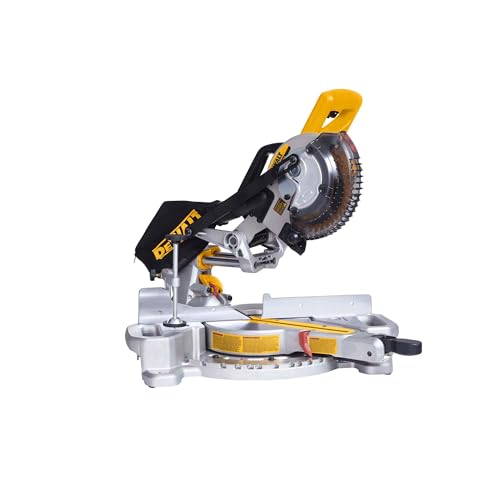
DEWALT 20V MAX 7-1/4-Inch Miter Saw
What We Like
- Integrated cut line system for adjustment-free accuracy
- Compact, 30-pound design for easy transport
- Stainless steel miter detent plate with 11 stops
- Oversized bevel scale for easy angle adjustments
Trade-offs
- Tool only: requires separate purchase of battery and charger
- 7-1/4-inch blade limits depth of cut versus larger saws
Its 7-1/4-inch blade and capacity for 3 5/8-inch nested crown molding make it a uniquely capable cordless saw for trim work. The cordless design and 30-pound frame mean you can set up on a staircase or in a finished room without hunting for an outlet. An integrated cut line system and 11 positive miter stops deliver the precision needed for tight joints, which is why it stands out as the most versatile and well-rounded option for detailed finish carpentry.
The main compromise is that it’s a bare tool, so you’ll need a DEWALT 20V battery and charger to run it. For stationary shop work where corded power is preferred, a heavier saw like the BOSCH 10-Inch Dual-Bevel Glide offers a larger blade and different motion. But for the balance of power, portability, and trim-specific accuracy, this miter saw’s design hits a sweet spot that handles the majority of on-site cutting tasks.
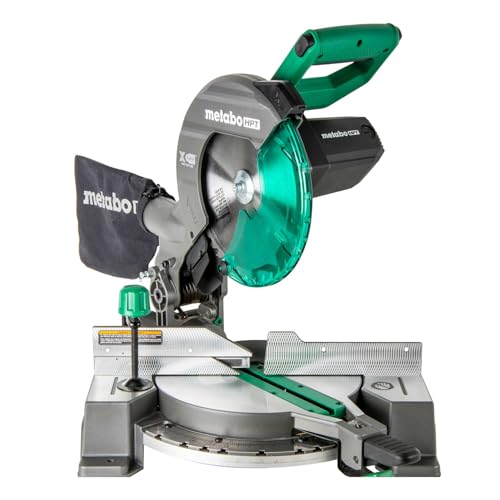
Metabo HPT 10-Inch Compound Miter Saw
What We Like
- Exceptionally lightweight at 24.2 lb for easy transport
- Powerful 15-Amp motor for effortless trim cuts
- Large table and vice clamp improve stability and safety
Trade-offs
- Single-bevel design requires flipping wide stock for compound cuts
- No included laser or shadow cutting guide for alignment
Weighing only 24 pounds, this saw is easy to maneuver and transport to any job site, so you can carry it from your vehicle to a work area without strain. Its 15-Amp motor delivers a no-load speed up to 5,000 RPM, providing high power for effortless cuts in wood. The improved miter scale and large table provide better material support and accurate adjustments for precise woodworking.
The trade-off for that portability is a single-bevel design. You’ll have to flip the workpiece to make a compound cut in the opposite direction, which adds a step compared to a dual-bevel model like the BOSCH 10-Inch Glide. So, if your project involves moving the saw more than the material, the Metabo HPT’s lightweight build and corded reliability make it a pragmatic, no-fuss companion for finish carpentry.
DEWALT 20V MAX Oscillating Tool Kit

What We Like
- Brushless motor for longer runtime
- Three preset speeds for application control
- Quick-change accessory system, no wrenches needed
- LED light for dark work surfaces
Trade-offs
- 3.0-pound weight is heavier than some cordless oscillating tools
- Oscillating action is less precise for fine trim than a dedicated miter saw
The three-speed selector gives you a clear choice for material and task, moving from delicate flush-cutting to aggressive removal without guesswork. That brushless motor means you’ll spend more time cutting and less time waiting for a charge, a solid match for a contractor moving between jobs or a DIYer tackling a varied remodel. This tool suits someone who needs one device to undercut door casings, notch baseboard, and scrape old caulk, valuing control over raw cutting speed.
An oscillating tool won’t replace the clean, repeatable chops of a miter saw like the DEWALT DCS361B for production trim work. It’s a problem-solver, not a production cutter. For intricate finish carpentry, its oscillating blade can wander, and the universal adapter might introduce more play than a dedicated tool system. Keep it in your bag for the tricky cuts a bigger saw can’t reach, and you’ll appreciate the dual-grip trigger when working in awkward corners.
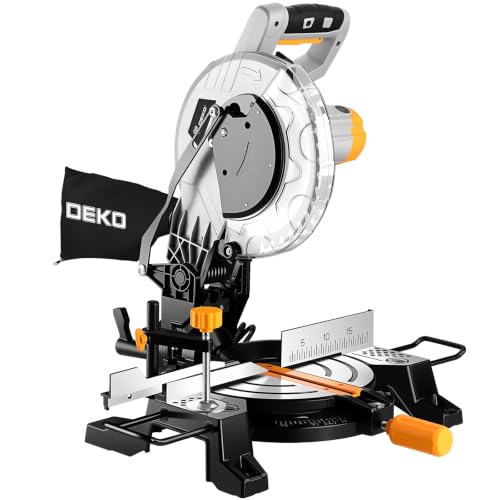
DEKOPRO 10-Inch Compound Miter Saw
What We Like
- Wide 0-45° bevel and miter adjustments
- Lightweight 20.5 lb design for easy transport
- Transparent blade guard for clear cut line view
- Integrated clamp for secure workpiece holding
Trade-offs
- Single-bevel design requires flipping wide boards for compound cuts
- 13-Amp motor is less powerful than some 15-Amp competitors
- Large 10-inch blade demands careful handling for fine trim details
A miter range of 45 degrees left and right, combined with a 0-45 degree bevel, gives you the flexibility to tackle crown molding, baseboards, and window casings without constantly repositioning the workpiece. This saw is built for the DIYer or trim carpenter who needs to make frequent, precise angle changes on a jobsite or in a home shop. The lightweight build and locking head make it genuinely portable, a real advantage when you’re moving between rooms or packing it in a truck.
This saw’s 13-amp motor runs a bit slower than 15-amp models such as the Metabo HPT, trading some power for its portable design. That’s fine for trim and lighter stock, but you’ll want to feed dense hardwoods more patiently. A heavier saw for a dedicated shop offers more stability, but for adjusting angles on the fly in different locations, the DEKOPRO’s design hits a practical sweet spot.
Product photos
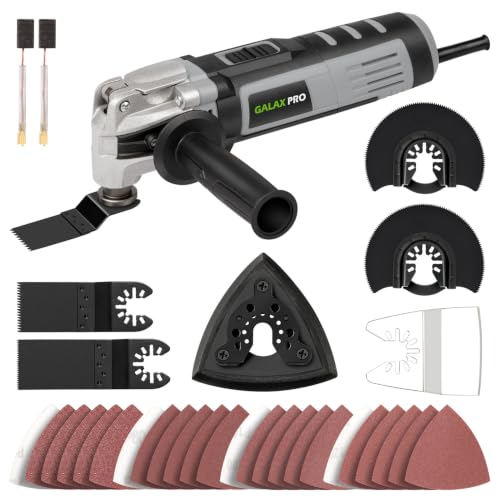
GALAX PRO Corded Oscillating Multi Tool
What We Like
- Lightweight ergonomic design for tight spaces
- Variable speed dial for precise control
- Quick-release system for fast accessory changes
- Comprehensive kit with scraper and sanding pad
Trade-offs
- Corded design limits range of movement
- Weighs more than cordless competitors like the Milwaukee M18
At 4.1 pounds with a small grip diameter, the GALAX PRO Corded Oscillating Multi Tool fits into corners and other tight spaces that larger tools cannot reach. This design makes it suitable for finish tasks like cutting window trim or baseboards in place, aided by variable speed control for different materials. The kit includes blades for cutting wood, plastic, and soft metal, a scraper, and a sanding pad with papers.
Its affordable price comes with a power cord, which can snag and limit your reach compared to a cordless oscillating tool. For extensive overhead or remote work, a battery-powered option might prove less frustrating. But for stationary, detail-oriented trim work where an outlet is nearby, this corded tool delivers capable power without the cost of a battery system.
Product photos
BLACK+DECKER BD200MTB Oscillating Tool

What We Like
- Tool-free accessory release
- Universal accessory adapter
- Comfort grips for control
- Unlimited corded runtime
Trade-offs
- Corded design limits mobility
- Includes only one cutting blade
A 2.5-amp motor and variable speed dial give you the control to sneak up on delicate trim cuts or power through a nail-embedded board. The tool-free release lever makes swapping between the included sanding pad and blade a one-handed affair, which is a genuine time-saver when you’re up a ladder. This is the saw for the DIYer who needs a dependable, no-fuss multi-tool for occasional trim work and a hundred other household tasks, without the complexity or cost of a pro system. You get a solid foundation of features that just work.
The power cord means you’ll never run out of juice mid-cut, but you’ll also be hunting for outlets or managing an extension cord. Compared to a cordless option, you sacrifice portability for simplicity and consistent power. The included accessory set is basic, so plan to buy a dedicated flush-cut blade for precise trim work. For its category, however, the build and feature set deliver reliable performance where it counts.
Product photos
ENERTWIST Oscillating Multitool Kit
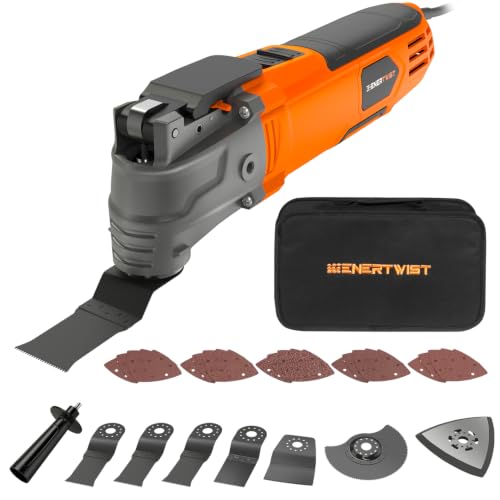
What We Like
- 5° oscillation angle for markedly faster cutting
- Universal fit accepts all major brand accessories
- Tool-less quick-change accessory system
- Includes a broad 33-piece accessory kit
Trade-offs
- Corded design limits portability and range of motion
- Fixed cord requires access to a power outlet at the worksite
The 5-degree oscillation angle is the key spec here, as it directly translates to cutting trim up to 40% faster than many other multitools. That extra bite makes quick work of slicing through door casings or notching flooring without bogging down. For a DIYer facing a trim-heavy renovation, this tool turns a tedious chore into a series of swift, controlled cuts. Its universal accessory system is a practical bonus, letting you use any blade you have on hand without hunting for proprietary adapters.
You gain consistent, unlimited runtime from the cord, but lose the unplugged freedom of a cordless model. At 4.4 pounds, it also has a bit more heft to manage in tight spaces compared to lighter options. This makes it a fantastic shop or single-room tool, but think twice if your project involves constantly moving between rooms without convenient outlets.
Product photos
How We Evaluated Saws For Cutting Trim
Our evaluation is based on researching product specifications, manufacturer documentation, expert round-ups from professional woodworking sources, and patterns in owner feedback. We focused on criteria critical for trim work: cutting precision, portability, and versatility. We prioritized features like integrated cut-line guides, adjustable bevel and miter ranges, and lightweight designs that matter on a job site or in a home workshop.
The tool’s suitability for common trim tasks like cutting molding and creating precise miter joint cuts was also considered. For a deeper understanding of tool types, comparisons like circular saw vs miter saw were reviewed. A research-based evaluation cannot replicate years of direct use, so long-term durability and personal feel are best assessed through experience.
What To Look For In Saws For Cutting Trim
Choosing the right saw means matching its capabilities to your specific trim projects, from simple baseboards to complex crown molding.
Look for a tool that offers precise angle adjustments, a fine-tooth blade for clean cuts, and a design that balances power with portability for your workspace.
Cutting Precision & Guidance
For trim, precision is non-negotiable. Look for features that ensure accuracy, such as positive miter detents at common angles, clear bevel scales, and integrated cutting guides like lasers or shadow lines. A fine-tooth blade with 60 to 90 teeth is essential for smooth cuts in molding without splintering the delicate edges. The ability to make repeatable, accurate cuts is what separates a professional finish from an amateur one, especially for miter joints.
Portability & Workspace Fit
Consider where you’ll use the saw. For job-site mobility or storage in a small garage, weight and footprint are key. Many quality compact miter saws weigh under 25 pounds. Cordless models offer ultimate portability but require battery investment, while corded tools provide unlimited runtime but need power access. For work in confined areas, a compact oscillating tool might be the best fit over a larger miter saw.
Power & Cutting Capacity
Match the saw’s power and capacity to your material. A 15-amp motor in a corded miter saw handles hardwoods easily, while a cordless model’s effectiveness depends on its voltage system. Check the maximum cutting depth and width, especially for crown molding; a 10-inch blade typically crosscuts a 6-inch board. For wider stock, you need a sliding compound miter saw. Remember that a tool designed for cutting small pieces safely is different from one meant for ripping large boards.
- Verify the bevel range for compound cuts on crown molding.
- Ensure the miter range covers common angles.
- Consider dust collection ports to keep your line of sight clear and your workspace clean.
The best saw for you balances the precision of a dedicated tool with the practicality of your typical project scale.
Saws For Cutting Trim Compared
The table below compares key specifications to help you see the differences at a glance.
| Product | Weight | Power Type | Motor / Power | Max Speed / RPM |
|---|---|---|---|---|
| DEWALT 20V MAX 7-1/4-Inch Miter Saw | 30.0 Pounds | Cordless | 20V MAX | N/A |
| Metabo HPT 10-Inch Compound Miter Saw | 24.2 pounds | Corded | 15 Amp | 5,000 RPM |
| DEWALT 20V MAX Oscillating Tool Kit | 3.0 Pounds | Cordless | Brushless | 20,000 OPM |
| DEKOPRO 10-Inch Compound Miter Saw | 20.5 lbs | Corded | 13-Amp | 5,000 RPM |
| GALAX PRO Corded Oscillating Multi Tool | 4.1 pounds | Corded | 3.5A | 22,000 OPM |
| BLACK+DECKER BD200MTB Oscillating Tool | 4.2 pounds | Corded | 2.5 Amp | 20,000 OPM |
| ENERTWIST Oscillating Multitool Kit | 4.4 Pounds | Corded | 4.2 Amp | 16000 OPM |
Frequently Asked Questions
What type of saw is best for cutting trim?
A power miter saw is generally the best tool for cutting trim. It is designed specifically for making the precise angled crosscuts required for baseboards, crown molding, and window casings. Its fixed position and adjustable fence allow for repeatable accuracy that is difficult to achieve with a handheld circular saw or jigsaw.
What type of saw is best for trimming wood?
For trimming wood to length or making fine adjustments, a miter saw or a sharp handsaw is ideal. A miter saw provides speed and power for multiple cuts, while a quality handsaw offers ultimate control for delicate touch-ups and fitting in situations where a power tool is too cumbersome or loud.
What type of saw is best for cutting baseboards?
A compound miter saw is the best choice for cutting baseboards. It allows you to make both straight 90-degree cuts for butting ends and precise 45-degree miter cuts for outside corners. The compound feature lets you add a bevel for more complex joints, though a single-bevel model is sufficient for most basic baseboard installations.
What type of saw is best for cutting molding?
A dual-bevel compound miter saw is the top tool for cutting crown molding and other complex moldings. It enables you to make the combined miter and bevel cuts required for crown molding laid flat against the fence without flipping the workpiece. This saves time and reduces errors on intricate, expensive material.
Should I use a fine-tooth blade for cutting trim?
Yes, you should always use a fine-tooth blade for cutting trim. Blades with 60 to 90 teeth produce a much smoother, splinter-free cut on delicate molding materials compared to standard 24-tooth framing blades. Investing in quality miter saw blades designed for finish work is crucial for a professional-looking result.
The Bottom Line
For finish carpenters and serious DIYers who need cordless freedom without sacrificing precision, the DEWALT 20V MAX 7-1/4-Inch Miter Saw is the best overall choice, provided you already own compatible batteries. If your priority is a budget-friendly, versatile tool for occasional projects, consider the reliable BLACK+DECKER BD200MTB Oscillating Tool.
For those who frequently transport their tools or work in tight spaces, our lightweight and compact picks offer excellent portability. Ultimately, the most important factor is matching the saw’s cutting precision and capacity to the specific demands of your trim work, ensuring every joint fits tightly and looks clean.
