
Types of Sandblasting Media: What to Use and When
This post contains affiliate links. As an Amazon Associate, we earn from qualifying purchases.
The right sandblasting media cleans, strips, or etches a surface based on three variables: hardness (Mohs scale), particle shape (angular vs. Round), and density. Hard, angular, dense media like steel grit cut aggressively for heavy rust removal. Soft, round, low-density media like plastic pellets or baking soda clean delicate surfaces without damage. The choice is not about the “best” media; it’s about matching these physical traits to your substrate and desired finish.
To clarify: the phrase “sandblasting media” is a misnomer. You should almost never use actual silica sand. It’s a health hazard, and it’s less efficient than modern alternatives. The real conversation starts with the SSPC standard that categorizes everything else, including the many types of sandblasting media.
This guide walks through the official classifications, breaks down the physical science of how abrasives work, and gives you a side-by-side comparison of the dozen common types of sandblasting media. By the end, you’ll be able to look at a job, be it an engine block, a wooden deck, or a concrete wall, and know which bag to open first.
Key Takeaways
- Match abrasive hardness to substrate hardness. Using steel grit (40-65 HRC) on aluminum will warp the part; using walnut shells (Mohs 3) on mill-scale won’t touch it.
- Angular particles cut, round particles clean. For coating adhesion, you need an angular media anchor profile. For a smooth, polished finish, use round media like glass beads.
- Factor in recyclability for long-term cost. Steel grit lasts 500+ cycles, making it cheaper per use than expendable media like coal slag, despite a higher initial price tag.
- Follow the SSPC AB 1-2015 standard for specification. If a spec sheet doesn’t state a class (A, B, C) or type (I, II), any class and either type is acceptable per the standard.
- Play sand is explicitly prohibited for blasting. Most bags are marked ‘Not for sandblasting’; it’s inconsistently sized, creates a toxic silica dust cloud, and can damage your equipment.
The SSPC AB 1-2015 Standard: Type vs. Class
Forget the hardware store labels. The professional world uses SSPC AB 1-2015, the standard for mineral and slag abrasives. It gives you a precise language to specify what you need. The standard cuts through two big questions: what the abrasive is made from, and how much crystalline silica it contains.
First, it defines two abrasive types. Type I covers Natural Mineral Abrasives, like olivine or staurolite. Type II covers By-Product or Manufactured Abrasives, which includes most slags, crushed glass, and synthetic materials like aluminum oxide. The crucial point is this: if a project specification doesn’t name a type, the standard says either Type I or Type II is acceptable. You’re not locked in.
Second, it establishes three classes based on crystalline silica content. This is the health-and-safety guardrail.
- Class A: ≤1.0% silica. This is your go-to for the safest airborne dust.
- Class B: ≤5.0% silica. A common middle-ground for many industrial slags.
- Class C: Unrestricted silica content. This is where you’d find old-school silica sand, and you should avoid it. Just like with the types, if no class is specified, any class (A, B, or C) is acceptable. This gives contractors flexibility but places the burden on the buyer to demand a Class A product if safety is critical.
The SSPC AB 1-2015 Standard categorizes abrasives into Type I (Natural Mineral Abrasives) and Type II (By-Product or Manufactured Abrasives). It further sorts them into three classes based on crystalline silica content per SSPC AB 1-2015: Class A (≤1.0%), Class B (≤5.0%), and Class C (Unrestricted). If no type is specified, either is acceptable; if no class is specified, any class is acceptable.
The takeaway? When you’re buying media or bidding a job, these codes matter. Specifying “SSPC AB 1-2015, Type II, Class A” ensures you get a manufactured, low-silica abrasive. It’s the difference between saying “get some sand” and asking for a specific brand and grade of cement.
Abrasive Shape, Density, Hardness: The Physical Trio
Next, consider what happens when the types of sandblasting media hit the metal. The outcome is controlled by a trio of physical properties: shape, density, and hardness. Get these right, and the job is efficient. Get them wrong, and you’re either polishing a brick or destroying a delicate component.
Shape determines the cut. Angular media, think crushed glass, garnet, coal slag, have sharp edges. They slice into the substrate, scraping away material and leaving a textured anchor profile for paint or coatings to grip. Round media, like glass beads, plastic pellets, or sugar sand, have no edges. They peen and clean the surface, but they leave it smooth. They won’t provide a mechanical bond for a new coating.
Density is about impact force. Imagine throwing a ping-pong ball versus a golf ball of the same size. The golf ball hurts more because it’s denser. In blasting, a denser particle transfers more energy on impact. Garnet has a bulk density of 145 lb/ft³, while plastic media is only 50 lb/ft³. That’s why garnet can strip thick mill-scale and plastic is for stripping paint off fiberglass.
Hardness determines who wins. Measured on the Mohs scale (or HRC for steel), hardness decides if the media cuts the workpiece or the workpiece dulls the media. Aluminum oxide (Mohs 8-9) will etch hardened steel. Soda bicarbonate (Mohs 2.5) will cloud glass but won’t scratch it. A NIOSH/CDC field study found abrasive breakdown rates were 13% to 60% higher than laboratory rates for most abrasives.
Where this goes sideways: Using a media that’s harder than your substrate. Steel grit on thin aluminum sheet metal doesn’t just clean it; it warps it with peening stress and can actually cut holes through it. The part is scrap by the time you see the first shiny spot.
These three traits work together. You need the right combination, not just the hardest or the cheapest stuff in the bag. The table below shows how they interact for common jobs.
| Job / Substrate | Ideal Media Traits | Media Example | If You Use the Opposite |
|---|---|---|---|
| Heavy rust removal on steel | Very Hard, Angular, High Density | Steel Grit (40-65 HRC) | Progress stalls; media breaks down too fast. |
| Paint stripping from aluminum | Soft, Round, Low Density | Plastic Media (Mohs 3-4) | Substrate is gouged and dimensionally altered. |
| Creating anchor profile for epoxy on concrete | Hard, Angular, Medium Density | Crushed Glass (Mohs 6) | Surface stays smooth; coating delaminates. |
| Cleaning/peening without removing base metal | Medium Hard, Round, Medium Density | Glass Beads (Mohs 5-6) | You get an unintended, aggressive etch. |
| De-greasing & fire cleanup | Soft, Angular, Low Density (often expendable) | Walnut Shells (Mohs 3) | Media embeds in soft surfaces, creating a new contaminant. |
The Media Roster: From Aggressive to Gentle
You’ve got the theory. Now, here’s the cast of characters. Think of this as your menu, sorted from the most aggressive cutters to the gentlest cleaners.
The Heavy Hitters (Metal & Concrete)
These are for serious surface preparation where you need to remove material and create a profile.
- Steel Grit & Shot: The kings of recyclability and power. Steel shot lasts for 500 times more cycles than glass, and McMaster-Carr states steel grit stays effective for twice as many cycles as steel shot. With a hardness of 40-65 HRC, it’s for heavy rust, mill scale, and foundry work. It’s magnetic, making reclamation in a cabinet easy. Cost per use is low, but upfront cost is high.
- Aluminum Oxide: The workhorse synthetic. At Mohs 8-9, it’s extremely hard and sharp. It cuts fast, produces a sharp anchor profile, and is a common choice for industrial blasting operations. It’s also recyclable multiple times. You’ll find it in everything from large pressure blasters to small cabinets.
- Silicon Carbide: The hardest common abrasive at Mohs 9-9.5. It’s fast and expensive, used less for cleaning and more for etching glass and stone or specialized industrial cutting.
- Coal Slag: A by-product of coal power plants. It’s angular, hard (Mohs 6-7), and cheap upfront. A NIOSH/CDC field study found its cost was comparable to silica sand ($0.69 vs. $0.72 per square foot). The catch? It’s usually a one-and-done expendable media, creating a lot of dust.
The All-Purpose Contenders
These balance aggression with cost and are suitable for a wide range of DIY and professional tasks.
- It cuts well, creates a good profile, and is less friable than slags, meaning it breaks down slower. It’s a popular, mid-price choice for everything from steel to wood.
- Crushed Glass: Made from recycled bottle glass. It’s angular, medium-hard (Mohs 5-6), and a favorite for dustless blasting setups. It’s effective and environmentally friendly, but as Dustless Blasting notes, it’s generally not worth reclaiming because the particles shatter into smaller, unusable bits upon impact.
The Delicate Cleaners
When you must preserve the underlying material at all costs, you drop down to these.
- Glass Beads: Round and medium-hard (Mohs 5-6). They produce a bright, satin finish and are used for peening, cleaning, and cosmetic finishing. In practice, their reusability is limited.
- Plastic Media: Round or angular, soft (Mohs 3-4). Perfect for stripping coatings from composites, aluminum, and sensitive electronics without abrasion. It’s lightweight (50 lb/ft³ density) and often reusable.
- Walnut Shells & Corn Cob: Organic, soft abrasives. Walnut shells are soft, with a hardness of Mohs 3. They’re for cleaning soft metals, wood, and historical restoration where any scratching is unacceptable. They’re biodegradable and generate less dust.
- Soda Bicarbonate (Baking Soda): The softest blaster (Mohs 2.5). It’s for deodorizing fire damage, cleaning soft stone, or removing graffiti without harming the substrate. It’s water-soluble, which makes cleanup easy but rules it out for wet blasting.
The Best Media Blaster: Recyclability vs. Upfront Cost
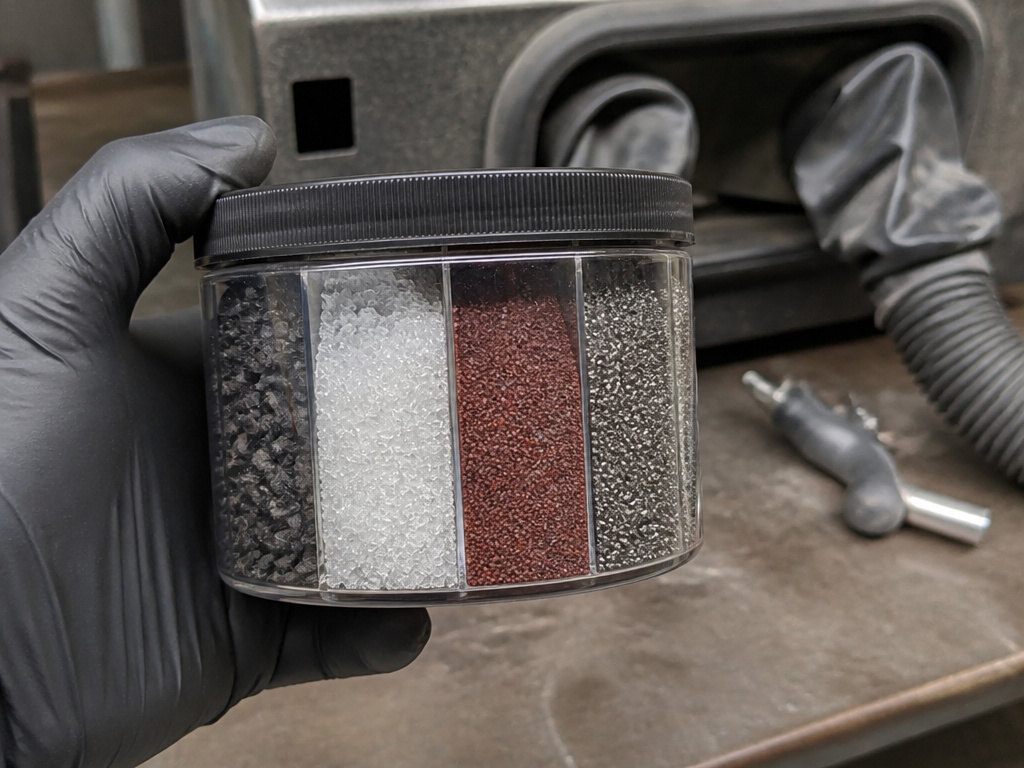
This is where most DIY guides stop, and where the real financial decision happens. The cheapest bag per pound is almost never the cheapest bag per job. You must consider breakdown rate, how much media turns to dust on impact, and whether your equipment lets you reclaim and recycle.
A NIOSH/CDC study put numbers on this. In a field test, they found abrasive breakdown rates were 13% to 60% higher than lab rates for most materials. Steel grit was the stunning exception: its field breakdown rate was 3.92%, actually 50% lower than its lab rate, because it’s tougher than the steel it was cleaning.
To make a choice, consider this example. You’re blasting 100 square feet of steel.
| Media Choice | Upfront Cost (Est.) | Breakdown Rate | Cycles/Lifespan | Disposal Concern | Best For |
|---|---|---|---|---|---|
| Coal Slag | Low | Very High (Expendable) | 1 | High (Dust, Slag Waste) | One-off outdoor jobs with no reclamation. |
| Crushed Glass | Medium | High | 1-2 | Low (Inert) | Dustless blasting setups, eco-friendly projects. |
| Garnet | Medium-High | Medium | 3-5 | Medium | General shop work with basic reclamation. |
| Steel Grit | High | Very Low | 100+ | Low (Magnetic Reclaim) | High-volume professional shops and cabinets. |
The math is brutal for expendable media. If coal slag costs $0.69 per square foot but turns to dust in one pass, your 100 sq ft job costs $69 in media. If steel grit has a high upfront cost but lasts 100+ cycles, your cost per square foot per job plummets. The media blaster machine that lets you recycle, like a cabinet with a reclaim system, is what provides that long-term value.
Common mistake: Choosing media based solely on the project in front of you, without considering your next ten projects. Buying a 50lb bag of disposable slag for a single fence is fine. Using it for every automotive part you restore will bankrupt you in media costs long before your blaster wears out.
Choosing for Your Project: A Step-by-Step Filter
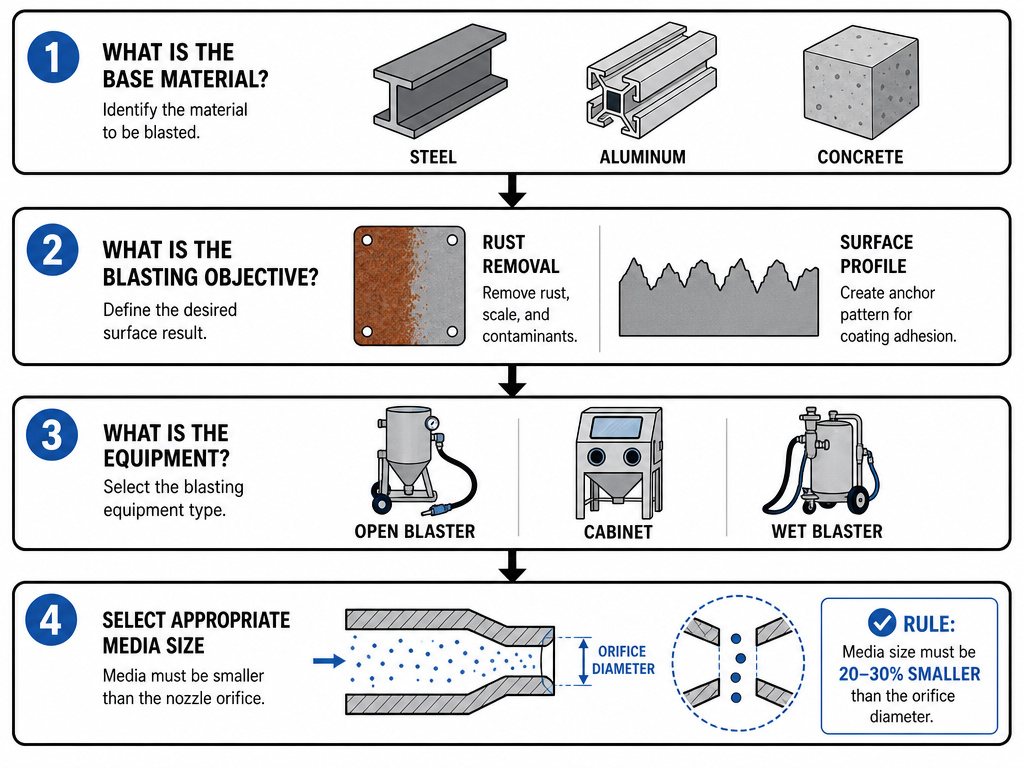
Enough theory. Now, make a selection. Follow this sequence of questions. It’s the same logic a pro would use, compressed into a flowchart you can follow.
-
What is the SUBSTRATE? Identify the material you’re blasting.
- Hard Steel, Cast Iron: Move to Aggressive Media (Steel, Aluminum Oxide, Garnet).
- Aluminum, Soft Metals, Fiberglass, Plastics: Move to Delicate Media (Plastic, Walnut, Soda).
- Wood, Historical Surfaces: Delicate Media only.
- Concrete, Masonry: Aggressive or All-Purpose Media (Crushed Glass, Slag).
-
What is the GOAL?
- Remove Heavy Material (rust, mill scale): You need an angular, hard media.
- Strip Paint/Coatings, Preserve Base Material: You need a softer media, shape depends on if you need a new profile.
- Clean/De-grease/Peen: You need a round, medium-hard media (like glass beads).
- Create a Surface Profile for New Coating: You need an angular media.
-
What is your EQUIPMENT?
- Open Pressure Blaster (No Reclaim): Lean towards expendable media like coal slag or crushed glass. Avoid expensive, recyclable media you can’t recover.
- Blast Cabinet (With Reclaim): This is where steel grit, aluminum oxide, or glass beads pay off. This closed system allows you to reuse them.
- Dustless/Wet Blaster: Remember the rule: for wet blasting, you can only use media that sinks in water and is not water soluble. Garnet and crushed glass work; soda blasting media does not.
-
Check Media & Machine Specs.
- Nozzle Size: Your media mesh size must be smaller than your nozzle orifice. Blasting 80-grit media through a 1/8″ nozzle will clog it instantly. It’s a physical jam.
- Air Pressure: As a guideline, 110 PSI works for many setups. Running below 100 PSI increases blasting time and media consumption because each particle hits with less force. Always check your machine’s manual first.
What most people get wrong: They buy a media labeled “for rust removal” and use it on their classic car frame. That media is for structural rust removal, it’s aggressive. On the thin sheet metal of a car body, it will warp panels and blow holes through rust-weakened spots. The right media for auto body work is often far gentler than you think.
Common Pitfalls and Media Mismatches
I’ve seen the aftermath. Here’s what happens when the match is wrong.
Using Silica Sand or Play Sand. Just don’t. Besides the silicosis risk, play sand isn’t graded. It has a huge range of particle sizes, from dust to pebbles. The dust clouds your vision and clogs your lungs, the pebbles clog your nozzle, and the medium-sized grains do an inconsistent job. The bag literally says “Not for sandblasting.”
Reusing Damp Media. Media is hygroscopic, it absorbs moisture from the air. If you leave a bucket of garnet or crushed glass open in a humid garage, it will clump. When you blast with it, those clumps shoot through, then immediately plug your gun. Your day turns into a frustrating exercise in disassembly and cleaning. Store media in a sealed container.
Ignoring Mesh Size. If you have a 3/16″ nozzle, you need media that passes through a 3/16″ hole. If the media package says “20/40 mesh,” that means the particles are larger than 40-grit but smaller than 20-grit. Check a mesh size chart. Forcing the wrong size is like trying to force oatmeal through a coffee stirrer.
Blasting Without a Defined Goal. Are you prepping for paint or just cleaning? If paint is coming, you need that anchor profile. If you blast an engine block with round plastic media to clean it, and then try to paint it, the paint will flake off in sheets. The surface is too smooth.
Sandblasting Media for Metal, Wood, and Concrete
Choosing the right media starts with the substrate. For heavy rust and mill scale on steel, a hard, angular abrasive like steel grit or garnet is effective. Steel grit is notably durable, with a field breakdown rate far lower than other abrasives, making it a cost-effective choice for large metal projects. For cleaning or peening metal without changing its dimensions, round media like glass beads or softer steel shot are suitable. On wood, you need a gentle abrasive to strip paint or clean without gouging. Soft, angular materials like walnut shells or plastic media work well. For cleaning concrete or creating an etch for coating, a mid-range hardness abrasive like crushed glass or coal slag can remove coatings and profile the surface without excessive damage.
Frequently Asked Questions
What is the most aggressive blast media?
For pure cutting speed and material removal on hard metals, silicon carbide (Mohs 9-9.5) is the hardest. For a combination of aggression, recyclability, and cost-effectiveness on industrial steel, steel grit (40-65 HRC) is a highly aggressive practical choice. It lasts for many cycles due to its low breakdown rate.
What is the cheapest media for sandblasting?
The cheapest upfront cost per pound is usually coal slag. A NIOSH study found it cost $0.69 per square foot, comparable to silica sand. However, it’s expendable, you use it once. For long-term, lowest cost per use, steel grit is cheapest because you can recycle it hundreds of times in a reclaim system.
Can I use any media for wet blasting?
No. For wet blasting, the media must sink in water and not be water-soluble. Garnet, crushed glass, aluminum oxide, and steel media work. Soda bicarbonate dissolves in water, so it’s for dry blasting only. Also, avoid media that breaks down into fine mud when wet.
How do I choose media size (mesh)?
Match the mesh size to your nozzle size. The largest media particle must be smaller than your nozzle’s interior diameter to prevent clogs. Match the mesh size to your nozzle size; the largest media particle must be smaller than your nozzle’s interior diameter. Always defer to your blaster manufacturer’s recommendation.
Is recycled glass media good?
Crushed recycled glass is an excellent, eco-friendly all-purpose media. It’s angular (for good profiling), medium-hard (Mohs 5-6), and inert. It works well for dustless blasting on steel, concrete, and wood. The main downside, as noted by Dustless Blasting, is that it’s not really worth reclaiming because it fractures into smaller pieces upon impact, changing its cutting characteristics.
What media should I use to remove paint without damaging metal?
To strip paint but leave the underlying soft metal (aluminum, brass) or fiberglass undamaged, use a soft, non-metallic media. Plastic media (Mohs 3-4) or walnut shells (Mohs 3-4.5) are the top choices. They’ll fracture the paint layer on impact but won’t have the hardness to cut into the base metal.
The Bottom Line
Stop looking for a single “best” sandblasting media. There isn’t one. The right choice is a system: match an abrasive’s hardness, shape, and density to your material and your desired finish.
For most home shops tackling a mix of steel, auto parts, and occasional delicate work, garnet is the smart default. It’s aggressive enough for rust, gentle enough for some careful work, and recyclable a few times in a decent cabinet. If you go professional and blast steel daily, the math flips: invest in a media blaster cabinet and steel grit. The upfront cost stings, but the long-term savings are massive.
One final, essential rule: if you remember only one thing, remember that play sand is off the menu. Your lungs and your equipment will thank you for spending a few extra dollars on a proper, graded abrasive designed for the job. Everything else is a matter of matching the right tool, or in this case, the right grain, to the task.
