
10 Best Track Saws in 2026
This post contains affiliate links. As an Amazon Associate, we earn from qualifying purchases.
Our best overall track saw is the Festool TSV 60 KEB-F-Plus Plunge-Cut Saw for its integrated scoring blade that delivers stationary-table-saw precision in sheet goods. For outstanding dust collection in a cordless tool, the DeWalt DCS525B is a top choice, while the Makita SP6000J1 offers the best corded value.
Choosing the right saw depends on whether you prioritize tear-free finish, job-site mobility, or raw power. This guide helps you decide based on your specific woodworking or contracting needs. We researched specifications, expert evaluations, and patterns in owner feedback to identify the key differences between ten leading models.
Top 10 Track Saws in the Market
Certain content that appears on this site comes from Amazon. This content is provided "as is" and is subject to change or removal at any time.
The Best Track Saws, Reviewed
Festool TSV 60 KEB-F-Plus Plunge-Cut Saw

What We Like
- Integrated scoring blade for zero-tearout cuts
- KickbackStop system enhances user safety
- Precision guide rail system eliminates play
- Durable diamond scoring blade for longevity
Trade-offs
- Corded design limits mobility compared to battery models
The built-in scoring blade guarantees splinter-free edges on both sides of the cut in a single pass, which means panels are ready for glue-up immediately. That level of finish, typically reserved for a stationary shop machine, is now portable. This saw is for the craftsman who refuses to compromise on cut quality, whether breaking down sheet goods on site or in the workshop. Its system of rails and clamps delivers the precision needed for flawless joinery and installations.
Festool designed the TSV 60 KEB-F-Plus to deliver stationary-machine precision for panel processing on a jobsite. That capability comes with significant weight, as the kit weighs 29.6 pounds. This is heavier than cordless models like the 11.7-pound Milwaukee M18 FUEL, so moving the tool between cuts requires more effort. For a user who values splinter-free cuts from an integrated scoring blade and the safety of a KickbackStop system, the mass contributes to a stable, workshop-grade result in a portable format.
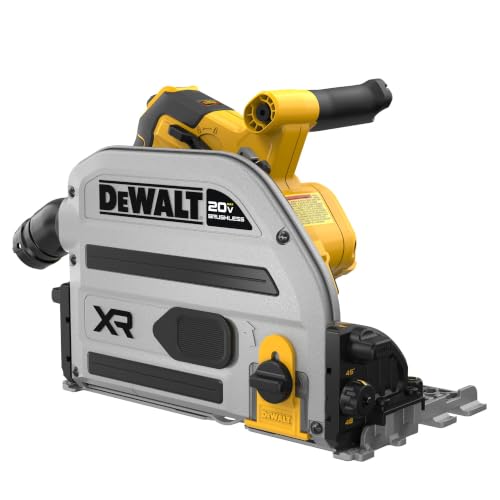
DEWALT DCS525B Cordless Plunge Track Saw
What We Like
- Kickback Brake System helps maximize user safety.
- Variable speed dial matches blade to material.
- Onboard wrench for quick blade and track changes.
Trade-offs
- Requires separate purchase of track and connecting rod.
- At 13 pounds, it's heavier than some cordless rivals like the Metabo HPT.
Capturing up to 94% of dust at the source fundamentally changes the cleanup equation for sheet goods. That’s the core strength of the DEWALT DCS525B, making it a prime candidate for anyone working in finished spaces or who simply hates sweeping. This combination is perfect for the detail-oriented woodworker or installer who values a clean jobsite as much as a straight cut.
Weighing 13 pounds, this saw is heavier than some cordless competitors like the Milwaukee and Metabo HPT models listed. The listing is for the tool only, so a track, battery, and charger must be purchased separately. According to research on a similar model, the build includes a thick magnesium base and rubberized grips, with depth adjustments made using a simple, marked scale.
Product photos
Makita SP6000J1 Corded Plunge Saw

What We Like
- Powerful 12-amp motor for demanding cuts
- Variable speed dial matches blade to material
- Wide bevel range with positive stops at 22.5° and 45°
- Comes with a 55-inch guide rail and stackable case
Trade-offs
- Corded operation limits mobility on large job sites
- At 16.5 lb, it's heavier than many cordless rivals
A 12-amp motor and a variable speed dial give this saw the muscle and control to handle everything from softwoods to sheet goods without bogging down. This delivers the splinter-free finish a track saw is known for. It’s the right pick for a shop-bound woodworker or a contractor who wants a reliable, corded workhorse without the premium price tag of some pro brands.
This corded plunge saw delivers consistent power without battery concerns, making it a solid value for stationary or shop work. Its 12-amp motor and electronic speed control maintain smooth cuts in a variety of materials. Reviewers describe it as a proven platform offering a reliable corded option.
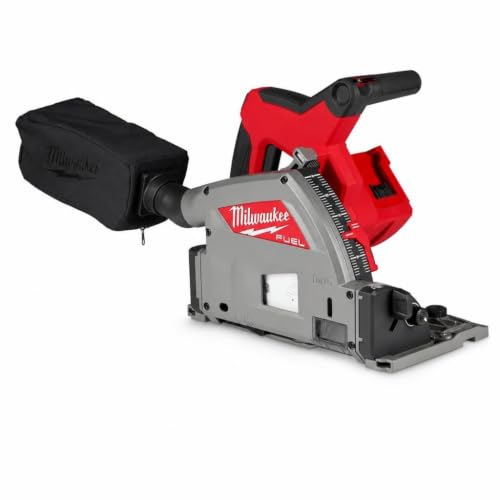
Milwaukee M18 FUEL Plunge Track Saw
What We Like
- Brushless motor provides power for tough materials
- Anti-tip system works with Makita tracks
- Micro-adjust depth knob for perfect settings
- Quick-lock blade change system
Trade-offs
- Tool only: requires separate M18 battery and charger
- At 11.7 lb, it's heavier than some cordless competitors
- Proprietary anti-tip design excludes Festool track compatibility
This is a cordless plunge saw that locks onto a track with an anti-tip mechanism compatible with Makita’s rails. That shared design means your investment in one brand’s track system isn’t wasted if you switch. For anyone already committed to Milwaukee’s M18 platform, this saw is a logical and powerful extension. You get the familiar battery ecosystem, a smooth plunging action, and a riving knife to reduce kickback, all in a tool that feels purpose-built for job-site sheet goods.
This 11.7-pound cordless saw offers a stable feel on the track, though its weight could be noticeable during extended overhead work. It can cut without its track for slightly deeper freehand passes, a capability shared with several other brands. A variable speed dial tailors blade RPM to the material, while an adjustable cam system lets users fine-tune the saw-to-track fit for straight cuts. The tool requires a separate Milwaukee M18 battery and charger.
Festool TS 55 FEQ Track Saw Kit

What We Like
- Virtually splinter-free cuts on both sides
- Tied for top precision with zero measurable error
- Single knob controls bevel tilt from -1° to 48°
- Includes track clamps and attachable splinter guard
Trade-offs
- Track system lacks an integrated anti-tip feature
- Depth-of-cut scale reads in metric only
A combined error score of just 0.1 degrees means this saw hits perfect 90-degree and 45-degree cuts with remarkable consistency. That level of precision, combined with its attachable splinter guard, makes it the clear choice for finish carpentry and cabinet work where flawless edges are non-negotiable. It’s engineered for users who prioritize calibration and repeatability over all else.
Festool’s TS 55 FEQ sits tied for the top spot in precision, with a combined error score of just 0.1 degrees, meaning it delivers exceptionally accurate and consistent cuts. This benchmark performance comes in a corded design that weighs 22.8 pounds, which gives it a solid feel on the track. Its guide rail system is widely compatible, though it lacks the integrated anti-tip feature found on Makita and Milwaukee tracks.
Metabo HPT C3606DPA Cordless Track Saw

What We Like
- Exceptionally lightweight at 9.7 pounds
- Deep 2-1/2" cutting capacity for tough jobs
- Precise micro-adjustment dial for depth control
Trade-offs
- 9.7-pound weight may feel less stable on thick stock
- 36V battery system is not compatible with other major brands
At just 9.7 pounds, this saw is the one you’ll want to grab for overhead cuts or hauling up a ladder, not just for its portability but for the consistent power its brushless motor delivers. It’s a natural fit for finish carpenters and remodelers who need a full-featured track saw that won’t wear out an arm by lunchtime. The adjustable bevel and micro-adjust depth dial give you the precision needed for clean trim and cabinetry, all packed into a tool that stows easily in a truck bed or crowded van.
Weighing only 9.7 pounds makes the Metabo HPT C3606DPA easy to maneuver, though that lightness can mean less mass to dampen vibration on dense hardwoods. It feels more nimble than the heavier Festool TS 55, which is helpful for overhead work, but may require a steadier hand on the toughest materials. Research indicates its track connection and alignment performance is among the highest across brands, using a single-piece connector that aligns tracks well and allows for unobstructed clamp travel.
Bosch GKT18V-20GCL14 Cordless Track Saw

What We Like
- Compact footprint for easy transport and storage.
- Biturbo brushless motor for corded-like performance.
- Eco mode extends battery runtime by up to 30%.
- Onboard control module for speed settings and feedback.
Trade-offs
- 5-1/2 inch blade limits maximum cut depth.
- Single bevel pivot restricts complex angled cuts.
The Bosch GKT18V-20GCL14 measures just 14.5 inches long, making it one of the most space-efficient track saws you can find. That compact size, paired with its cordless 18V platform, is a major advantage for contractors or DIYers who need to move the tool between job sites or up a ladder. Its Biturbo brushless motor and included 8 Ah battery deliver the power for cutting sheet goods, while the onboard control module lets you fine-tune the speed. This saw is built for the user who prioritizes portability and convenience in a capable cordless package.
The trade-off for that compact design is a 5-1/2 inch blade, which cuts slightly shallower than the more common 6-1/2 inch models like the Milwaukee M18 FUEL. That smaller blade is perfectly fine for plywood and most sheet goods, but it limits your capacity for thicker stock. If your primary work involves breaking down cabinets or paneling in tight spaces, this Bosch is a standout. For users who regularly need to plow through the maximum depth of 2x lumber, a larger saw might be a better long-term fit.
Product photos
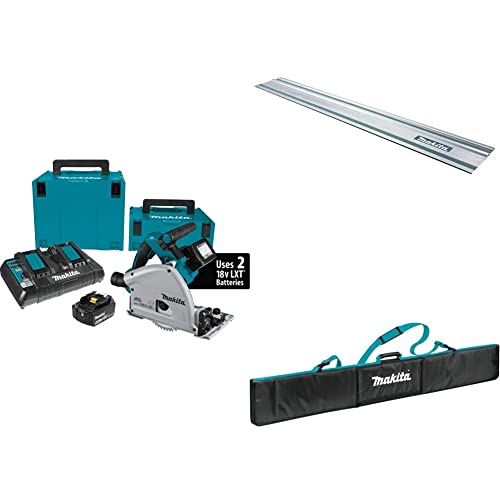
Makita XPS01PTJ Cordless Plunge Saw Kit
What We Like
- Electronically controlled brushless motor for efficiency
- Cordless design with dual-battery power
- Includes padded protective bag for rail and tool
Trade-offs
- Kit includes a 55-inch rail, not a longer one for full sheet rips
- Dual-battery system adds weight compared to single-battery tools
The dual 18V battery setup provides the muscle for demanding jobsites where dragging a cord is a hassle. It’s a top choice for professionals who need pro-grade cutting performance without being tethered to an outlet. The included 55-inch guide rail and protective bag make it a ready-to-work kit right out of the box.
Operating the tool requires two batteries, so users must manage charging for both. A corded alternative like Makita’s own SP6000J1 exists for those who prefer a direct power connection. One expert round-up calls it arguably the best cordless track saw overall, citing incredible power and precision.
WEN CT1274 Corded Track Saw

What We Like
- Variable speed from 2000 to 6000 RPM
- Includes a 40-tooth carbide-tipped blade
- Compatible with multiple WEN track lengths
- Comes with a two-year warranty
Trade-offs
- Corded design limits mobility on large job sites
- Requires separate purchase of track for full functionality
A variable speed motor that adjusts from 2000 to 6000 RPM gives you control for different materials, from plywood to hardwoods. This saw accepts standard 7-1/4-inch blades, so finding replacements is straightforward and inexpensive. It’s a solid choice for the DIYer or contractor who needs reliable plunge and bevel cuts without the premium price tag, especially if you already have a collection of circular saw blades. The included dust port adapter helps keep your workspace cleaner, which is a nice touch at this level.
A corded design means you won’t run out of battery on a long job, but you are tethered to an outlet. For breaking down sheet goods in a fixed workshop, the cord is no issue, though dragging it across a large site can be a hassle. The saw weighs 13.3 pounds, so extended overhead work might tire your arm faster than a lighter tool. It’s built to rip boards and make bevel cuts, but you’ll need to buy a compatible track separately to unlock its full potential.
Product photos
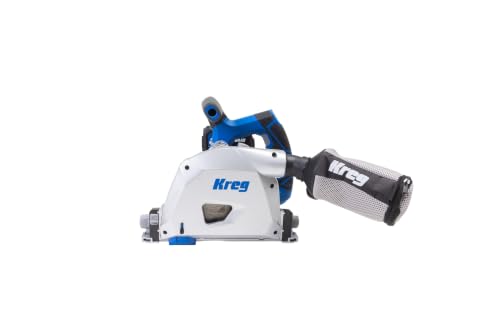
Kreg KPTBPS100A Cordless Track Saw
What We Like
- Unique blade-left design for right-handed users.
- Cordless design offers full worksite mobility.
- Plunge mechanism allows for precise cut starts.
Trade-offs
- Guide track is sold separately.
- Bevel depth reduces to 1 1/2 inches at 45°.
Kreg’s track saw uses a blade-left design that keeps the motor housing out of a right-handed user’s sightline, which provides a clear view of the cut path for better control. This cordless tool offers plunge cutting with a bevel range from -1 to 47 degrees and a cutting depth of two and one-eighth inches at 90 degrees. It is compatible with a Kreg 62-inch guide track, sold separately, for cutting solid wood and plywood.
The tool’s cordless design provides freedom of movement without being tethered to an outlet. Its bevel-cutting capacity extends to 47 degrees, and it cuts to a depth of one and a half inches at a 45-degree angle. For right-handed users, the blade-left design is intended to optimize cutting visibility and control during operation.
Product photos
How We Evaluated Track Saws
Our evaluation was based on manufacturer specifications, professional round-ups, and consistent themes in user feedback across multiple retailers. We focused on criteria most critical for a tool designed for precision cuts: cutting accuracy and finish quality, power and cutting capacity, and design features that impact real-world usability like dust collection and track compatibility. This research-based approach identifies meaningful differences, but it cannot replicate the feel of a tool in your hand or predict long-term durability beyond warranty periods.
What To Look For In Track Saws
A track saw should transform sheet goods and lumber into precise, ready-to-use parts. Key considerations include the cut quality it delivers, the power system that fits your workflow, and the features that make it efficient and safe to use.
Prioritize a saw that delivers a clean, splinter-free cut on your chosen materials. Consider whether cordless mobility or corded power is more important for your projects, and evaluate the track system and included features for ease of use and safety.
Cutting Accuracy and Finish
The primary reason to choose a track saw over a standard circular saw is its ability to make perfectly straight, clean cuts. Look for features that minimize tear-out, like a scoring blade mechanism or an adjustable splinter guard that presses against the workpiece. Precision is also measured in the saw’s ability to hold a consistent bevel angle and depth setting, which is crucial for fine joinery. Our research highlighted models with virtually zero measurable error in expert cutting tests.
Power and Cutting Capacity
Motor power, measured in amps for corded tools or volts for cordless systems, determines how easily the saw will handle dense hardwoods or thick sheet materials. Cutting depth, especially at a 90-degree angle, defines the maximum thickness you can process in a single pass. A deeper capacity, such as 2 1/2 inches, provides more versatility. Remember that a cordless saw offers complete site mobility but requires investment in a compatible battery platform, while a corded model delivers consistent, unlimited power for shop work.
Design and Usability Features
Ergonomic design reduces fatigue during long cutting sessions. Look for comfortable grips, intuitive plunge mechanisms, and clear depth scales. Integrated anti-tip features that engage with the track add a significant layer of safety by preventing the saw from tipping backward.
Effective dust collection, often via a standard 35mm port, is essential for maintaining a clear line of sight and a cleaner work environment. The track system itself is critical; check for compatibility with other brands’ tracks if you plan to expand, and look for solid connection methods for joining multiple sections.
.### Practical Checks Before You Buy
.### Practical Checks Before You Buy
-## Practical Checks Before You Buy
- Verify the included track length. Many kits come with a 55-inch rail, which is sufficient for crosscuts but requires a second section for ripping full 8-foot sheets.
- Check blade change mechanisms. Some saws feature a tool-free system or an onboard wrench, which streamlines workflow when switching between materials.
- Confirm dust port size. Most track saws use a 35mm connection, but it’s wise to ensure compatibility with your existing dust extractor or shop vacuum hose.
The best track saw for you balances the precision you need with the power system that fits your existing tools and workflow.
Track Saws Compared
The following table compares key specifications and features across our ten picks at a glance.
| Product | Weight | Bevel Range | Blade Size |
|---|---|---|---|
| Festool TSV 60 KEB-F-Plus Plunge-Cut Saw | 29.6 pounds | N/A | N/A |
| DEWALT DCS525B Cordless Plunge Track Saw | 13.0 pounds | N/A | 6-1/2 in. |
| Makita SP6000J1 Corded Plunge Saw | 16.5 pounds | -1° to 48° | 6-1/2" |
| Milwaukee M18 FUEL Plunge Track Saw | 11.7 pounds | 22.5, 45, 48 Degrees | 6 1/2 Inch |
| Festool TS 55 FEQ Track Saw Kit | 22.8 pounds | -1° to 48° | N/A |
| Metabo HPT C3606DPA Cordless Track Saw | 9.7 pounds | -1 to 46° | 6-1/2" |
| Bosch GKT18V-20GCL14 Cordless Track Saw | N/A | Single bevel with track | 5-1/2 inches |
| Makita XPS01PTJ Cordless Plunge Saw Kit | N/A | N/A | 6-1/2 inch |
| WEN CT1274 Corded Track Saw | 13.3 pounds | 45° | 7.25 inches |
| Kreg KPTBPS100A Cordless Track Saw | 0.9 Pounds | -1° to 47° | 6 1/2" |
Frequently Asked Questions
What is the main advantage of a track saw over a circular saw?
A track saw provides far greater accuracy and a cleaner cut by locking onto a straight aluminum guide rail. This eliminates the guesswork and potential wandering of a freehand circular saw, making it ideal for breaking down sheet goods and cutting precise joinery. The plunge-cut capability also allows you to start a cut safely in the middle of a panel.
Can I use different brand tracks with my track saw?
Compatibility varies. Some brands, like Makita and Milwaukee, have designed their anti-tip systems to work on each other’s tracks. Most other brands use proprietary connections. If mixing systems is important, research track saw versus circular saw compatibility specifically before purchasing a saw or additional track sections.
How important is dust collection on a track saw?
Very important. Good dust collection keeps your cut line visible, improves safety by reducing airborne particles, and makes cleanup easier. Look for a saw with a well-designed dust port that connects securely to a standard 35mm shop vacuum hose. For indoor work or fine woodworking, a model praised for high dust capture, like those in our best cordless track saws guide, is a smart choice.
Do I need a special blade for my track saw?
While track saws often come with a high-quality blade suitable for general plywood and sheet goods, you will need different track saw blades for specific materials. A fine-tooth blade is best for veneered plywood and melamine to prevent chipping, while a blade with fewer teeth is better for ripping lumber. Always ensure the blade’s bore size matches your saw’s arbor.
Is a track saw good for cutting plywood?
Yes, a track saw is one of the best tools for cutting plywood. It handles full sheets more easily than a table saw and delivers a clean, straight edge with minimal tear-out, especially when used with a sharp, fine-tooth blade. For more on tool choices for this task, see our resource on the best saws for cutting plywood.
The Bottom Line
For woodworkers or craftsmen who require tear-free, table-saw-level precision in a portable format, the Festool TSV 60 KEB-F-Plus is the best overall track saw. Its integrated scoring blade is a unique feature that delivers exceptional edge quality. If your priority is raw power on a budget, the corded Makita SP6000J1 offers strong value, while those already using the Milwaukee M18 system should consider the Milwaukee M18 FUEL for cordless integration.
Ultimately, the right choice hinges on whether your projects demand the ultimate finish, complete jobsite mobility, or the most power for your dollar.
