
How to Switch Cordless Power Tool Battery Platforms
This post contains affiliate links. As an Amazon Associate, we earn from qualifying purchases.
Switching cordless power tool battery platforms means moving your entire tool collection from one brand’s proprietary battery system to another’s. The process isn’t plug-and-play; it requires selling old tools, buying new ones, and sometimes using third-party battery adapters, a project that costs both time and money, but can pay off if your current platform lacks the specialty tools you need.
The physical connector is just the first lock. The real barriers are voltage, internal communication protocols, and that sinking feeling when you realize your new dream tool doesn’t share a battery with your six old drills. This isn’t about buying a single adapter. It’s about recalculating your whole workshop’s infrastructure, which is the core challenge of how to switch cordless power tool battery platforms.
What follows is a no-nonsense breakdown of the switch: the real cost math, the trade-offs of adapters, the logistics of selling old gear, and the five questions that decide if you should even start.
Key Takeaways
- Batteries are almost never interchangeable across major brands due to proprietary physical connectors and communication electronics, voltage alone guarantees nothing.
- Battery adapters offer a temporary bridge but can void tool warranties, lack safety protections, and deliver uneven power, making them a poor long-term solution.
- Selling your old tools is the most effective funding method, with online marketplaces potentially recovering a significant portion of the tool’s original value if it’s in good condition.
- Switching platforms is financially justified only if your current brand lacks multiple specialty tools you genuinely need, not just a single attractive new drill.
- Universal battery systems like the Cordless Alliance System are the exception, allowing true cross-brand compatibility but within a narrower, often pro-focused, tool selection.
The Core Truth: Your Battery is a Lock-In Key
You bought a drill. Then an impact driver. Then a leaf blower that came with two more batteries. Without noticing, you’ve built a small fortress around one brand’s ecosystem. The battery is the key to that fortress, and it doesn’t open any other doors.
Manufacturers design it this way. A DeWALT battery is designed to be used only with DeWALT tools and chargers. A Milwaukee M18 pack has a different physical shape and its own electronic dialogue. Makita LXT, Ryobi ONE+, Craftsman V20, each is an island. The research is blunt: cordless tool batteries are interchangeable within one brand’s platform, but almost never across brands.
Common mistake: Assuming two 18V batteries from different brands will work together. The voltage is just the potential; the connector, the battery management system, and the communication protocol are the real gates. Force the wrong key, and at best nothing happens. At worst, you damage the tool or the battery.
This isn’t just about inconvenience. It’s a deliberate ecosystem strategy that turns your initial tool purchase into a long-term relationship. Before you even think about switching, you need to audit what that relationship actually costs you.
Why Consider Switching? (And When to Stay Put)
The grass often looks greener. Milwaukee releases a cordless framing nailer with unbelievable depth of drive. Makita’s new track saw system is getting rave reviews. Your brand’s oscillating multi-tool, however, feels underpowered and the blade-change mechanism is clunky. The temptation to jump ship is real, but it’s rarely about one tool.
The decision of how to switch cordless power tool battery platforms should only be entertained if your current system is failing you in multiple categories that matter to your work. For a professional carpenter, that might be the lack of a cordless table saw or miter saw in their brand’s lineup. For a serious DIYer, it could be the absence of a robust outdoor power equipment range.
When switching makes sense:
- Your current platform lacks critical tools in two or more categories you use regularly (e.g., no concrete drill, no high-torque impact wrench).
- You’re moving heavily into a new trade or hobby (e.g., landscaping) and your brand’s outdoor tool selection is weak or overpriced.
- You’ve had recurring reliability issues with multiple tools or batteries from your current brand, eroding your trust.
When you should stay put:
- You’re chasing one “shiny new” tool. Buy it as a corded model instead.
- You’re frustrated by a single underperforming tool. See if a higher-end model exists within your platform.
- The cost of replacing your core kit (drill, driver, circular saw) exceeds the benefit of the new specialty tools.
Here’s the financial reality most people avoid when considering how to switch cordless power tool battery platforms: if you have more than three tools and a couple of batteries, a full platform switch will likely cost over a thousand dollars. That new track saw needs to earn its keep.
The 5-Step Decision Checklist
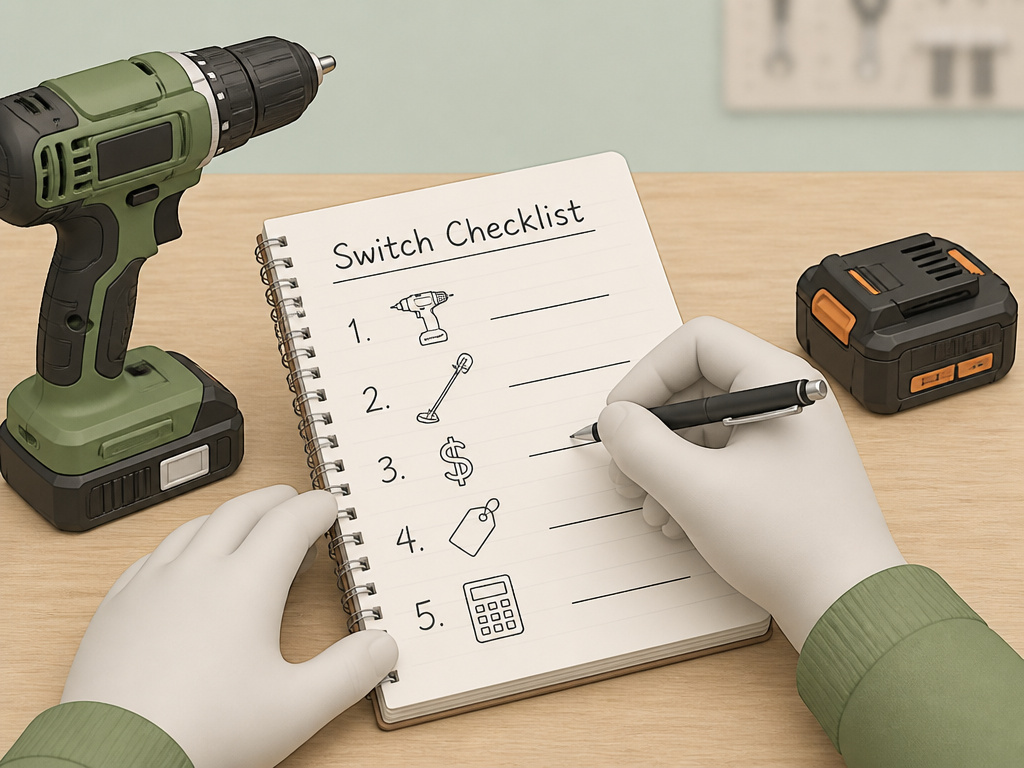
Don’t make this decision emotionally. Work through these five questions with a notepad. Your answers will tell you if a switch is a strategic move or an expensive whim.
- What tools do I use weekly? List them. Be brutal. The cordless pin nailer you used once six months ago doesn’t count.
- What tools is my current brand missing that I would buy tomorrow? Be specific. “Better outdoor tools” is vague. “A cordless power washer and a high-capacity string trimmer” is a target.
- What is the rough resale value of my current kit? Check completed listings on eBay or Facebook Marketplace for your used tool models. Total it.
- What is the cost to replace my weekly-use tools in the new brand? Price out bare tools (no battery) for the equivalents. Don’t forget chargers.
- What is the net cost? (Cost of new tools) minus (Resale value of old kit). This is the real number you’re investing.
If the net cost is high but the new platform gives you access to three specialty tools you’ll use monthly for years, it might be an investment. If the net cost is high and you’re gaining one slightly better drill, it’s a luxury purchase. Be honest with yourself.
Option 1: The Battery Adapter Bridge (Pros, Cons, and Real Limits)
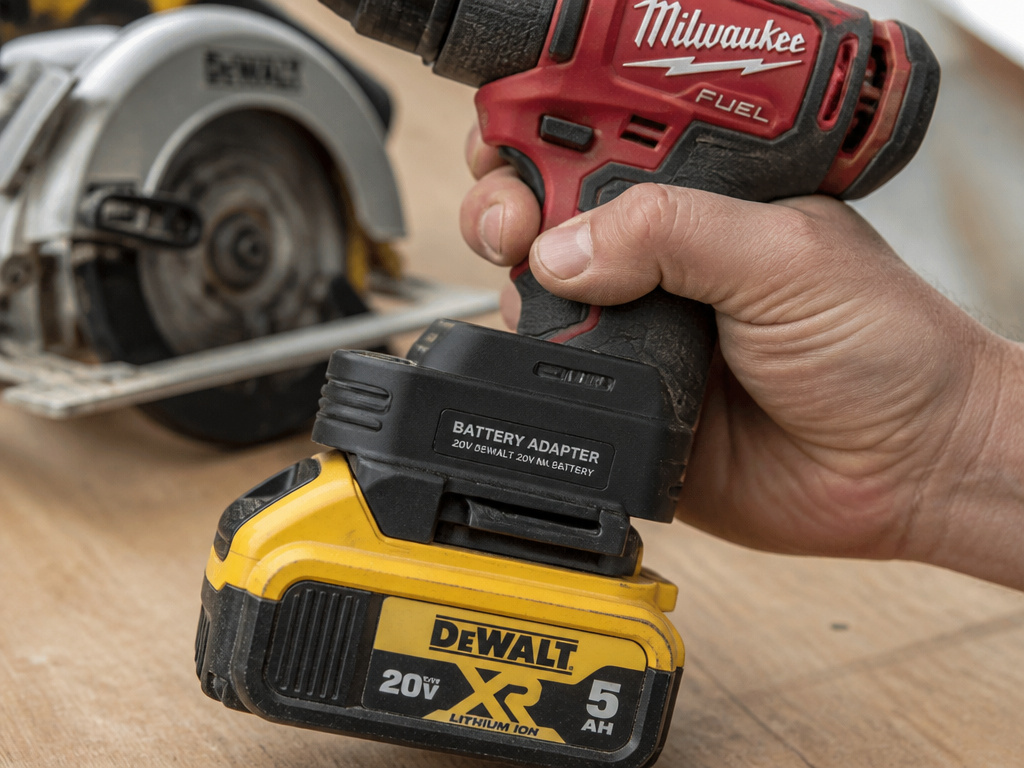
When the idea of selling everything feels overwhelming, a battery adapter whispers a tempting alternative. These third-party plastic pieces physically convert, say, a DeWALT 20V MAX battery to fit a Milwaukee M18 tool socket. They exist for most major brand combinations.
In theory, it’s a brilliant stopgap. In practice, it’s a compromise with real teeth.
Where this goes sideways: An adapter is a dumb bridge. It passes voltage, but it cannot translate the proprietary communication between the battery and the tool. Modern tools and batteries talk to each other to manage discharge rates, temperature, and cell balancing. An adapter silences that conversation.
To be direct,. Using an adapter voids the warranty on both the tool and the battery. Manufacturers explicitly state you should only use designated battery packs. The safety logic is sound: if your adapted battery overheats and damages the tool, neither company is on the hook. You’re on your own.
There are also performance hits. High-draw tools like angle grinders or concrete mixers may trigger the battery’s internal protection circuit because the communication is missing, causing the tool to cut out under load. You’ll feel it as a sudden, frustrating loss of power in the middle of a cut.
| Adapter Use Case | Realistic Outcome | Risk |
|---|---|---|
| Low-drain tools (Lights, radio, fan) | Usually works fine | Low; mostly an inconvenience if it fails |
| Medium-drain tools (Drill, driver, jigsaw) | Often works, may experience slight voltage sag | Moderate; potential for reduced torque or runtime |
| High-drain tools (Circular saw, angle grinder) | Unreliable; frequent cut-outs likely | High; tool damage, battery stress, safety hazard |
I keep a DeWALT-to-Milwaukee adapter in my kit for one reason only: to power my M18 job site radio when all my M18 batteries are dead and my DeWALT packs are charged. For any tool that spins a blade or drives a fastener, I use the correct, native battery. I strongly advise this.
Option 2: Sell Your Old Kit (or Don’t)
This is the clean-break method. Selling your old tools funds the new ones and clears your mental shelf. It’s also the most work.
Selling is your best path if: Your tools are in good condition, less than 3-4 years old, and from a mainstream brand (DeWALT, Milwaukee, Makita, Ryobi). These hold value. List them as “bare tools” (tool only, no battery or charger) in lots. A “Drill & Impact Driver Combo” sells faster and for a better total price than two separate listings.
Don’t sell, repurpose if: You have a mix of brands already or a dedicated space like a garage workshop. Your old 18V drill becomes your permanent press-drill for pocket holes. Your old cordless circular saw gets a dedicated guide rail and lives at your cutting station. This turns your “old platform” into a static, functional asset instead of a sunk cost.
The logistics matter. Many big-box stores have recycling drop-offs. For the old charger, if it’s not part of the sale, it’s e-waste. Check your local municipal guidelines.
I once tried to switch from a mid-tier brand to a pro brand by buying adapters and selling nothing. Two years later, I had a drawer full of orphaned adapters, half my old tools, and a nagging sense of inefficiency. Selling the old kit in one go was the catharsis I needed. The cash funded two proper tools immediately.
The Universal System Exception: Bosch, Einhell, and CAS
While the big players guard their ecosystems, a few alliances deliberately break the rules. These are true universal systems, not hacks.
Bosch 18V Power for All: This isn’t just for Bosch tools. The same 18V battery is designed to work across a partner alliance that includes Gardena garden tools, Wagner paint sprayers, and Husqvarna outdoor equipment. The compatibility is official and engineered-in. It’s a “home and garden” focused ecosystem.
Einhell Power X-Change: Similar philosophy, with partnerships extending to other value brands like Ozito. One 18V battery family runs a wide range of tools from different manufacturers within the partnership.
Cordless Alliance System (CAS): This is the pro-oriented version. Over 50 brands (like Fein, Stier, and Stihl in some lines) share an 18V platform, offering over 500 compatible tools. It’s a niche solution, but it proves true cross-brand compatibility is possible when manufacturers agree on a standard.
If your work spans multiple disciplines, say, woodworking, automotive, and landscaping, and you hate the idea of multiple battery types, these alliances are worth a hard look. The tool selection within each alliance is your limiting factor.
Making the Switch: A Tactical Timeline
If you’ve done the math and the checklist says “go,” execute with strategy. Don’t just walk into a store and max out a credit card.
Phase 1: Fund the Foundation (Month 1)
Sell your old, high-value core tools (drill, impact driver, maybe circular saw). Use this cash to buy the equivalent bare tools in your new platform. This gets you operational. Immediately buy one charger and two batteries for the new system (a compact and a larger capacity battery covers most needs).
Phase 2: Consolidate and Specialize (Months 2-6)
As you need other tools, sell your old equivalents and use the proceeds. Wait for holiday sales (Memorial Day, Black Friday, Father’s Day) to buy the new platform’s specialty tools you craved. This is when kit deals appear,
Phase 3: Complete the Transition (6+ Months)
By now, you should have switched your most-used tools. The old batteries that remain need a plan. If they still hold a charge, consider giving the last old tool (like a radio or light) to a family member.
What are multi-voltage battery platforms?
Some manufacturers offer battery platforms designed to work across different tool voltages. In these systems, a single battery pack can automatically switch its output to power both lower-voltage and higher-voltage tools from the same brand. This way, you can use the same batteries for many tools, including small drills and larger, powerful ones. It simplifies your kit by reducing the number of distinct battery types you need to own and manage. When researching a new platform, check if the brand offers this feature, as it provides significant flexibility as your tool collection grows.
How do outdoor and workshop tool needs differ?
Your primary work environment should guide your platform choice. Workshop tools like drills and saws often prioritize sustained power and ergonomics for repetitive tasks. Outdoor equipment, such as trimmers and blowers, faces different challenges like dust, moisture, and temperature extremes. Some battery systems are part of broader alliances, sharing batteries with brands specializing in garden tools or cleaning equipment. This can be a major advantage if you need a single battery platform for both indoor and outdoor jobs. Assess the full range of tools available in a system to ensure it covers all the areas where you work.
Frequently Asked Questions
Can I use a higher voltage battery in a lower voltage tool with an adapter?
No, and you should never attempt it. A tool’s motor and electronics are designed for a specific voltage range. Applying a higher voltage (e.g., using a 20V battery on a 12V tool via an adapter) will almost certainly overload and burn out the tool’s motor or circuitry instantly. Adapters only change the physical connection, not the voltage.
Do battery adapters work with brushless tools?
They can, but with heightened risk. Brushless motors rely heavily on precise communication between the tool’s controller and the battery. An adapter disrupts this communication, which can lead to erratic performance, reduced efficiency, and potential damage to the tool’s expensive electronic controller. The risk outweighs the convenience.
Is it worth rebuilding my old batteries instead of switching?
Rebuilding, replacing the worn-out lithium cells inside the plastic shell, can extend the life of a battery from a platform you’re keeping. If you’re switching platforms, it’s not a cost-effective solution. Only rebuild if the battery model is expensive and discontinued.
My new battery platform has two sub-platforms (like Makita LXT and XGT). What gives?
This is a common brand strategy to segment markets. Makita’s 18V LXT is the mainstream line, while the 40V XGT is for high-performance tools. They are incompatible. Always check the specific platform name (LXT, XGT, M12, M18, ONE+, 40V) not just the voltage. This is the most common buying trap within a single brand.
How do I handle the different battery chemistries?
You’re almost certainly switching between lithium-ion batteries. The important differences are in performance, not compatibility. Newer batteries might have different energy densities or discharge rates, but they’ll work within their designated platform.
The Bottom Line
Switching cordless power tool platforms is a project, not an impulse buy. It’s justified only when your current ecosystem is holding back your work in multiple, tangible ways, not when you’re bored or tempted by a single new gadget.
The most successful switches I’ve seen follow a ruthless three-part rule: they start by selling the old core tools to fund the new core, they avoid adapters for anything more demanding than a job site radio, and they time their purchases to coincide with sales on the specialty tools that prompted the jump in the first place.
If your checklist shows a net cost of hundreds of dollars for marginal gain, stop. Invest that money in a premium corded version of the one tool you covet, or in a higher-tier model within your current platform. Your battery platform is your workshop’s foundation. You don’t rip up a foundation on a whim. You do it when the house needs a new addition, and you’ve already drawn the plans.
