
Power Tool Battery Adapters Pros and Cons: How to Choose
This post contains affiliate links. As an Amazon Associate, we earn from qualifying purchases.
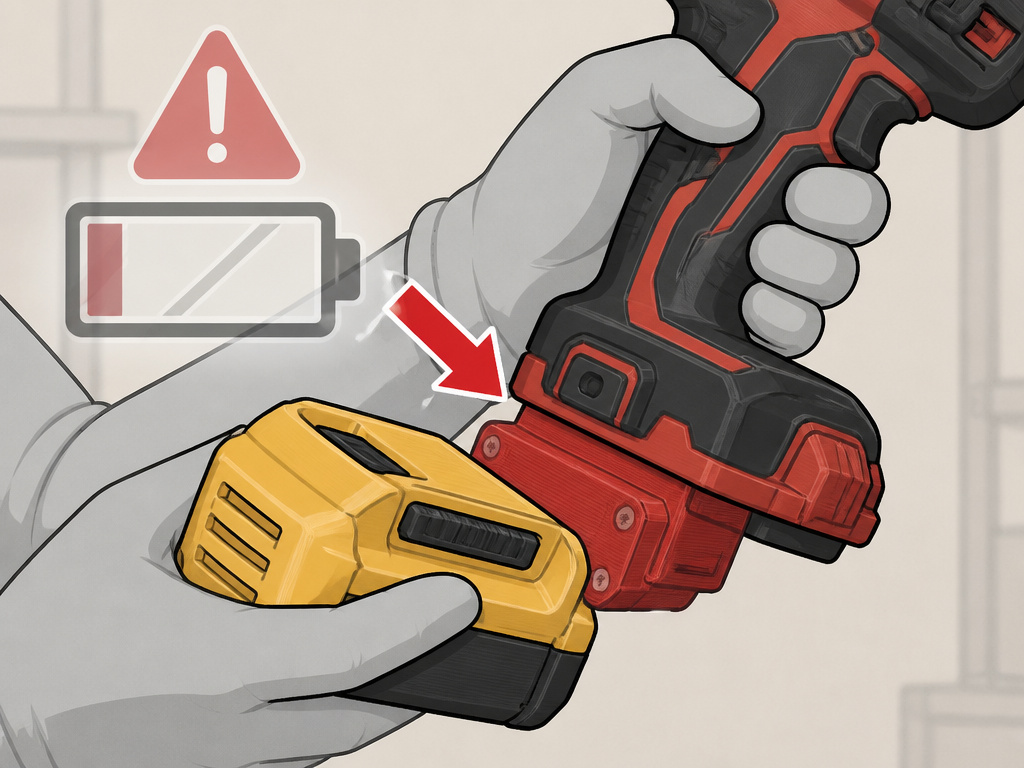
Power tool battery adapters let you use one brand’s battery with another brand’s tool, a mechanical bridge between incompatible systems. The pros include cost savings and convenience, while the cons center on safety risks like fire, battery damage, and voided warranties because adapters bypass the critical communication between a tool and its battery.
That answer is the surface. The real question is whether the convenience is worth the gamble, which depends entirely on the specific tools you’re bridging and how you use them. A key part of this is understanding power tool battery adapters pros and cons.
What follows: a breakdown of the three core risks every adapter introduces, the two specific scenarios where they can make sense, and a head-to-head look at the power tool battery adapters pros and cons for the adapters that actually come from tool manufacturers versus the generic ones flooding Amazon. By the end, you’ll know exactly which combo to avoid and the one check you must perform before buying any adapter.
Key Takeaways
- Adapters are passive connectors; they cannot replicate the voltage, temperature, or battery-health data the tool and battery normally exchange.
- The Power Tool Institute warns that adapters may allow users to bypass Battery Management System (BMS) elements, creating potentially dangerous situations.
- Official manufacturer adapters, like the DeWALT DCA1820, come with explicit compatibility lists and warnings that generic adapters lack.
- Using an adapter almost certainly voids the warranty on both the battery and the tool.
- Adapters are most viable for low-draw, intermittent-use tools like LED work lights or fans, and are a terrible idea for high-draw tools like circular saws or grinders.
Before You Start:
Before you start: Using a battery adapter carries real risk. The battery, tool, and charger are designed as a communicating system. An adapter breaks that chain. If you proceed, you accept that risk. Never leave a battery connected to an adapter when not in use, as this can lead to deep discharge. Never charge a battery through an adapter. And if your tool or battery gets abnormally hot during use, stop immediately.
The Core Risk: How Adapters Bypass Safety Systems
The danger is that adapters turn a smart system into a dumb one, though many are also poorly made. Modern cordless tools and their batteries don’t just pass power; they have a conversation.
The Power Tool Institute (PTI) frames it clearly: “Since battery adapters do not contain the proper electronics, their use may allow the user to bypass the BMS elements contained in tools or chargers, which can create a potentially dangerous situation.”
Think of it like putting jet fuel in a car engine because the nozzles fit. The physical connection works, but the engine’s computer has no way to manage the burn rate. Something will eventually give.
| Safety Feature | Where It Usually Lives | What the Adapter Disrupts |
|---|---|---|
| Low-Voltage Cutoff (LVC) | Tool (DeWALT, Milwaukee) or Battery (Ryobi, Makita) | Prevents deep discharge; without it, cells can drop below 2.5V and become a fire hazard if recharged. |
| Overload Protection | Tool’s Electronic Protection System (EPS) | Stalls the tool to protect the motor and battery from drawing excessive current. |
| Temperature Monitoring | Communication between battery & tool | Allows a battery to keep discharging even when hot, accelerating cell degradation and risk of thermal runaway. |
An adapter reshapes the physical connector only, it does not replicate the voltage, temperature, or battery-health data the tool and battery normally exchange. That missing communication link is what turns a simple fit problem into a real overheating and fire risk.
I learned this the hard way not with an adapter, but by ignoring a tool’s built-in safety. I once smoked a DeWalt 20V drill mixing thinset. The motor was screaming, the housing was hot enough to burn, and it kept running. The Electronic Protection System should have cut power. It didn’t. That’s with a matched battery and tool. Now imagine that same scenario, but the tool has no way to ask the battery how it’s feeling. The failure happens faster, and you have zero warranty to fall back on.
The Good: Where Adapters Actually Shine (It’s a Short List)
To be clear. For high-draw tools, circular saws, angle grinders, rotary hammers, an adapter is a hard no. The risk-to-reward math never works. But there are two narrow use cases where the risk plummets.
First, for low-draw, intermittent-use accessories. An LED work light, a job site radio, or a fan pulls minimal, steady current. These devices rarely trigger thermal or overload protection even in their native system. The communication they have with their battery is often basic. Using a beefy Milwaukee battery to power a Ryobi light via an adapter is low-stakes. The battery door might not close, but it’ll run for days.
Second, for transitioning between an old platform and a new one. DeWALT sells the DCA1820 adapter so users can run their newer 20V Max batteries on older 18V NiCd tools. This is a manufacturer-sanctioned bridge. Crucially, the manual states: “The battery pack must be removed from the adapter before charging. Do not force or modify the adapter to fit a charger.” Even official adapters have strict limits.
| Scenario | Adapter Viable? | Why | Key Limitation |
|---|---|---|---|
| LED Work Light / Fan | Yes, cautiously. | Low, steady power draw minimizes heat and communication needs. | Battery door may not fit; no warranty. |
| Compact Drill / Driver | Maybe, for light duty. | Moderate power needs; risk increases with extended use. | Loss of torque & possible overheating under load. |
| Circular Saw / Grinder | No. | High, bursty power demands create heat and require EPS communication. | High risk of tool/battery damage or adapter failure. |
| Official Platform Migration | Yes, follow OEM manual. | Designed for specific tool/battery pairs with known parameters. | Strict compatibility lists (e.g., not for nailers or radios). |
If you’re considering an adapter for one of the green-light scenarios after reviewing the power tool battery adapters pros and cons, the next step is choosing the least risky one. That brings us to the official versus third-party divide.
Official vs. Third-Party Adapters: The Chasm Between Them
Not all adapters are created equal. The difference between a DeWALT DCA1820 and a $15 generic from Amazon involves price, intent, documentation, and liability.
The DeWALT DCA1820 manual is a masterclass in specific warnings. It’s NOT COMPATIBLE with 18V DeWALT radios, nailers, certain worklights, or the DCS370 bandsaw. For the DC500 Vacuum, DW074, and DW079 Rotary Lasers, it works, but the battery doors won’t fully close. This level of detail is what you’re paying for: a manufacturer has tested specific combinations and tells you exactly where the system breaks.
A generic adapter has one line of small print: “Use at your own risk.” There’s no compatibility list because there’s no testing. The goal is physical connection, not system integrity. These are the adapters responsible for most forum horror stories about deep discharge and melted plastic.
Where this goes sideways: Charging through an adapter. The DeWALT DCA1820 manual and the PTI warn against it: never do it. The charging cycle relies on precise communication between the battery’s BMS and the charger. An adapter blocks this, risking overcharge, overheating, and fire.
Furthermore, brand protections like Milwaukee’s RedLink Plus or Makita’s STAR system are rendered useless. RedLink monitors heat and load within the Milwaukee ecosystem. Slap a Milwaukee battery into a DeWalt saw via an adapter, and that RedLink chip might as well not exist. The tool can’t read it, and the battery can’t talk to the tool.
Specific Brand Combinations: What Works, What Melts
General warnings are useful, but you’re probably wondering about your specific garage combo. Here’s what the collective experience from forums and manuals suggests.
- Ryobi to Milwaukee/Makita/DeWALT: Ryobi ONE+ batteries have their low-voltage cutoff inside the battery. A passive adapter might not trigger this LVC if the tool doesn’t have its own. This is a classic over-discharge risk. Best reserved for Ryobi lights powered by a bigger brand’s battery, not the other way around.
- Milwaukee to DeWalt/Makita: Milwaukee tools typically handle the LVC. If you use a Milwaukee battery on a DeWalt tool via an adapter, the battery has no built-in cutoff. You must watch the battery gauge and stop well before it’s empty to avoid bricking it.
- DeWALT to Makita (or vice versa): Both brands often put LVC in the tool. An adapter severs this link. The result is that neither the tool’s cutoff nor the battery’s protection (if any) may engage, leading both to a deep discharge scenario.
- Within the same parent company (Ryobi & Ridgid): Don’t assume compatibility. Both are under Techtronic Industries (TTI), but as WoodworkingAdvisor.com notes, “a shared ownership does not carry over into a shared battery connector.” You still need an adapter, with all the same risks.
The pattern is clear: mixing systems disables safeties. The only semi-reliable combo is using a larger brand’s high-capacity battery to power a smaller brand’s low-draw accessory, where the power demands are trivial and the risk of deep discharge is low.
Making an Informed Choice: A Step-by-Step Framework
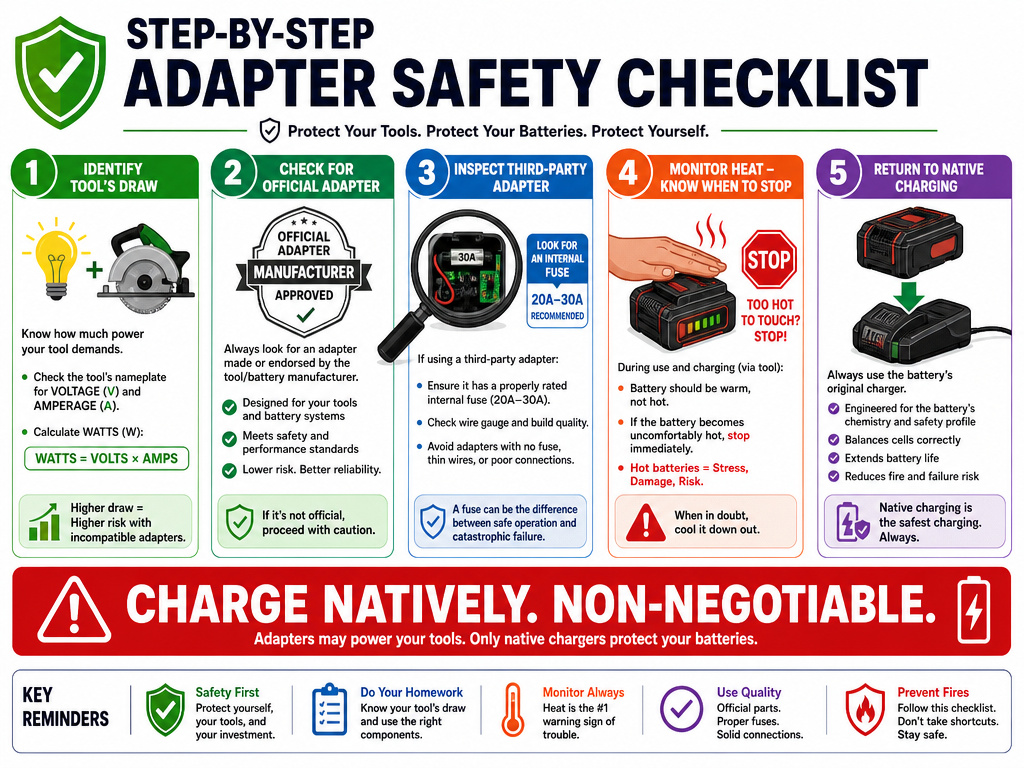
If you’ve weighed the risks and still want to proceed, this framework minimizes the danger. Treat it as a checklist.
- Identify the Tool’s Draw. Is it a light, fan, or radio (low)? Or a saw, grinder, or hammer drill (high)? If high, stop here. The answer is no.
- Check for an Official Adapter. Does the tool’s manufacturer make one for your specific transition (like DeWalt 20V to 18V)? If yes, read its manual cover-to-cover and follow every limitation.
- If Using a Third-Party Adapter:
- Source Carefully. Look for adapters that specifically mention “over-current protection” or have built-in fuses. This is rare but better than nothing.
- Inspect the Build. Does it feel flimsy? Are the terminals thin metal? Poor construction increases resistance, which creates heat.
- Never Set It and Forget It. Use the tool only while you’re actively holding it. Do not leave the battery attached to the adapter when not in use.
- Monitor Religiously. Pay attention to heat. If the adapter, battery, or tool gets warmer than with a native battery, stop immediately. Feel the battery periodically during use.
- Charge Natively. Always remove the battery from the adapter and charge it in its original manufacturer’s charger. This is essential.
Skipping any of these steps, especially step 5, turns a calculated risk into a blind gamble. The consequence isn’t just a dead battery; a deeply discharged lithium-ion cell can vent or ignite when you try to charge it.
The Warranty and Long-Term Reality
Frankly,. Both Ryobi and the tool brand consider adapter use outside normal operation, so damage claims on either side are typically denied. Your warranty voided the moment you clicked that third-party plastic between the battery and tool.
Long-term, even if you avoid a catastrophic failure, you’re accelerating wear. Batteries and tools are designed for specific charge/discharge curves and thermal profiles. An adapter forces both to operate outside those parameters. You might get a year of seemingly fine performance, only to find your battery now holds half its charge and your tool’s motor brushes are shot. With no warranty, you own both problems.
Common mistake: Assuming an adapter that works today means it’s safe forever. Lithium-ion cells degrade with each cycle, and the stress of mismatched communication accelerates that. A battery that seems fine for months can hit a failure point abruptly.
Do battery adapters reduce tool power?
An adapter only reshapes the physical battery connector. It does not replicate the voltage, temperature, or battery-health data the tool and battery normally exchange. This means the critical conversation between a smart battery and a smart tool is broken. While power may flow, the tool cannot request or receive the full performance profile it was designed for. This often results in a noticeable drop in speed, torque, or overall power, as the system operates without its full suite of electronic controls and protections.
Are 18V and 20V batteries compatible with adapters?
Adapters are often marketed to bridge voltage platforms like 18V and 20V Max, which are typically the same underlying voltage. However, voltage is only one factor. However, voltage is only one factor. Using an adapter can bypass the battery management system (BMS) elements in the tools or chargers, which creates a potential safety risk. Always check the adapter manufacturer’s specific compatibility list, as many tools, especially those with sensitive electronics or specific physical battery compartments, will not work correctly or safely.
Frequently Asked Questions
Are battery adapters for power tools safe?
They are not inherently safe. They bypass designed safety communications, introducing risks of over-discharge, overheating, and fire. Safety depends heavily on using them only with low-draw tools, monitoring for heat, and never charging through them.
What is the best universal battery adapter for power tools?
There is no “best” universal adapter, as universality is the problem. The safest options are official, brand-specific adapters like the DeWALT DCA1820, which are engineered for a known transition. For third-party options, look for units with over-current protection, but recognize the risk remains high.
What are the disadvantages of using battery converters?
The main disadvantages are: 1) Voided warranties for both tool and battery. 2) Disabled safety features (low-voltage cutoff, overload protection, temperature monitoring). 3) Risk of battery deep discharge, leading to permanent failure or fire. 4) Potential for tool damage due to unregulated power delivery. 5) Added bulk and poor ergonomics.
Should you leave your power tool battery plugged in all the time?
No, and this is especially critical with adapters. Never leave a battery plugged into an adapter when not in use. Parasitic drain can deeply discharge the battery below recovery levels, turning it into a brick or a hazard.
The Bottom Line
An adapter is a compromise, not a tool. For most users, especially those running high-draw tools, that compromise isn’t worth the very real risk of destroying expensive gear with no recourse.
If you must cross the streams, let it be one-way: use a big-brand battery to power a small-brand light, and only while you’re watching it like a hawk. For everything else, saws, grinders, drills you actually rely on, the math is simple. Save for the right battery, or sell the old tool and buy into the new system cleanly. The adapter’s cost is cheap; the price of learning why it’s a bad idea usually isn’t.
