
10 Best 10 Inch Wet Saw Blades For Porcelain Tile in 2026
This post contains affiliate links. As an Amazon Associate, we earn from qualifying purchases.
Our best overall 10-inch wet saw blade for porcelain tile is the RUBI Red Cobra Diamond Blade, a versatile choice that handles porcelain, stone, and glass smoothly. For a dedicated porcelain blade, consider the DEWALT DW4764, and for great performance on a budget, the QEP Premium Diamond Blade offers strong value. Cutting porcelain demands a blade that can handle its density without chipping the delicate glaze. We researched specifications, manufacturer data, and expert insights to find blades that deliver clean, controlled cuts for your project.
Top 10 10-Inch Wet Saw Blades for Porcelain Tile in the Market
Certain content that appears on this site comes from Amazon. This content is provided "as is" and is subject to change or removal at any time.
The Best 10-Inch Wet Saw Blades for Porcelain Tile, Reviewed
RUBI Red Cobra Diamond Blade

What We Like
- Versatile for many hard materials including glass
- Includes 5/8-inch arbor adapter
- Wet technology enables smooth, chip-free cuts
- Thickened center minimizes wobble during operation
Trade-offs
- General-purpose design isn't specialized for hardest porcelain like dedicated blades
- Continuous rim requires wet use only, no dry cutting option
The Red Cobra’s true strength is its versatility across materials from porcelain to glass, all while delivering the chip-free cuts wet technology is known for. That thickened center is a smart design, fighting the vibration that can ruin a precise line on expensive tile. For the pro who tackles a mix of jobs or the serious DIYer stocking one reliable blade, this breadth of capability without sacrificing cut quality is the deciding factor. It handles the common range of bathroom and kitchen materials without needing a separate blade for each type.
Rubi and Husqvarna are the two brand names that come up most for tile blades, and this 10-inch Red Cobra is built as a versatile, general-purpose option. Its design handles materials from marble and granite to ceramic and glass, making it a practical single-blade choice for mixed renovation work. The blade includes a 5/8″ ring adapter for compatibility and features a thicker center to avoid vibrations and wobbling during cuts, which helps maintain control.
DEWALT DW4764 Premium Porcelain Blade

What We Like
- Designed specifically for wet cutting applications
- Sturdy 1.5-pound construction
Trade-offs
- Heavier than the 1.0-pound RUBI Red Cobra blade
Designed specifically for porcelain tile, this 10-inch blade is intended for wet cutting, which helps manage dust and heat during precise work. The DEWALT DW4764 is built for installers focused on porcelain, where a dedicated tool can be critical for clean results. Its ‘Premium Porcelain’ designation suggests a formulation aimed at that material’s hardness.
The trade-off is in its heft and specialized focus. At 1.5 pounds, it’s a solid chunk of steel on your arbor, which contributes to its stability but makes it noticeably heavier than options like the RUBI Red Cobra. It’s a purpose-built blade, so if your work mix includes a lot of softer ceramics or natural stone, a more general-purpose diamond blade might offer better versatility for the investment.
QEP Premium Diamond Blade

What We Like
- Reinforced hub enhances blade stability.
- Laser cutouts help keep the blade cooler.
- Designed for minimal vibration and no chipping.
- Compatible with any wet tile saw.
Trade-offs
- Arbor size versatility may require adapters for some saws.
- No explicit thickness measurement for cut width precision.
The dual 5/8-inch and 1-inch arbor compatibility means this blade slides right into most common tile saws without a fuss, a real time-saver on a busy job. Its reinforced hub and thin continuous diamond rim are built for the repeated punishment of cutting hard porcelain and granite, promising a steady cut and long life. For the DIYer tackling a kitchen backsplash or the pro running a high-volume saw, it delivers the core durability needed without overcomplicating the purchase.
Where it makes its trade-off is in the finer details. Compared to a blade like the DEWALT DW4764, which specifies a precise .060-inch cutting width, the QEP doesn’t list its gauge. That’s fine for most cuts, but if you’re fitting tiles into a perfectly scribed layout, that unknown variable might give you pause. It’s a workhorse designed for reliable, chip-free performance across common materials, not for hyper-specialized applications where every fraction of a millimeter is critical.
Product photos
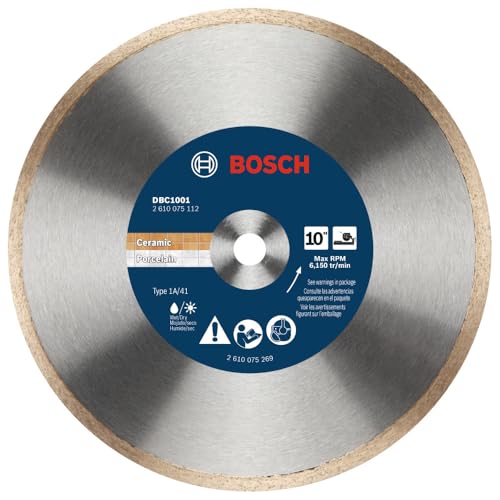
Bosch DBC1001 Diamond Wheel
What We Like
- Continuous rim design for exceptionally smooth cuts
- Optimized formula for hard, delicate materials
- Universal 5/8-inch arbor fits most tile saws
- Engineered for professional-grade longevity
Trade-offs
- Precision focus means it's not the fastest cutting blade
The Bosch DBC1001’s continuous rim and fine-grit diamond formula are engineered for one thing: clean, chip-free results. This blade is for the installer who needs to make intricate cuts for a backsplash or shape a marble countertop edge without a second thought about tear-out. Its softer matrix is calculated to cut smoothly through hard, delicate materials, making it a reliable choice for detail-oriented tile and stone work where the finish is everything.
That focus on finesse comes with a trade-off. The blade’s design prioritizes a smooth finish over raw speed or extreme longevity in high-volume scenarios. For straight, rapid cuts through bulk porcelain, a more aggressive turbo rim blade like the DEWALT DW4764 might be the better fit. The Bosch sits in its own category, built for the moments where precision can’t be compromised.
Product photos
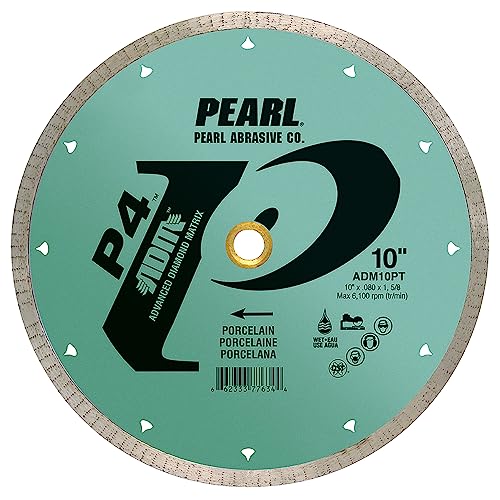
Pearl P4 ADM Reactor Blade
What We Like
- ADM diamond matrix for faster, longer cuts
- Thicker core reduces deflection for precision
- Continuous rim reduces chipping on edges
- Laser-cut slots aid cooling and blade life
Trade-offs
- Weighs 1.7 pounds, heavier than some 10-inch blades
- Arbor size range from 5/8" to 1" may require an adapter for some saws
The Pearl P4 ADM Reactor is built around a thicker steel core. This extra rigidity means the blade deflects less under load, so your cuts stay straighter and smoother even on dense porcelain. Combined with its Advanced Diamond Matrix pattern, it’s engineered for pros or serious DIYers who prioritize cut quality and blade longevity over sheer budget. It’s a tool for someone who needs a blade to perform consistently over many projects, not just a single bathroom.
Weighing 1.7 pounds, the Pearl P4 ADM Reactor Blade has a solid heft, which comes from its thicker steel core and laser-cut cooling slots. This design provides rigidity for straighter cuts, but it is heavier than the 1.3-pound DEWALT DW4762. That extra weight contributes to its construction for precision cutting on hard materials.
DEWALT DW4762 Porcelain Blade

What We Like
- Continuous rim design for clean cuts
- Wet-cutting application reduces dust
- Specifically engineered for porcelain tile
Trade-offs
- Amazon listing lacks detailed material or bond specifications
- Repeated feature bullets offer limited technical insight
This 10-inch diamond blade is designed specifically for cutting porcelain or tile, giving you a tool focused on one of the hardest tile materials. Its continuous rim is intended for wet cutting, a method commonly used to reduce dust and heat during tile work. It’s a straightforward choice for the tile setter or serious DIYer who needs a dedicated porcelain blade from a known brand.
The DW4762 is a solid workhorse, but it trades some of the advanced features found in higher-end blades. For instance, DeWalt’s own DW4764 model is noted as a ‘Premium’ choice in round-ups. If your project list is exclusively porcelain and you value a trusted brand name for core performance, this blade delivers.
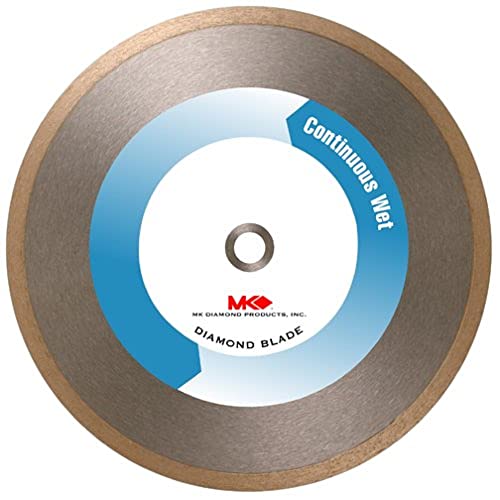
MK Diamond MK-415 Blade
What We Like
- Supreme grade diamond construction for durability
- Continuous rim design for clean, precise cuts
- Wet cutting capability reduces heat and dust
- 5/8 inch arbor fits most common tile saws
Trade-offs
- Weighs 1.3 pounds, heavier than some 10-inch blades.
- Arbor size is only 5/8 inches, no adapter included.
A supreme-grade continuous rim blade like the MK-415 is built for durability, meaning it can handle a high volume of porcelain and tile cuts while resisting wear. The MK Diamond brand is considered a workhorse category that many shops stock for its wide-range capability. This makes the blade a solid choice for installers who need a single, dependable option for mixed material jobs rather than a dedicated specialist for each type.
The trade-off is that it’s not specifically engineered for porcelain like some competitors. Research indicates blades like the Montolit Progres CG use a diamond matrix designed to stay cooler on that harder material, which can prolong life on pure porcelain projects. The MK-415 is a generalist, so while it cuts porcelain well, it might not have the ultimate longevity of a porcelain specialist when that’s all you’re cutting day in and day out. Think of it as the reliable all-rounder, not the niche expert.
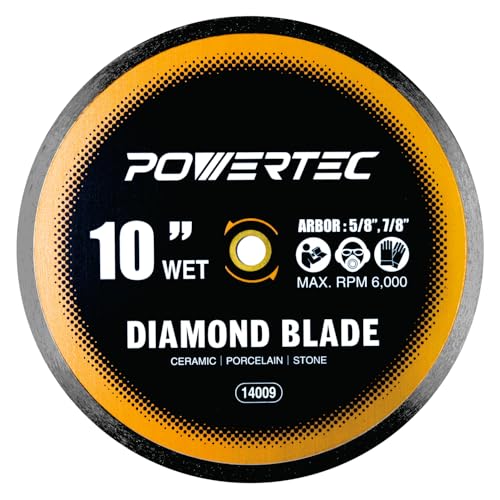
POWERTEC Continuous Rim Blade
What We Like
- Continuous rim for smooth, precise cuts
- Spring steel core for durable construction
- Includes 5/8-inch adapter ring for compatibility
- Premium diamond matrix for reduced chipping
Trade-offs
- Exclusively for wet cutting; a single dry cut ruins it
A spring steel core and high-grade diamond matrix are the foundation of this blade’s durability. This construction means it’s built to handle the abrasion of porcelain and hard stone over the long haul, not just a single bathroom job. It’s the right pick for a contractor or serious DIYer who needs a workhorse blade that can be mounted on multiple saws, thanks to the included adapter ring, and trusted for repetitive, precise cuts with minimal chipping.
This blade is engineered exclusively for wet cutting, so it must be used with a water-cooled tile saw to prevent damage. Its continuous rim design and premium diamond grit are intended to produce smooth cuts with reduced chipping on materials like ceramic, porcelain, and natural stone. A spring steel core aims to provide the durability needed for demanding projects, as long as water is consistently used to cool the blade and flush out debris.
Product photos
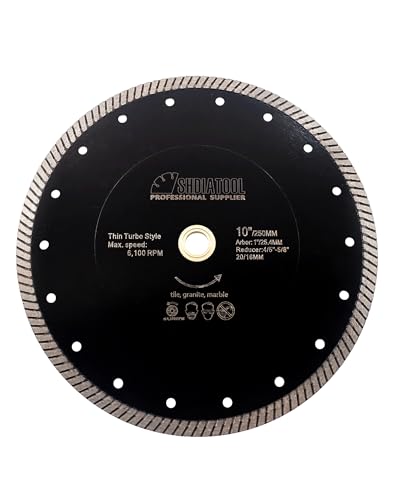
SHDIATOOL Turbo Diamond Blade
What We Like
- Super thin 2mm rim for clean cuts
- Reinforced core reduces blade flex
- Works with both wet and dry cutting
- Includes arbor reducers for compatibility
Trade-offs
- Thin rim may wear faster on dense stone
That 2mm turbo rim is the whole story here. It takes a sliver of material out with each pass, which means less force on the tile and dramatically reduced chipping along your cut line. This blade is built for the installer who needs a clean, precise finish on expensive porcelain without needing a second pass to clean up the edge. The reinforced core adds just enough stiffness so the thin rim doesn’t wander, giving you control for intricate cuts.
A super thin 2mm turbo diamond rim gives this blade its clean, precise cutting action on tile, which means noticeably less chipping and dust during a job. That design focus makes it ideal for porcelain and ceramic, though the thin rim may wear faster on dense stone like granite if used aggressively. For general heavy-duty stone cutting, a blade built with a thicker segment could be a better match, but this one delivers a flawless edge where it counts.
Product photos
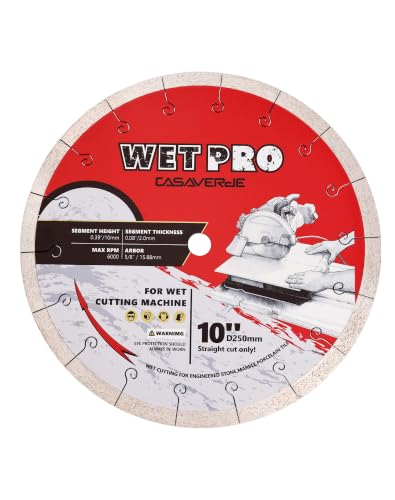
Casaverde Diamond Blade
What We Like
- J-Slot stress relief for chip-free cutting
- Extra-thin, closed cutting edge for clean cuts
- Continuous rim design reduces breaks
- Suitable for porcelain, marble, quartz, and engineered stone
Trade-offs
- Wet cutting only limits its use to wet saws
- No dry-cutting versatility for quick scoring cuts
The Casaverde blade’s J-Slot stress relief and continuous rim are engineered specifically to prevent chipping, which is the single biggest headache when cutting expensive porcelain. That extra-thin, closed cutting edge is designed to slice through tile cleanly, leaving a straight edge that often needs little to no extra finishing. This makes it a solid choice for installers and dedicated DIYers who prioritize a flawless finish on visible edges and want to minimize waste from damaged tiles.
This blade is strictly for wet cutting, which means it must be used with a water-cooled saw. That dedicated setup prevents overheating and preserves the diamond edge, but it cannot be used for quick dry cuts with an angle grinder. Compared to other continuous rim blades, the Casaverde is designed specifically for wet applications.
Product photos
How We Evaluated 10-Inch Wet Saw Blades
Our evaluation focused on manufacturer specifications and the consensus from professional tile tool resources. We prioritized blades designed specifically for the hard, dense nature of porcelain tile, which requires a specialized bond and diamond matrix to cut cleanly. Key criteria included blade design for chip-free cuts, material compatibility, and build quality for stability and longevity. As a research-led guide, we cannot verify personal claims about blade lifespan, but we highlight models consistently noted for their performance in expert round-ups and by contractors.
What To Look For In 10-Inch Wet Saw Blades
Choosing the right blade is critical for clean, efficient cuts in hard porcelain. The wrong blade can chip the tile’s surface or wear out prematurely.
Look for a blade with a continuous rim for smooth cuts, a diamond matrix formulated for hard materials, and a sturdy core to minimize wobble. Ensure it’s rated for wet cutting only, as this is essential for porcelain work.
Rim Design and Cutting Action
The rim design dictates the cut’s finish and speed. A continuous rim provides the smoothest, most chip-free edge, which is essential for visible cuts on porcelain. Turbo or segmented rims cut faster and stay cooler but leave a rougher edge better suited for rough work or stone. For most porcelain tile installations, especially on edges that will be seen, a continuous rim is the standard choice. This design is a hallmark of the best wet saw blades for porcelain.
Diamond Bond and Material Compatibility
Not all diamond blades are created equal. The bond, the metal matrix holding the diamond grit, must be formulated to match the material’s hardness. A soft bond wears quickly on hard porcelain, while a bond that’s too hard will glaze over and stop cutting.
Look for blades explicitly labeled for porcelain or hard ceramic. These use a specialized bond that breaks down at the correct rate to expose fresh diamonds, maintaining a sharp edge. For guidance on selecting a specialized blade, our resource on choosing a blade for porcelain tile can help.
Core Construction and Arbor Size
A blade’s steel core prevents flex and wobble during cuts, which directly impacts precision. A thicker, reinforced core, like a spring steel design, offers more stability for straight cuts. Always check the arbor size (the center hole) for compatibility with your saw. The most common size is 5/8 inch, but many blades include adapter rings for versatility. A secure, wobble-free fit is non-negotiable for safety and clean results.
- Verify your wet saw’s arbor size before purchasing.
- Look for included adapter rings if your saw uses a less common size.
- A heavier blade often indicates a thicker, more rigid core.
- Ensure the blade is clearly marked for wet use only when cutting porcelain.
- Store blades in a protective case to prevent damage to the rim.
For porcelain, prioritize a continuous-rim blade labeled specifically for that material over a general-purpose option.
10-Inch Wet Saw Blades for Porcelain Tile Compared
The table below compares key features across our picks to help you see the differences at a glance.
| Product | Arbor Size | Cutting Type | Rim Type | Primary Materials |
|---|---|---|---|---|
| RUBI Red Cobra Diamond Blade | 5/8 inch | Wet cutting only | N/A | Porcelain, ceramic, glass, marble, granite, natural stone |
| DEWALT DW4764 Premium Porcelain Blade | N/A | Wet Cutting | N/A | Porcelain Tile |
| QEP Premium Diamond Blade | 5/8" & 1" | Wet use | Thin continuous diamond rim | Porcelain, ceramic, marble, granite |
| Bosch DBC1001 Diamond Wheel | 5/8 inch | N/A | Continuous rim | Porcelain, ceramic, slate, marble |
| Pearl P4 ADM Reactor Blade | 5/8"-1" | N/A | Continuous rim | Porcelain |
| DEWALT DW4762 Porcelain Blade | 5/8 inch | Wet cutting | Continuous rim | Porcelain or tile |
| MK Diamond MK-415 Blade | 5/8 inch | Wet cutting | Continuous rim | Porcelain and vitreous tile |
| POWERTEC Continuous Rim Blade | 7/8 inch | Wet cutting only | Continuous rim | Ceramic, Porcelain, Natural Stone Tile |
| SHDIATOOL Turbo Diamond Blade | 1" with reducers | Wet & Dry | Turbo | Porcelain, ceramic, stone |
| Casaverde Diamond Blade | 5/8 inches | Wet cutting only | Continuous rim | Porcelain or tile |
Frequently Asked Questions
What is the best 10″ wet saw blade for cutting porcelain tile?
For most users needing a versatile and reliable blade, the RUBI Red Cobra Diamond Blade is an excellent choice as it performs well on porcelain, stone, and glass. If your work is exclusively porcelain, a dedicated blade like the DEWALT DW4764 Premium Porcelain Blade is specifically engineered for that task.
What type of blade is best for cutting porcelain tile?
A continuous-rim diamond blade designed for wet cutting is best for porcelain tile. This design provides a smooth, chip-free cut on the hard, glazed surface. The diamond matrix must also be formulated for hard materials to prevent premature wear.
What is the best wet saw for porcelain tile?
While this guide focuses on blades, pairing a quality blade with a capable saw is key.
What is the best blade to cut porcelain tile without chipping it?
Blades engineered for chip-free results, like the Bosch DBC1001 Diamond Wheel or the Casaverde Diamond Blade, use a continuous rim and specialized bond to protect the tile’s edge. Proper technique, including using ample water and a steady feed rate, is also crucial. For a full tutorial, see our step-by-step guide for cutting porcelain.
Can I use a dry-cut blade on porcelain tile with a wet saw?
No, you should not. Blades designed for wet cutting rely on water to cool the diamond matrix and lubricate the cut. Using a wet blade dry will overheat it, damaging the bond and ruining the blade. Always use a blade rated for the correct application.
The Bottom Line
For a top-performing, do-it-all blade that handles porcelain alongside stone and glass, the RUBI Red Cobra Diamond Blade is our best overall pick. It’s ideal for renovators and setters who work with a mix of materials.
If your budget is tight, the QEP Premium Diamond Blade delivers reliable performance for wet cutting porcelain and ceramic. For detail work where a flawless edge is everything, seek out a precision-focused blade like the Bosch DBC1001.
Ultimately, the single most important factor is using a continuous-rim blade specifically formulated for cutting hard porcelain with a wet saw. This combination is your best defense against chipping and wasted tile.
