
10 Best 10” Table Saw Blades For Ripping Hardwood in 2026
This post contains affiliate links. As an Amazon Associate, we earn from qualifying purchases.
For dedicated hardwood ripping, the CMT Orange Tools Heavy-Duty Glue Line Ripping Blade is our best overall pick for its stable, full-kerf plate and clean finish. The CMT ORANGE TOOLS 250.024.10 excels as a thin-kerf option for lower-horsepower saws, and the Amana Tool Carbide Tipped Glue Line Ripping Blade is ideal for those needing a joint-ready edge straight from the saw.
Choosing the wrong blade can lead to burning, binding, or a rough finish that requires extra cleanup. We researched specifications, manufacturer data, and owner feedback to identify blades that deliver efficient, clean cuts in hardwoods, balancing power requirements with cut quality.
Top 10 10-Inch Table Saw Blades for Ripping Hardwood in the Market
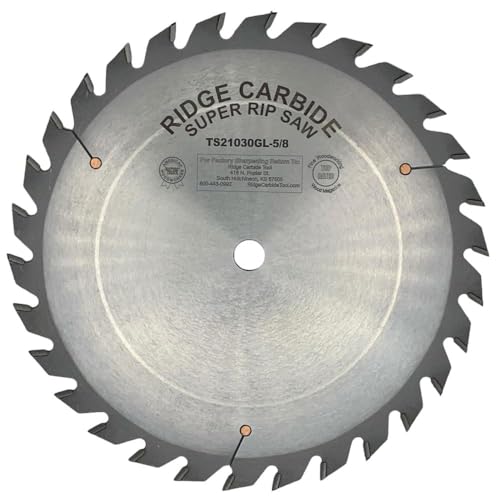
Certain content that appears on this site comes from Amazon. This content is provided "as is" and is subject to change or removal at any time.
The Best 10-Inch Table Saw Blades for Ripping Hardwood, Reviewed
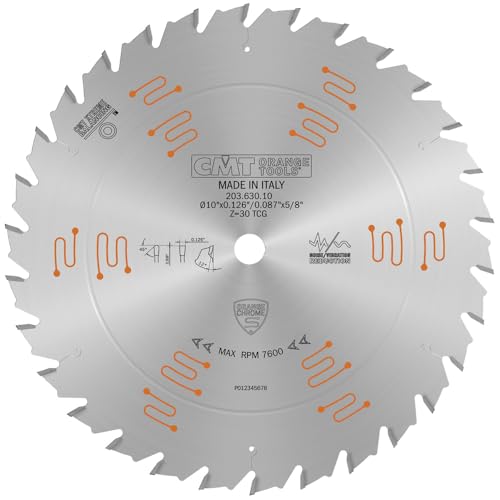
CMT Orange Tools Heavy-Duty Glue Line Ripping Blade
What We Like
- Laser-cut heat expansion slots for stability
- Tri-metal brazing for durable tooth attachment
- Precision mirror-finish sharpening for clean cuts
- Polymer-filled sound dampening slots reduce noise
Trade-offs
- Full 0.126-inch kerf demands more power than thin-kerf blades
- 30-tooth configuration is slower for softwoods than a 24-tooth blade
- Heavy-duty plate design is less suited for general-purpose crosscuts
This CMT blade is specified for ripping cuts in materials like hardwoods, OSB, plywood, and softwoods. Its 30-tooth configuration and TCG grind are features often associated with producing a smoother cut face. The laser-cut heat expansion slots and polymer-filled sound dampening slots are design elements intended to manage heat and vibration during operation.
With a 0.126-inch kerf, it is a full-kerf blade, which generally requires a saw motor with sufficient power. Compared to the CMT 250.024.10 ripping blade, which has 24 teeth, this model has a higher tooth count, a factor that can influence cut speed. The blade’s stated applications are limited to rip cuts, so it is not designed for crosscutting tasks.
Product photos
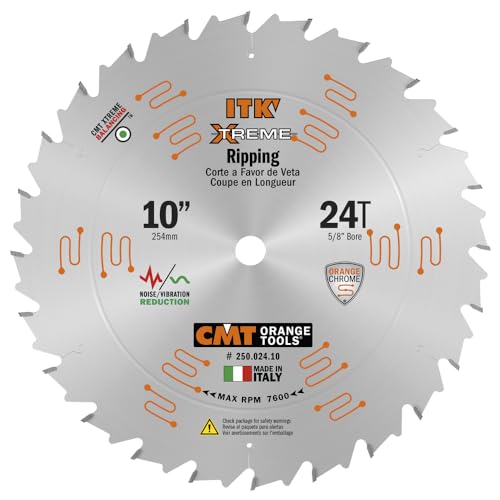
CMT ORANGE TOOLS 250.024.10 10'' Table Saw Blade
What We Like
- Thin 0.102-inch kerf reduces waste and strain.
- 24-tooth ATB grind for efficient hardwood ripping.
- Designed for both softwoods and hardwoods.
- Works on stationary and portable table saws.
Trade-offs
- 0.071-inch plate is thinner, requiring careful handling to avoid deflection.
- ATB grind is not a dedicated ripping grind like FTG.
A 0.102-inch kerf means this blade removes less material with each pass. This can reduce strain on a saw’s motor and waste less wood. Its 24-tooth ATB grind is intended for cutting softwoods, hardwoods, plywood, and other sheet goods on a table saw.
The trade-off for that thin kerf is a thinner 0.071-inch plate, which can be less stable than a full-kerf blade when tackling highly figured or dense stock. You need a well-tuned saw with a true fence to keep it tracking perfectly. For a more rigid, dedicated rip blade on a powerful cabinet saw, the Ridge Carbide TS21024-5 with its 0.125-inch kerf and FTG grind is the logical upgrade.
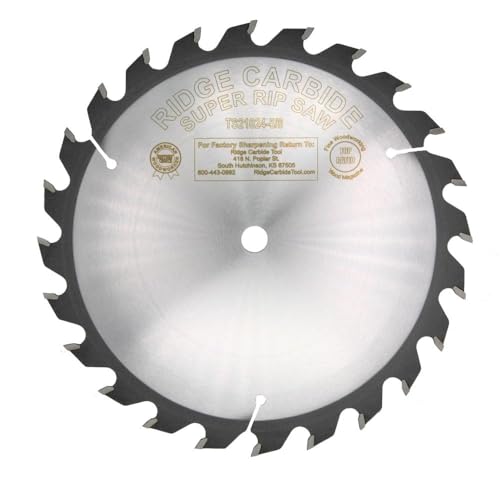
Ridge Carbide Tool Co. TS21024-5 10'' Table Saw Blade
What We Like
- FTG grind for aggressive material removal.
- +20° hook angle pulls wood through quickly.
- Full kerf design provides maximum stability.
Trade-offs
- Full 0.125\" kerf requires a powerful saw motor.
- 0.087\" thick plate demands more feed pressure.
- Not a glue-line blade; finish is functional, not polished.
Every tooth is a flat-top chisel that scoops out a full-width chip, making it exceptionally efficient at clearing material in thick stock. This blade is for the woodworker whose primary concern is speed and durability in demanding ripping operations, where getting through dense maple or oak without bogging down is the goal. Its heavy 0.087\” plate and full kerf are about brute-force stability, not finesse.
That stability comes with a real trade-off. The 0.125\” kerf and aggressive tooth design demand a saw with plenty of torque, so it’s not the best match for underpowered contractor saws. You’ll feel the extra resistance in the feed, which is the price for its unyielding cut path. If you need a cleaner, ready-to-glue edge from your rip cuts, you’d look to its sibling, the Ridge Carbide TS21030GL-5 glue line blade, which uses a different grind. This one is the pure workhorse.
Amana Tool Carbide Tipped Glue Line Ripping Blade

What We Like
- Leaves a glue-line rip finish ready for assembly.
- Thick laser-cut plate minimizes vibration for stable cuts.
- Micrograin carbide tips for long-lasting, repeatable accuracy.
- 22-degree hook angle supports fast feed rates in hardwood.
Trade-offs
- Polished edge finish prioritizes quality over maximum material removal speed.
- Specialist blade for ripping only, not crosscuts or combination work.
This blade’s 30-tooth Triple-Chip Grind and 22-degree hook angle are engineered for one specific task: producing a polished, ready-to-glue edge on ripped hardwood and softwood. That thick, laser-cut plate helps minimize vibration and deflection, so cuts stay consistent and edges require no sanding or jointing before assembly. It supports fast feed rates while maintaining the polished edge finish.
The design prioritizes a glue-line finish for table saws, sliding table saws, and single or gang ripping operations. Its carbide-tipped teeth provide extended edge life and repeatable accuracy for this specialized ripping work. The blade leaves edges ready to glue directly from the cut.
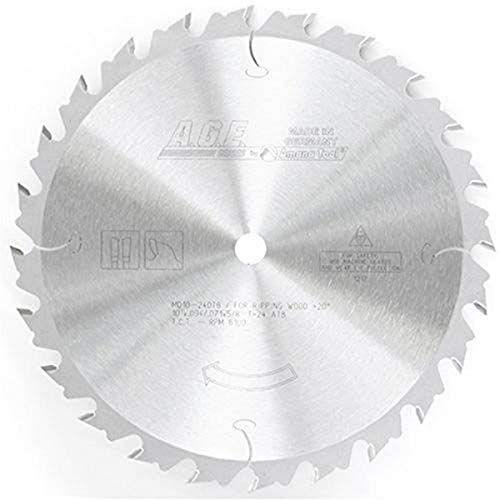
Amana Tool Thin Kerf Ripping Saw Blade
What We Like
- Thin kerf design reduces material waste
- Carbide-tipped teeth for durability
- 24-tooth ATB grind for aggressive ripping
- 5/8-inch bore fits most table saws
Trade-offs
- No plate thickness specified for rigidity check
- ATB grind may not produce a perfectly flat bottom cut
- Lower tooth count limits finish quality on crosscuts
This Amana Tool blade is a thin kerf design with a 24-tooth ATB grind and a 5/8-inch bore. The thin kerf means a narrower cut, while the 24-tooth ATB configuration is a pattern commonly used for ripping. The 5/8-inch arbor hole is a standard size for many table saws.
An Alternate Top Bevel grind like this one differs from the TCG grind used on a dedicated glue line ripping blade, such as the Amana Tool Carbide Tipped Glue Line Ripping Blade listed. The product is described by the brand as a ripping blade, which indicates its intended primary use.
Product photos
Ridge Carbide Tool Co. TS21030GL-5 10'' Table Saw Blade
What We Like
- TCG grind optimized for hard materials
- +20° hook angle for aggressive feed
- Designed specifically for glue-line ripping
- Full kerf plate for stability in hardwoods
Trade-offs
- Not recommended for crosscutting natural wood
- 0.145" kerf removes more material than thin-kerf blades
The Triple Chip Grind is the key here, a configuration designed for harder materials like manmade laminates and hardwood. This specific grind, paired with a +20° hook, is engineered to shear through dense stock cleanly, leaving a glue-ready surface. Its design focuses capability squarely on demanding ripping tasks where a splinter-free cut is the priority over versatility.
That focus means a trade-off. While it excels at ripping hard materials, the manufacturer explicitly states it’s not for crosscutting wood, limiting it to a dedicated role on the saw. You’ll want a powerful table saw to drive its full 0.145″ kerf through thick stock, but for the right job, it delivers a cut that needs minimal cleanup.
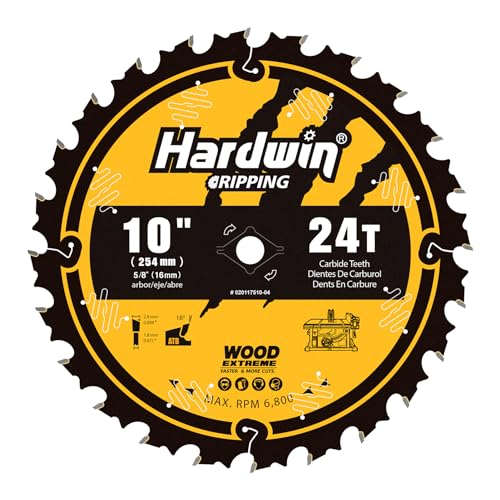
HARDWIN Thin Kerf Carbide Table Saw Blade
What We Like
- Thin kerf design reduces resistance and saves material.
- Carbide teeth offer exceptional hardness and impact resistance.
- Universal compatibility fits major table saw and miter saw brands.
- Suitable for multi-material cutting, including hardwood and plywood.
Trade-offs
- Rough ripping focus means it is not optimized for fine finish cuts.
With its 0.094-inch thin kerf design, this blade reduces cutting resistance and motor strain, allowing a standard 10-inch saw to power through hardwoods with less effort and material waste. For the budget-conscious woodworker, it serves as a reliable, general-purpose ripper that handles the grunt work on everything from oak to plywood, though projects demanding a polished glue-line edge may require a more specialized tool.
The primary trade-off involves specialization. This 24-tooth blade is marketed for consistent rough ripping or fine finishing, delivering speed across multiple materials. For comparison, the Ridge Carbide TS21030GL-5 is a full kerf blade with 30 teeth and a TCG grind, a configuration often associated with glue-line joint preparation. The HARDWIN blade acts as an economical workhorse for quick dimensioning before a final pass with a finer tool.
Product photos
Diablo Combination Saw Blade

What We Like
- TiCo carbide for sharp, durable cutting edge
- Perma-SHIELD non-stick coating resists heat and gumming
- Super thin laser cut kerf for fast, clean cuts
- Tri-metal shock resistant brazing for impact durability
Trade-offs
- A 50-tooth blade is slower for pure ripping than a 24-tooth ripper.
- Not a dedicated ripping blade like the CMT 24-tooth model.
A 50-tooth combination blade is designed to handle both rip cuts and crosscuts in various wood materials. This makes it an excellent choice for the woodworker who needs a single blade on the saw for general shop work, avoiding frequent blade changes. The hardened steel body and Tri-Metal Shock Resistant brazing promise longevity, so you can expect it to hold up to daily use. It’s a sensible pick if your projects mix ripping boards with cutting plywood or making crosscuts.
This blade is a combination tool, designed to handle both rip cuts and crosscuts in various wood materials, which means you don’t need to swap blades for different tasks during a project. While it performs both functions, a dedicated ripping blade like the CMT ORANGE TOOLS 250.024.10, with its 24 teeth, is built specifically for that single purpose. The Diablo’s versatility makes it a strong choice for general remodeling and demolition work where you need to switch between cutting types frequently.
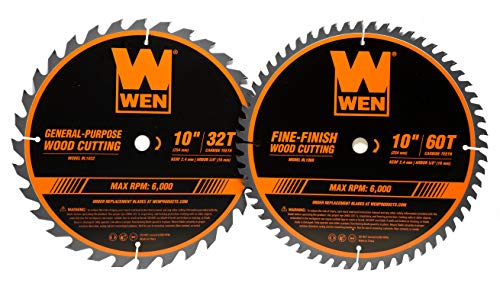
WEN Carbide-Tipped Woodworking Saw Blade Set
What We Like
- Ultra-thin kerf reduces waste and motor strain
- Rated for hardwoods and softwoods
- Fits most common 10-inch table saws
Trade-offs
- Set includes a finish blade not optimized for ripping
This set gives you two blades for the price of one, offering a 32-tooth blade for general ripping and a 60-tooth blade for clean crosscuts. That versatility is a huge advantage for a woodworker just setting up shop, as it covers more tasks with a single purchase. The ultra-thin kerf makes efficient cuts and is easier on a lower-powered saw motor, which is common in starter setups. It’s a practical choice for someone who needs to rip hardwood but also wants a ready solution for finer work without swapping in a dedicated finishing blade later.
The trade-off is specialization. For marathon ripping sessions in oak or maple, a dedicated ripper will stay sharper longer and produce a straighter glue-line edge. Think of the WEN set as your workshop’s reliable multitool, it gets you started competently on a variety of projects, but you’ll appreciate a specialized ripping blade once your volume and precision demands increase.
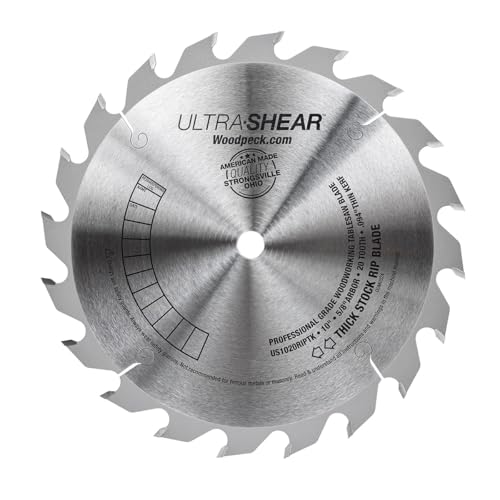
Ultra-Shear Thick Stock Rip Blade
What We Like
- Optimized tooth geometry for thick stock.
- 3/32" thin kerf reduces motor strain.
- Precision-machined American steel plate.
- Deep gullets for efficient waste removal.
Trade-offs
- 20-tooth design yields a rougher cut surface.
- Not a glue-line blade for joint-ready edges.
Built for ripping thick stock, the Ultra-Shear blade uses a 3/32″ thin kerf design to reduce strain on lower-powered saw motors. Its 20-tooth geometry and deep curved gullets are optimized for efficient waste removal, allowing for aggressive feed rates. This makes it a specialist tool for quickly breaking down dense material rather than creating finished edges.
You trade a smooth finish for pure rip speed. The cut will often need a pass with a jointer or planer for a clean glue-up. When the project calls for resawing or breaking down thick, stubborn lumber, this blade’s focused design gets the work done.
Product photos
How We Evaluated 10-Inch Table Saw Blades for Ripping Hardwood
Our evaluation is based on research into manufacturer specifications, expert round-up comparisons, and patterns in owner feedback. We prioritized tooth design and count for efficient material removal, kerf thickness relative to saw power, and plate construction for stability during the cut. We also considered specialized features like sound-dampening slots or coatings that affect performance. A research-led evaluation cannot replicate long-term durability testing in a workshop, so we focused on design intent and consistent owner-reported outcomes.
What To Look For In 10-Inch Table Saw Blades for Ripping Hardwood
Selecting the right blade means matching its design to your saw’s power and your need for speed versus finish quality. A dedicated ripping blade will transform your table saw’s performance in hardwoods.
Look for a low tooth count (20-30 teeth), an aggressive hook angle, and a kerf width suited to your saw’s horsepower. A full kerf blade (approx. 0.125″) offers maximum stability for powerful saws, while a thin kerf blade (approx. 0.102″) reduces strain on lower-powered motors.
Tooth Design and Count
Ripping blades have fewer, larger teeth than crosscut blades. A tooth count between 20 and 30 is typical, designed to chisel out material quickly along the wood grain. The tooth grind is crucial: a Flat Top Grind (FTG) is most aggressive for pure ripping, while an Alternate Top Bevel (ATB) offers a slightly cleaner cut. For the cleanest, joint-ready edges directly from the saw, look for blades with a specialized Triple Chip Grind (TCG) or a dedicated glue-line design.
Kerf Thickness and Saw Power
The kerf is the width of the cut the blade makes. A full kerf, typically 0.125 inches, provides a rigid blade plate that resists deflection, but it demands more from your saw’s motor. For powerful cabinet saws, this is ideal. A thin kerf, often around 0.102 inches, removes less material, creating less drag and strain. This makes it the better choice for contractor or jobsite saws with lower horsepower, as it allows them to tackle thicker hardwoods more effectively.
Blade Plate and Construction
A blade’s steel plate provides the foundation for a straight cut. Thicker plates, common on full-kerf blades, resist bending and vibration for more consistent results. Laser-cut expansion slots help manage heat, while polymer-filled slots can dampen noise. The method of attaching carbide teeth, like tri-metal brazing, impacts long-term durability and resistance to losing a tooth during heavy use. These construction details separate a blade built for the long haul from one meant for occasional projects.
- Check your saw’s arbor size (commonly 5/8″) for compatibility.
- Ensure the blade’s maximum RPM rating exceeds your saw’s no-load speed.
- Verify the riving knife or splitter thickness matches your blade’s kerf.
Match the blade’s kerf to your saw’s power: thin kerf for lower-horsepower saws, full kerf for high-torque cabinet saws.
10-Inch Table Saw Blades for Ripping Hardwood Compared
The following table compares key specifications across all ten blades to help you see the differences at a glance.
| Product | Tooth Count | Kerf Width | Hook Angle |
|---|---|---|---|
| CMT Orange Tools Heavy-Duty Glue Line Ripping Blade | N/A | 0.126 inches | 12 degrees |
| CMT ORANGE TOOLS 250.024.10 10'' Table Saw Blade | 24 teeth | 0.102 inches | 10° |
| Ridge Carbide Tool Co. TS21024-5 10'' Table Saw Blade | 24 teeth | 0.125" | +20° |
| Amana Tool Carbide Tipped Glue Line Ripping Blade | 30 teeth | N/A | 22 degree |
| Amana Tool Thin Kerf Ripping Saw Blade | 24 teeth | Thin Kerf | N/A |
| Ridge Carbide Tool Co. TS21030GL-5 10'' Table Saw Blade | 30 teeth | 0.145" | +20° |
| HARDWIN Thin Kerf Carbide Table Saw Blade | 24 teeth | 0.094 inches | N/A |
| Diablo Combination Saw Blade | 50 teeth | .098" | N/A |
| WEN Carbide-Tipped Woodworking Saw Blade Set | 32-tooth and 60-tooth | 1/10-inch | N/A |
| Ultra-Shear Thick Stock Rip Blade | 20 Teeth | 3/32" | N/A |
Frequently Asked Questions
What type of blade is best for ripping wood on a table saw?
A dedicated ripping blade is best. It features a low tooth count (typically 20-30), an aggressive hook angle to pull the wood through, and a tooth grind like FTG or ATB optimized for cutting with the grain. These design choices prioritize fast material removal and efficient chip clearing over a polished cross-grain finish.
What is a good 10-inch ripping blade for a table saw?
Our best overall pick, the CMT Orange Tools Heavy-Duty Glue Line Ripping Blade, is an excellent choice for powerful saws, offering stability and a clean cut. For saws with less power, the CMT ORANGE TOOLS 250.024.10 is a top thin-kerf option that reduces motor strain while still ripping efficiently.
How many teeth for ripping hardwood?
For ripping hardwood, look for a blade with between 20 and 30 teeth. This lower count allows for larger, more aggressive teeth that remove material quickly and prevent burning or bogging down in dense wood. Higher tooth counts are for crosscutting or combination work and will cut more slowly when ripping.
What is the best 10-inch saw blade for hardwood?
The “best” depends on your primary task. For dedicated ripping, our top picks are specialized for that job. For general shop work that includes both ripping and crosscutting hardwood, a high-quality combination blade like the Diablo Combination Saw Blade offers a versatile balance.
Can I use a thin kerf blade on any table saw?
You can physically mount one, but you must check compatibility with your saw’s riving knife or splitter. A thin kerf blade is often narrower than a standard splitter, which can be a safety issue. Many woodworkers successfully use them on lower-powered saws, but always ensure your safety equipment is correctly matched to the blade’s kerf.
The Bottom Line
For woodworkers with a sufficiently powerful saw who demand clean, stable rips in hardwood, the CMT Orange Tools Heavy-Duty Glue Line Ripping Blade is the top choice. If your saw struggles with a full-kerf blade, immediately consider the CMT ORANGE TOOLS 250.024.10 for its efficient thin-kerf design.
For those needing a ready-to-glue edge without further planing, the Amana Tool Carbide Tipped Glue Line Ripping Blade is the specialist to seek out. Ultimately, matching the blade’s kerf and tooth design to your saw’s capability is the most critical factor for successful and safe hardwood ripping.
