
10 Best Thin Kerf Table Saw Blades in 2026
This post contains affiliate links. As an Amazon Associate, we earn from qualifying purchases.
For the woodworker who wants one reliable blade for most tasks, the Diablo Combination Thin Kerf Saw Blade is our best overall pick for its sharp carbide teeth and durable construction. For dedicated crosscuts, the Freud Fine Finish Crosscut Blade excels, and budget-minded DIYers should look at the Freud P1060X.
A thin kerf blade reduces waste and motor strain, but picking the right one for your specific work is key. This guide was built by researching specifications, manufacturer data, and patterns in expert and owner feedback to help you make a confident choice.
Top 10 Thin Kerf Table Saw Blades in the Market
Certain content that appears on this site comes from Amazon. This content is provided "as is" and is subject to change or removal at any time.
The Best Thin Kerf Table Saw Blades, Reviewed
Diablo Combination Thin Kerf Saw Blade

What We Like
- TiCo carbide teeth for sharp, durable edges.
- Perma-SHIELD coating resists heat and corrosion.
- Tri-metal shock resistant brazing for impact durability.
Trade-offs
- General-purpose 50-tooth design is not specialized for ultra-fine finishes.
That thin cut, paired with 50 TiCo carbide teeth, makes this a true do-everything blade for the workshop. It handles rips and crosscuts in common materials without bogging down, and the Perma-SHIELD coating fights the gunk that dulls blades. This is the blade you leave on your saw when you need to switch between tasks quickly and cleanly.
The trade-off for that versatility is in specialization. For silky-smooth crosscuts on expensive oak, you’d want a dedicated fine-finish blade like the Freud LU88R010 with its higher tooth count. The Diablo’s lighter body can also be a double-edged sword; it reduces friction but lacks the sheer mass of some blades, which can matter during demanding, continuous ripping. It’s a brilliant generalist that covers 90% of shop work, understanding that last 10% belongs to a specialist.
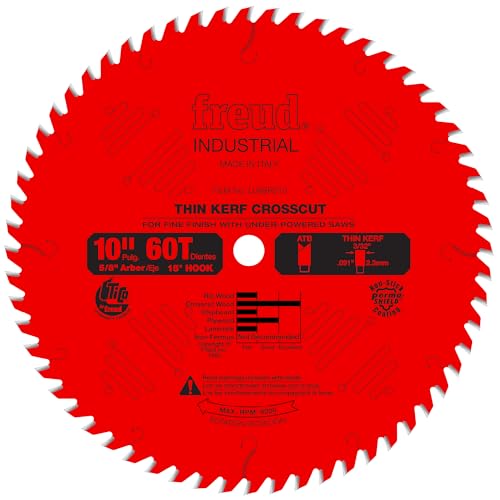
Freud Thin Kerf Fine Finish Crosscut Blade
What We Like
- 60-tooth ATB grind with 15° hook angle for smooth crosscuts
- Perma-Shield coating reduces drag and protects from corrosion
- Premium carbide blend promises extended edge life
Trade-offs
- At 1.7 lb, it is heavier than the 1.0 lb Diablo combination blade
The 15° positive hook angle pulls the material through cleanly without tear-out, which is exactly what you need for finish work on cabinets or furniture. This blade suits a woodworker who prioritizes a ready-to-finish surface straight off the saw, saving time on sanding. Its design is focused on precision over brute force.
That focus means it’s not your all-day ripper. For a dedicated crosscut blade in this guide, it faces competition from options like the WEN 80-tooth blade. Choose the Freud when your typical project involves dimensioning hardwoods for joinery where the cut quality is non-negotiable.
Product photos
DEWALT Thin Kerf General Purpose Saw Blade

What We Like
- Thin kerf for fast, smooth cuts
- Computer-balanced plate reduces vibration
- Wedge shoulder design increases durability
Trade-offs
- 24-tooth count is coarse for fine finish work
With its thin kerf design, the DEWALT DW3112 blade reduces friction for a smoother cutting action. A computer-balanced plate minimizes vibration, which improves accuracy and finish quality during operation. The Wedge shoulder design adds steel behind each tip to increase durability and maintain cut precision.
The 24-tooth configuration is coarser than blades like the 50-tooth Diablo Combination or 90-tooth FOXBC Ultimate Polished Finish blade. This tooth count is typical for general purpose cutting rather than creating a polished surface. Reviewers report that such a blade leaves a surface requiring sanding for a fine finish.
Product photos
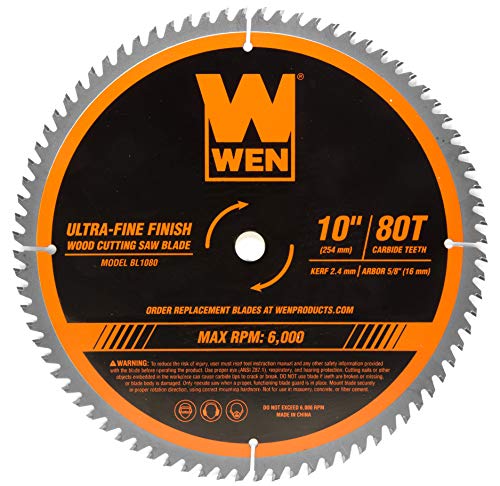
WEN Ultra-Fine Finish Thin Kerf Saw Blade
What We Like
- 80-tooth design for ultra-fine finish cuts
- Ultra-thin kerf for efficient material use
- Carbide-tipped teeth for durability
- Compatible with most 10-inch miter and table saws
Trade-offs
- 80 teeth cut slower in thick hardwoods than a ripping blade
- Fine finish blade is not optimized for fast, rough cuts
With 80 carbide-tipped teeth, the WEN BL1080 is designed for ultra-fine finish wood cutting. This high tooth count is built for leaving a polished, ready-to-finish surface on crosscuts and miters in both hard and softwoods. Its ultra-thin 1/10-inch kerf provides clean and efficient cuts, which can waste less of your expensive hardwood.
A blade with this many teeth will move through stock more deliberately than a lower-tooth-count option like a general-purpose or ripping blade. The trade-off for a fine finish is cutting speed, especially in dense material. For a different approach to polished cuts, the other-products list includes a 90-tooth Forrest Chopmaster blade and an 80-tooth FOXBC Ultimate Polished Finish Blade.
Product photos
Diablo Fine Finish Thin Kerf Blade 2-Pack

What We Like
- Hi-ATB geometry for ultra-smooth finish
- Perma-SHIELD coating resists heat and gumming
- Shock-resistant brazing for demanding jobs
- Thin kerf design reduces waste and strain
Trade-offs
- Fine finish tooth geometry is not optimized for heavy ripping
- Pack includes two identical blades, limiting task versatility
A .098-inch thin kerf means your saw motor works less and you waste less wood on every cut, which is a serious advantage for any workshop running a standard contractor saw. The 60-tooth Hi-ATB design is built for clean crosscuts and fine plywood, minimizing tear-out so your pieces come off the table ready for glue-up. This two-pack delivers that capable performance in duplicate, making it a logical choice for the woodworker who burns through blades on long projects or simply wants a fresh spare ready to mount.
This two-pack delivers ultra-smooth finishes for wood, minimizing blowout and reducing sanding. The blades are specialized for fine woodworking, so tasks like ripping thick hardwoods would be better suited to a dedicated ripper like the HARDWIN 24T. You get two blades built for consistent, clean-cutting performance instead of pushing a single blade to its limits.
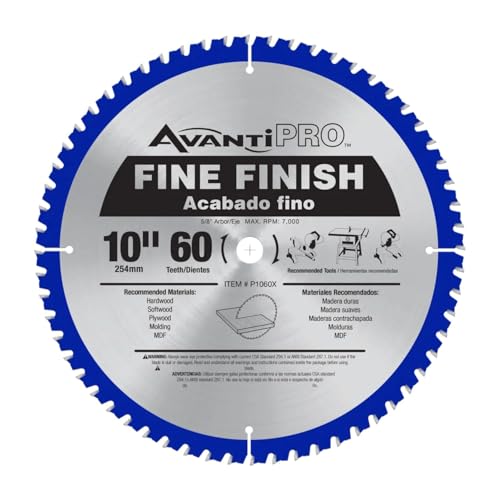
Freud P1060X Thin Kerf Table Saw Blade
What We Like
- Thin kerf design reduces friction and material waste.
- Friction-reducing coating aids smooth, efficient operation.
- Versatile for hardwood, plywood, MDF, and laminates.
Trade-offs
- Fine-finish focus less suited for heavy ripping tasks.
A thin kerf and 60-tooth carbide design mean this blade pulls less on your saw motor and leaves a clean, splinter-minimized edge on crosscuts and sheet goods. It’s a solid choice for the cost-conscious woodworker who needs a single blade to handle a variety of fine-finish tasks in hardwood, plywood, and laminates without breaking the bank. The friction-reducing coating is a thoughtful touch that helps keep cuts smooth.
The trade-off for its budget-friendly position is in heft and specialization. It’s notably lighter than the Freud Thin Kerf Fine Finish Crosscut Blade, which suggests a difference in core steel and vibration dampening. For dedicated pros running material all day, that premium blade’s extra mass might be worth the investment. But for weekend projects and general shop work, this Freud delivers capable performance where it counts.
Product photos
FOXBC Thin Kerf Fine Finish Crosscut Blade

What We Like
- Thin 0.087-inch kerf for efficient material use
- 60-tooth ATB design for fine finish crosscuts
- High-density carbide for toughness and long life
- Compatible with many major 10-inch saw brands
Trade-offs
- Fine finish crosscut focus limits heavy ripping utility
A 0.087-inch kerf removes less wood than a standard blade, which means less strain on your saw’s motor and less wasted material on every cut. That’s the core appeal of the FOXBC blade. It’s built for the woodworker who needs clean, splinter-free crosscuts in materials like oak, pine, and plywood. The 60-tooth ATB grind and carbide construction are aimed at delivering a smooth finish right off the saw, making it a solid fit for detailed trim work and cabinetry where sanding time matters.
The FOXBC blade is designed specifically for crosscutting, with a 60-tooth ATB grind that creates a smooth surface on materials like oak, pine, and plywood. Its 0.087-inch thin kerf reduces waste and demands less power from your saw, which can mean less strain on the motor during cuts. This focus makes it a dedicated tool for fine finish work, not a general-purpose blade for tasks like heavy ripping.
Product photos
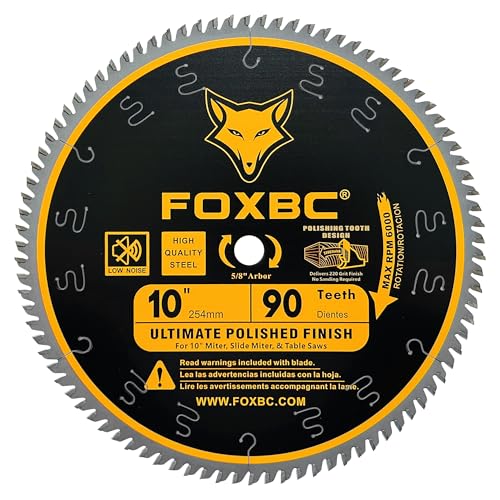
FOXBC 90T Ultimate Polished Finish Blade
What We Like
- Ultra-thin 0.087-inch kerf for reduced waste
- ASFG design shears cleanly for superior finish
- Double Side Grind equals 220-grit sandpaper finish
- Proprietary carbide is wear-resistant for long life
Trade-offs
- 90-tooth design is slower for heavy ripping than a 24T blade
The 0.087-inch kerf is the star here, letting your saw motor work easier and wasting less of your expensive hardwood. Combine that with the Double Side Grind geometry, which FOXBC claims delivers a finish as smooth as 220-grit sandpaper straight from the cut, and you have a blade built for final passes. This is the one you reach for when you’re cutting fine moldings, veneered plywood, or melamine and you want to minimize sanding time. It’s a specialist for the woodworker who values a flawless surface above all else.
That focus on a polished finish comes with a trade-off. The high tooth count and fine-cutting geometry aren’t meant for hogging through thick stock. For fast, rough dimensioning, you’d want a dedicated ripping blade like the HARDWIN 24T. Compared to another fine-finish option like the WEN 80T blade, the FOXBC offers a slightly thinner kerf and a specific claim about its finish quality, but both serve a similar niche. If your projects demand the absolute smoothest possible cut with minimal tear-out, this blade’s specifications are engineered precisely for that task.
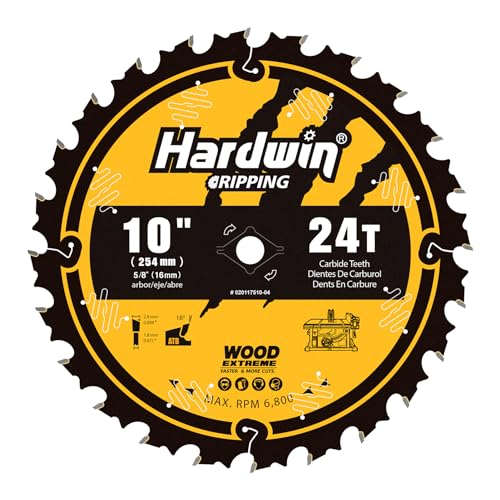
HARDWIN 24T Thin Kerf Ripping Blade
What We Like
- Thin 0.094-inch kerf reduces waste and motor strain
- Durable tungsten carbide teeth for long blade life
- Universal 5/8-inch arbor fits major saw brands
- Stable high-speed operation rated for 6800 RPM
Trade-offs
- 24-tooth design is too aggressive for fine crosscuts
Designed specifically for fast ripping, the HARDWIN 24T blade uses a 0.094-inch thin kerf and 24 teeth. This thin kerf design reduces resistance so the blade cuts faster and more accurately while saving material. It’s ideal for handling hardwood, softwood, plywood, and composites when the goal is consistent rough ripping or breaking down stock.
With only 24 teeth, this blade is built for ripping, not fine finishing. That aggressive tooth count leaves a rougher surface, so edges straight from the saw will need further work. For dedicated ripping tasks, it’s a straightforward tool that excels in its lane.
Product photos
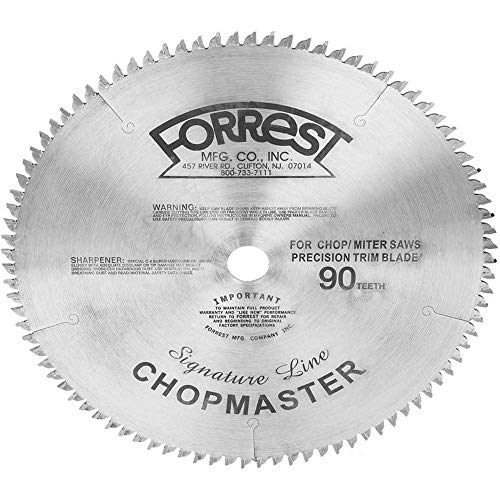
Forrest Chopmaster Signature Line Blade
What We Like
- 90-tooth design for quiet, splinter-free cuts
- Double-hard C-4 carbide for long life
- Heavy steel plate for maximum stability
- Proprietary tooth geometry for delicate molding
Trade-offs
- 30mm arbor requires an adapter for most 5/8-inch saws
- Primarily for crosscuts and molding, not ripping
The 90-tooth configuration and proprietary flat-tooth design make this blade a specialist for pristine crosscuts in finished materials. That hi-tech tooth pattern is engineered to leave virtually no tear-out, so it excels on delicate prefinished crown or picture frame molding where every cut shows. It’s built for the woodworker who demands a polished, ready-to-assemble edge straight off the saw, prioritizing flawless finish over raw cutting speed. The heavier steel plate isn’t for nothing, it dampens vibration to keep that ultra-fine cut consistent.
This blade’s 7/64-inch kerf saves material compared to full-kerf designs, though it is not the thinnest available. You pay for its precision in flexibility, as the 30mm arbor is a European standard and typically requires a reducing bushing for North American saws. It functions as a dedicated finisher, not a general-purpose blade, so tasks like rough dimensioning or ripping thick stock demand a different tool.
How We Evaluated Thin Kerf Table Saw Blades
Our research focused on specifications from manufacturers, expert tool round-ups, and consistent patterns in owner reviews. We prioritized criteria that directly impact thin kerf performance: tooth geometry for different cut types, the physical kerf width for material efficiency, and blade construction for durability under reduced power strain.
We also considered the importance of a proper blade comparison for your saw’s power, such as thin kerf vs full kerf. A research-based evaluation like this cannot replicate hands-on feel, but it effectively identifies the top options for a given task based on their verified features and reliable user experiences.
What To Look For In Thin Kerf Table Saw Blades
Choosing the right thin kerf blade means balancing cut quality, material savings, and your saw’s capability. It’s about matching the blade’s specialty to your most common tasks.
Focus on tooth count and geometry for your primary cut type, confirm the kerf width fits your saw’s riving knife, and look for durable carbide and coatings to handle the reduced power load.
Tooth Count and Geometry
This is the primary determinant of a blade’s purpose. A blade with 24 teeth, like a dedicated ripper, has deep gullets to clear chips for fast, aggressive cuts along the wood grain. For clean crosscuts across the grain, a blade with 60 or more Alternate Top Bevel (ATB) teeth shears the wood fibers cleanly. A 40 or 50-tooth combination blade uses a hybrid geometry for acceptable performance in both ripping and crosscutting, making it a solid all-rounder, though not a specialist for fine woodworking or heavy ripping.
Kerf Width and Saw Compatibility
The kerf is the width of the slot the blade cuts. A standard ‘full kerf’ is about 1/8 inch (3.2mm). A ‘thin kerf’ is typically narrower, with some options described as ultra-thin.
This narrower cut removes less material, reducing waste and requiring less motor power, which is ideal for lower-horsepower benchtop saws. Crucially, you must ensure a thin kerf blade is compatible with your saw’s riving knife or splitter, as a kerf that’s too narrow for a thick splitter can cause dangerous binding.
Blade Construction and Coatings
A thin plate requires strong construction to prevent deflection and vibration. Look for features like copper brazing or reinforced shoulders that strengthen the tooth bond. High-density carbide teeth stay sharper longer, which is important because a thin kerf blade works harder per tooth than a full kerf blade. Friction-reducing coatings, such as Perma-SHIELD or similar, are especially beneficial for thin kerf blades. They reduce heat buildup and pitch accumulation, which promotes smoother cuts and longer blade life, particularly when cutting plywood or resinous woods.
- Check your saw’s arbor size (usually 5/8-inch for a 10-inch blade) and maximum RPM rating.
- Verify the blade’s stated kerf width against your riving knife thickness for safety. Consider specialized blades for dedicated tasks, like a fine-finish crosscut blade or a dedicated blade for ripping hardwood.
In general, a 40 to 50-tooth combination blade is the most versatile single blade for a workshop, but serious woodworkers benefit from owning specialized blades.
Thin Kerf Table Saw Blades Compared
The table below highlights the key specifications to help you compare our picks at a glance.
| Product | Diameter | Tooth Count | Arbor Size | Kerf Width |
|---|---|---|---|---|
| Diablo Combination Thin Kerf Saw Blade | 10 inches | 50 teeth | 5/8 inches | .098" |
| Freud Thin Kerf Fine Finish Crosscut Blade | 10 inches | 60 ATB | 5/8" | .090" |
| DEWALT Thin Kerf General Purpose Saw Blade | 10 inches | 24-Tooth | 5/8 inches | Thin kerf |
| WEN Ultra-Fine Finish Thin Kerf Saw Blade | 10 inches | 80 carbide-tipped | 5/8 inch | 1/10 inch (2.4 mm) |
| Diablo Fine Finish Thin Kerf Blade 2-Pack | 10" | 60 Hi-ATB | N/A | .098" |
| Freud P1060X Thin Kerf Table Saw Blade | 10 inches | 60 carbide-tipped | N/A | Thin kerf |
| FOXBC Thin Kerf Fine Finish Crosscut Blade | 10" | 60 ATB | 5/8" | 0.087" |
| FOXBC 90T Ultimate Polished Finish Blade | 10 inches | 90 teeth | 5/8 inch | 0.087 inches |
| HARDWIN 24T Thin Kerf Ripping Blade | N/A | 24 Teeth | 5/8 inch | 0.094 inches |
| Forrest Chopmaster Signature Line Blade | 260mm | 90 teeth | 30mm | 7/64 inch |
Frequently Asked Questions
What is the best thin kerf table saw blade?
The “best” blade depends entirely on your primary task. For a great all-around blade that handles ripping, crosscutting, and sheet goods well, the Diablo Combination Thin Kerf is our top pick. For dedicated, splinter-free crosscuts, choose the Freud Fine Finish Crosscut Blade, and for maximum material savings on fine work, consider an ultra-thin option like the FOXBC 90T.
What is the typical kerf of a table saw blade?
A standard full-kerf blade cuts a slot about 1/8 inch (3.2mm) wide. A thin kerf blade is significantly narrower, with widths commonly ranging down to 0.087 inches or even less for specialty blades. This reduced width is the core feature that saves material and eases the load on your saw’s motor.
What is the best table saw blade for fine cuts?
For the finest finish straight off the saw, you want a blade with a high tooth count, like 80 or more. You also want a specialized tooth geometry like an Alternate Top Bevel (ATB) or a Triple Chip Grind (TCG). Blades like the WEN Ultra-Finish or the Forrest Chopmaster are designed for this, leaving a surface that requires minimal sanding. Our comprehensive table saw blade guide covers more options for polished results.
What is considered a thin kerf blade?
A thin kerf blade is broadly defined as any blade with a cutting width significantly less than the standard 1/8 inch. In practical terms, for a 10-inch blade, a kerf narrower than the standard is commonly marketed as thin kerf. The specific measurement should always be listed in the blade’s specifications.
Can I use a thin kerf blade on any table saw?
You can use a thin kerf blade on most table saws, but you must check two things for safety and performance. First, ensure the blade’s arbor hole matches your saw’s arbor size. Second, and most critically, verify that the blade’s kerf is not narrower than your saw’s riving knife or splitter, as this can cause pinching and dangerous kickback.
The Bottom Line
For most woodworkers who need one blade to handle a variety of tasks efficiently, the Diablo Combination Thin Kerf Saw Blade is the best overall choice. It offers a great balance of durability and performance for ripping, crosscutting, and remodeling. If your budget is tight, the Freud P1060X provides excellent value for clean crosscuts. Those doing volume ripping should consider the dedicated HARDWIN 24T Ripping Blade.
Ultimately, the single most important factor is matching the blade’s tooth design to your most common cuts, don’t buy a fine-finish blade for heavy ripping, or vice versa. Specializing pays off in cut quality and efficiency.
