
10 Best 7 1 4 Circular Saw Blades in 2026
This post contains affiliate links. As an Amazon Associate, we earn from qualifying purchases.
The DEWALT DWA271424 is our best overall 7 1/4 inch circular saw blade, thanks to its durable design that promises longer life and smooth cuts in challenging materials. For a high-volume pack, the Diablo 10-Pack is the Best Value Pack. For flawless crosscuts, the Freud Diablo Finish blade is our top pick.
Choosing the wrong blade for the job wastes material, strains your saw, and delivers poor results. This guide helps you match blade specifications to your specific tasks, whether that’s fast framing, smooth finish work, or cutting metal. Our picks are based on manufacturer specifications, expert analysis, and patterns in user feedback to identify the blades that perform as promised for their intended use.
Top 10 7 1/4 Inch Circular Saw Blades in the Market
Certain content that appears on this site comes from Amazon. This content is provided "as is" and is subject to change or removal at any time.
The Best 7 1/4 Inch Circular Saw Blades, Reviewed
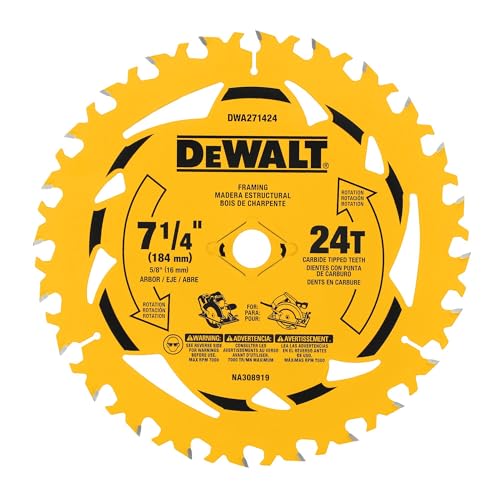
DEWALT DWA271424 7-1/4 Inch Circular Saw Blade
What We Like
- Thick plate promises up to 2X the life.
- PTFE coating minimizes friction for smooth cuts.
- Heat-vent design reduces binding and workpiece burning.
- Optimized tooth geometry handles wet or challenging materials.
Trade-offs
- At 24 teeth, it's not ideal for fine finish cuts.
Engineered to last up to twice as long as some other blades under ideal conditions, this DEWALT blade is built for contractors or serious DIYers who prioritize durability in general construction. Its thick plate and state-of-the-art engineering allow it to cut through tough applications like framing lumber and plywood without wearing out prematurely. A proprietary heat-vent design and PTFE coating work together to limit binding, warping, and friction, which helps prevent the saw from bogging down or scorching the workpiece.
Optimized tooth geometry allows it to work in challenging or wet materials, delivering crisp, clean cuts suitable for tasks like rough framing, deck building, or breaking down sheet goods. While its 24-tooth design is effective for these applications, it is not a dedicated finish blade. For users whose primary need is a durable blade for demanding cuts, this model provides reliable performance.
Product photos
Diablo 7-1/4 Inch Framing Saw Blade 10-Pack

What We Like
- Tracking Point design for straighter cuts
- Anti-vibration vents for smoother operation
- Non-stick coating resists heat and gumming
- Ultra-efficient for cordless saw battery life
Trade-offs
- 24-tooth design is too aggressive for fine finish work
- Pack of 10 is bulkier to store than single blades
A 10-pack of blades is the single most decisive feature here, transforming a consumable into a long-term investment. This Diablo set is engineered for the repetitive, demanding cuts of framing and pressure-treated lumber, with a thin kerf and anti-stick coating that power through material without bogging down your saw. It’s the logical choice for contractors or serious DIYers who burn through blades on jobsites and want to eliminate downtime for blade changes. The optimized design for cordless tools means you’ll squeeze more cuts from each battery charge, a real advantage when the outlet is far away.
Diablo designed this 24-tooth blade specifically for framing, plywood, and pressure-treated lumber, so it excels at fast, straight cuts in construction work. The 10-pack format provides significant convenience and a lower per-blade cost compared to single or three-pack options from other brands, which is ideal for contractors or frequent users who can utilize multiple blades. While its tooth count is optimized for rough cutting, achieving clean crosscuts on materials like plywood would require a higher-tooth-count blade such as the Freud Diablo 7-1/4 Inch Finish Saw Blade.
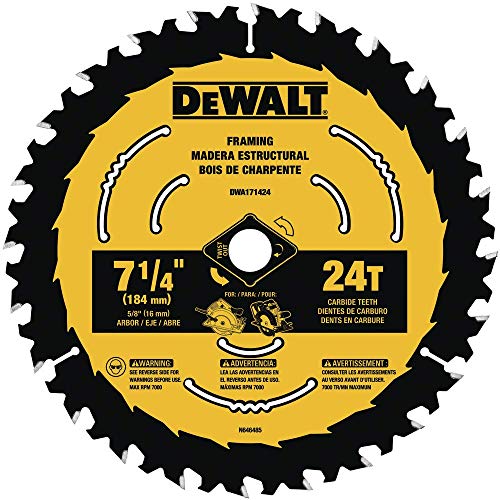
DEWALT DWA171424 7-1/4 Inch Circular Saw Blade
What We Like
- Toughtrack design promotes accurate blade tracking
- Tungsten carbide teeth for toughness and long life
- Anti-stick coating reduces friction and gumming
- Reinforced shoulder for impact resistance in nail-embedded wood
Trade-offs
- 24-tooth count limits smoothness in finish cuts
- Specific design focus may not suit fine crosscutting tasks
The patent-pending Toughtrack tooth design is the core of this blade, engineered to maintain precise alignment as it wears. That means your saw stays on the scribe line cut after cut, project after project. This is exactly what you need for framing, sheathing, and any rough carpentry where speed and line-tracking are more critical than a glass-smooth edge. The reinforced shoulder and anti-stick coating back this up for demanding site work, letting you power through occasional nails without throwing the blade off its path or bogging down.
The trade-off for that tracking and durability is in finish quality. With 24 teeth, it’s built for fast, aggressive rips and crosscuts, not for leaving a ready-to-stain surface. If your next project involves cabinets or trim, you’ll want a finer blade like the Makita B-68585. For the foundational work, however, this DEWALT blade delivers consistent, predictable performance where accuracy in the rough dimension matters most.
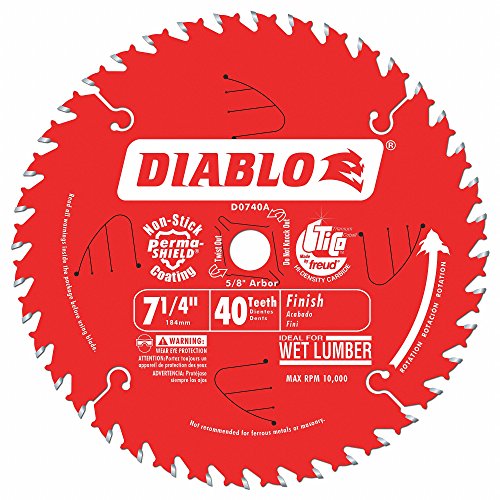
Freud Diablo 7-1/4 Inch Finish Saw Blade
What We Like
- Perma-SHIELD coating resists heat and gumming
- Super thin kerf for minimal material waste
- Tri-metal brazing withstands extreme impact
- Hardened steel body maintains a sharp edge
Trade-offs
- 40-tooth ATB grind is optimized for crosscuts, not rips
The 40-tooth ATB grind and super thin laser-cut kerf are engineered for one thing: clean, splinter-free cuts across the grain. This blade is built for the finish carpenter or serious DIYer who needs a pristine edge on trim, plywood, or fine hardwoods without needing a secondary sanding step. The Perma-SHIELD coating is the real workhorse, fighting off the pitch and heat that dull other blades during long sessions, so your last cut is as smooth as your first.
This 40-tooth ATB blade is engineered for smooth crosscuts in wood and plywood, so it excels at fine finish work rather than framing or aggressive ripping. Its hardened steel body and shock-resistant brazing contribute to long-term durability, but the design clearly prioritizes a polished cut over raw speed in demolition tasks.
Product photos
Makita B-61656-3 Max Efficiency Circular Saw Blade

What We Like
- Up to 70% more cuts per charge.
- Ultra-thin kerf reduces load on tool.
- ATAFR tooth design for smoother cuts.
- High-grade tungsten carbide for durability.
Trade-offs
- 24-tooth design creates rougher finish for fine crosscuts.
- Three-pack may be excessive for casual users.
- Framing focus limits versatility for finish work.
The ultra-thin 0.057-inch kerf reduces the load on your saw’s motor, which can lead to up to 70% more cuts per charge compared to standard blades. This efficiency is a key benefit for extended cutting tasks. Its special ATAFR carbide tooth pattern is engineered to provide smoother and faster cuts.
This is a framing blade, a category generally optimized for rapid cuts in construction lumber rather than fine finish work. The listed Makita B-68585 is a fine crosscutting blade with more teeth, representing a different design for different results. For framing applications, the design focus on speed and efficiency aims to maximize productivity.
Makita B-68585 7-1/4 Inch Fine Crosscutting Blade

What We Like
- Ultra-thin kerf reduces load on saw
- ATAFR tooth design for smoother cuts
- High-grade tungsten carbide for durability
- Engineered for faster cutting speed
Trade-offs
- 45-tooth fine crosscut design is not for rough framing
- Thin kerf may deflect in dense hardwoods without care
- Specialized design offers less versatility than a general-purpose blade
Makita’s blade uses an ultra-thin kerf that reduces the load put on your saw, so the motor works less and your cordless tool’s battery lasts longer. This design is ideal for making many clean crosscuts in sheet goods or trim without draining power. The 45-tooth ATAFR carbide tip geometry is engineered to provide smoother and faster cuts for a fine finish.
This blade prioritizes cutting speed and efficiency over brute-force durability. Compared to a dedicated framing blade like the Makita B-61656-3, it is designed for fine crosscutting rather than heavy demolition or framing work. The Makita B-68585 excels when your main goals are a clean cut and maximizing the number of cuts per battery charge.
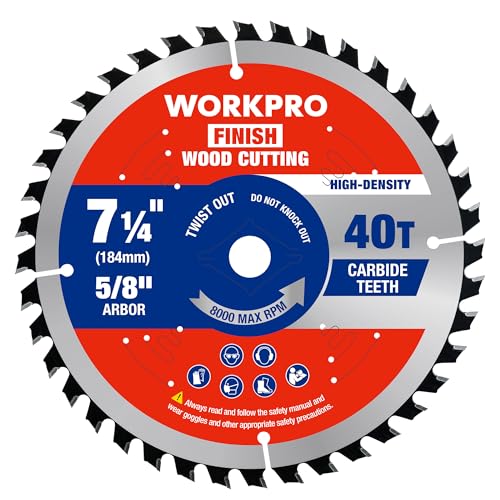
WORKPRO 7-1/4 Inch 40-Tooth Circular Saw Blade
What We Like
- Carbide-tipped teeth for long-lasting sharpness.
- Thin kerf design reduces cutting resistance.
- ATB tooth geometry for smooth, precise cuts.
- Wide compatibility with most circular saws.
Trade-offs
- The 40-tooth count is a compromise, not optimized for fast ripping.
- Thin kerf design may require more care to avoid deflection.
The 40-tooth ATB design balances cutting speed with clean edges, making it suitable for a variety of wood materials like plywood, hardwood, and softwood. This versatility means you can handle different tasks without switching blades for each one.
The trade-off is specialization. For rapid framing work, a dedicated 24-tooth blade like the DEWALT DWA271424 will power through lumber faster. Conversely, for flawless crosscuts in fine woodworking, you’d want a blade with a higher tooth count. The WORKPRO serves well in the broad center, offering dependable, multi-purpose cutting at an accessible point.
Product photos
CRAFTSMAN 7-1/4 Inch Framing Circular Saw Blade

What We Like
- Corrosion resistant coating prevents rust.
- Precision ground teeth for accurate cuts.
- Corrosion resistant coating.
Trade-offs
- At 24 teeth, it's optimized for fast ripping, not fine finish work.
- Framing focus means it's not a general-purpose wood blade.
A corrosion resistant coating helps prevent rusting, which means you can store the blade in humid conditions without immediate concern for surface degradation. Precision ground teeth are designed for smooth, accurate cuts according to the manufacturer. The product is listed as a framing and ripping saw blade, indicating its intended application.
As a 24-tooth framing and ripping blade, it is designed for specific tasks. Compared to a product like the Freud Diablo Finish Saw Blade which has 40 teeth, this blade has a lower tooth count. The corrosion protection is a feature that contributes to its maintenance profile.
Product photos
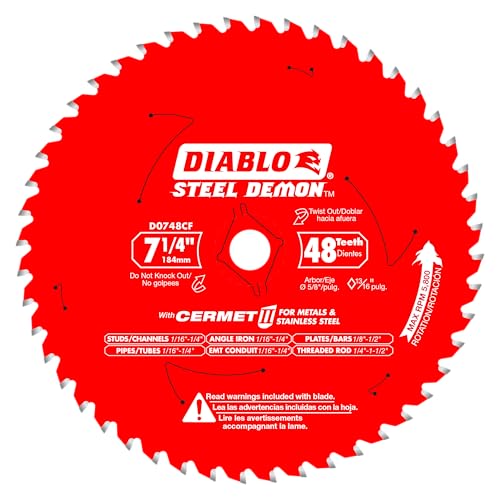
Diablo Steel Demon Cermet II Metal Cutting Blade
What We Like
- Cermet II teeth provide up to 25X longer life.
- Makes cuts up to 50X cooler than grinding discs.
- Triple Chip grind minimizes sparks for safer use.
- Stabilizer vents reduce vibration for accurate cuts.
Trade-offs
- The 48-tooth TCG grind is specialized for metal only.
- Its design prioritizes metal, not wood or demolition tasks.
A blade that cuts metal up to 10X faster than a standard grinding disc is a complete shift in productivity. The Diablo Steel Demon is built for that singular purpose, with Cermet II teeth that tolerate intense heat for dramatically longer life. It’s the clear choice for anyone regularly cutting steel or stainless, especially in regulated environments where its spark-minimizing Triple Chip grind keeps work safer and cleaner.
The trade-off is specialization. This isn’t a blade you’d swap onto your saw for framing lumber; its tooth geometry and weight are optimized for metal. For general woodcutting, a blade like the DEWALT DWA171424 is a more appropriate and efficient tool. But when your project calls for slicing through metal, this blade’s cooler, faster, and more durable performance makes it the only logical pick for the job.
Product photos
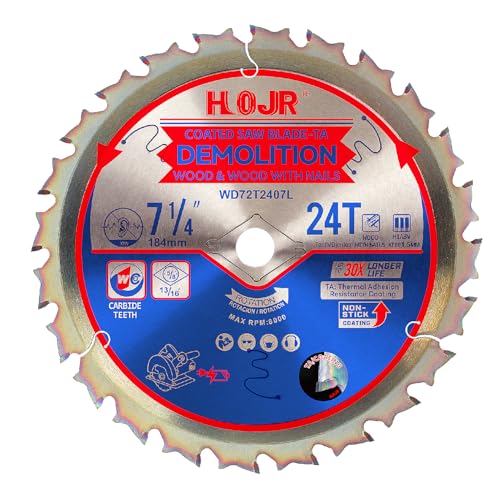
HOJR Demolition Circular Saw Blade
What We Like
- TA coating resists heat, gumming, and corrosion.
- HI-ABV tooth design handles impacts from nails.
- Laser-cut stabilizer vents reduce noise and vibration.
- Claimed 30x longer life than regular blades.
Trade-offs
- Surface printing may be inconsistent with product photos.
An anti-thermal adhesion coating on the cutting head is the key feature here, designed to shed pitch and resist the heat of aggressive cuts. This blade is built for the messy, unforgiving work of demolition and framing where hitting a nail is a question of ‘when,’ not ‘if.’ The 24-tooth HI-ABV design and laser-cut vents are engineered to power through obstructions and dampen vibration. This makes it a logical choice for tearing out old decks or cutting into reclaimed lumber where a smooth edge is the last thing on your mind.
The HOJR Demolition Circular Saw Blade is engineered for extreme framing and demolition, including wood with nails. Its 24-tooth HI-ABV design and anti-kickback feature handle impacts from embedded obstructions, so it can power through jobs where other blades might fail. The specialized TA coating on the blade tip resists heat, gumming, and corrosion, which helps keep it clean and can extend its working life.
Product photos
How We Evaluated 7 1/4 Inch Circular Saw Blades
Our evaluation started with manufacturer specifications and product documentation to understand the intended design and performance claims for each blade. We then analyzed expert tool round-ups and owner feedback patterns to see how these blades perform in real-world scenarios for tasks like framing, finish carpentry, and metal cutting.
The most important criteria were blade material and coating for durability, tooth count and geometry for cut quality, and kerf width for saw efficiency. A thick carbide-tipped blade with a non-stick coating, for example, will last longer and resist binding. Tooth count directly dictates whether a blade is for fast ripping or smooth crosscutting, while a thin kerf reduces strain on cordless saws. Since our research is based on specifications and reported experiences, we cannot provide laboratory test data on blade life or direct performance comparisons under controlled conditions.
What To Look For In 7 1/4 Inch Circular Saw Blades
The right blade turns a good saw into a precise tool. Your choice should be driven by the material you cut most and the finish you need.
Choose a blade by its tooth count and geometry: low (24T) for fast framing, medium (40T) for general work, and high (60T+) for fine finish cuts. Carbide-tipped teeth and anti-stick coatings significantly extend blade life.
Tooth Count & Geometry
Tooth count is your primary guide. A 24-tooth blade, like our best overall pick, is designed for aggressive, fast cutting in framing lumber and construction tasks. A 40-tooth blade offers a compromise, suitable for general-purpose crosscuts and rips in plywood and dimensional lumber.
For the smoothest possible finish on fine hardwoods or veneered plywood, look for blades with 60 teeth or more. The tooth grind also matters: an Alternate Top Bevel (ATB) is excellent for clean crosscuts, while a Triple Chip Grind (TCG) is tougher and used for metals and abrasive materials.
Blade Material & Coating
High-quality tungsten carbide tips are essential for long-lasting sharpness, especially when cutting pressure-treated lumber or wood with occasional nails. The steel plate itself also contributes to durability; a thicker plate resists deflection and warping. Many premium blades feature a non-stick coating, such as PTFE or Perma-SHIELD, which reduces friction, heat, and pitch buildup. This coating helps prevent the blade from binding in the cut and minimizes burning on the workpiece.
Kerf & Design Features
Kerf refers to the width of the cut the blade makes. A thin-kerf blade removes less material, which reduces strain on the saw motor and is a major benefit for maximizing battery life in cordless tools. However, a thinner blade can be more prone to deflection in very hard or dense materials.
Other design features to consider include stabilizer vents or expansion slots cut into the blade body, which reduce vibration and noise for a smoother cut and help dissipate heat to prevent warping. For a deeper understanding of how these features combine for different jobs, our guide to circular saw blade types breaks it down.
- Match the blade’s advertised purpose (framing, finish, demolition) to your most common task.
- For cordless saws, prioritize thin-kerf blades to extend runtime.
- Always check that the blade’s arbor hole size (commonly 5/8″) matches your saw.
A simple rule: dedicate one blade to rough cuts and another to fine work for the best results and longest blade life.
7 1/4 Inch Circular Saw Blades Compared
The following table compares the key specifications of our top picks to help you see the differences at a glance.
| Product | Diameter | Tooth Count | Kerf |
|---|---|---|---|
| DEWALT DWA271424 7-1/4 Inch Circular Saw Blade | 7-1/4 inches | 24 teeth | N/A |
| Diablo 7-1/4 Inch Framing Saw Blade 10-Pack | 7-1/4 inches | 24 teeth | N/A |
| DEWALT DWA171424 7-1/4 Inch Circular Saw Blade | N/A | 24 teeth | Thin kerf |
| Freud Diablo 7-1/4 Inch Finish Saw Blade | 7-1/4 inches | 40 ATB | Super Thin Laser-Cut Kerf |
| Makita B-61656-3 Max Efficiency Circular Saw Blade | 7-1/4 inches | 24 teeth | 0.057 inches |
| Makita B-68585 7-1/4 Inch Fine Crosscutting Blade | 7-1/4 inches | 45 teeth | 0. 057" |
| WORKPRO 7-1/4 Inch 40-Tooth Circular Saw Blade | 7-1/4 inch | 40 teeth | Thin kerf |
| CRAFTSMAN 7-1/4 Inch Framing Circular Saw Blade | 7-1/4 Inch | 24 Teeth | N/A |
| Diablo Steel Demon Cermet II Metal Cutting Blade | 7-1/4 inches | 48 TCG | N/A |
| HOJR Demolition Circular Saw Blade | 7-1/4 inches | 24 HI-ABV teeth | 0.059 inches |
Frequently Asked Questions
What is the best 7-1/4 inch circular saw blade?
The best blade depends entirely on your primary task. For a durable, general-purpose blade that excels in construction and framing, the DEWALT DWA271424 is our top overall choice. If your main goal is achieving glass-smooth crosscuts in fine woodworking, you should look at a dedicated finish blade like the Freud Diablo.
What is the best all-round circular saw blade?
An “all-round” blade is a compromise designed to handle both ripping and crosscutting reasonably well. These typically have a tooth count in the 40-tooth range, like the WORKPRO blade in our picks, which uses an ATB grind for smooth, precise cuts in mixed materials. For more dedicated performance, our best blades for wood guide offers specialized options.
Which brand of saw blades is considered the best?
Several brands consistently earn high marks from professionals. DEWALT and Diablo (by Freud) are renowned for their durability and performance in construction and woodworking applications. Makita also produces highly efficient blades, especially for their cordless tool ecosystem. The “best” brand often comes down to the specific use case and user preference.
Can I use a 7 1/4 inch blade to cut metal?
You should only use a blade if it is specifically designed for metal. Standard wood-cutting blades will be damaged and are unsafe for cutting metal. Our Best For Cutting Metal pick is the Diablo Steel Demon, which uses a special Cermet II tooth compound and a Triple Chip Grind to cut steel and stainless safely and with long life.
How do I choose a blade for plywood?
Cutting plywood requires a blade with a high tooth count and a sharp, fine grind to prevent tear-out on the veneer layers. A dedicated finish blade with 40 to 60 teeth and a thin kerf, like the Freud Diablo Finish blade or the Makita fine crosscutting blade, is ideal. For more details, see our recommendations for the best plywood blades.
The Bottom Line
For contractors and serious DIYers needing one reliable blade for general construction, the DEWALT DWA271424 stands out with its durable build and smooth-cutting design. If you’re on a tighter budget but still need quality for mixed projects, the WORKPRO 40-tooth blade offers excellent versatility, while high-volume framers should look at the Diablo 10-pack for its sheer value.
Your most important decision is matching the blade’s tooth count and design to your primary material. Trying to frame a deck with a fine-finish blade will be slow and frustrating, just as using a framing blade on fine furniture will ruin your work. Investing in the right blade for the job is the single most effective way to improve your saw’s performance and your results.
