
10 Best Circular Saw Blades For Wood in 2026
This post contains affiliate links. As an Amazon Associate, we earn from qualifying purchases.
The best all-around circular saw blade for wood is the Freud D0740A, which balances smooth crosscuts, efficient ripping, and clean sheet-good cuts in a single blade. We also name a standout pick for fine woodworking and an exceptional value pack for high-volume framing. Choosing the wrong tooth count or kerf can leave you with frustrating tear-out, burned edges, or a blade that just won’t last.
Our research identifies the blades that excel at specific tasks, so you can match the tool to your project. This guide is built from product specifications, expert insights, and patterns in professional user feedback.
Top 10 Circular Saw Blades For Wood in the Market
Certain content that appears on this site comes from Amazon. This content is provided "as is" and is subject to change or removal at any time.
The Best Circular Saw Blades For Wood, Reviewed
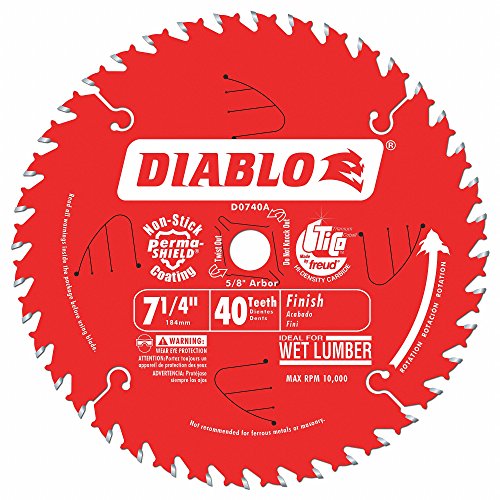
Freud D0740A Circular Saw Blade
What We Like
- TiCo carbide teeth for hardwood and plywood
- Perma-SHIELD non-stick coating reduces gumming
- Laser-cut thin kerf for less waste
- Tri-metal brazing for impact resistance
Trade-offs
- 40-tooth design is not a dedicated fine-finish blade
- General-purpose cut leaves a smooth but not ultra-fine surface
A 40-tooth ATB grind and a super thin laser-cut kerf make this a true all-rounder, delivering smooth crosscuts in hardwood, softwood, and plywood. The hardened steel body and Tri-metal brazing provide durability for both rip and crosscuts in wood and plywood, while the Perma-SHIELD coating protects against heat and corrosion to extend blade life.
Its balanced design focuses on covering a wide range of tasks, from crosscuts to ripping in wood and plywood, with a combination of cutting speed and a smooth finish. For projects demanding an extra-fine surface, blades like the Bosch 7-1/4 Inch 60-Tooth are designated for that specific purpose.
Product photos
Diablo 12 Inch 80-Tooth Ultra Finish Saw Blade

What We Like
- 80-tooth Hi-ATB geometry for minimal tear-out
- Perma-SHIELD coating resists heat and corrosion
- Super thin kerf design reduces material waste
- TiCo Hi-Density carbide for maximum durability
Trade-offs
- 1-inch arbor limits compatibility to larger saws
- Primarily for fine finish crosscuts, not for ripping or framing
An 80-tooth alternate top bevel grind is built for one thing: leaving a glassy-smooth surface on your crosscuts. That high tooth count, paired with the super thin kerf, means this blade slices through hardwoods and softwoods with a finesse that nearly eliminates sanding. It’s the clear choice for a woodworker whose final passes on a table saw or miter saw demand a flawless finish. The Perma-SHIELD coating is a practical touch, fighting the pitch and heat that can ruin a blade’s temper during long sessions.
Weighing 2.5 pounds, this blade is built for stationary saws like miter or table saws, not lighter handheld tools. Its 12-inch diameter and 80-tooth design are specialized for final, fine cuts in cabinetry or furniture. For general construction, a framing blade is more practical, but here the Hi-Density carbide and thin kerf deliver a finished edge straight from the saw.
Diablo 7-1/4 Inch 24-Tooth Framing Blade 10-Pack

What We Like
- Tracking design for straighter cuts
- Anti-vibration vents reduce warping
- Non-stick coating extends blade life
- Thin kerf for faster, cleaner cuts
Trade-offs
- 24-tooth design leaves rougher cut edges
- 10-pack bulk is excessive for occasional users
- Optimized for framing, not fine finish work
A 10-pack of blades turns a consumable into a stocked supply, ideal for users who go through them quickly. The thin .059-inch kerf reduces resistance for cordless saws, helping the battery last longer, while laser-cut stabilizer vents minimize vibration for straighter cuts in framing lumber. An advanced coating resists heat and gumming, which extends blade life during prolonged use with tough materials like pressure-treated wood.
With 24 teeth, this blade is designed for fast framing and ripping, not for fine finish work. The unique tooth design is noted for delivering straight, controlled cuts. For clean crosscuts in materials like plywood, a separate blade with more teeth, such as a 60-tooth model, would be required.
CMT ORANGE TOOLS P07060 Circular Saw Blade

What We Like
- Super-thin kerf reduces material waste.
- 10-degree shear angle for smooth, fast cuts.
- Non-stick Orange Shield coating reduces pitch buildup.
- Special carbide resists material failure.
Trade-offs
- At 60 teeth, it's designed for finish work, not fast framing.
- Kerf thickness is 0.069 inches, requiring a saw that can accept a thin-kerf blade.
A 60-tooth count with a 10-degree shear angle is built for slicing through laminated surfaces without chipping. This blade is engineered for the cabinet shop or serious DIY project where the final cut on melamine or plywood needs to be ready for edge-banding or painting right off the saw. Its super-thin kerf puts less strain on your portable circular saw’s motor, and the non-stick coating is a smart touch for keeping the blade clean during long runs of sheet goods.
The trade-off is in specialization. This isn’t a blade for rough framing or aggressive ripping; for that, you’d grab something like the DEWALT 7-1/4 Inch 24-Tooth Framing Saw Blade. The CMT blade’s thin plate and fine teeth are about finesse, not brute force. It excels at the specific task of delivering a glue-ready edge on manufactured sheet stock, making it a premium choice for finish carpentry where a flawless surface is the entire goal.
Product photos
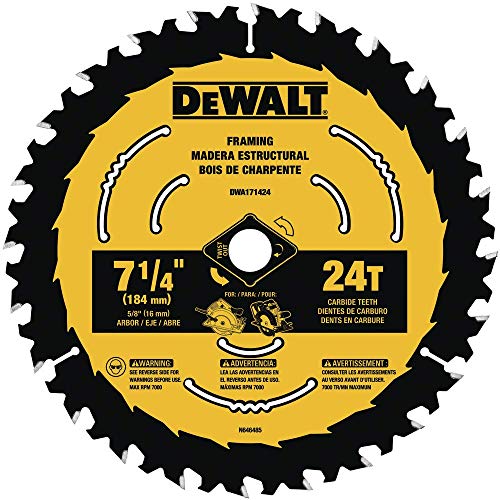
DEWALT 7-1/4 Inch 24-Tooth Framing Saw Blade
What We Like
- Toughtrack tooth design for accurate tracking.
- Reinforced shoulder resists nail impacts.
- Anti-stick coating reduces friction and gumming.
- Thin kerf design yields smooth cuts.
Trade-offs
- 24-tooth count leaves a rougher cut than fine-finish blades.
- General framing design, not for fine woodworking finishes.
The 24-tooth configuration and reinforced shoulder are built for fast, aggressive cuts through dimensional lumber, even when you hit an unexpected nail. That makes it a go-to for framing, deck building, and rough carpentry where speed and durability trump a polished edge. Its thin kerf and anti-stick coating help the saw motor work efficiently, reducing bind and keeping your cuts smooth for a blade in this class.
A 24-tooth framing blade like this DEWALT is built for fast, aggressive cuts in structural lumber, where surface smoothness is secondary. Its design prioritizes speed and durability over a polished surface, which is the intended trade-off for its job. You would use this for the rough framing of a project and switch to a higher-tooth-count blade for visible trim.
Bosch 7-1/4 Inch 60-Tooth Extra-Fine Finish Blade
What We Like
- ATB geometry for fast crosscuts and trim work
- Thinner kerf provides faster cuts with less waste
- SpeedCoat finish reduces friction and burning
- Brute Carbide teeth resist impact damage
Trade-offs
- 60-tooth fine finish design is slower for heavy ripping
- Extra-fine finish focus limits its utility for rough framing
Its 60 ATB teeth are made for fast crosscuts and trim work on wood and plywood. That geometry and high tooth count produce a clean cut on sheet goods, leaving a finish that often requires minimal sanding. A thinner kerf provides faster cuts with less waste, while the SpeedCoat antifriction finish helps prevent burning or melting. This combination makes it a specialist for cabinetry, built-ins, and any project where the cut edge will be visible.
The trade-off for that clean finish is speed in thicker stock. It won’t rip through framing lumber as quickly as a 24-tooth blade like the DEWALT 7-1/4 Inch 24-Tooth Framing Saw Blade. The extra-hard steel blade body resists bending and deflection for true cuts, but the thin kerf is engineered for speed and efficiency, not maximum stiffness. This Bosch is a master of its specific domain, sacrificing raw speed for a pristine edge.
Product photos
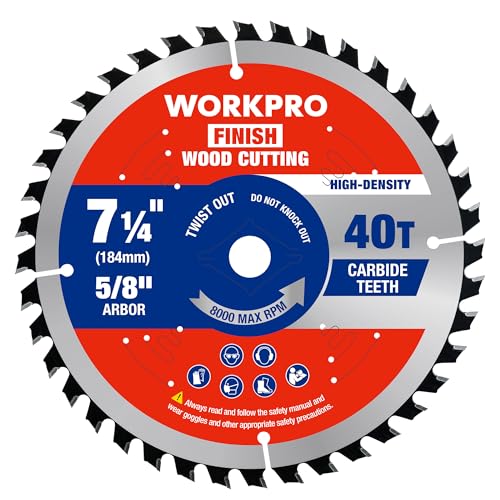
WORKPRO 7-1/4 Inch 40-Tooth General Purpose Blade
What We Like
- Carbide-tipped teeth for long life
- Thin kerf design for less resistance
- ATB geometry for smooth, clean cuts
- Versatile for plywood, hardwood, and softwood
Trade-offs
- Thinner 0.1-inch plate than some 7-1/4" blades
- No maximum RPM rating specified
A 40-tooth, thin-kerf design with carbide tips means this blade is built to handle plywood, trim, and general crosscuts efficiently without bogging down a modest saw. It’s the right pick for a DIYer or occasional user who needs reliable performance across a range of common materials without a specialist’s investment. The ATB tooth geometry helps keep splintering in check, so your projects look clean straight off the saw.
The trade-off is in specialization. For instance, the Freud D0740A Diablo blade shares the same 7-1/4-inch size and 40-tooth count. It is listed with a thicker 0.3-inch plate and an 8000 Max RPM rating, suggesting a more rigid construction for demanding, precise work. The WORKPRO delivers solid value for its intended general-purpose role, but when finish quality or heavy-duty use is paramount, a more premium blade becomes the logical upgrade.
Product photos
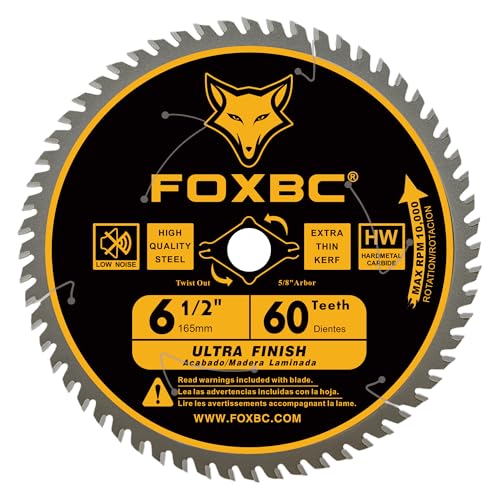
FOXBC 6-1/2 Inch 60-Tooth Ultra Fine Finish Blade
What We Like
- Ultra-thin kerf for fast, effortless cuts.
- Laser-cut stabilizer vents reduce noise and vibration.
- High-density tungsten carbide teeth for durability.
- Compatible with major corded and cordless saw brands.
Trade-offs
- 6-1/2 inch diameter limits maximum cut depth.
- 60-tooth finish blade is not suited for fast ripping.
This blade’s ultra-thin 0.059-inch kerf is designed for fast and effortless cuts. A thinner kerf removes less material, which can make cutting feel easier on both corded and cordless saws. Its 60-tooth carbide design and laser-cut stabilizer vents target a super clean cutting surface on materials like plywood and MDF, prioritizing finish quality over aggressive speed.
The trade-off for that fine, thin cut is a smaller 6-1/2 inch diameter, which won’t give you the depth capacity of a standard 7-1/4 inch blade like the Bosch DCB760. That makes it a specialist. Keep it on a dedicated saw for finish work, and you’ll appreciate how it leaves a surface that often needs little sanding. For a general-purpose shop saw that tackles both framing and finish cuts, you’d want a more versatile tooth count.
Product photos
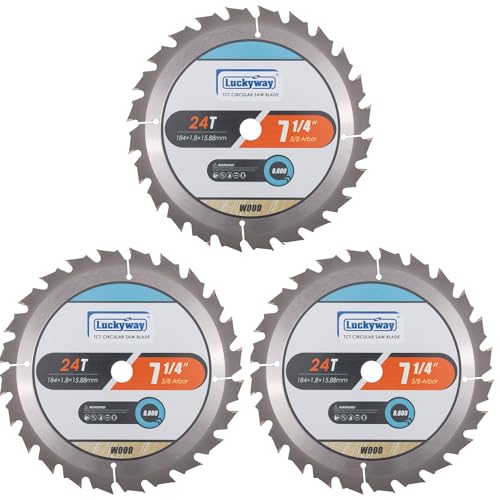
Luckyway 7-1/4 Inch 24-Tooth Framing Blade 3-Pack
What We Like
- Three-blade pack for extended use
- Thin kerf design for smoother cuts
- Compatible with major 7-1/4" saw brands
Trade-offs
- 24-tooth count limits finish quality on crosscuts
- Lower tooth count than dedicated finish blades like the Bosch 60-tooth
Getting three blades in one pack means you can keep one sharpened and ready while another is in the saw, and still have a spare for when the job runs long. The 24-tooth configuration and thin kerf are built for fast, aggressive ripping and framing work in dimensional lumber and plywood, even if you hit an occasional nail. This setup is for the contractor or serious DIYer who burns through blades on rough construction and wants to minimize downtime, not for someone seeking a polished finish on cabinetry.
A 24-tooth count prioritizes speed for framing and rough construction, rather than a smooth finish. The cut edge will be rougher than those from blades with higher tooth counts, like a 40-tooth Freud or a 60-tooth model. This makes it a practical choice for initial sizing of structural lumber, where speed matters more than surface quality.
Product photos
DEWALT 8-1/4 Inch 24T Framing Blade

What We Like
- Toughtrack tooth design for accurate tracking
- Anti-stick coating reduces friction and gumming
- Reinforced shoulder for impact resistance
- Thin kerf provides smooth cuts
Trade-offs
- 24-tooth count leaves a rougher finish than fine-tooth blades
- Specialized design offers less versatility for finish cuts
A reinforced shoulder provides impact resistance in nail-embedded wood, making this blade suited for demolition, renovation, and rough framing where fasteners are likely. Its teeth are made from high-density tungsten carbide for toughness and wear-resistance. The thin kerf design is for smooth cuts, and a tough coat anti-stick coating reduces friction and gumming.
Its 24-tooth configuration suits framing and ripping, which prioritizes speed over a polished finish. For comparison, a blade like the Bosch 7-1/4 Inch 60-Tooth Extra-Fine Finish Blade targets finer results on new lumber. The patent-pending toughtrack tooth design aims for accurate tracking over the life of the blade.
Product photos
How We Evaluated Circular Saw Blades
Our evaluation started with manufacturer specifications for diameter, arbor size, tooth count, and kerf thickness to ensure physical compatibility. We then studied expert round-up articles that define performance criteria like finish quality, tear-out resistance, and durability in specific materials. We also looked for consistent patterns in owner feedback regarding blade life, gumming, and how a blade performs in real-world applications like framing or cabinetmaking. You can learn more about our selection process for the best circular saw blades.
A research-based method cannot replicate hands-on long-term durability testing, so we focused on measurable specs and widely-reported user experiences. The key criteria were cut quality for the intended use, long-term durability features like carbide quality and coatings, and the value proposition of multi-packs for professionals. We prioritized blades that owners confirm deliver on their specific promises, whether that’s a glue-ready edge or the ability to chew through nail-embedded lumber.
What To Look For In Circular Saw Blades For Wood
Matching your blade to your material and desired finish is the most important step. A blade that excels at ripping framing lumber will tear up plywood veneer, while a fine-finish blade will bog down and overheat in heavy ripping tasks. Understanding the basic differences in types of circular saw blades will help you shop confidently.
Choose blade teeth and kerf based on your primary task. Use a low-tooth-count (24T) blade for fast, rough cuts in framing lumber. A mid-range (40-60T) blade provides a versatile, smooth cut for general woodworking. For polished, tear-out-free cuts in veneers and melamine, select a high-tooth-count (80T+) finish blade.
Tooth Count & Geometry
Tooth count determines the speed and smoothness of the cut. Blades with 24 teeth are designed for fast, aggressive ripping in framing lumber, leaving a rougher edge. Blades in the 40-60 tooth range, like our best overall Freud pick, offer a good balance for crosscutting, ripping, and cutting sheet goods with a clean finish.
For the absolute smoothest crosscuts on fine furniture and veneered plywood, an 80-tooth or higher blade, such as our fine woodworking pick, is essential. Tooth geometry also matters; Alternate Top Bevel (ATB) teeth are common for clean crosscuts, while Flat Top Grind (FTG) teeth are better for ripping.
Kerf & Blade Plate
Kerf is the width of the cut the blade makes. A thin-kerf blade removes less material, puts less strain on your saw’s motor, and yields less waste, which is ideal for cordless saws or cutting expensive sheet goods. However, thinner blades can be more prone to deflection and may not be compatible with all saws. The blade plate’s thickness and stability also affect cut quality; laser-cut plates with expansion slots reduce vibration and noise for a straighter, quieter cut.
Durability Features
The quality of the carbide teeth and any protective coatings directly impacts a blade’s lifespan. Premium blades use higher-grade, thicker carbide that stays sharper longer when cutting hardwoods or abrasive materials like plywood. Non-stick coatings, like Freud’s Perma-SHIELD or Diablo’s similar treatment, reduce heat buildup and pitch adhesion, which helps prevent gumming and burning. These features are especially valuable when cutting plywood and other sheet goods where heat can quickly degrade performance.
- Check your saw’s arbor size. The most common is 5/8-inch, but some blades, especially larger diameters, use a 1-inch arbor.
- Confirm the blade diameter matches your saw. A 7-1/4 inch blade is the standard for most handheld circular saws.
- Verify maximum RPM rating. Ensure the blade’s rated speed exceeds your saw’s no-load RPM to operate safely.
For general woodworking, start with a versatile 40-tooth blade; for dedicated tasks, buy a blade specialized for that job.
Circular Saw Blades For Wood Compared
The table below organizes our picks by their primary strength to help you compare key specifications at a glance.
| Product | Diameter | Tooth Count | Kerf Type |
|---|---|---|---|
| Freud D0740A Circular Saw Blade | 7-1/4 inches | 40 ATB | Super Thin Laser-Cut Kerf |
| Diablo 12 Inch 80-Tooth Ultra Finish Saw Blade | 12 inches | 80 Hi-ATB teeth | Super Thin Kerf |
| Diablo 7-1/4 Inch 24-Tooth Framing Blade 10-Pack | 7-1/4 inches | 24 teeth | .059 inch |
| CMT ORANGE TOOLS P07060 Circular Saw Blade | 7-1/4 inches | 60 teeth | 0.069 inches |
| DEWALT 7-1/4 Inch 24-Tooth Framing Saw Blade | 7-1/4 Inch | 24 Teeth | Thin kerf |
| Bosch 7-1/4 Inch 60-Tooth Extra-Fine Finish Blade | 7-1/4 Inch | 60 Teeth | Thinner kerf |
| WORKPRO 7-1/4 Inch 40-Tooth General Purpose Blade | 7-1/4 Inch | 40 Teeth | Thin Kerf |
| FOXBC 6-1/2 Inch 60-Tooth Ultra Fine Finish Blade | 6-1/2 inches | 60 teeth | 0.059 inch |
| Luckyway 7-1/4 Inch 24-Tooth Framing Blade 3-Pack | 7-1/4 inch | 24T | 0.07" thin kerf |
| DEWALT 8-1/4 Inch 24T Framing Blade | 8-1/4 inch | 24 teeth | Thin kerf |
Frequently Asked Questions
What circular saw blade is best for wood?
For most woodworkers needing one blade to handle a variety of tasks, a 40-tooth general-purpose blade like the Freud D0740A is the best choice. It provides a good balance between smooth crosscuts and efficient ripping in both hardwood and softwood, while also handling plywood and other sheet goods cleanly. It’s the most versatile single blade you can own.
Which circular saw blade is better, Milwaukee or Diablo?
Both brands produce high-quality blades, but Diablo is often recognized for its specialized offerings in the woodworking space. Our research shows Diablo blades like our fine woodworking pick are consistently praised for their finish quality and durability, particularly for sheet goods and fine crosscuts. The best choice depends on your specific task, not just the brand name.
What are the best quality circular saw blades?
The best quality blades feature high-density carbide teeth for long life, laser-cut steel bodies to reduce vibration, and advanced non-stick coatings to resist heat and pitch buildup. Brands like Freud, Diablo, and CMT consistently incorporate these features. Our top picks, such as the Freud D0740A and Diablo Ultra Finish blade, exemplify this high-quality construction for their respective applications.
What saw blade makes the smoothest cut?
A blade with a high tooth count and specialized geometry makes the smoothest cut. The Diablo 12 Inch 80-Tooth Ultra Finish Saw Blade is designed specifically for this, using an 80-tooth Hi-ATB design to produce a polished, tear-out-free surface on crosscuts, ideal for fine furniture and trim work. For a setup focused on cabinetry, pairing it with a stable circular saw is key.
What is the most common circular saw blade size?
The most common size for handheld circular saws is 7-1/4 inches in diameter. This size offers a good balance of cutting depth and saw portability, making it the industry standard for framing, general construction, and DIY projects. Many of our recommendations, including our best value pack and best all-purpose framing blade, are in this popular 7¼-inch blade size.
The Bottom Line
The Freud D0740A is our best overall circular saw blade for wood. Its 40-tooth design and advanced coatings deliver reliable, smooth results across a wide range of common tasks, from cutting plywood to ripping lumber. If you’re on a tight budget, consider the WORKPRO 40-Tooth blade. For bulk blades for a framing crew, the Diablo 10-pack offers serious value. Ultimately, the single most important factor is matching the blade’s specialty to the work you do most often, be it fine finishing, fast framing, or clean sheet-good cuts.
