
10 Best 8 Inch Wet Tile Saw Blades in 2026
This post contains affiliate links. As an Amazon Associate, we earn from qualifying purchases.
For a single, long-lasting blade that delivers clean cuts on all common tile and stone, the Alpha Porcellana Wet Diamond Blade is our best overall pick. For dedicated chip-free porcelain work, consider the Casaverde Porcelain Diamond Blade, and for budget-friendly ceramic tile jobs, the QEP Continuous Rim Diamond Blade offers reliable value.
Choosing the right 8-inch blade is about matching its design to your material and workflow. A blade that excels on dense porcelain will be overkill for simple ceramic, while a fast turbo blade can chip delicate edges.
Top 10 8-Inch Wet Tile Saw Blades in the Market
Certain content that appears on this site comes from Amazon. This content is provided "as is" and is subject to change or removal at any time.
The Best 8-Inch Wet Tile Saw Blades, Reviewed
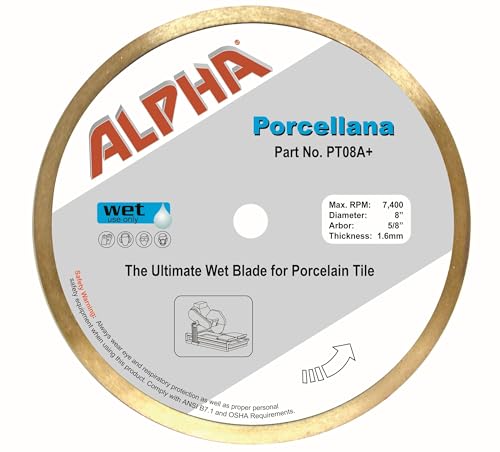
Alpha Porcellana Wet Diamond Blade
What We Like
- Exceptionally tall diamond layer for long blade life
- Designed for chip-free cuts on porcelain and tile
- Hybrid design suitable for cutting all common tile types
- Widely recommended by professional tile installers
Trade-offs
- Wet use only limits portability and dry-cut convenience
- The 5/8" arbor may require an adapter for some saws
A 3/8-inch diamond layer is what gives this blade its staying power, allowing you to work through a serious amount of hard porcelain and stone before it wears out. It’s the installer’s choice for a reason, delivering clean, chip-free edges that minimize cleanup and material waste. This makes it the most reliable and versatile single blade for a pro or a dedicated DIYer who tackles a mix of materials and values a clean finish above all else.
This blade is designed strictly for wet saws, so it cannot be used for a quick dry cut like the VOSIDUE Super Thin blade. Its hybrid design is recommended for cutting granite, marble, porcelain, engineered stone, travertine, and ceramic tiles. For the majority of tile work, the Porcellana is presented as a single blade for these materials.
Casaverde Porcelain Diamond Blade

What We Like
- J-Slot design for chip-free cutting.
- Ultra-thin rim for fast, exact cuts.
- Closed edge for clean porcelain cuts.
Trade-offs
- Wet cutting only limits portability.
- No dry-cutting option for quick cuts.
A 1.8mm thick, continuous rim combined with J-Slot stress relief is engineered specifically to prevent chipping on brittle materials. This makes the Casaverde blade a focused choice for installers where a pristine edge on porcelain or engineered stone is the primary goal. It’s built for the tile saw station, not the jobsite truck, prioritizing cut quality above all else for a finished look.
Designed for wet cutting only, the Casaverde blade’s continuous rim and J-slot stress relief aim to reduce breaks and deliver chip-free, straight cuts on porcelain, marble, quartz, and engineered stone. Its 1.8mm thick, ultra-thin outer rim is intended for fast, exact cutting on these specific materials. This focus on a clean finish for delicate tiles means it is not presented as a general-purpose or dry-cutting option.
Product photos
QEP Continuous Rim Diamond Blade

What We Like
- Precise, wobble-free cuts per specifications
- Long-lasting diamond edge minimizes chipping
- General-purpose design for ceramic tile
- Lightweight at 0.8 pounds for easy handling
Trade-offs
- Continuous rim is slower than turbo blades for other materials
- Designed for ceramic, not harder stone or concrete
A maximum RPM of 7640 and specs engineered for a wobble-free spin mean this blade makes smooth, precise cuts in ceramic tile without fuss. It’s the right tool for a weekend warrior redoing a bathroom or a pro knocking out a kitchen backsplash who needs reliable performance without the premium price tag. The diamond edge holds up, so you spend less time changing blades and more time making cuts.
This general-purpose blade is intended for wet cutting ceramic, not harder materials like porcelain or stone. For porcelain, other products like the Casaverde Porcelain Diamond Blade are marketed specifically for that task. The QEP blade’s exact specifications are engineered to deliver what is promised: a smooth, precise cut in ceramic tile.
Product photos
VOSIDUE Super Thin Diamond Blade

What We Like
- Versatile wet or dry cutting operation
- 10mm rim height for extended blade life
- Cooler rim design increases cutting speed
Trade-offs
- Arbor range may require reducers for some saws
- General material list lacks specific performance claims
The ability to cut wet or dry is this blade’s standout feature, giving you the flexibility to work in the shop or on a job site without a water source. That 10mm rim height and the cooler rim design are built to handle heat, which directly translates to a longer-lasting edge when you’re pushing through hard porcelain or granite. It’s a solid choice for the contractor or serious DIYer who needs one blade that can adapt to any cutting situation, regardless of the setup.
The trade-off for that dual-use versatility is that it isn’t a dedicated specialist. For pure, high-volume wet cutting of porcelain, a blade like the Alpha Porcellana Wet Diamond Blade is engineered specifically for that single, demanding task. The VOSIDUE blade, however, covers a broader range of materials and conditions, making it a dependable all-rounder for mixed tile work where convenience is a priority.
Product photos
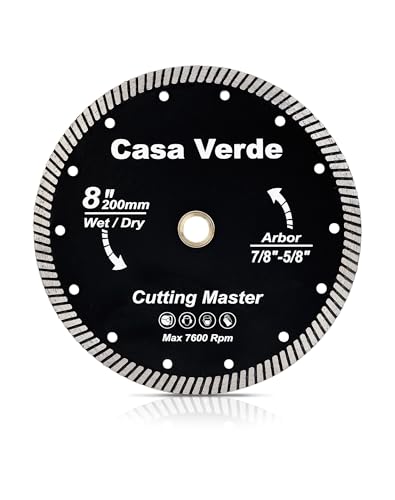
Casaverde Turbo Diamond Saw Blade
What We Like
- 10mm segments for smooth cuts and long life
- Turbo rim design reduces edge chipping
- Efficient cooling holes for low vibration
- Hot pressing process for low noise operation
Trade-offs
- At 1.2 pounds, it's heavier than the 0.8-pound QEP blade
- General purpose, not specialized for porcelain like the Casaverde Porcelain blade
With 10mm thick diamond segments, this blade has the mass for smooth cuts on hard stone like granite. The turbo rim design helps reduce edge chipping, while efficient cooling holes support longer work sessions with less vibration. It is designed for both dry and wet use, performing better with water.
Its design prioritizes cutting granite and hard stone, not delicate porcelain. The turbo rim aims to reduce chipping, but reviewers report that dedicated continuous rim blades, like the QEP model, are preferred for a polished finish on ceramic tile. This blade’s hot-pressing process and raw materials are intended for low noise and amplitude at high speeds.
Product photos
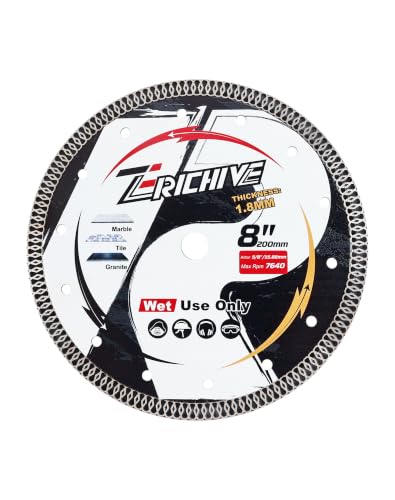
Zerichive Porcelain Diamond Tile Blade
What We Like
- Specified for chip-free porcelain and quartzite cutting.
- Wet-use design up to a high 7640 RPM.
- Broad application across granite, marble, and Dekton.
- Standard 5/8-inch arbor fits common wet tile saws.
Trade-offs
- Segment thickness of 1.8mm creates a wider kerf than super-thin blades.
The Zerichive blade’s explicit focus on chip-free cuts for quartz and porcelain makes it a specialist’s choice. That 10mm segment height suggests a blade built for endurance through hard, dense materials, not just a quick job. It’s the right pick for a tile setter who needs clean, polished edges on premium stone and engineered slabs without slowing down. The listed compatibility with Dekton, a notoriously tough sintered surface, confirms it’s meant for modern, demanding substrates.
This blade is engineered for wet cutting at speeds up to 7640 RPM, so it’s built to handle the demands of a standard wet tile saw. Its application list includes granite, marble, porcelain tile, ceramic, and Dekton, making it a versatile choice for various stone and tile materials. The manufacturer describes it as providing extremely smooth, chip-free cutting, which is a priority for finished installations where the edge appearance matters.
Product photos
GoYonder Super Thin Diamond Ceramic Blade

What We Like
- Super thin 1.6mm kerf minimizes material waste.
- Turbo rim design increases cutting efficiency.
- Compatible with 7/8 inch and 5/8 inch arbors.
Trade-offs
- Thin kerf may require extra care to avoid blade drift.
A 1.6mm kerf is the defining feature here, slicing through porcelain with minimal chipping and wasted material. This makes the GoYonder blade a strong candidate for detail work, intricate cuts, or any project where preserving expensive tile is a priority. Its ability to run wet or dry adds versatility for quick cuts where setting up a water source is a hassle, and the turbo rim helps it power through hard ceramics efficiently.
That ultra-thin profile, however, demands a steady hand and a well-tuned saw to prevent wandering on longer cuts. For general-purpose tile work where absolute precision on every cut isn’t critical, a standard blade like the QEP Continuous Rim Diamond Blade might offer a more forgiving experience. The GoYonder excels where its specific thin-cut advantage is needed, trading some user forgiveness for a cleaner, more economical cut line.
Product photos
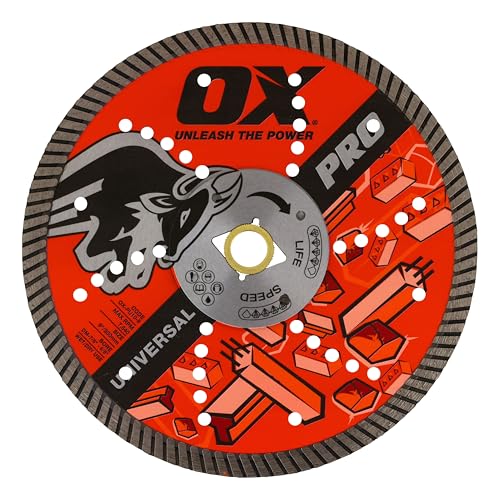
OX Segmented Turbo Diamond Blade
What We Like
- Segmented turbo rim for fast, aggressive cuts
- 12mm segment height provides extended blade life
- Reinforced plate reduces vibration for user comfort
- Cuts a very wide range of building materials
Trade-offs
- Segmented rim is more aggressive than a continuous rim for delicate tile
- Turbo design may produce more spray than a smooth-rim blade
A 12mm segment height signals a blade built for the long haul, designed to wear down slowly through tough materials. That reinforced center plate and semi-silent damping aren’t just specs on a sheet, they translate directly to less chatter in your hands and a smoother feed when you’re pushing through dense concrete or stone. This is the blade you grab when the job site delivers a surprise, from engineering brick to steel, and you need one tool that can handle it all without a second trip to the truck.
This OX blade is designed for aggressive, fast cuts across a wide range of tough materials on a jobsite, from concrete and granite to steel and engineering bricks. Its segmented turbo rim and reinforced center plate prioritize cutting power and reduced vibration over producing a polished edge. For projects demanding a flawless finish on delicate tile, a continuous-rim blade like the QEP model is a more precise choice.
Product photos
Z-LION Turbo Segmented Diamond Blade
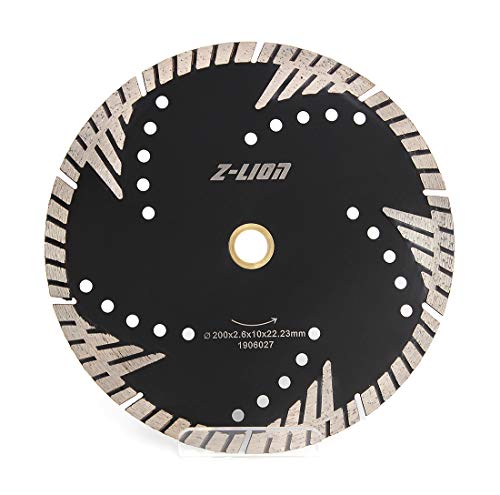
What We Like
- Segmented rim for aggressive cutting speed
- Laser-welded, heat-treated steel body for durability
- Wet or dry cutting capability with cooling holes
- Compatible with angle grinders and wet saws
Trade-offs
- Segmented rim creates a rougher cut edge than continuous blades.
- 2.6 mm thickness removes more material than super-thin blades.
The Z-LION blade’s segmented rim is built for fast, aggressive cuts through tough materials like granite and concrete. Its laser-welded construction and ability to run wet or dry mean it can handle heavy-duty, messy jobs where pure cutting speed is the priority. This is the blade you grab when you need to rip through a stack of pavers or demo old masonry, not when you need a polished finish. It suits a contractor or serious DIYer tackling hardscape projects who values a blade that won’t bog down.
The Z-LION Turbo Segmented Diamond Blade is built for cutting tough materials like concrete, stone, and granite, which makes it suitable for heavy-duty construction and masonry tasks. Its segmented rim design allows for aggressive cutting, though this same feature means it will not produce a smooth, finished edge like a continuous rim blade. According to product comparisons, a blade like the QEP Continuous Rim Diamond Blade is designed specifically for clean cuts on ceramic tile.
OSECH Super Thin Diamond Ceramic Blade

What We Like
- High-temperature diamond extraction for long life
- Super thin 1.8mm segments for efficient cuts
- Dual arbor compatibility fits most saws
- Reinforced 10mm rim height adds durability
Trade-offs
- At 1.2 lb, it's heavier than blades like the 0.9 lb Alpha Porcellana
- General material list lacks specific quartz mention
The core advantage here is the high-temperature diamond extraction process, which bonds the abrasive more securely to the blade matrix. This directly translates to a longer service life, especially when pushing through hard porcelain or during long cutting sessions that generate heat. The 10mm rim height provides extra diamond material to wear through, making this a solid pick for contractors or serious DIYers who need a blade that can handle sustained use without degrading quickly. Its super thin 1.8mm profile also minimizes material waste and cutting effort on expensive tile.
You do pay for that durability with a bit more heft, as it’s one of the heavier blades in the guide. That extra mass can be felt on the saw, though it also contributes to stability. For someone focused purely on delicate ceramic work, a lighter option like the Alpha Porcellana might be easier to handle. But if your projects mix ceramic, porcelain, and stone, and you prioritize a blade that resists wear, the OSECH’s construction is built to last.
Product photos
How We Evaluated 8-Inch Wet Tile Saw Blades
Our evaluation started with manufacturer specifications and expert round-ups from tile tool specialists to understand the core design differences between blade types. We focused on three key criteria: cutting performance for the intended material, blade longevity, and practical compatibility with common saws.
Cutting performance was paramount. We looked for blades engineered for specific materials, like porcelain or quartz, and designs that promote chip-free edges on visible cuts. Blade longevity, indicated by features like segment height and diamond bond quality, was another critical factor, as a long-lasting blade saves money and downtime. Finally, we checked arbor compatibility and weight, as a blade that doesn’t fit your saw or feels unwieldy is a non-starter.
This is a research-led guide. We haven’t physically tested these blades, so our recommendations are based on a synthesis of published specs, professional installer feedback patterns, and expert analysis of blade construction and intended use.
What To Look For In 8-Inch Wet Tile Saw Blades
An 8-inch wet tile saw blade is a precision tool, not a commodity. The right blade prevents costly chipping, speeds up your work, and lasts through multiple projects. Your primary goal is to match the blade’s design to your most common material and your tolerance for edge quality.
The key is matching rim type to material. A continuous rim gives clean cuts on ceramic and porcelain, while a turbo rim handles hard stone faster. For aggressive masonry work, choose a segmented rim. Always verify the arbor size fits your saw, and consider blade weight for handling comfort.
Rim Type & Cutting Performance
The blade’s rim design dictates its speed and finish. A continuous, smooth rim provides the cleanest, most chip-free cuts, making it ideal for ceramic, porcelain, and glass tile where the edge will show. A turbo rim, with its notched segments, cuts faster and stays cooler in hard materials like granite and engineered stone but may leave a slightly rougher edge. For rough construction work on concrete, brick, or pavers, a segmented turbo rim offers maximum aggression and speed, sacrificing a smooth finish entirely.
Material Specificity & Blade Life
Blades are often engineered for specific materials. A general-purpose blade might cut many things, but a blade specified for porcelain or quartz uses a different diamond bond and segment design to handle that material’s hardness without premature wear. Features like a tall diamond segment (e.g., 10mm or 12mm height) directly contribute to longer blade life, as there’s more cutting material to wear down.
For high-volume work, look for mentions of high-temperature diamond extraction or laser-welded segments, which indicate a construction built for durability, a crucial factor when choosing a wet saw blade.
Practical Compatibility & Handling
Always check the arbor hole size. The standard for 8-inch wet tile saws is 5/8-inch, but some blades come with a 7/8-inch arbor or include reducers; using an incorrect size can be dangerous. Blade weight affects handling, especially on a portable saw, lighter blades around 0.8 pounds reduce user fatigue, while heavier blades over 1 pound often signal a more durable, reinforced construction.
Finally, confirm whether the blade is for wet-use only or allows dry cutting. Wet-use blades last longer and cut cleaner, but a dry-capable blade offers portability for quick cuts.
- Verify the arbor hole matches your saw’s spindle (typically 5/8″).
- Consider if you need a wet-only blade or the option for dry cutting.
- Note the blade weight if you’ll be making many cuts in a session.
A good rule of thumb: invest in a material-specific blade for your primary tile type, and ensure it fits your saw before you buy.
8-Inch Wet Tile Saw Blades Compared
The following table compares the key specifications and strengths of all ten blades at a glance to help you narrow your choice.
| Product | Cutting Type | Segment/Rim Height | Compatible Materials |
|---|---|---|---|
| Alpha Porcellana Wet Diamond Blade | Wet use only | 3/8" (10mm) | Granite, marble, porcelain, engineered stone, travertine, ceramic |
| Casaverde Porcelain Diamond Blade | Wet cutting only | N/A | porcelain tile,marble,quartz,engineered stone |
| QEP Continuous Rim Diamond Blade | Wet cutting | N/A | Ceramic tile |
| VOSIDUE Super Thin Diamond Blade | Wet or dry | 10mm | Porcelain, ceramic, granite, marble |
| Casaverde Turbo Diamond Saw Blade | Dry and wet | 10 MM | Granite, hard stone |
| Zerichive Porcelain Diamond Tile Blade | wet cutting | 10mm | Granite, Marble, Porcelain Tile, Ceramic, Dekton |
| GoYonder Super Thin Diamond Ceramic Blade | Wet & Dry | 10mm | porcelain tile, ceramia tile, granite |
| OX Segmented Turbo Diamond Blade | N/A | 12mm | Granite, natural stone, clay products, engineering bricks, metal, concrete products, steel, all building materials |
| Z-LION Turbo Segmented Diamond Blade | Wet/Dry | 10 mm | Marble, Granite, Pavers,Brick, Block, Stone, Concrete |
| OSECH Super Thin Diamond Ceramic Blade | Wet or dry | 10mm | granite, marble, ceramic, and porcelain tiles |
Frequently Asked Questions
What is the best saw blade for cutting wet tile?
The best blade depends on your tile material. For a versatile blade that handles ceramic, porcelain, and stone with a clean edge, a continuous-rim diamond blade like our best overall pick is excellent. For dedicated, chip-free porcelain work, a blade specifically engineered for porcelain, like our chip-free cutting award winner, is the top choice.
How long should a wet tile saw blade last?
Blade life varies dramatically with use. Cutting soft ceramic tile, a quality blade can last for hundreds of feet. Cutting dense porcelain or granite significantly reduces lifespan. Features like a tall diamond segment and strong bonding extend life. Proper care, including dressing the blade and using adequate water, is essential for longevity.
How to keep tile from chipping on a wet saw?
Use a blade designed for chip-free cutting, typically a continuous rim or specialized porcelain blade. Ensure the blade is sharp and not worn out. Feed the tile into the blade slowly and steadily without forcing it. Always use a sufficient flow of water to cool the blade and lubricate the cut, which is a fundamental part of using a wet tile saw correctly.
What is the best blade for tile cutting?
There is no single “best” blade. The optimal blade is the one matched to your specific tile material and desired cut quality. For clean finish cuts on ceramic and porcelain, choose a continuous rim blade. For faster cuts on hard stone, a turbo rim is better. For rough masonry, a segmented blade is appropriate. Our guides on blades for porcelain tile and tile saw blades for porcelain delve deeper into that specific material.
Can I use a 7-inch blade on an 8-inch saw?
No, you should not. A saw is designed for a specific maximum blade diameter. Using a smaller blade reduces your cutting depth and can be unsafe if it doesn’t properly align with the saw’s guard and water system. If your saw uses an 8-inch blade, stick with that size. For info on smaller blades, see our resource on 7-inch wet tile saw blades.
The Bottom Line
For most installers tackling a mix of ceramic, porcelain, and natural stone, the Alpha Porcellana Wet Diamond Blade is the best overall choice. Its hybrid design and tall diamond layer provide clean cuts and long life across common materials, making it a reliable workhorse.
If your budget is tight and you’re cutting primarily ceramic tile, the QEP Continuous Rim Diamond Blade delivers dependable performance without the premium price. For contractors who frequently switch between wet and dry cutting or work on mixed building materials, the VOSIDUE blade offers crucial versatility.
Ultimately, the single most important factor is matching the blade’s rim design and material specification to your project. A blade built for your primary tile type will always outperform a general-purpose option, saving you time, material, and frustration.
