
10 Best Wet Tile Saw Blades in 2026
This post contains affiliate links. As an Amazon Associate, we earn from qualifying purchases.
For most tile jobs, our research points to the QEP 7-Inch Continuous Rim Premium Blade as the best overall, thanks to its clean-cutting continuous rim and compatibility with most saws. The Bosch DBC0701 is the top pick for chip-free cuts, while the DEWALT DW4764 stands out as the Best Premium Porcelain Blade. A cheap or mismatched blade can chip delicate edges and slow your project to a crawl. We examined manufacturer specifications, expert round-ups, and patterns in owner feedback to identify the ten best options for specific needs.
Top 10 Wet Tile Saw Blades in the Market
Certain content that appears on this site comes from Amazon. This content is provided "as is" and is subject to change or removal at any time.
The Best Wet Tile Saw Blades, Reviewed
QEP 7-Inch Continuous Rim Premium Blade

What We Like
- Continuous rim design for clean cuts.
- 7-inch size fits most common tile saws.
- Cuts ceramic, porcelain, and marble.
- Standard 5/8-inch arbor ensures compatibility.
Trade-offs
- Continuous rim is slower for heavy volume.
- Designed for tile, not harder stone like granite.
A 7-inch continuous rim blade is the workhorse for most tile installations. The QEP 6-7003Q handles ceramic, porcelain, and marble, covering the core materials for kitchen and bathroom projects. Its clean-cutting continuous rim design leaves a finished edge that minimizes chipping, so your cuts are ready for grout right off the saw. This makes it a reliable, do-it-all choice for contractors and dedicated DIYers who need predictable performance across common jobs.
A continuous rim design is intended for precise cuts on hard materials like porcelain. This contrasts with turbo-rim blades listed for other products, such as the Pearl P4 Thin Mesh Turbo Porcelain Blade. The blade’s specified material range focuses on ceramic, porcelain, and marble.
Product photos
DEWALT DW4764 10-Inch Porcelain Tile Blade

What We Like
- 10-inch diameter for deep cutting capacity.
- Designed for wet cutting to reduce dust.
Trade-offs
- At 1.5 pounds, it's heavier than most 7-inch blades.
- Large 10-inch size requires a compatible wet saw.
A 10-inch diameter provides the depth needed for thicker slabs and large-format tile, a clear step up from common 7-inch models. The product is designated a premium porcelain tile blade, and it is intended for wet cutting. This combination suits a user whose projects involve porcelain and require a larger cutting capacity.
The trade-off is in its specialization and physical size. Its weight and diameter mean it’s overkill for a small tile saw or occasional ceramic work. For general-purpose tile cutting, the DEWALT DW4791 7-Inch Tile Blade offers a more nimble and versatile option. But when your project calls for clean, consistent cuts in premium porcelain, this larger, dedicated blade is the logical choice to get the job done right.
Bosch DBC0701 Continuous Rim Diamond Wheel
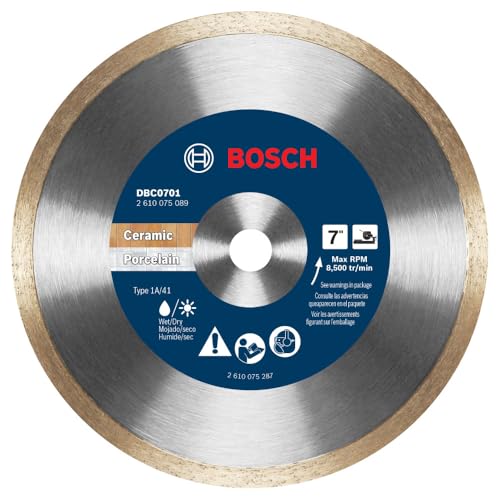
What We Like
- Continuous rim design for chip-free cuts.
- Fine diamond grit and softer matrix for smooth cuts.
- Universal 5/8-inch arbor fits most tile saws.
- Durable, professional-grade construction for longevity.
Trade-offs
- Maximum cutting depth is 2-1/2 inches.
- Fits only 5/8-inch arbor tile saws.
A continuous rim with a fine diamond grit and softer matrix is engineered specifically for smooth, chip-free cuts in delicate materials. This blade is the clear choice for installers and DIYers working on finish work like backsplashes or marble countertops where a flawless edge is non-negotiable. It delivers precise, clean results in ceramic, porcelain, and natural stone, making it ideal for projects where the cut will be visible.
Designed for exceptionally smooth, chip-free cuts, the Bosch DBC0701 uses a continuous rim with fine diamond grit and a softer matrix. This engineering makes it ideal for hard, delicate materials like porcelain and marble, perfect for detailed tasks such as shaping countertops or installing backsplashes. Its performance is optimized for precision rather than rapid material removal.
Product photos
Pearl P4 Thin Mesh Turbo Porcelain Blade
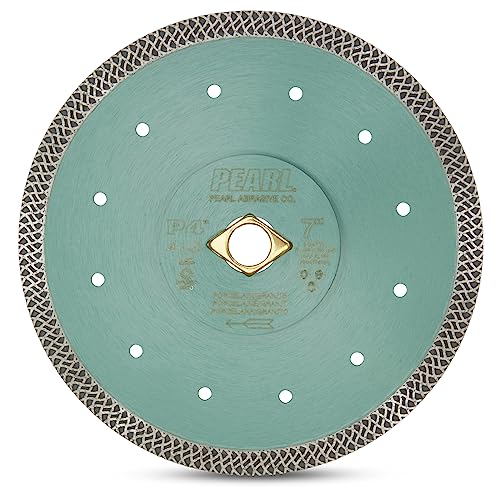
What We Like
- Extra thin kerf for fast, clean cuts
- Mesh rim design runs extremely cool
- Laminated hub for straighter cutting
- Full diamond rim for long tool life
Trade-offs
- 7-inch size limits depth for thick stone
- Thin kerf optimized for porcelain, not rugged demo
An extra thin kerf and mesh pattern rim let this blade slice through hard porcelain and ceramics with minimal chipping and reduced heat. That’s the core advantage for installers who need clean, finished edges on brittle tile without slowing down. The laminated center hub adds stability, so your cuts stay straight even when you’re pushing for speed.
Pearl designed the P4 specifically for fast, clean cuts in hard, brittle materials like porcelain and ceramic tile. Its extra-thin kerf and mesh pattern rim reduce friction to keep the blade running cool, which helps extend its life and minimizes chipping on finish-sensitive work. This focus on cool, precise cutting means it is engineered as a specialist, not a general-purpose blade for a wide mix of materials.
QEP Premium Diamond Blade for Glass Tile
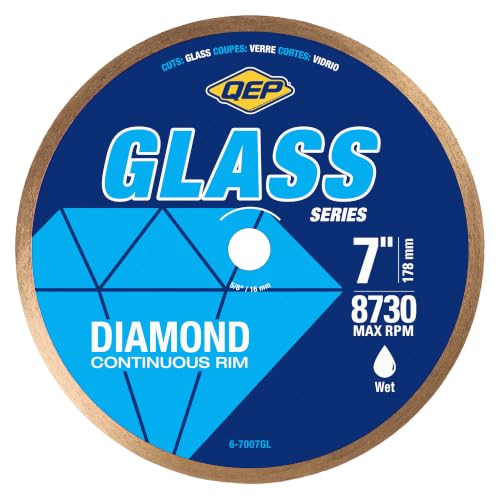
What We Like
- Diamond-coated rim for clean glass cuts
- High 8,730 RPM speed rating
- 5/8" arbor fits most wet tile saws
- Specifically engineered for glass and mosaic
Trade-offs
- 7-inch diameter limits depth of cut on thick materials
- At 0.6 lb, lighter construction than some 7-inch blades
This blade’s 7 mm diamond-coated rim is engineered for accurate, cleaner cuts, which is essential when working with fragile glass tile, mosaic, or stained glass. Its continuous edge is designed specifically for those materials, making it a focused choice for backsplashes or artistic installations where cut quality matters most.
This blade is listed for cutting glass tile, ceramic, and porcelain. For bulk cutting of dense porcelain tile, some users prefer a dedicated turbo or segmented blade like the Pearl P4, which is designed for that material. This QEP blade remains specialized for glass and mosaic work.
Product photos
DEWALT DW4791 7-Inch Tile Blade
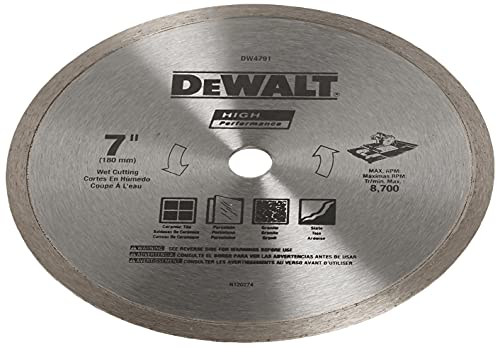
What We Like
- High-performance diamond matrix for long life
- Fast, chip-free cutting action
- Thin kerf minimizes dust and speeds cuts
- Handles all tile and stone materials
Trade-offs
- 7-inch size limits depth of cut versus 10-inch models like the DEWALT DW4764
- 7-inch size limits depth of cut versus 10-inch models
With a 5mm diamond segment height and a thin kerf, the DEWALT DW4791 is built for fast cutting while minimizing dust. Its design supports wet cutting of all types of tile and stone, which allows it to handle mixed material jobs from ceramic to natural stone. The chip-free cutting feature means it can work on finished surfaces without causing edge damage.
The blade’s 7-inch diameter determines its maximum cutting depth, so it cannot make cuts as deep as a 10-inch model like the DEWALT DW4764. For intricate work on fragile materials like glass tile, some users might prefer a blade specifically engineered for that task, such as the QEP Premium Diamond Blade for Glass Tile. As a general-purpose option, this DEWALT blade covers a wide range of standard tile and stone cutting.
Product photos
MK Diamond MK-415 Continuous Rim Blade
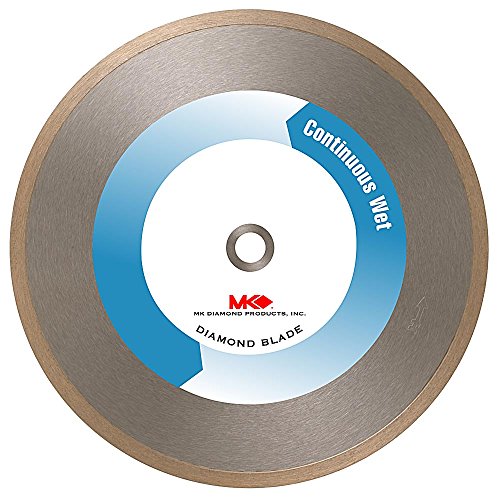
What We Like
- Thicker core handles high-production jobs
- Continuous super hi-rim provides longer life
- Designed for fast, straight cuts
- Wet cutting blade for porcelain and vitreous tile
Trade-offs
- No listed weight or shipping dimensions.
- Arbor size is 5/8 inch only.
The MK-415’s thicker core and super hi-rim are built for straight, fast cuts, making it a go-to for shops that need to push through a lot of tile without changing blades. It’s a classic workhorse, handling a wide range of porcelain and vitreous materials reliably. This is the blade you keep in stock for general production, where consistent performance across many jobs matters more than peak specialization for a single material.
For a high-volume tile shop that values a single, reliable blade over a cabinet full of specialized options, the MK-415 delivers. If every cut is on ultra-hard porcelain, a dedicated porcelain blade might serve you better, but for mixed workloads, this one covers the bases.
Bosch DB4543S Standard Continuous Rim Blade
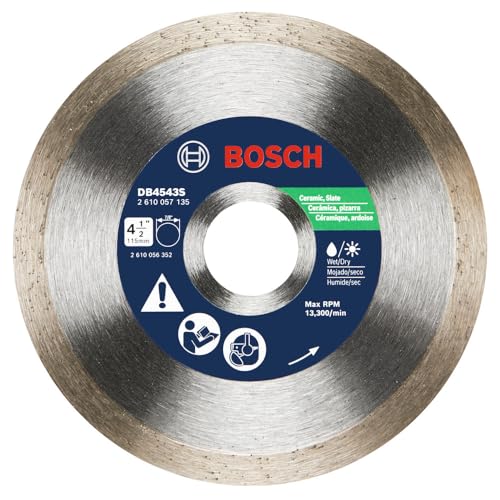
What We Like
- Continuous rim for durable, fast ceramic and slate cuts
- Soft bond formulation for efficient cutting
- Steel core reduces wobble for straighter cuts
- Optimized diamond pattern engages material effectively
Trade-offs
- 4.5-inch diameter limits depth of cut per pass.
- At 0.3 lbs, it's a small blade for smaller saws.
The Bosch DB4543S is a 4.5-inch diamond blade, a size that pairs with smaller tile saws for a lightweight and maneuverable cutting setup. Its continuous rim design and soft bond formulation are engineered for durable, fast performance in ceramic tile and slate, promoting cleaner cuts with less material damage. The steel core provides straight, smooth cuts with reduced wobble for longer blade life.
A 10-inch blade like the DEWALT DW4764 offers a larger cutting diameter for different applications. The Bosch DB4543S uses an optimized diamond pattern where quality diamonds are arranged to effectively engage the material for efficient cutting.
Product photos
OSTEK 5-Inch Super Thin Diamond Blade
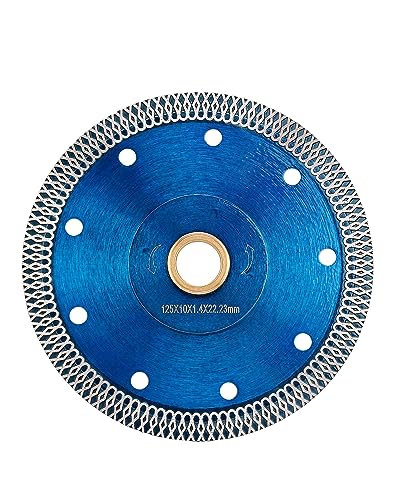
What We Like
- Super thin 1.4mm kerf for efficient cuts
- Universal arbor fits most handheld saws
- Designed for both wet and dry operation
- Suitable for porcelain, granite, and ceramics
Trade-offs
- 5-inch diameter limits depth of cut
- Primarily matches handheld machines, not large saws
With a segment thickness of 1.4mm, this blade creates an exceptionally narrow cut. The design is universal for both dry and wet cutting, so you don’t need separate blades for different jobs. Its 5-inch diameter and compatibility with a 7/8-inch or 5/8-inch arbor make it a match for handheld machines.
The 5-inch diameter limits its maximum cutting depth compared to larger blades like a 10-inch model. It is available for cutting tile, porcelain, ceramic, granite, sandstone, and quartz. A 10mm rim height contributes to its profile for use with compact tools.
Product photos
Makita X-Lock Continuous Rim Diamond Blade
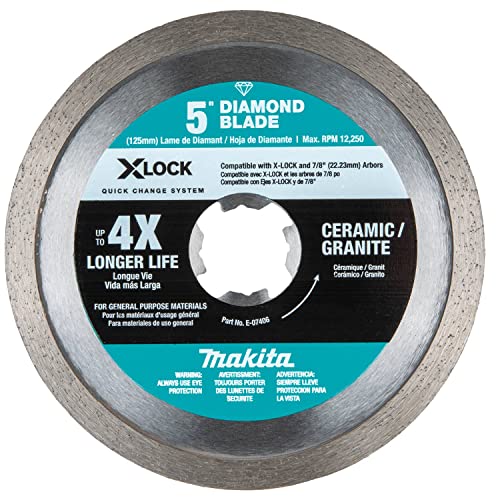
What We Like
- X-LOCK system enables tool-free blade changes.
- Continuous rim delivers a finer finish.
- Claimed up to 4x longer blade life.
- Optimum bond matrix for smoother cutting.
Trade-offs
- 5-inch diameter limits depth of cut.
- Requires an X-LOCK compatible grinder.
The X-LOCK quick-change system is the core of this blade’s design, letting you swap it out in seconds without a wrench. That’s a major efficiency boost for any project requiring frequent material switches. This makes it a standout choice for contractors or dedicated DIYers who already use, or are investing in, the Makita X-LOCK grinder ecosystem. The continuous rim and specialized bond matrix are engineered for clean cuts in ceramic and granite, prioritizing finish over raw speed.
You trade cutting capacity for that convenience, however. The 5-inch diameter is notably smaller than common 7-inch wet saw blades like the QEP 6-7003Q, so it can’t handle thicker materials or deep scoring passes. It’s a precision blade for specific materials and a specific tool system. If your work revolves around a standard tile saw arbor, this blade’s unique mount is a non-starter, but for the right grinder, it transforms a cutting tool’s versatility.
Product photos
How We Evaluated Wet Tile Saw Blades
Our evaluation is research-based, not hands-on. We analyzed manufacturer specifications for arbor size, blade diameter, and intended materials. We studied expert round-ups from professional tile sources to understand performance claims and industry standards.
Finally, we reviewed patterns in owner feedback for real-world insights on durability, cut quality, and common issues. The key criteria were blade design (continuous vs. Segmented rim), material compatibility (porcelain, glass, etc.), and saw compatibility (arbor size and diameter). A research-led evaluation cannot replicate the experience of cutting hundreds of linear feet, so we focused on construction, specifications, and consensus from experienced users.
What To Look For In Wet Tile Saw Blades
Choosing the right blade transforms your saw from a rough cutter to a precision tool. The design, material match, and physical fit are the most critical factors.
The right blade combines a compatible diameter and arbor size with a rim design suited to your material, continuous for clean cuts on tile and glass, segmented or turbo for faster cutting on stone.
Blade Design: Continuous Rim vs. Turbo/Segmented
The rim design dictates cut quality and speed. A continuous rim provides an unbroken cutting edge, which yields the cleanest, most chip-free finish on delicate materials like porcelain and glass tile. This is the go-to choice for most finish work. Turbo or segmented blades have gaps in the rim that help clear debris and run cooler, allowing for faster cuts. They are better suited for high-volume work or harder natural stones where a slightly rougher edge is acceptable. Our guide to tile saw blades details these differences further.
Material Compatibility
Not all blades cut all materials well. Porcelain is dense and hard, requiring a blade with a specific diamond matrix formulated to stay sharp and resist glazing. Glass and mosaic tiles need an ultra-fine, diamond-coated rim to prevent shattering and chipping. General-purpose ceramic is less demanding, but for the best results, match the blade to your primary material. Using a blade for porcelain tile on a granite slab, for example, will lead to rapid wear and poor performance.
Saw Compatibility: Diameter & Arbor Size
A blade must physically fit your saw. The diameter (like 7-inch or 10-inch) determines the maximum cutting depth per pass. A larger 10-inch blade, like our best 10-inch blades pick, can handle thicker tiles and slabs. The arbor is the hole in the center; a 5/8-inch arbor is the nearly universal standard for tile saws. Always verify your saw’s specifications before purchasing. Using an incompatible blade is unsafe and will damage your equipment.
- Check your saw’s manual for the maximum recommended blade diameter.
- Confirm the arbor size (5/8-inch is standard).
- Ensure the blade’s RPM rating meets or exceeds your saw’s maximum speed.
- For specialized tasks, consider a dedicated blade rather than a general-purpose one.
When in doubt, a 7-inch continuous rim blade with a 5/8-inch arbor is the safest starting point for most ceramic and porcelain tile projects.
Wet Tile Saw Blades Compared
The table below summarizes the key specs and best uses for our top picks to help you compare them quickly.
| Product | Blade Diameter | Cutting Style/Rim Type | Material Compatibility |
|---|---|---|---|
| QEP 7-Inch Continuous Rim Premium Blade | 7 inches | Continuous Rim | Ceramic, Porcelain, Marble |
| DEWALT DW4764 10-Inch Porcelain Tile Blade | 10 inches | N/A | Porcelain Tile |
| Bosch DBC0701 Continuous Rim Diamond Wheel | 7 inches | Continuous rim | Ceramic, porcelain, slate, marble |
| Pearl P4 Thin Mesh Turbo Porcelain Blade | 7 inches | Thin Mesh Turbo | N/A |
| QEP Premium Diamond Blade for Glass Tile | 7 inches | N/A | Glass, mosaic, ceramic, porcelain |
| DEWALT DW4791 7-Inch Tile Blade | 7.0 inches | Thin kerf | All types of tile and stone |
| MK Diamond MK-415 Continuous Rim Blade | 7 inches | Continuous rim | Porcelain and vitreous tile |
| Bosch DB4543S Standard Continuous Rim Blade | 4.5 inches | Continuous rim | Ceramic tile and slate |
| OSTEK 5-Inch Super Thin Diamond Blade | 5 inches | N/A | Porcelain Tiles |
| Makita X-Lock Continuous Rim Diamond Blade | 5 inches | Continuous rim | Ceramic and granite |
Frequently Asked Questions
What is the best saw blade for cutting wet tile?
For most users cutting ceramic, porcelain, or marble, the best all-around blade is a 7-inch continuous rim design like our best overall, the QEP 7-Inch Continuous Rim Premium Blade. It provides clean cuts and fits most common tile saws. For dedicated porcelain work, a specialized blade like the DEWALT DW4764 or Pearl P4 is a better match.
What is the best 7 inch diamond blade for a wet tile saw?
Our research identifies the QEP 7-Inch Continuous Rim as the best general 7-inch blade for its balance of performance and value. For the ultimate in chip-free finishing on delicate materials, the Bosch DBC0701 Continuous Rim Diamond Wheel is the top choice. You can explore more options in our list of recommended 7-inch wet saw blades.
What is the best blade for porcelain tile cutting?
Porcelain is exceptionally hard, so you need a blade designed for it. The DEWALT DW4764 10-Inch Porcelain Tile Blade is our premium pick for deep cuts, while the Pearl P4 Thin Mesh Turbo is the best for fast, chip-free cuts on a 7-inch saw. Using a dedicated wet saw blade for porcelain will extend blade life and improve cut quality.
How do you change a blade on a wet tile saw?
First, disconnect the saw from power. Then, use the wrench provided with your saw to loosen the arbor nut holding the blade, typically by turning it opposite the blade’s rotation direction. Remove the old blade, install the new one with the arrow on the blade facing the correct rotation direction, and securely retighten the nut. Always consult your saw’s manual, and you can find a detailed step-by-step blade replacement guide on our site.
Can you use a wet tile saw to cut glass tile?
Yes, but you must use a blade specifically engineered for glass. Standard tile blades are too aggressive and will chip or shatter glass. Our best pick for this task is the QEP Premium Diamond Blade for Glass Tile, which has a fine diamond-coated rim designed to cut cleanly without damaging fragile materials.
The Bottom Line
The QEP 7-Inch Continuous Rim Premium Blade is the best overall starting point for DIYers and pros tackling common ceramic and porcelain tile jobs, offering clean cuts and broad saw compatibility. If your budget is tight or you need a blade for a handheld saw, look to the OSTEK 5-Inch Super Thin Diamond Blade. For pros focused solely on high-volume porcelain, the MK Diamond MK-415 is built for that pace.
No matter your project, matching the blade’s design and intended material to your specific tile is the single most important factor for a professional, chip-free finish.
