
5 Best Air Compressors For Sand Blasting in 2026
This post contains affiliate links. As an Amazon Associate, we earn from qualifying purchases.
For serious sandblasting, you need an air compressor that delivers high volume and pressure without stalling. Our best overall is the Campbell Hausfeld CE4104 Air Compressor for its massive 80-gallon tank and high-volume air delivery, ideal for extended blasting sessions. We also highlight picks for continuous industrial duty and true off-grid portability.
Sandblasting puts a sustained, heavy load on an air supply, and a compressor that’s too small will constantly stop your work. The key is matching your compressor’s output to your blaster’s air consumption.
This guide is based on manufacturer specifications, expert round-ups, and patterns in owner feedback. We’ll help you understand the critical specs and choose a compressor that can keep up with your projects.
Top 5 Air Compressors For Sandblasting in the Market
Certain content that appears on this site comes from Amazon. This content is provided "as is" and is subject to change or removal at any time.
The Best Air Compressors For Sandblasting, Reviewed
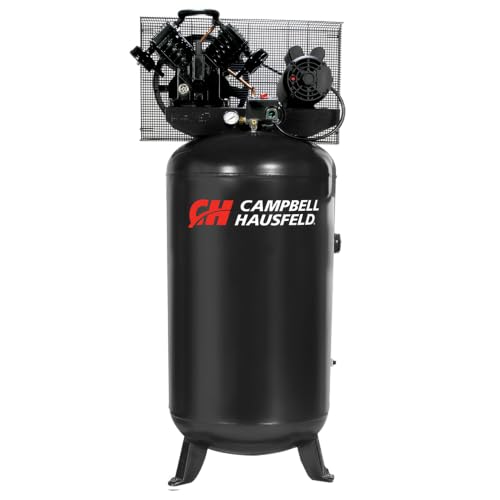
Campbell Hausfeld CE4104 Air Compressor
What We Like
- Large 80-gallon tank for extended work periods
- High-volume air delivery for demanding tools
- Durable cast-iron pump for long service life
- Single-phase power simplifies shop installation
Trade-offs
- Massive 460-pound weight requires permanent placement
- 84-inch height needs significant vertical clearance
An 80-gallon vertical tank stores a large volume of compressed air, which means you can run demanding tools longer before the motor needs to cycle on again. This compressor delivers 16.0 CFM at 90 PSI, a flow rate capable of supporting professional tasks like paint spraying, sanding, and grinding. Its vertical design also helps conserve floor space in a garage or shop, making it a practical choice for serious automotive repair work.
The trade-off is its substantial footprint and industrial heft. At 460 pounds and over seven feet tall, this isn’t a tool you’ll move around; it’s a shop cornerstone that needs a dedicated, level home with the proper 230V circuit.
Product photos
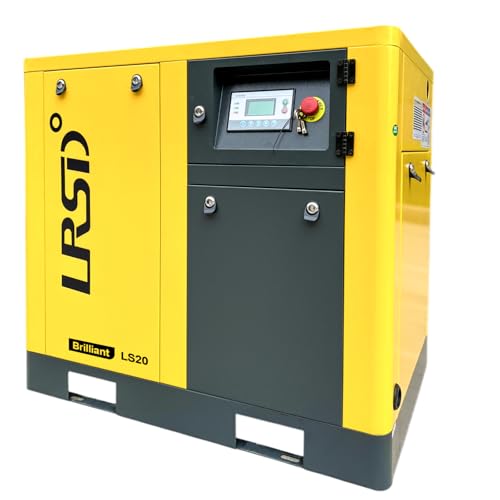
LRSD Rotary Screw Air Compressor
What We Like
- Precision screw rotor for low-noise, stable performance.
- Efficient air cooling prevents overheating during continuous use.
- Complete filtration system delivers clean, dry compressed air.
- Built for reliable 24/7 operation with consistent air flow.
Trade-offs
- Requires a 230V 3-phase electrical hookup; no single-phase option.
- Industrial design is not portable like a truck-mounted gas unit.
With a 75 CFM flow at 100 to 145 PSI, this LRSD compressor is designed for the continuous demands of workshop applications like sheet metal processing and sandblasting. Its rotary screw air end and efficient cooling system are built for long-hour operation, which avoids the frequent start-stop cycles of traditional piston compressors. This design aims to maintain stable output pressure with only slight airflow variation, making it suitable for shops that rely on a consistent air supply for production.
This compressor requires a dedicated 230-volt, three-phase power circuit, and the manufacturer specifies a converter is not allowed. That limits its use to facilities with that specific electrical service. Unlike a portable gas-powered unit like the MutsMover, this is a stationary compressor meant to be permanently wired in. It represents an infrastructure commitment for industrial continuous duty, not a plug-and-play tool for occasional tasks.
Product photos
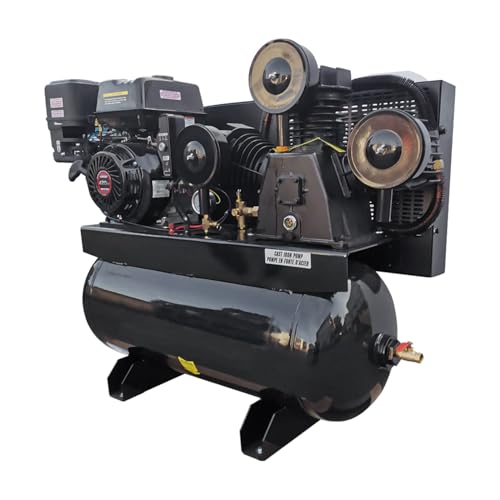
MutsMover Gas Powered Air Compressor
What We Like
- High 44 CFM output for demanding tools
- Gas engine enables true off-grid portability
- Truck-mounted design for mobile service
- Durable cast iron pump construction
Trade-offs
- Gas engine requires fuel, oil, and exhaust management
- 30-gallon tank is modest for continuous sandblasting
A 13HP gasoline engine drives this compressor, delivering up to 44 CFM, which the manufacturer states is for use with sandblasters and other demanding tools. Its truck-mounted design and gas power mean you can bring that air supply to remote sites or field repairs where electricity isn’t available. Built for a mechanic or contractor who needs air on demand away from an outlet, it uses a heavy-duty cast iron pump and an ASME-certified tank to handle the vibration of professional use.
The trade-off for that portability is the 30-gallon tank size, which will cycle the engine more during extended use compared to larger stationary units like the 80-gallon Campbell Hausfeld. It’s a workhorse for mobile operations, but if your shop has three-phase power, a unit like the LRSD Rotary Screw offers a higher 75 CFM output. For sandblasting where power is unavailable, this compressor provides a portable high-airflow option.
Product photos
VEVOR Gas Powered Air Compressor

What We Like
- Gas engine for remote site operation
- 33 CFM supports demanding air tools
- Dual outlets for running two tools
- Cast iron construction for durability
Trade-offs
- Weighs 271 pounds, requiring a solid surface to roll on.
- 115 PSI max pressure limits some high-end sandblasting nozzles.
- Horizontal tank design has a larger footprint than vertical units.
Its 33 cubic feet per minute air delivery at 115 PSI comes from a gas engine, which means it can operate away from electrical outlets on a jobsite. A 30-gallon tank provides a stable air reserve for two tools at once, reducing how often the pump needs to cycle. Four wheels allow this 271-pound unit to be rolled to where the work is, making it a mobile air source for construction or outdoor projects.
Moving the compressor requires a clear path, as its horizontal tank and substantial weight make it best suited for level ground. Compared to the gas-powered MutsMover model listed at 44 CFM, this unit delivers a lower air volume. The VEVOR’s combination of dual outlets, tank capacity, and portability offers a practical setup for varied pneumatic tasks where grid power isn’t available.
Product photos
DEWALT DXCM603 Air Compressor

What We Like
- High-pressure 175 max psi ASME tank
- Delivers 14.6 CFM at 90 PSI for continuous blasting
- Single-phase power suits most workshops
Trade-offs
- Stationary design lacks portability for mobile work
- Requires a dedicated 240V electrical circuit
A 175 max psi tank pressure is the key here. It provides the high-pressure reserve a sandblasting gun needs to maintain a consistent abrasive stream without constant motor cycling. This DEWALT is built for the serious hobbyist or small shop where you need to run a pressure pot blaster for decent stretches. The 60-gallon ASME tank and 5 HP motor are sized to keep up, and the single-stage pump is straightforward to maintain. It’s a workhorse for someone whose projects demand reliable, high-pressure air without stepping into industrial three-phase territory.
This compressor stands over five feet tall, so you need a workshop with the ceiling height and floor space to accommodate it permanently. It’s not something you’ll roll into a corner. For continuous, high-volume blasting, the larger Campbell Hausfeld CE4104 offers more air, but this DEWALT hits a sweet spot for pressure-focused tasks in a more common single-phase package. If your work is entirely on-site or you lack 240V power, you’d look at the gas-powered options instead.
How We Evaluated Air Compressors For Sandblasting
Our evaluation focused on technical specifications and documented performance from manufacturer data and expert sources. We prioritized delivered air volume (CFM) at a working pressure of 90 PSI, as this directly determines whether a compressor can sustain a sandblaster’s demand. Tank capacity, power source, and duty cycle design were also key factors.
The main criteria were airflow capacity for sustained blasting, pressure output to effectively propel abrasive, and overall durability for this demanding application. We also considered practical factors like portability and power requirements, as these dictate where and how you can use the machine.
This guide provides recommendations by comparing published product specifications and expert consensus with the known demands of sandblasting equipment.
What To Look For In Air Compressors For Sandblasting
Choosing the right compressor means looking beyond horsepower or tank size alone. You need a unit that can deliver a steady stream of high-pressure air to keep your blaster working effectively.
Focus on the compressor’s CFM (cubic feet per minute) output at 90 PSI, as this is the working pressure for most sandblasters. Ensure this number meets or exceeds your blaster’s requirement, and consider a larger tank or a continuous-duty design for longer work sessions.
Airflow (CFM) and Pressure (PSI)
The compressor’s CFM rating at 90 PSI is the most important number. Most sandblasters operate efficiently at 90 to 100 PSI, and if the compressor can’t deliver enough air volume at that pressure, you’ll experience frustrating pressure drops. A small blasting cabinet might need 10-20 CFM, while a large pressure pot blaster can require 50 CFM or more. Always check your specific sandblaster model for its air consumption requirement.
Duty Cycle and Tank Size
A compressor’s duty cycle indicates how long it can run before needing a cool-down period. For sandblasting, you ideally want a 100% duty cycle or a very large tank buffer. A large tank acts as a reservoir, allowing the compressor motor to cycle off and on while you continue blasting. However, a large tank alone cannot compensate for a compressor that produces less CFM than your blaster consumes; the pressure will eventually fall.
Power and Portability
Your work environment dictates your best power source. For a fixed workshop, a powerful 240V electric unit like our best overall offers quiet, reliable operation. For remote sites, a gas-powered compressor provides true portability, though it requires fuel and produces exhaust. Consider the unit’s weight and mobility; a wheeled portable gas compressor is very different from a stationary 80-gallon tank that requires a permanent installation.
- Check the voltage and amperage requirements against your available electrical service.
- For gas engines, factor in routine maintenance like oil changes and air filter cleaning.
- Ensure the unit’s physical dimensions and weight are manageable for your intended space.
- Verify the air connection type and size matches your blaster’s hose fittings.
- Listen for owner feedback on noise levels, especially for indoor shop use.
Always size your compressor to exceed your blaster’s CFM requirement to account for pressure loss in hoses and nozzle wear.
Air Compressors For Sandblasting Compared
The following table compares the key specifications of our top picks at a glance, focusing on the metrics that matter most for sandblasting.
| Product | Air Delivery (CFM @ PSI) | Max Pressure (PSI) | Tank Capacity | Motor/Power Source |
|---|---|---|---|---|
| Campbell Hausfeld CE4104 Air Compressor | 16.0 CFM at 90 PSI | 140 PSI | 80-gallon vertical ASME | 5 HP single-phase 208-230V |
| LRSD Rotary Screw Air Compressor | 75 CFM @ 100-145 PSI | N/A | N/A | 20HP 230V 3-Phase |
| MutsMover Gas Powered Air Compressor | 44 CFM | 125 PSI | 30-gallon ASME | 13HP gas engine |
| VEVOR Gas Powered Air Compressor | 33 CFM @ 115 PSI | 115 PSI | 30-gallon horizontal | 15HP gas engine |
| DEWALT DXCM603 Air Compressor | 14.6 cfm @ 90 PSI | 175 max psi | 60 gallons | 5 HP 208-230V Single Phase |
Frequently Asked Questions
What is the best air compressor for sand blasting?
The best air compressor depends on your specific needs. For a dedicated home workshop, our best overall, the Campbell Hausfeld CE4104, provides the high-volume air and large tank needed for extended work. For mobile contractors, the MutsMover Gas Powered Air Compressor offers off-grid capability with high CFM output.
What type of compressor is needed for sandblasting?
You need a compressor capable of delivering high air volume (CFM) at a sustained pressure of around 90 PSI. Reciprocating piston compressors are common for intermittent shop work, while rotary screw compressors are better for continuous, industrial-duty blasting. The required size of your air compressor is determined by your blaster’s nozzle and pressure settings.
What size compressor for a sand blaster?
There is no universal size; it depends entirely on your blaster’s air consumption. Start with the CFM requirement listed for your blaster’s nozzle at your intended operating pressure, then choose a compressor that exceeds that number. For light cabinet work, you might manage with 15-20 CFM, but for open blasting with a pressure pot, 30-50 CFM or more is typical.
What psi should you sand blast at?
Most abrasive blasting is performed efficiently between 90 and 100 PSI. Operating at this pressure ensures the abrasive has enough velocity to clean or strip surfaces effectively. Some industrial sandblasting equipment or specific applications may call for slightly higher pressures, but 90 PSI is a reliable baseline for sizing your compressor.
Can I use a small portable compressor for sandblasting?
You can, but only for very small, intermittent tasks like using a tiny blasting cabinet. Most portable compressors lack the sustained CFM output needed for meaningful sandblasting work. They will cycle constantly, cause pressure drops, and overheat quickly. For any substantive project, you’ll need a larger, more powerful unit designed for high air demand.
The Bottom Line
For most serious home restorers and small shop owners, the Campbell Hausfeld CE4104 Air Compressor is the best overall choice. Its high-volume output and large 80-gallon tank are built for the sustained demand of sandblasting, provided you have the floor space and a 230V outlet.
If your work takes you off-grid, look to the MutsMover Gas Powered Air Compressor for true portability and high CFM. For a fixed industrial setting requiring 24/7 operation, the LRSD Rotary Screw Air Compressor is the tool for the job. Ultimately, matching your compressor’s CFM output to your blaster’s requirement is the single most important step to a successful setup.
