
8 Best Arbor Presses in 2026
This post contains affiliate links. As an Amazon Associate, we earn from qualifying purchases.
Our best overall arbor press is the Dake Model 1 Single Leverage Arbor Press for its smooth, adjustable operation and durable open-frame design. We also highlight the budget-friendly VEVOR 1-Ton Manual Arbor Press for hobbyists and the high-force Dake Model 4 Compound Leverage Arbor Press for demanding shops.
Choosing the wrong press can leave you struggling with insufficient force, a cramped workspace, or an unstable tool that compromises your work. We built this guide by analyzing manufacturer specifications and owner feedback to help you find a press that fits your shop’s specific needs for capacity, space, and control.
Top 8 Arbor Presses in the Market
Certain content that appears on this site comes from Amazon. This content is provided "as is" and is subject to change or removal at any time.
The Best Arbor Presses, Reviewed
Dake Model 1 Single Leverage Arbor Press

What We Like
- Adjustable handle for comfortable grip and maximum leverage
- Ram cap can be adjusted with included shims to compensate for wear
- Smooth action gears enable fine control over ram movement
- Open base and slotted table support a wide variety of workpieces
Trade-offs
- At 130 pounds, it is not a tool you'll move around the shop casually
- Maximum working height of 11.5 inches limits taller projects
A single lever provides up to three tons of force, making this a press suited for stationary bench use. The smooth-action gears enable fine control over ram movement, which aids in careful positioning. An open base and slotted table plate provide support for solid objects and an outlet for arbors to pass through, accommodating various workpiece shapes. At 130 pounds, its heft contributes to stability during operation.
Generating its maximum force requires the full lever swing inherent to a single-leverage design. For a different mechanism, one could consider a ratcheting press from the other-products list, such as the Baileigh AP-3R. Compared to a half-ton press like the JET AP0-M, the Dake Model 1 has a higher force capacity and a larger overall size.
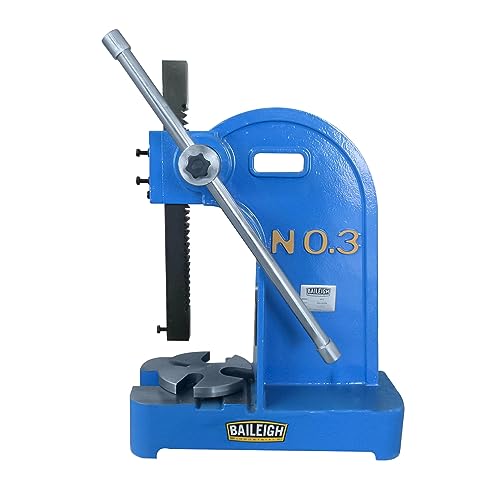
Baileigh AP-3 3-Ton Arbor Press
What We Like
- Large 12-1/2" maximum work height
- Solid 1-1/2" square ram for precise operation
- Machined four-position die plate for secure positioning
- Bottom die plate allows broaches to push through
Trade-offs
- At 108 pounds, it requires a sturdy, permanent mounting
- Non-ratcheting design demands more manual leverage for full 3-ton force
- Its 18-inch depth needs significant bench space
A 12-1/2 inch maximum working height is the key spec here, letting you press items that are simply too tall for most bench-top models. Combined with the 5-27/40 inch throat, this press is built for the larger assemblies, bearings, or broaching jobs that overwhelm smaller units. The rigid cast iron frame and case-hardened ram ensure the force goes into the work, not into flexing the tool. If your projects routinely involve hefty components, this is the straightforward, brute-strength option.
The trade-off is its heft and simplicity. At 108 pounds, you’re bolting it down for good. It also lacks a ratcheting mechanism, so you must provide all the leverage yourself on the single arm. For the same 3-ton capacity but with a mechanical advantage for tougher presses, you’d look at the ratcheting version like the Baileigh AP-3R. That model, however, has a much larger footprint. This AP-3 delivers maximum clearances in a relatively compact, no-frills package.
Dake Model 4 Compound Leverage Arbor Press

What We Like
- Compound leverage multiplies applied force
- Converts easily between leverage modes
- Cast iron frame for heavy-duty stability
- 12-ton capacity for demanding press work
Trade-offs
- No ratchet mechanism for precise incremental pressure
A 12-ton capacity supported by a cast iron frame allows this press to manage demanding bending or broaching tasks with minimal frame flex. Its compound leverage mechanism applies greater pressure with minimum effort on the handle, a design distinct from basic single-leverage models. The sliding pin enables conversion between compound and single leverage, stepping up pressure for heavier work.
Control involves a trade-off, as this model lacks the ratcheting mechanism found on presses like the Baileigh AP-3R or HHIP ratchet-type models. That design allows for fine, incremental adjustments under load. The Dake’s sliding pin offers a choice between two leverage modes, but tasks requiring precise, click-by-click advancement may need a dedicated ratcheting press.
Baileigh AP-3R Ratcheting Arbor Press

What We Like
- Ratcheting flywheel for precise, delicate setup
- Rigid cast iron frame eliminates flex
- Slideway adjusts tension and gap
- Bottom die plate accepts most broaches
Trade-offs
- At 170 lb, it requires permanent bench mounting
- 48-inch length demands significant shop floor space
The 3-ton capacity and ratcheting flywheel set this press apart for intricate work. That flywheel lets you nudge the ram down in tiny increments, which is critical when you’re aligning a delicate bushing or a precisely broached gear. It’s built for the user who needs control as much as raw force. The solid cast iron frame and hefty 170-pound weight mean it won’t shudder or drift when you’re applying full pressure, so your work stays exactly where you set it.
The trade-off for that stability and control is a substantial footprint; at 48 inches long, this isn’t a press you’ll tuck away on a shelf. Compared to the more compact Baileigh AP-3, you gain the ratcheting action but commit to a much larger, heavier tool. For general-purpose pressing where fine adjustment isn’t paramount, a standard lever press like the Dake Model 1 might be more maneuverable, but for detailed, repetitive pressing tasks, the AP-3R’s design is purpose-built.
HHIP 2-Ton Ratchet Type Arbor Press
What We Like
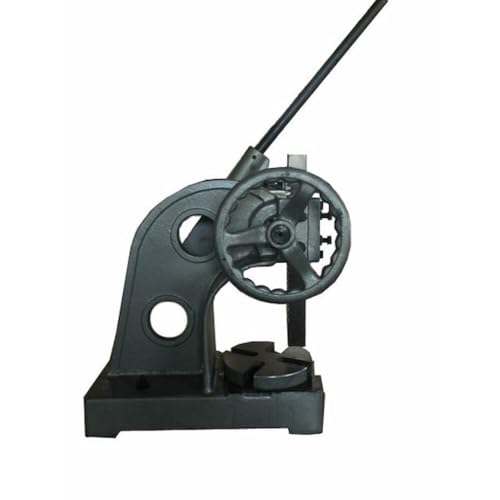
- Ratchet mechanism allows lever use in any position
- Includes a hand wheel for rapid ram advance
- Four-position anvil provides work flexibility
- Compact, heavy-duty cast iron frame
Trade-offs
- At 100 lbs, it requires a sturdy, permanent bench.
- 8-1/2" capacity over the table limits very tall workpieces.
The combination of a ratcheting lever and a dedicated hand wheel makes this 2-ton press uniquely efficient for repetitive tasks. You can swing the lever to the most comfortable spot and then use the wheel to quickly advance the ram down to the workpiece before applying precise, incremental force. It’s a smart fit for a shop doing consistent production work like stamping or broaching, where saving seconds on each cycle adds up. The four-position anvil and nearly 9.5-inch maximum work diameter handle a useful range of parts.
The HHIP arbor press requires a clear area over three feet wide for its lever swing, so it’s not a press you tuck into a corner. Its 61-inch length and 35.6-inch width demand dedicated floor space, unlike more compact half-ton models. For general workshop use where you need controlled force and value speed, the HHIP’s dual-action design with a hand wheel and ratchet lever is a practical advantage.
Product photos
VEVOR 1-Ton Manual Arbor Press

What We Like
- Includes three versatile drift molds for basic tasks
- Labor-saving lever principle for easier operation
- Durable cast iron construction with anti-rust coating
- Four-hole anvil plate secures various shaped items
Trade-offs
- 1-ton capacity limits it to light-duty materials
- 5.9-inch stroke restricts work on taller objects
With a one-ton maximum working pressure, this press is designed for controlled, small-scale tasks like stamping leather or forming jewelry. Its capacity suits hobbyists and light workshop duties where precision matters more than raw force. Three included molds and a 3.5-inch diameter anvil plate provide the tooling to start basic deformation and riveting immediately. The cast iron construction and 9.5 by 6.7-inch footprint result in a desktop unit built for long-term use on limited space.
The 5.9-inch maximum working stroke defines the vertical limit for any workpiece, confining it to smaller items. That one-ton force is intended for materials like aluminum and leather under ideal conditions, not for heavy-duty shop applications. For operations requiring greater force or height, other models like the 3-ton Dake Model 1 offer a larger capacity and frame.
VEVOR 3-Ton Ratchet Arbor Press

What We Like
- Ratchet lever multiplies force with less effort
- Includes three drifts for versatile forming work
- Four-hole anvil plate secures odd-shaped items
- Handwheel allows for smooth, precise height adjustment
Trade-offs
- At 99.2 lb, moving it requires planning and a sturdy bench
- No slotted table is mentioned for off-center pressing work
A three-ton capacity paired with a ratcheting lever means you can generate serious pressing force without needing a massive swing arc. That’s the core appeal here. It’s built for the shop tackling stubborn bearings, U-joints, or consistent metal forming where a standard lever press would require too much floor space for its handle rotation. The included drifts and a sizable anvil plate get you started on basic deformation work right out of the crate.
You’ll want to bolt it down permanently. For general-purpose bench work where a full lever swing isn’t an issue, the similarly-capacitied Dake Model 1 offers a slotted table for more flexible workpiece positioning, though it lacks the ratcheting mechanism.
Product photos
HHIP Pro-Series 2-Ton Arbor Press

What We Like
- Cast-iron construction for sturdy operation
- Removable anvil with four slot positions
- Base is pre-drilled for secure mounting
- Machined pinion drives the rugged steel ram
Trade-offs
- 2-ton capacity limits heavy-duty pressing tasks
A 2-ton capacity and a removable machined steel anvil make this press a standout for precise, repeatable bench work. The anvil’s four slot positions provide accurate support for different part shapes, which is crucial for tasks like aligning bearings or broaching keyways. Its cast-iron frame and drilled base deliver the solid, vibration-free foundation you need for clean punches and bends. This is the press for the meticulous machinist or gunsmith who values setup flexibility and rock-solid support over brute force.
With a 2-ton capacity, this arbor press handles common shop tasks like riveting and bending. Its sturdy cast-iron construction and base drilled for mounting keep it solidly anchored during use. The removable machined steel anvil offers accurate work support in four slot positions, adding versatility for different projects. A rugged steel ram is driven by a machined pinion in a standard single-leverage design.
Product photos
How We Evaluated Arbor Presses
This guide compares manufacturer specifications for capacity, frame construction, and physical dimensions. It highlights features that affect usability, such as ratcheting mechanisms for control, table configurations for workpiece support, and the overall footprint for shop space. Patterns in user feedback illustrate common strengths and trade-offs for daily use. While precise tonnage ratings or long-term durability cannot be independently verified, the key specifications and reported experiences are provided to inform your decision.
What To Look For In Arbor Presses
The right arbor press provides the necessary force in a stable, controllable package for your specific tasks. Key considerations are the press’s rated capacity, its physical size and mounting requirements, and the control mechanisms that allow for precise operation.
Look for a press with a capacity rating exceeding your toughest job, a sturdy frame that fits your workspace, and features like a ratchet or compound leverage for the control you need.
Capacity and Force
An arbor press’s tonnage rating is its maximum safe pressing force. A 1-ton press is suitable for light-duty work with soft metals, plastics, or leather, while 3-ton and 12-ton models handle pressing bearings, broaching, or heavy assembly. The mechanical advantage is also crucial; compound leverage presses multiply your input force for high-capacity work, while a simple lever requires more muscle. For heavy, repetitive tasks, understanding the difference between arbor and hydraulic presses is a critical first step.
Frame and Workspace
The press’s frame, typically cast iron, must be rigid to prevent flex under load. Physical dimensions dictate what you can work on: the “throat depth” is the distance from the ram to the column, and the “daylight” or maximum height is the clearance under the ram. A slotted or multi-position table provides flexibility for off-center work. Consider the tool’s footprint and weight; a 100+ pound press needs a permanent, sturdy bench, much like selecting a stable base for a stationary drill press.
Control and Features
Precision work benefits from features that enhance control. A ratcheting lever allows you to apply force in increments and work the handle from any position. A handwheel permits fast, fine adjustment of the ram height before applying pressure. Other useful features include a removable or slotted anvil for tooling, a bottom die plate for push-through broaching, and pre-drilled bases for secure mounting. For smaller shops, the space-saving benefits of a benchtop drill press mirror the need to consider a compact arbor press footprint.
- Check the base for pre-drilled mounting holes.
- Ensure the table has slots or holes to secure workpieces or tooling.
- Verify the stroke length is sufficient for your typical components.
- Confirm the handle design (straight, ball, ratcheting) for your comfort and control needs.
Match the press’s control features to the precision required by your most common task.
Arbor Presses Compared
The following table compares key specifications across our picks to help you see the differences at a glance.
| Product | Capacity | Max Working Height | Frame Material |
|---|---|---|---|
| Dake Model 1 Single Leverage Arbor Press | 3 tons | 11.5 inches | N/A |
| Baileigh AP-3 3-Ton Arbor Press | 3 tons | 12-1/2 inches | Cast Iron |
| Dake Model 4 Compound Leverage Arbor Press | 12-ton | N/A | Cast Iron |
| Baileigh AP-3R Ratcheting Arbor Press | 3 ton | 11 inches | Cast Iron |
| HHIP 2-Ton Ratchet Type Arbor Press | 2 Ton | 18-1/2" | N/A |
| VEVOR 1-Ton Manual Arbor Press | 1 Ton | 5.9 inches | Cast iron |
| VEVOR 3-Ton Ratchet Arbor Press | 3 ton | 12.2 inches | Cast iron |
| HHIP Pro-Series 2-Ton Arbor Press | 2 Ton | 18 inches | Cast iron |
Frequently Asked Questions
What is the best arbor press?
The best arbor press depends on your specific needs. For most general shop tasks requiring a balance of control, durability, and versatility, the Dake Model 1 Single Leverage Arbor Press is an excellent choice due to its smooth action and adjustable components.
Which RCBS press is considered the best?
RCBS is a renowned brand in reloading presses, but they are a different type of tool designed specifically for ammunition cartridge resizing and bullet seating. For metalworking tasks like broaching, bearing pressing, or assembly, a manual arbor press from brands like Dake, Baileigh, or VEVOR is the appropriate tool.
What can you do with a 1 ton arbor press?
A 1-ton arbor press is ideal for light-duty precision work. Common uses include pressing small bearings or pins, light broaching and punching in soft metals, riveting, setting grommets in leather or fabric, and small assembly tasks in model-making or jewelry crafting.
How much space does an arbor press need?
Arbor presses need a dedicated, sturdy bench space. Consider both the base footprint and the swing radius of the operating lever. Many presses weigh over 100 pounds and must be securely bolted down, so plan for a permanent location with enough clearance to operate the handle fully.
What is compound leverage on an arbor press?
Compound leverage uses a system of linked levers to multiply the force you apply to the handle. This allows a press like the Dake Model 4 to achieve a high 12-ton capacity with a manageable input force, making it suitable for demanding pressing, bending, and assembly jobs.
The Bottom Line
For a reliable, general-purpose press suitable for most shop tasks, the Dake Model 1 Single Leverage Arbor Press stands out with its fine control and durable build. Those on a budget should consider the VEVOR 1-Ton Manual Arbor Press, while shops needing to apply significant force to larger components will find a suitable option in the Baileigh AP-3 3-Ton Arbor Press.
Ultimately, the most important factor is matching the press’s rated capacity and physical size to the specific jobs you do most often. Investing in a press that’s either underpowered or overwhelmingly large for your workspace is a common mistake; let your project requirements guide your choice.
