
Arbor Press vs Hydraulic Press: Which Should You Buy?
This post contains affiliate links. As an Amazon Associate, we earn from qualifying purchases.
An arbor press is a manually-operated tool for precise, low-force jobs like installing bearings or broaching, offering direct tactile feedback. A hydraulic press uses fluid power to generate immense force for heavy-duty tasks like bending metal or pressing large assemblies, sacrificing some operator feel. For most home workshops, an arbor press is the practical first buy; a hydraulic press is an upgrade for high-tonnage needs.
The difference isn’t just about power. It’s about the kind of control your hands have over the work. With an arbor press, you feel every bit of resistance through the lever. A hydraulic press does the heavy lifting for you, but you trade that intimate feedback for raw force.
What follows is a breakdown of where each press wins, a clear guide on matching tonnage to your actual jobs, and the safety trade-offs nobody mentions until they’ve pinched a finger or blown a seal. By the end, you’ll know which one belongs in your shop first, and when owning both stops being a luxury and starts making sense.
Key Takeaways
- Choose an arbor press for jobs under 5 tons that need precision and feel, like bearing installation or broaching keyways.
- A hydraulic press is for force above 10 tons, where bending thick steel or straightening a shaft is the goal, not finesse.
- The “feel” is an essential safety feature on an arbor press; you sense binding before parts break. A hydraulic press lacks this and requires strict pressure monitoring.
- Most home shops outgrow a 1-ton arbor press fast. A 3-ton model is a better starting point for automotive and general machining work.
- Hydraulic press frames are not all equal. An H-frame design offers superior stability for off-center loads compared to many open-throat hydraulic models.
Arbor Press vs Hydraulic Press: The Core Differences
Forget the spec sheet war. The real split in the arbor press vs hydraulic press question is how they translate your effort into force. An arbor press is a simple mechanical amplifier. You pull a lever, which turns a pinion gear, which drives a rack and pinion to push the ram down. Every ounce of resistance comes straight back to your hand. A hydraulic press uses a pump to push fluid into a cylinder, moving the ram. The force multiplication is enormous, but the fluid column dampens the feedback. You’re operating a system, not feeling the part.
An arbor press provides direct tactile feedback through its manual lever and gear mechanism, allowing the operator to sense binding or misalignment instantly. A hydraulic press generates force via a fluid-powered cylinder, which can introduce a slight lag and dampen the physical feedback from the workpiece, making it less suited for delicate, feel-dependent operations.
That difference in feel dictates everything. It decides what you can safely press, how you set up the job, and what your failure mode looks like. A binding bearing in an arbor press sends a clear “stop” signal up the lever. In a hydraulic press, you might not feel that same bind until the hydraulic pressure spikes and something, the bearing, the housing, or the tooling, cracks.
Force and Control: The Trade-Off
This is the central trade-off. That’s its ceiling. A hydraulic press starts where the arbor press leaves off, commonly ranging from 10 tons to 50 tons for shop models, and going into the hundreds of tons for industrial use. But more power isn’t free. You sacrifice the direct link between your muscle and the work.
The arbor press gives you control at the expense of power. You are the pressure gauge. If a bushing starts to cock sideways, you feel the lever get jerky, not smooth. You stop, realign, and try again. This is why they’re the default for broaching, pushing a serrated tool through a hole to cut a keyway. If the broach binds, you feel it immediately and can back off before snapping a hundred-dollar tool.
The hydraulic press gives you power at the expense of control. You set a pressure limit on the gauge (if your model has one), and the system applies that force relentlessly. It’s fantastic for jobs where the goal is “move this metal,” like straightening a bent axle or pressing a bushing into a backhoe linkage. But for seating a tiny needle bearing in a fragile aluminum housing? That’s where the lack of feel turns a simple job into a scrap-making exercise.
Where Each Press Earns Its Keep
Don’t think of these as interchangeable tools in the arbor press vs hydraulic press debate. They’re specialized for different ends of the force-finesse spectrum. Assigning jobs to the wrong press is how you break things.
The Arbor Press’s Domain: Precision and Feedback
This is your go-to for any job where the cost of a mistake is higher than the time it takes to do it carefully.
- Bearing and Bushing Installation/Removal: This is the classic use. An arbor press applies clean, vertical force. It’s the antidote to the hammer, which can dent bearing races and shock components. For pressing a wheel bearing into a hub or a bushing into a control arm, it’s unmatched. You can use a ratcheting model for repetitive work, but the standard manual arbor press gives the purest feedback.
- Broaching: As mentioned, cutting internal keyways or splines is a perfect arbor press job. The process is all about detecting bind, and your hand on the lever is the best sensor you have.
- Staking and Pin Seating: When you need to deform a tiny bit of metal to lock a pin or secure a sleeve, you need pinpoint force. An arbor press concentrates pressure exactly where the ram hits, preventing the surrounding material from distorting.
- Light Forming and Assembly: Pressing pins into linkages, seating valve guides in a cylinder head, or even light-duty riveting are all in its wheelhouse.
Common mistake: Using an arbor press for a job that needs more tonnage. You’ll bend the press frame or, more likely, stall the ram. If the lever won’t budge with your full weight on it, the job needs a hydraulic press.
The Hydraulic Press’s Domain: Brute Force
When the objective is to overcome the material’s resistance, not dance with it, you reach for the hydraulic press.
- Metal Bending and Forming: Bending a steel bracket, flattening a piece of bar stock, or forming sheet metal, these jobs need sustained, high force.
- Straightening Shafts and Axles: A bent driveshaft or axle needs tons of force applied steadily to coax it back straight. An arbor press simply can’t deliver the required tonnage.
- Heavy-Duty Bushing and Bearing Work: Think tractor linkages, heavy machinery pivot points, or large-diameter bearings. The interference fit is too great for an arbor press’s mechanical advantage.
- Pressing and Punching in Industrial Contexts: For production work like punching holes in plate steel or pressing together large sub-assemblies, the hydraulic press’s speed and power are essential.
While a hydraulic press can do some of an arbor press’s jobs, it’s often overkill. Using a 20-ton press to install a small bearing is like using a sledgehammer to drive a finish nail, you might get it done, but you’re working harder to avoid a disaster.
How to Choose: A Tonnage and Use Case Guide
The most common question isn’t “which press?” but “how much press do I need?” To be clear: the tonnage rating is the maximum force the press can theoretically apply. Your real need is usually lower.
| Your Project | Minimum Tonnage Needed | Best Press Type | Why |
|---|---|---|---|
| Installing alternator bearings, small bushings | 1–3 tons | Arbor Press | Requires feel to avoid cocking and damaging the soft bearing housing. |
| Broaching a 1/2″ keyway in steel | 2–4 tons | Arbor Press | Critical to feel broach bind to prevent tool breakage. |
| Straightening a bent 1″ steel rod | 10+ tons | Hydraulic Press | Arbor press lacks the sustained force; needs hydraulic power. |
| Pressing a large tractor pivot bushing | 15+ tons | Hydraulic Press | High interference fit demands force only a hydraulic system can provide. |
| General garage/DIY shop (first press) | 3-ton Arbor | Arbor Press | Handles 90% of automotive and machinery repair jobs a home shop encounters. |
The 3-ton arbor press is the sweet spot for a first shop press. A 1-ton model sounds sufficient, but you’ll outgrow it the first time you try to press a stubborn wheel bearing. The 3-ton has the heft for most light truck and car work, and the frame is rigid enough to handle occasional off-center loads without complaining. I learned this after stalling my first 1-ton press on a simple bushing job; the 3-ton model I replaced it with hasn’t flinched at the same task in years.
For a hydraulic press, don’t get sucked into the “more is better” trap. A 20-ton H-frame press is a monster for a home shop. A 12-ton model is often plenty unless you’re working on heavy equipment. The limiting factor often becomes the throat depth, the distance from the ram to the frame. An open-throat hydraulic press gives you more room for wide objects, while an H-frame design, common on many hydraulic tools, offers incredible stability at the cost of some access.
Safety, Feel, and the Risk of Getting It Wrong
Safety on these tools isn’t just about guards and glasses. It’s built into their operation.
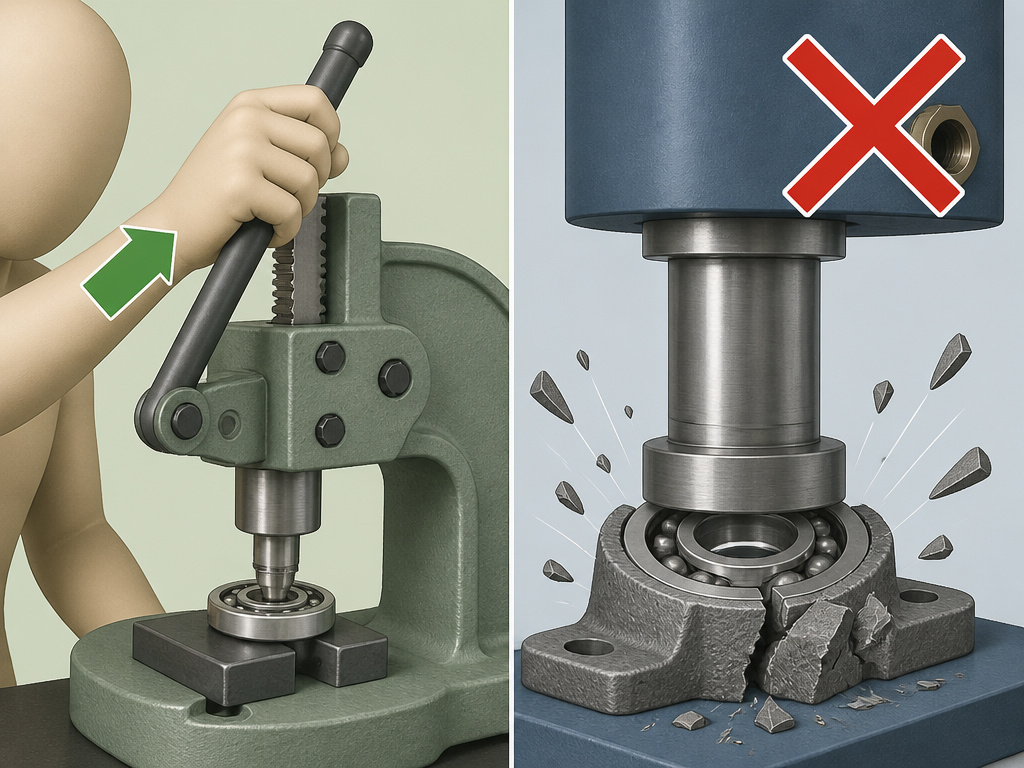
Arbor press safety is tactile. Your hand on the lever is the primary safety device. If something binds, you feel it and stop. The risks are pinch points and the rare chance of a rack-and-pinion failure under extreme overload. Always use proper tooling, don’t just stack sockets and hope. A dedicated guide on arbor press setup is worth reading before your first use.
Hydraulic press safety is procedural. You can’t feel a bearing about to crack. You rely on pressure gauges, mechanical stops, and careful setup. The risks are higher: hydraulic fluid injection from a leaking hose is a serious injury, and overpressure can turn a workpiece into shrapnel. The frame must be on a solid, level floor. The slow, relentless force of a hydraulic ram is deceptive; it doesn’t look dangerous until it is.
Where this goes sideways: Using a hydraulic press for a precise bearing job without a pressure gauge. You’ll apply way too much force, crack the bearing race or housing, and send sharp metal fragments flying. The repair cost instantly exceeds the price of a proper arbor press.
The “feel” of an arbor press isn’t a luxury. For tasks like bearing installation, it’s the whole game. You develop a sense for when the bearing is fully seated, there’s a distinct change in resistance. Without that feedback, you’re guessing, and with press-fit parts, guessing usually ends in breaking.
Modifications, Hybrids, and the Used Market
The line between these presses isn’t always hard. People modify them, and hybrid models exist.
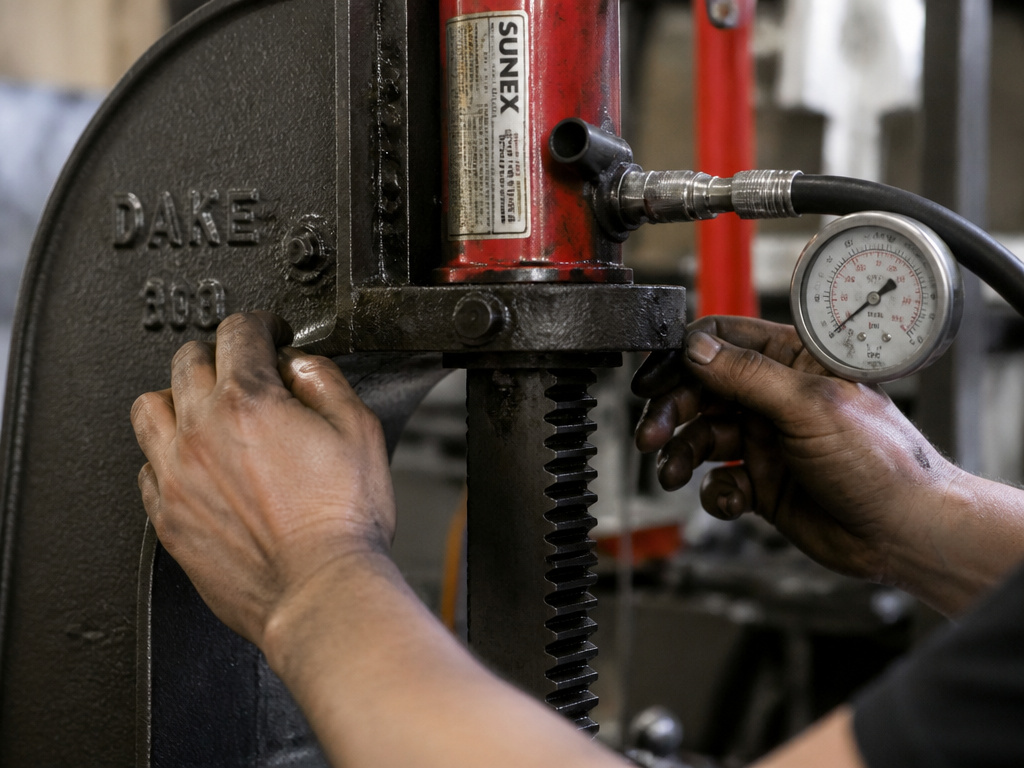
Modifying an Arbor Press: The most common mod is adding a hydraulic or air-over-hydraulic jack to the ram. This creates a “hybrid” press, you get the fine control and frame of an arbor press with the sustained power of hydraulics. It’s a great upgrade for shops that do a mix of precise and heavier work. You can also add a pressure gauge to the hydraulic line, bringing some quantitative feedback to the system.
The KR Wilson and Similar Hybrids: These are purpose-built combination presses, often with a manual arbor press action on one side and a hydraulic ram on the other. They’re the “best of both worlds” but are niche, often expensive, and typically found on the used market. For a generalist shop, they can be a brilliant single-tool solution.
Buying Used: This is where you can find incredible value, but you must inspect carefully.
- Arbor Press: Check the rack and pinion teeth for chips or wear. Look for cracks in the cast iron frame, especially around the base and the column. Ensure the ram moves smoothly without side play.
- Hydraulic Press: The jack is the heart. Pump it to full extension and let it sit, any significant settling indicates worn seals. Check the frame for welds or repairs, which can indicate past overload. Look for rust in the cylinder reservoir. A clean, well-maintained used press from a known brand like Precision Matthews or Grizzly can be a much better deal than a new, low-quality import. The used market for arbor presses is particularly active among machinists upgrading their shops, with many top-rated models available.
Cost Comparison
For a shop on a budget, the initial price tag is a major deciding factor. Arbor presses are fundamentally simpler machines with fewer moving parts, which translates to a significantly lower upfront cost. They are an accessible entry point for basic pressing tasks. Hydraulic presses, with their pumps, cylinders, and valves, involve more complex engineering and materials, commanding a higher purchase price. When considering cost, also factor in the potential for hydraulic systems to require fluid and seal maintenance over their lifespan, whereas an arbor press is largely maintenance-free beyond basic lubrication.
Space/Footprint Considerations
Shop space is prime real estate. Arbor presses have a clear advantage here, as their compact and self-contained design allows them to fit on a benchtop or a small standalone stand. They don’t need clearance for swing arms or large pump assemblies. A hydraulic press requires a more substantial footprint to accommodate its frame, pump location, and the full range of ram travel. You need to plan for a dedicated floor space, considering not just the press’s base but also the area needed to safely maneuver workpieces into and out of the press bed.
Frequently Asked Questions
What is an arbor press good for?
An arbor press is ideal for any job requiring controlled, precise force and operator feedback. Its best uses are installing and removing bearings and bushings, broaching keyways, staking pins, and other light assembly work where feeling the resistance prevents damage to expensive components.
What are the disadvantages of a hydraulic press?
The main disadvantages are a lack of direct tactile feedback, making it less suitable for delicate work, and generally higher cost and maintenance. Hydraulic systems can leak, require fluid, and need more space than a comparable arbor press. They can also be slower to set up for simple jobs.
Can I use a hydraulic press for broaching?
You can, but it’s not ideal. Broaching relies on the operator feeling the broach bind in the cut. The dampened feedback of a hydraulic system makes it harder to detect this binding, increasing the risk of snapping the expensive broach tool. An arbor press is the recommended tool for broaching.
How many tons do I need for a home shop?
If you plan on straightening axles, bending thick metal, or other heavy-duty work, a 10- to 20-ton hydraulic press is a logical addition. Start with the arbor press.
Is a ratcheting arbor press better than a manual one?
A ratcheting mechanism allows work in confined spaces or on a press with a short lever stroke, as you can reset the lever without losing ram position. It’s more convenient for repetitive production work. However, some machinists prefer the pure, uninterrupted feel of a smooth, continuous lever on a manual press for delicate tasks.
The Bottom Line
In practice, most home shops don’t need a hydraulic press first. They need an arbor press. They need an arbor press. The jobs that demand real hydraulic tonnage, bending one-inch plate, straightening tractor parts, are rare for the average DIYer. The jobs that need feel and precision, pressing in a wheel bearing, fixing a transmission bushing, come up all the time.
So, if you’re equipping a garage or home workshop, buy a solid 3-ton arbor press first. Learn to use an arbor press safely and effectively. You’ll use it constantly. The day you find yourself needing to straighten a bent trailer axle or crush a bearing race out of a massive housing, that’s the day you start shopping for a 12- or 20-ton H-frame hydraulic press. By then, you’ll know exactly what you need it for, and the arbor press will still be on the bench, handling the precise work the hydraulic press shouldn’t touch.
That’s the real workshop hierarchy. One isn’t better than the other; they’re a team. But you build the team in the right order.
