
8 Best Band Saw Blades in 2026
This post contains affiliate links. As an Amazon Associate, we earn from qualifying purchases.
The best band saw blade for most woodworkers is the POWERTEC 80 Inch Bandsaw Blades Assortment, which provides a versatile set for curves, ripping, and resawing. For cutting metal, choose the Lenox Classic Tuff Tooth Bimetal Blade, while the POWERTEC 93.5 Inch Bandsaw Blades Assortment offers great value for common 14-inch saws.
A poor blade choice leads to rough cuts, broken blades, and frustration. The right blade transforms your saw’s performance for specific tasks.
We researched specifications, manufacturer data, and patterns in owner feedback to find blades that deliver. This guide will help you match a blade to your saw and your most common work.
Top 8 Band Saw Blades in the Market
Certain content that appears on this site comes from Amazon. This content is provided "as is" and is subject to change or removal at any time.
The Best Band Saw Blades, Reviewed
POWERTEC 80 Inch Bandsaw Blades Assortment

What We Like
- Three versatile widths for different cuts
- Covers scroll, curve, and resawing tasks
- Heat-resistant welding for durability
- Precision tooth geometry for clean cuts
Trade-offs
- Only fits 80-inch band saws, limiting compatibility
- No blade wider than 3/8 inch for heavy resawing
A single pack containing three different blades allows a woodworker to handle scroll work, curves, and straight cuts without buying separate blades. The 1/8-inch blade with 14 teeth per inch is designed for producing tight curves, while the wider 1/4- and 3/8-inch blades with fewer teeth are suited for resawing and rip cuts. Made from premium high grade carbon steel with unique welding for heat resistance, this construction aims for durability during extended use on hardwoods and plastics.
These blades are intended for cutting hard and soft woods, plastic, and non-ferrous metals. The set is specifically designed for band saws that use an 80-inch blade length, so verifying your saw’s required size is essential before purchase. For saws requiring a different length, such as 93.5 inches, a different assortment like the POWERTEC 93.5 Inch set would be needed.
Product photos
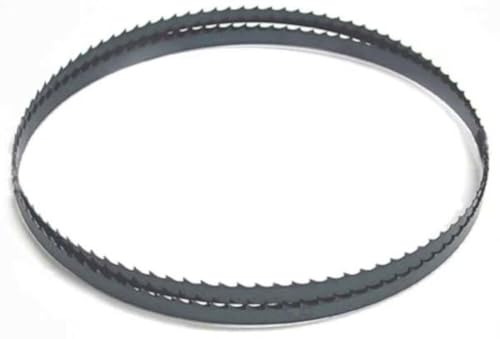
Olson Saw HEFB 3/16 Inch Skip Tooth Blade
What We Like
- Works on a wide range of materials
- Fits common 14-inch stationary band saws
- Heavy-duty, commercial-grade construction
Trade-offs
- At 4 TPI, it leaves a rougher cut in fine woods
- 93.5-inch length is specific to 14-inch saws only
With only four teeth per inch in a skip pattern, this blade clears material quickly, which suits the mixed hard and soft woods, plastics, and metals listed for it. Olson markets it as a heavy-duty, commercial-grade blade for industrial, DIY, and professional use on 14-inch vertical band saws. Its construction is intended for users who need a durable blade for demanding projects across those material types.
The 4 TPI count is substantially lower than blades like the Lenox Diemaster 2, which offers 10-14 TPI for finer cuts. This Olson model is specified exclusively for 14-inch stationary two-wheel band saws, so verifying your saw’s size is essential. According to the manufacturer, it is designed for use on several material categories, not just one.
Product photos
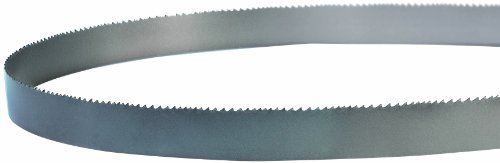
Lenox Classic Tuff Tooth Bimetal Blade
What We Like
- Bimetal construction cuts steel and nonferrous metals
- M-42 steel tooth edge resists heat and wear
- Tuff tooth design reduces tooth strippage
- Wavy set prevents stripping on thin workpieces
Trade-offs
- The 0.035-inch thickness requires a saw that accepts it.
- A 93-inch length fits specific saws, not universal machines.
An M-42 high-speed steel tooth edge gives this blade the heat resistance needed for tough alloys and stainless steel without dulling prematurely. That makes it a natural choice for anyone regularly slicing through structural shapes, tubes, or solid bars in a metal shop. Its bimetal build and wavy tooth set are engineered to handle the stress of cutting thin-walled materials, so you spend less time dealing with stripped teeth and more time making precise cuts.
With 18 teeth per inch, this Lenox blade is built for clean cuts in metal, not for wood. Its high tooth count produces a smooth finish on steel and aluminum, but it will clog and cut slowly in softer materials. This bimetal design focuses entirely on metalworking, sacrificing versatility for durability in its specific role.
Product photos
Lenox Diemaster 2 Vari-Raker Blade

What We Like
- Vari-tooth design for faster, smooth cuts
- Bimetal construction cuts wood and metals
- Versatile for solids, tubes, and sheets
- Good for contoured cutting applications
Trade-offs
- At 64.5 inches, it won't fit longer-throat saws
The bimetal construction is the key here, letting one blade handle everything from aluminum to stainless steel without a swap. That versatility, combined with the vari-raker tooth set, makes it a true shop workhorse for the user who needs to cut mixed materials on a single machine. It’s built for the job where you might need to trim a piece of oak, then slice through some angle iron, and you don’t want to stop and change blades every time.
As a general-purpose bimetal blade, its versatility across materials is the core advantage. It cuts wood, aluminum, nonferrous metals, carbon steel, alloy steel, tool steel, structural steel, and stainless steel, allowing a single blade to transition between different project phases. The Vari-raker set and Vari-tooth design are intended for faster cutting rates and smooth cuts in solid shapes, tubes, structural shapes, and sheets, which suits a mixed-material workflow over specialized single-material tasks.
Product photos
Timber Wolf Alloy Steel Bandsaw Blade

What We Like
- Milled teeth are 50% sharper for aggressive cuts
- More ductile alloy steel improves flex life
- Thin kerf design reduces waste and power demand
Trade-offs
- Specific 93.5" length fits only compatible saws
- 6 TPI tooth count is coarse for fine veneer work
The key advantage of this Timber Wolf blade is its induction-hardened alloy steel, which makes the tooth edge 20% harder than standard high carbon steel. That translates directly to a blade that stays sharp through more linear feet of cutting, whether you’re breaking down green lumber or shaping thick hardwoods. It’s a smart pick for the woodworker who gets frustrated with blades that dull too quickly on demanding projects and wants to minimize blade changes. The milled teeth start out sharper, and the more ductile steel body resists fatigue from the tension and curves of the saw, leading to a cooler, smoother-running operation.
You’re trading some versatility for that longevity, as this is a dedicated wood-cutting blade. For resawing thick stock into thin boards, its aggressive 6 TPI tooth pattern and thin kerf are excellent, but you’d want a finer blade for intricate curves in thinner material. The alloy steel construction focuses on wear resistance over the extreme toughness of a bimetal blade meant for mixed materials. It’s a specialist that excels at its core task, backed by manufacturing details that explain why it’s a frequent recommendation from seasoned workshop voices.
POWERTEC 93.5 Inch Bandsaw Blades Assortment
What We Like
- Assortment covers scroll cuts to resawing.
- Carbon steel build for durability.
- Heat-resistant welding for performance.
- Fits a wide range of popular 14" saws.
Trade-offs
- Carbon steel, not bimetal, limits metal-cutting.
- 93.5" length is not adjustable for other saw sizes.
This three-blade assortment gives you the essential widths for a 14-inch bandsaw right out of the box. You get a 1/8-inch blade for tight scrollwork, a versatile 1/4-inch blade for general curves, and a 1/2-inch blade for resawing and rip cuts. It’s a pragmatic starting kit for a woodworker who wants to handle most common tasks without buying blades individually. The carbon steel construction and specific welding are designed for longevity in wood, plastic, and non-ferrous metals, making it a solid foundational set.
These blades are made from premium high-grade carbon steel, which provides long-term durability for cutting wood, plastic, and non-ferrous metals. Their construction is not bimetal, so they are not intended for cutting ferrous materials like steel. For a dedicated woodshop, the set efficiently covers tasks from resawing to creating tight curves with its included scroll blade.
Product photos
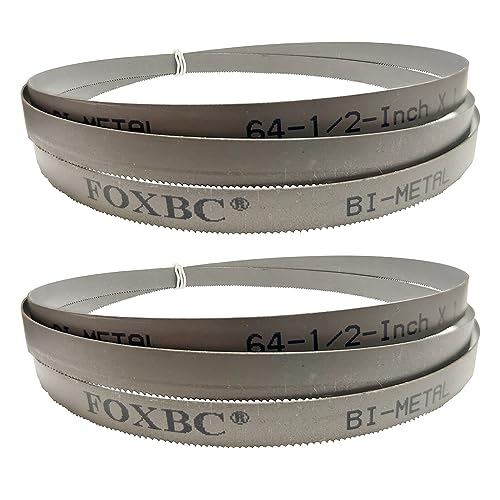
FOXBC 64.5 Inch Metal Cutting Bandsaw Blades
What We Like
- Bi-metal M42 steel with 8% cobalt for durability.
- 24 TPI blade cuts diverse metals and some plastics.
- Compatible with many popular 4×6 horizontal/vertical saw models.
- Two-pack provides immediate backup or different material setup.
Trade-offs
- 64.5-inch length is specific, won't fit common 14-inch woodworking saws.
- 24 TPI is a fine cut, slower for thick solid stock.
A 64.5-inch bi-metal blade in a two-pack is the core value for anyone running a small metal-cutting bandsaw like a Harbor Freight or Wen 3970. The M42 steel with its 8% cobalt content is a serious spec for the money, promising to hold an edge longer through stainless and tough alloys. This makes it a smart, affordable stockpile for a garage shop where the saw sees intermittent but demanding use on mixed materials from aluminum to hard plastics. You get a spare on the shelf, minimizing downtime when the first blade finally goes.
The trade-off is specialization. This blade’s 24 TPI provides a smooth finish but demands a slower feed rate on thick material compared to a coarser blade. A variable-tooth blade would be the faster choice for heavy structural steel. For the hobbyist or maintenance pro cutting a bit of everything on a budget saw, however, the FOXBC pack delivers capable, general-purpose performance without a premium investment.
Product photos
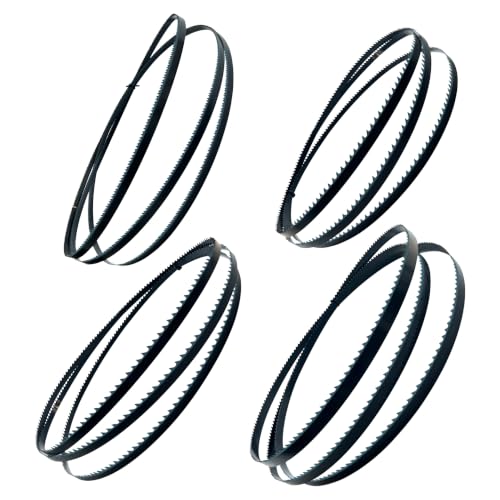
FOXBC 80 Inch Blades Assortment
What We Like
- Four-blade assortment covers three versatile widths
- Induction-hardened teeth for extended blade life
- Optimized tooth geometry for smoother cutting
- Compatible with several common 12" band saw models
Trade-offs
- 80-inch length incompatible with popular 14" saws
- Carbon steel material less durable than bimetal alternatives
An 80-inch length means this four-pack is purpose-built for specific 12″ band saws like the Craftsman 137.224320 or older Atlas models. For a new owner of one of those saws, the assortment is a clever launch point. It delivers a 1/4-inch blade for tight curves, a 3/8-inch for general purpose work, and a 1/2-inch for resawing, all made from wear-resistant carbon steel. You get a practical toolkit of blades ready to handle hardwoods, plastics, and non-ferrous metals right out of the gate, which is exactly what a starter pack should be.
The trade-off is in the material choice. While the hardened teeth resist wear, carbon steel doesn’t have the same longevity or heat tolerance as a bimetal construction. A bimetal blade would be a better choice for someone cutting abrasive materials or demanding professional use. But for the home workshop user with a compatible 12″ saw, this FOXBC pack offers a straightforward, affordable path to getting the right blade on the saw for the job at hand.
Product photos
How We Evaluated Band Saw Blades
Our evaluation began with manufacturer specifications for materials, tooth geometry, and compatible saw lengths. We then examined expert round-ups and shop forums to identify brands and models consistently praised for performance and durability.
We prioritized three key criteria. First is material and construction, which determines if a blade can handle wood, metal, or both. Next is tooth design and TPI, which control cut speed, finish, and the ability to cut curves. Finally, proper sizing for your specific saw model is critical, as a mismatched length is useless. Our research into using a band saw reinforces that a well-chosen blade is the most critical factor for good results.
A research-led evaluation has limits. We cannot replicate the long-term wear testing of blades in a personal shop, so our findings rely on documented patterns in owner feedback and expert consensus over time.
What To Look For In Band Saw Blades
Choosing a band saw blade means matching its physical traits to your material and your machine. Ignoring compatibility guarantees poor performance.
Focus on three things. The blade material matters, like carbon steel for wood or bimetal for mixed use. Teeth per inch, or TPI, is also key, with a low count for fast cuts and a high count for smooth finishes. Finally, you need the exact length your saw requires. Width determines how tight a curve you can cut.
Material and Construction
Blade material dictates what you can cut. Carbon steel blades are affordable and very sharp, making them excellent for general woodworking, but they dull quickly on metal. For cutting steel, aluminum, or mixed materials, a bimetal blade is essential. These blades weld a hard, heat-resistant tooth edge to a flexible alloy steel back, offering far greater durability. For dedicated metal cutting blades, a high-cobalt bimetal construction is the standard.
Tooth Design and TPI
Tooth geometry controls the cut. Teeth Per Inch (TPI) is the primary factor: a blade with 3-4 TPI cuts aggressively and is good for resawing thick stock, while a 10-14 TPI blade leaves a smoother finish on thinner materials. For cutting curves, a narrower blade with a skip-tooth design (widely spaced teeth) clears sawdust efficiently. A Vari-Tooth or Vari-Raker design mixes tooth groupings to reduce vibration and handle a wider range of material thicknesses smoothly, which is a key feature in versatile bandsaw blades.
Size and Compatibility
A blade must physically fit your saw. The length is non-negotiable; an 80-inch blade will not fit a saw built for 93.5-inch blades. Width affects cutting radius, a 1/4-inch blade can cut much tighter curves than a 1/2-inch blade, and stability, with wider blades excelling at straight-line resawing. Thickness also matters, as some saws cannot tension a very thick blade properly. Always consult your saw’s manual for its specific requirements before purchasing.
- Check your manual for the exact blade length, width range, and maximum thickness your saw accepts.
- Measure your old blade from end to end if the manual is unavailable.
- Know your common tasks to select width: narrow for scrollwork, wide for resawing, mid-width for general use.
- Consider a multi-pack if you’re new, to have blades for different jobs on hand.
- Prioritize a proper fit over any other feature; a perfect blade of the wrong length is worthless.
The right blade makes your saw feel like a new tool. Start by confirming the exact length you need.
Band Saw Blades Compared
The table below compares the key features of our top picks at a glance. Use it to quickly match blade specs to your project needs.
| Product | Blade Length | Material | Teeth Per Inch (TPI) | Blade Width |
|---|---|---|---|---|
| POWERTEC 80 Inch Bandsaw Blades Assortment | 80 inches | High grade carbon steel | 14TPI, 6TPI, 4TPI | 1/8", 1/4", 3/8" |
| Olson Saw HEFB 3/16 Inch Skip Tooth Blade | 93-1/2 inches | N/A | 4 TPI | 3/16 inch |
| Lenox Classic Tuff Tooth Bimetal Blade | 93 inches | Bimetal | 18 TPI | 3/4 inch |
| Lenox Diemaster 2 Vari-Raker Blade | 64.5 inches | Bimetal | 10-14 TPI | 1/2 inch |
| Timber Wolf Alloy Steel Bandsaw Blade | 93-1/2" | Alloy Steel | 6 TPI | 1/4" |
| POWERTEC 93.5 Inch Bandsaw Blades Assortment | 93.5 inches | Premium high-grade carbon steel | 6TPI, 14TPI | 1/8", 1/4", 1/2" |
| FOXBC 64.5 Inch Metal Cutting Bandsaw Blades | 64.5 inches | Bi-Metal M42 | 24 TPI | 0.5 inches |
| FOXBC 80 Inch Blades Assortment | 80 inches | Carbon steel | 6, 10, 14 TPI | 1/4", 3/8", 1/2" |
Frequently Asked Questions
What are the best quality bandsaw blades?
Quality depends on your material. For woodworking, blades from brands like Timber Wolf and Highland Woodworking are consistently praised for sharpness and durability. For cutting metal, Lenox bimetal blades are a top choice. The best quality for you is the blade specifically engineered for your primary task, whether that’s selecting a blade for wood or steel.
Who makes the best quality saw blades?
Several manufacturers have strong reputations among professionals. Lenox is renowned for its durable bimetal blades for metal and mixed materials. For wood, brands like Timber Wolf, Olson, and blades sold by specialty retailers like Highland Woodworking receive high marks. The “best” often comes down to the specific application and saw compatibility.
What is the most useful bandsaw blade size?
A 1/4-inch width with 6 teeth per inch (TPI) is often cited as the most versatile single blade for woodworking. It’s narrow enough for moderate curves yet wide enough for straight cuts, making it a great general-purpose choice for a shop that doesn’t want to constantly change blades.
What bandsaw blade is best for cutting steel?
A bimetal blade with a high-speed steel tooth edge is mandatory for cutting steel. Look for blades specifically labeled for metal cutting, like the Lenox Classic Tuff Tooth. The tooth count should match your material thickness; a lower TPI (like 10-14) for thicker solid stock and a higher TPI (18-24) for thin-walled tubing or sheet metal.
How often should I change my band saw blade?
Change your blade when you notice a decline in performance: cutting becomes slower, requires more force, or leaves a much rougher surface. For a busy shop, this could be weekly; for a hobbyist, it might be every few months. Dull blades produce more heat and increase the risk of breaking, so don’t push a blade too far past its prime.
The Bottom Line
For a woodworking shop needing a versatile, ready-to-use set, the POWERTEC 80 Inch Bandsaw Blades Assortment is our best overall pick. Its combination of widths handles most common tasks from curves to resawing.
If you’re on a budget or own a popular 14-inch saw, the POWERTEC 93.5 Inch Bandsaw Blades Assortment offers tremendous value. For metal fabricators, the Lenox Classic Tuff Tooth Bimetal Blade is the essential choice, as carbon steel blades will fail on steel.
Ultimately, the single most important factor is compatibility. Always double-check that the blade length matches your saw exactly, a perfect blade of the wrong size is useless.
