
10 Best Band Saw Blades For Wood in 2026
This post contains affiliate links. As an Amazon Associate, we earn from qualifying purchases.
Our best overall band saw blade for wood is the POWERTEC 93-1/2 Inch Bandsaw Blades Assortment because its three-blade set covers common tasks like resawing and scroll work for 14-inch saws. We also highlight picks for specific needs like the Timber Wolf 3/4″ blade for heavy resawing and the Olson Saw skip-tooth blade for commercial-grade durability.
Choosing the wrong blade leads to rough cuts, excessive waste, and frustration, especially when trying to cut curves or thick stock on a saw that isn’t properly matched. This guide is based on manufacturer specifications, expert insights, and patterns in owner feedback to help you confidently select the right blade for your saw and your woodworking projects.
Top 10 Band Saw Blades For Wood in the Market
Certain content that appears on this site comes from Amazon. This content is provided "as is" and is subject to change or removal at any time.
The Best Band Saw Blades For Wood, Reviewed
POWERTEC 93-1/2 Inch Bandsaw Blades Assortment

What We Like
- Versatile three-blade assortment for common tasks.
- Heat-resistant welding for durable performance.
- Covers resawing, curves, and scroll work.
Trade-offs
- Only fits 93.5" bandsaws, excluding other common sizes.
- Carbon steel construction, not bimetal for harder materials.
A 93.5-inch three-blade set that hands you the right tool for the job right out of the box, covering everything from resawing with the 1/2-inch blade to tight scroll work with the 1/8-inch. For the woodworker with a compatible 14-inch saw, this assortment eliminates guesswork and downtime, offering a practical foundation for a shop. The carbon steel construction and specific tooth geometries are designed for clean cuts in wood and plastics, making it a reliable, ready-to-run package.
The trade-off is material specialization. These blades are built for wood, plastic, and non-ferrous metals, so they aren’t the choice for cutting hard metals or dense composites. If your projects demand that extra durability, a bimetal blade like the Lenox Diemaster 2 is the path to take. For general woodworking, however, this POWERTEC set’s thoughtful variety delivers focused utility without complication.
Product photos
Timber Wolf Bandsaw Blade 3/4" X 131.5"
What We Like
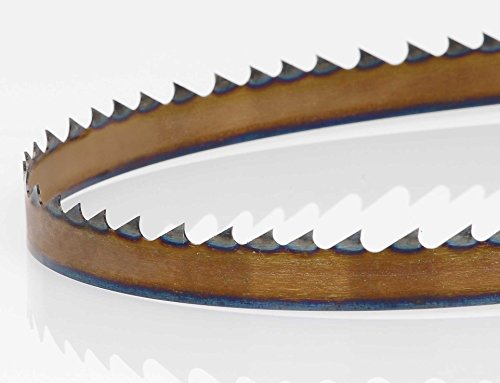
- Milled teeth are 50% sharper for clean cuts
- Induction hardening for uniform durability
- Ductile steel for extended flex life
- Premium steel runs cooler during heavy use
Trade-offs
- Specific 131.5-inch length fits limited saw models
- Low 2-3 TPI is too coarse for fine scrollwork
- Wide 3/4-inch blade limits tight-radius cutting
Timber Wolf’s milled teeth are described as 50 percent sharper than competitors’ stamped or crush-ground blades, which should reduce the effort needed to feed thick stock through the cut. The blade’s tooth edge is also 20 percent harder than any high carbon steel, a feature linked to extended sharp time during sustained use like resawing. Its wide 3/4-inch width with 2-3 TPI hook-style teeth is intended for efficient cutting in thick material.
A woodworker in the research mentions using Timber Wolf blades alongside a Laguna Resaw King specifically for resawing on an 18-inch bandsaw. The blade’s steel is described as more ductile than any high carbon steel, which the brand says leads to extended flex life and a cooler running blade under load. Stumpy Nubs is also cited as recommending the brand in the provided research context.
BOSCH BS5912-6H Heavy-Duty Band Saw Blade

What We Like
- Optimized tooth geometry for heavy-duty wood cutting.
- Advanced laser-cutting for precise blade manufacture.
- Constructed to resist heat buildup for long life.
- Designed to fit many standard stationary saws.
Trade-offs
- Only fits 59-1/2 inch stationary saws
- Weighs 0.1 pounds for shipping
A 59-1/2 inch length and 6 TPI heavy-duty design makes this blade a purpose-built choice for the owner of a standard stationary band saw tackling thick stock and resawing. The optimized tooth geometry and laser-cut precision translate to clean, aggressive cuts in wood, while the construction aims to manage heat for durability. It’s for the woodworker who needs a workhorse blade that matches their machine’s specific size and demands consistent performance in demanding applications.
The trade-off is specificity. This blade won’t fit the ubiquitous 14-inch benchtop saws that use longer blades, like the 93-1/2 inch options from brands such as POWERTEC. Its coarse tooth pattern is ideal for ripping and deep cuts but is a poor match for intricate curves or thin stock where a finer blade like the Olson Saw skip-tooth would excel. You’re buying a dedicated, high-quality component for a specific machine and job, not a versatile all-rounder.
Product photos
FOXBC 93-1/2 Inch Bandsaw Blades Assortment

What We Like
- Three versatile widths for different cuts
- SK5 carbon steel offers heat resistance
- Induction-hardened teeth for consistent hardness
- Precision-ground teeth promote true tracking
Trade-offs
- Fits only 93.5-inch 14-inch saws, limiting compatibility
- Assortment lacks a very coarse (2-3 TPI) blade for heavy resawing
This three-pack delivers immediate versatility for a 14-inch band saw with its mix of 1/8-inch, 1/4-inch, and 1/2-inch blades. The SK5 carbon steel construction and induction-hardened teeth are built for clean cuts in wood and plastic, meaning you can tackle everything from fine scrollwork to gentle curves right out of the box. It’s a solid foundation kit for a woodworker who wants to cover the basics without a hefty investment, getting a saw ready for common workshop tasks.
The blades are made from SK5 carbon steel, a material described as heat resistant for longer life. According to the product details, the teeth are induction hardened and milled for true tracking, which aims for consistent hardness. This assortment includes teeth configurations of 6 and 14 TPI, covering fine and coarser cuts for the materials specified.
Product photos
Olson Saw HEFB 3/16" Skip Tooth Band Saw Blade
What We Like
- Skip tooth design clears waste efficiently
- Heavy-duty commercial-grade construction
- Fits common 14" stationary band saws
Trade-offs
- 4 TPI is coarse for fine, detailed scrollwork
- Skip tooth pattern less ideal for veneer-thin cuts
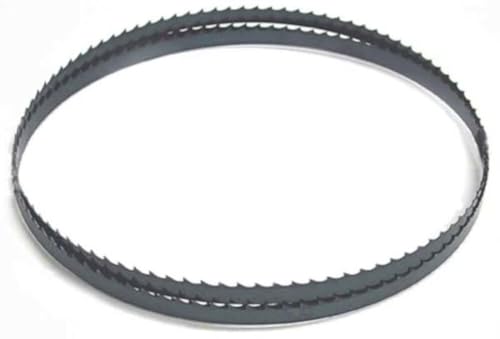
With its 4 TPI skip tooth pattern, this blade creates large gullets that clear material efficiently. It’s designed for hard or soft wood, plastic, mild steel, and non-ferrous metal on 14″ vertical, stationary saws. The heavy-duty, commercial-grade construction suits industrial, woodworking, DIY, and professional use where a coarse, aggressive cut is acceptable.
The coarse cut means it is not intended for producing a fine surface. For detailed scrollwork, a blade with finer teeth like the Lenox Diemaster 2 with 10-14 TPI would be more appropriate. This Olson blade is a durable, commercial-grade option for the stated materials on compatible 14″ floor-standing band saws, so keep a finer blade available for finishing work.
Product photos
POWERTEC 80 Inch Bandsaw Blades Assortment
What We Like
- Three widths for curves, rips, and scrollwork
- Specific 80-inch length for 12" band saws
- Carbon steel build for durability
- Optimized tooth geometry for clean cuts
Trade-offs
- Only fits band saws requiring 80-inch blades
- Set lacks a wide blade for heavy resawing
The 80-inch length is the key detail here, it’s made specifically for 12-inch band saws like the Sears Craftsman model mentioned. If your machine takes this size, this three-blade assortment gives you a practical starting kit. You get a 1/8-inch blade for tight scroll cuts, a 1/4-inch for general curves, and a 3/8-inch for straighter ripping and crosscuts. The carbon steel construction holds an edge well in wood and soft materials, making it a solid, affordable foundation for a workshop that runs a 12-inch saw.
The blades are made from carbon steel, a material suited for cutting wood, plastic, and non-ferrous metals as stated. The set includes a 3/8-inch wide blade, which can be used for resawing, though other products on the market offer wider blades specifically for that heavy-duty task. This assortment covers fundamental cuts but does not include every blade type a workshop might eventually need.
Product photos
DARTOTEK 93-1/2" Bandsaw Blades Assortment
What We Like
- Versatile 3-blade assortment covers resawing, general, and detail work.
- SK5 carbon steel construction promises good wear resistance and sharpness.
- Optimized tooth geometry is designed for smooth, clean cuts.
- Fits most common 14-inch band saw models without modification.
Trade-offs
- No coarse-tooth blade for aggressive ripping of thick stock.
- Requires verifying your specific saw's exact blade length before ordering.
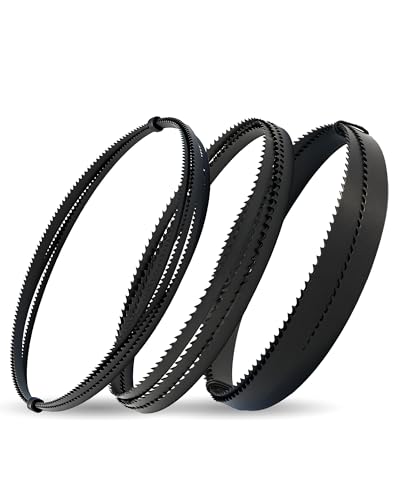
This set’s real strength is its curated variety of three distinct blades in one package. You get a 1/2-inch blade for resawing, a 1/4-inch for general cuts, and a narrow 1/8-inch blade for tight curves. That spread means a new band saw owner can tackle a wide range of common woodworking tasks right out of the gate without buying blades individually. The SK5 carbon steel should hold an edge reasonably well for the price, making it a solid foundation kit for building experience and learning what blade works best for each job.
This set offers a practical selection of widths and tooth counts, so a buyer can handle most common woodworking tasks without swapping between multiple purchases. Its SK5 carbon steel construction provides wear resistance and reduced breakage, which suits general workshop use across various woods and composites. The assortment prioritizes versatility for furniture making, DIY crafts, and professional shops that need a reliable, all-purpose setup rather than a single-purpose tool for extreme workloads.
Product photos
AYAO 72" Bandsaw Blades Assortment

What We Like
- Three-blade assortment covers common widths (1/8", 1/4", 3/8")
- Raker set teeth for better cutting performance
- Ground teeth stay sharper longer
- Strong welding point for smoother operation
Trade-offs
- 72-inch length only fits specific 10" and 11" saw models
- No blade wider than 3/8" limits resawing capacity
A 72-inch blade length makes this set a precise match for owners of 10″ Delta or Wen band saws and the 11″ Shopsmith. That specific fit is its main advantage, as a properly sized blade runs truer and puts less strain on the machine. The assortment gives you a practical starter kit: the 1/8″ blade for tight curves, the 1/4″ for general purpose work, and the 3/8″ for gentler curves and straight cuts. If your workshop centers on one of those specific saws and you need to cover basic woodworking tasks, this pack gets you running with the essentials.
The set’s specialization is its defining trait. The widest blade is 3/8 inch with a 6-tooth-per-inch configuration, a combination suited for the wood, PVC, and thin aluminum mentioned in its description. For owners of the compatible 10-inch and 11-inch saws, it delivers a focused foundation, but workshops needing to cut very thick material may require a different, single blade for that heavier work.
Product photos
Timber Wolf 3/8" 3 TPI Bandsaw Blade

What We Like
- 3 TPI tooth count excels on thick cuts
- Handles stock up to 6-8 inches thick
- Lightweight packaging for easy handling
Trade-offs
- 3 TPI tooth pattern is coarse for thin stock
- Specific 93-1/2 inch length fits only certain 14-inch saws
The 3 TPI tooth pattern is built for aggressive removal, letting you power through dense hardwoods up to eight inches thick without bogging down. This blade is for the woodworker who regularly tackles heavy resawing or needs to cut thick slabs for table legs and bench tops. It’s the right tool when your project starts with a massive chunk of wood that would stall a finer blade.
With only three teeth per inch, this blade is built for aggressive, fast cuts in thick stock, handling material up to eight inches thick. That coarse tooth pattern does leave a rougher surface, so any finished piece will require more sanding or planing. For a single-purpose blade, the Timber Wolf excels at its primary task.
Lenox Diemaster 2 Bimetal Blade

What We Like
- Bimetal construction for wood and metals
- Vari-tooth design for fast, smooth cuts
- Versatile for solid shapes and contoured cuts
- Positive rake angle for aggressive feed
Trade-offs
- 0.025-inch thickness limits tight-radius work
- Specific 64.5-inch length fits fewer saws than common 93-inch
The Lenox Diemaster 2’s bimetal construction allows it to cut wood, aluminum, and various steels, making it a versatile choice for shops that work with mixed materials. Its Vari-tooth design is noted for faster cutting rates and smooth cuts compared to a regular tooth pattern. This blade is also described as good for contoured cuts and for cutting solid shapes, rectangular tubes, and sheets.
Its 10-14 TPI range is a general-purpose configuration. The 1/2-inch width and 0.025-inch thickness are specific dimensions for the model. For projects requiring only wood, other dedicated woodworking blades are available in the market.
Product photos
How We Evaluated Band Saw Blades
Our evaluation began with manufacturer specifications on blade length, width, tooth count, and material. We cross-referenced this data with expert round-ups discussing performance characteristics like tooth geometry and steel quality. We also analyzed patterns in owner feedback to understand real-world durability and compatibility issues.
The most critical criteria were blade length compatibility for your specific saw. You also need the right tooth count and blade width for the intended cut, like resawing thick lumber versus detailed scrollwork. Finally, consider the construction material for durability and heat resistance. You can find more detailed analysis in our general guide to band saw blades.
The primary limit of a research-based evaluation is that we cannot report on long-term wear or direct performance comparisons between brands. Our goal is to equip you with the key specifications and user-reported insights to make an informed purchase.
What To Look For In Band Saw Blades For Wood
The right blade transforms your band saw from a noisy machine into a precise woodworking tool. It’s about matching the blade’s specifications to your saw’s capacity and your project’s demands.
Look for the correct blade length for your saw model first, then choose a width and tooth count suited to your primary cutting tasks, whether that’s fine scrollwork or ripping thick slabs.
Blade Length & Saw Compatibility
The most fundamental check is that the blade length matches your band saw’s specific requirements. Common sizes include 93.5 inches for many 14-inch saws, 80 inches for some 12-inch models, and 72 inches for 10-inch saws. Installing the wrong length blade prevents proper tensioning and tracking, which can damage your saw and produce poor cuts. Always verify your saw’s manual or existing blade for the exact measurement before ordering a replacement. For a deeper dive on saw compatibility, explore our list of recommended bandsaws for wood.
Tooth Count & Blade Width
Tooth count, measured in teeth per inch (TPI), and blade width work together to determine cutting performance. A low TPI (2-4) with a wide blade (1/2″ or 3/4″) is ideal for resawing, as the deep gullets efficiently clear waste from thick cuts. A medium TPI (6-8) on a 1/4″ blade offers a great balance for general curves and straight cuts.
For fine scrollwork, a narrow blade (1/8″ or 3/16″) with a higher TPI (10-14) provides the control needed for tight radii. You can learn more about blades for resawing and heavy-duty tasks.
Blade Construction & Tooth Geometry
Carbon steel blades are a common, affordable choice for wood and plastic, offering a sharp edge out of the box. Bimetal blades combine a flexible back with a hardened tooth edge, extending life and allowing for occasional cuts into nonferrous metals. Tooth geometry also matters; skip-tooth blades have widely spaced teeth for efficient waste clearance, while hook-tooth designs have a positive rake angle for more aggressive feeding into the material. Understanding these factors is key when selecting the right woodworking blade.
- Check the blade thickness, as thinner blades (like 0.014″) can cut tighter curves but may be less durable.
- Look for mentions of heat-resistant welding or induction-hardened teeth for longer life.
- Consider an assortment pack if you’re new to band saws, as it lets you experiment with different widths.
Remember, no single blade is perfect for every job; having a small selection for different tasks is a hallmark of an efficient shop.
Band Saw Blades For Wood Compared
Use the table below to quickly compare the key specifications of our top picks side-by-side.
| Product | Blade Length | Teeth Per Inch (TPI) | Blade Width / Set Contents |
|---|---|---|---|
| POWERTEC 93-1/2 Inch Bandsaw Blades Assortment | 93-1/2 inches | 6 TPI, 6 TPI, 14 TPI | 1/2", 1/4", 1/8" blades |
| Timber Wolf Bandsaw Blade 3/4" X 131.5" | 131.5 inches | 2-3 TPI | 3/4 inch |
| BOSCH BS5912-6H Heavy-Duty Band Saw Blade | 59-1/2 inches | 6 TPI | N/A |
| FOXBC 93-1/2 Inch Bandsaw Blades Assortment | 93.5 inches | 6 TPI, 6 TPI, 14 TPI | 1/2", 1/4", 1/8" widths |
| Olson Saw HEFB 3/16" Skip Tooth Band Saw Blade | 93-1/2 inches | 4 TPI | 3/16 inch |
| POWERTEC 80 Inch Bandsaw Blades Assortment | 80 inches | 6, 14, 4 TPI | 1/8", 1/4", 3/8" |
| DARTOTEK 93-1/2" Bandsaw Blades Assortment | 93-1/2 inches | 6TPI, 6TPI, 14TPI | 1/2" 6TPI, 1/4" 6TPI, 1/8" 14TPI |
| AYAO 72" Bandsaw Blades Assortment | 72 inches | 12TPI, 10TPI, 6TPI | 1/8", 1/4", 3/8" wide |
| Timber Wolf 3/8" 3 TPI Bandsaw Blade | 93-1/2 inches | 3 TPI | 3/8 inch |
| Lenox Diemaster 2 Bimetal Blade | 64.5 inches | 10-14 TPI | 1/2 inch |
Frequently Asked Questions
What type of band saw blade is best for cutting wood?
For most woodworking, a carbon steel blade with a medium tooth count (6-8 TPI) on a 1/4-inch width is an excellent all-purpose choice, balancing the ability to cut curves and make straight rips. For specialized tasks, use a wide, low-TPI blade for resawing thick lumber and a narrow, high-TPI blade for intricate scrollwork.
Who makes the best quality bandsaw blades?
Quality is subjective and depends on your specific needs, but several brands are consistently praised in woodworking communities for their performance. Our research highlighted brands like Timber Wolf for resawing blades and Olson Saw for durable, commercial-grade options, while companies like POWERTEC and FOXBC offer reliable value-priced assortments.
What TPI bandsaw blade is best for wood?
The best TPI depends entirely on the material thickness and desired cut quality. As a rule, you want at least two teeth engaged in the workpiece. For thick stock and resawing, a very low TPI (2-4) is best. For general cutting of 3/4-inch material, a medium TPI (6-8) works well. For fine, smooth cuts in thin stock, a higher TPI (10-14) is preferable.
What is the best saw blade for wood?
For band saws, the “best” blade is the one correctly sized for your machine and matched to your task. Our best overall pick, the POWERTEC 93-1/2 Inch Assortment, is a great starting point for 14-inch saw owners because it provides versatile blades for common jobs. For those focused solely on cutting thick wood, a dedicated resaw blade is the best choice.
How do I prevent my band saw blade from breaking or dulling quickly?
Proper saw setup is often more critical than the blade brand itself. Ensure the blade is correctly tensioned, a common finger test allows about 1/4 inch of deflection when pressed. Also, set the guide blocks so they barely touch the sides of the blade and just behind the teeth. Poor alignment and excessive pressure from guides are common causes of premature dulling and breakage, especially on thin blades.
The Bottom Line
The POWERTEC 93-1/2 Inch Bandsaw Blades Assortment is our best overall pick for woodworkers with a compatible 14-inch saw. This ready-made set covers common tasks like resawing, curves, and general cutting. If your budget is tight, consider the FOXBC 93-1/2 Inch Assortment for similar versatility at a lower price point. For those who primarily resaw thick lumber, the specialized Timber Wolf 3/4″ blade is the clear choice.
Ultimately, the single most important factor is matching the blade length to your specific saw model. A perfectly designed blade is useless if it doesn’t fit your machine, so always verify your saw’s required blade length first.
