
10 Best Band Saws For Woodworking in 2026
This post contains affiliate links. As an Amazon Associate, we earn from qualifying purchases.
For a serious, shop-ready bandsaw that handles thick stock and versatile cuts, our top pick is the Jet 14-Inch Woodworking Band Saw. For massive resaw capacity, consider the RIKON 10-1414, and for limited space, the RIKON 10-3062S is a great compact workshop option. Choosing the right bandsaw hinges on matching its power, capacity, and footprint to your specific woodworking tasks and available shop space. Our research-based evaluation compares key specs and owner feedback across ten models, from heavy-duty floor units to space-saving benchtop saws, to help you invest confidently.
Top 10 Band Saws For Woodworking in the Market
Certain content that appears on this site comes from Amazon. This content is provided "as is" and is subject to change or removal at any time.
The Best Band Saws For Woodworking, Reviewed
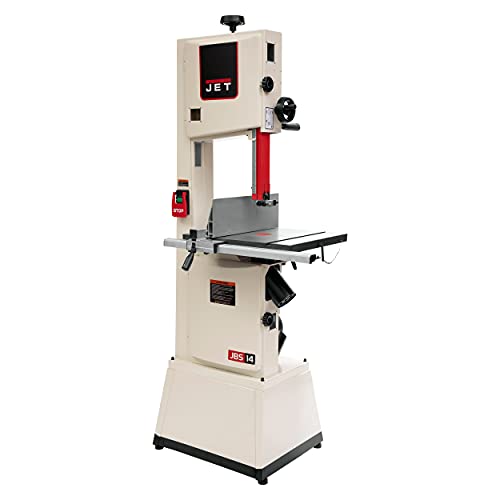
Jet 14-Inch Woodworking Band Saw
What We Like
- Massive 13-inch resaw capacity for thick stock
- Powerful 1.75 HP motor for demanding cuts
- Precise ball-bearing blade guides and tilting table
- Comes with a sturdy stand and resaw fence
Trade-offs
- Weighs 272 pounds, requiring a permanent shop footprint
- Saw blade is sold separately
A 13-inch resaw capacity paired with a 1.75 HP motor means you can slice thick slabs into veneer or bookmatched panels in a single pass, without needing a second machine. This makes the Jet 14-inch saw a perfect centerpiece for a serious home or small production wood shop that regularly works with thick hardwoods and manufactured boards. It’s engineered specifically for wood, with the heft and features to handle substantial projects day in and day out.
That capability comes with a substantial 272-pound footprint, making it a stationary tool you won’t move around the garage. While its frame and power are excellent for a 14-inch class saw, owner feedback notes that dedicated resawing shops might eventually crave the stronger frame and larger table of a true 17-inch bandsaw like the Laguna 18|bx. For the majority of woodworkers needing a reliable, versatile primary saw, however, the Jet hits a very sweet spot.
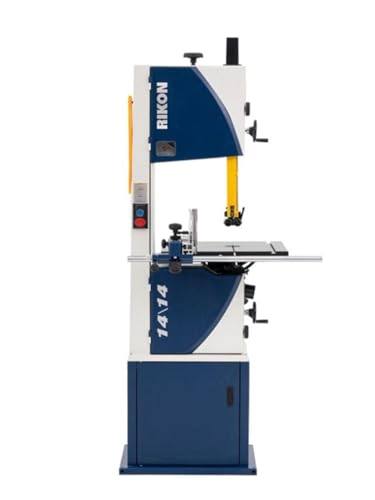
RIKON Power Tools 10-1414 Band Saw
What We Like
- Massive 14-inch resaw capacity for large stock
- Powerful dual-voltage motor for two-speed cutting
- Large, coated cast iron table reduces friction
- Tool-less blade guides and quick-adjust fence
Trade-offs
- Its 54.5-inch length demands significant floor space
- Deep resawing requires careful blade selection and setup
A 14-inch resaw capacity lets you process thick slabs and bookmatch wide boards right in your own shop. This saw is built for the woodworker who regularly works with large, expensive hardwoods and needs to maximize yield. The dual-voltage motor provides plenty of torque for the task, and features like the quick-adjust fence and tool-less guides mean you spend less time setting up and more time making sawdust. It’s a serious machine for serious stock.
With a resaw capacity that accepts stock up to 14 inches high, this bandsaw can handle large-scale woodworking projects like slicing thick slabs for bookmatched panels. Its dual-voltage 1-3/4 HP motor provides two blade speeds, offering flexibility for different cutting tasks. The trade-off is a substantial footprint, requiring over four and a half feet of floor space for a permanent workshop location.
Product photos
Laguna 18|bx Bandsaw

What We Like
- 3 HP motor and magnetic starter for demanding cuts
- Large 16-inch resaw capacity for wide stock
- Precision 10-point ceramic guide system
- Accepts blades from 1/8-inch to 1-1/4-inch wide
Trade-offs
- Requires 220V power, not a standard 110V outlet
- Weighs 410 pounds, demanding permanent shop space
- At 77.8 inches tall, it needs significant ceiling clearance
A 16-inch resaw capacity lets you slice thick slabs and veneers from your widest stock, which is the defining feature for serious furniture makers. This saw is built for the professional shop that runs daily. The 3 HP motor, massive cast iron table, and ceramic guides are all engineered for consistent, accurate cuts under heavy use. It’s a premium tool for the woodworker whose projects demand that level of performance and who has the space and electrical setup to support it.
This is a large, stationary machine that requires 220V power, so it needs a dedicated workshop space. With a weight of 410 pounds and a height of over six feet, it’s not a tool you can easily reposition. It’s designed as a permanent shop centerpiece, unlike more portable benchtop models.
Product photos
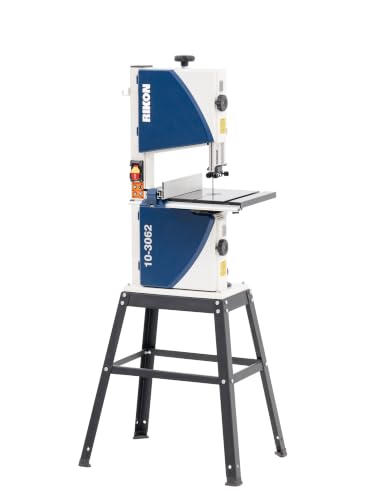
RIKON Power Tools 10-3062S Band Saw
What We Like
- Two-speed motor handles wood and other materials.
- Tool-less blade guide and tension adjustments for quick setup.
- SP-coated cast-iron table reduces friction and resists rust.
Trade-offs
- 5-inch resaw capacity is less than larger 14-inch models.
- 1/2 HP motor is less powerful than 1.75 HP saws for heavy resawing.
With a body just over 21 inches long, this bandsaw fits where many others won’t, a key feature for crowded workshops. Its 5-inch cutting height and 9-5/8-inch throat provide the core capacity for tasks like cutting curves or resawing thinner boards. The design combines professional features, including a two-speed motor for different materials and tool-less blade changes, within that space-saving footprint. It comes ready with a low-friction coated table and a steel stand, so you can set it up without needing to build a separate base.
The 1/2 HP motor and 5-inch maximum cutting height define its practical scope. This power drives blades up to a half-inch wide for detailed curves and straight cuts in typical workshop stock. When compared to a larger tool like the Jet 14-Inch model with a 13-inch resaw capacity, this RIKON is suited for dimensioning smaller material rather than milling thick lumber. For a dedicated small shop or a secondary station in a larger one, its blend of capacity and compact size offers a specific utility.
Product photos
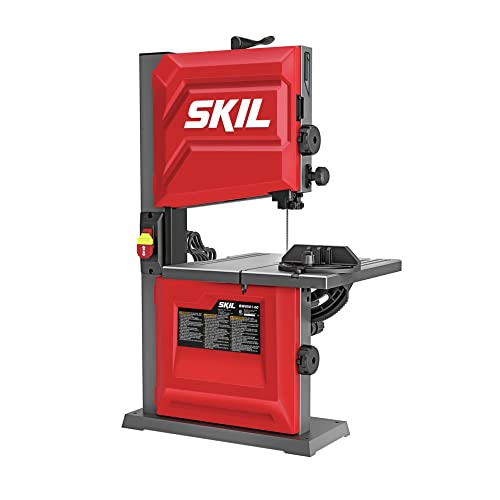
SKIL 9-Inch Benchtop Band Saw
What We Like
- Lightweight alloy frame for portability
- Quick, tool-free blade tension setting
- Solid blade guides for accurate tracking
Trade-offs
- Smaller 9-inch wheels limit cutting capacity
- 2.8-amp motor best for thinner stock
A 2.8 amp motor provides enough power to cut through a variety of wood materials, while its 9-inch frame keeps the overall tool compact. Features like a rack-and-pinion table allow for quick angle adjustments, and ball bearing guides help ensure consistent blade tracking for accurate cuts. This combination means the Skil band saw can handle serious woodworking tasks in a small shop without requiring a large footprint or budget.
Compared to larger saws like the 14-inch Jet model, this benchtop unit offers less power and a smaller cutting capacity. The expert review notes it lacks only a small amount of the cutting capacity of 10-inch models, making it suitable for common, smaller-scale tasks. For projects involving curves and crosscuts in typical dimensional lumber, its value and feature set stand out in the benchtop class.
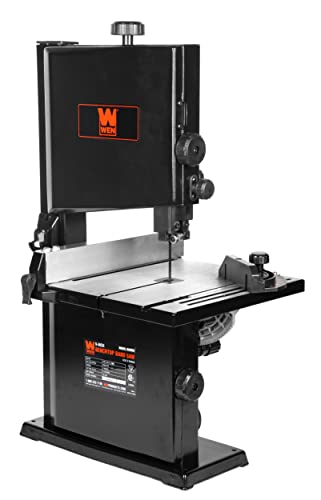
WEN 9-Inch Benchtop Band Saw
What We Like
- Spacious table bevels to 45 degrees
- Includes rip fence and miter gauge
- Deep 3-1/2-inch cut capacity for a benchtop
- Backed by a 2-year warranty
Trade-offs
- Modest 2.8-amp motor limits heavy resawing
- Blade speed is fixed at 2500 FPM
A 3-1/2-inch cut depth lets you slice through thick stock like turning blanks or layered boards, which is uncommon for a saw in this compact class. That capacity, plus the included fence and sizable work table, makes this WEN model a solid entry point for a hobbyist needing more than just curve-cutting ability. Research indicates it’s a favorite for those on a tight budget who want to step up from a jigsaw without committing to a floor-standing machine.
You trade some power and refinement for that deep-cut capability. The 2.8-amp motor will handle most tasks, but it’s not built for all-day resawing of dense hardwoods. Compared to a more feature-rich benchtop like the DeWalt, which offers a two-speed motor and a worklight, the WEN sticks to the fundamentals. It delivers the core functions you need to get started, packaged with a practical set of accessories.
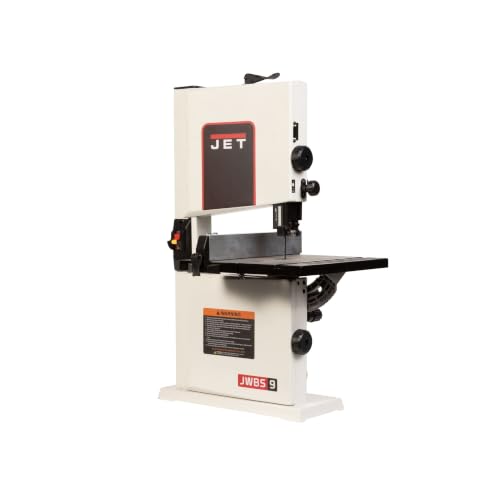
Jet 9-Inch Benchtop Band Saw
What We Like
- Five-year warranty offers long-term peace of mind.
- Cast aluminum wheels aid smooth, accurate blade tracking.
- Tilting worktable locks securely for repeatable angled cuts.
- Compact footprint fits easily on a workbench.
Trade-offs
- A 3-1/2 inch resaw capacity limits thick stock work.
- Mounting bolts and nuts for a stand are not included.
- Designed specifically for wood and wood composites.
A 3-1/2 inch resaw capacity and a full 45-degree tilting table make this a serious tool for detailed woodworking in a compact package. The five-year warranty and cast aluminum construction signal a machine built to last, which is a significant step up from many benchtop models. It’s the right fit for a woodworker with a dedicated bench who needs precise cuts and repeatable angles but doesn’t have the floor space for a larger saw. This model handles curves and general shop tasks capably, provided your projects stay within its scale.
Backed by a 5-year warranty, this JET bandsaw is built for long-term woodworking use. Its compact 40-pound frame bolts to a stand or bench, fitting into workshops where floor space is limited. The cast aluminum wheels and precision guides aim for smooth, accurate blade tracking during cuts.
Product photos
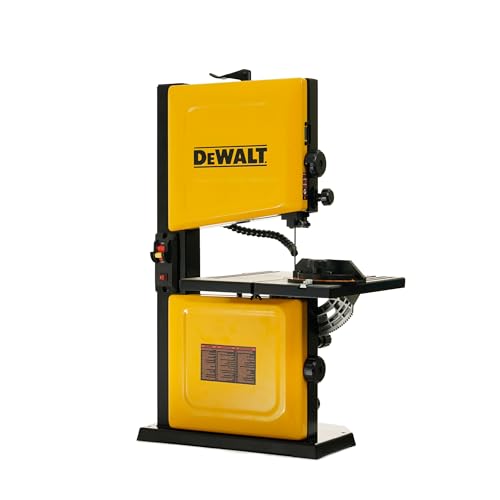
DeWalt 9-Inch Band Saw
What We Like
- Two-speed motor for material-specific cutting.
- Integrated LED worklight for precise cut-line visibility.
- Dual dust port adapters for easy shop-vac connection.
- Steady 3.5 AMP power for consistent cutting action.
Trade-offs
- 9-inch design limits resaw and large project capacity.
- Lacks the deep-throat capacity of 14-inch floor models.
This DeWalt band saw has a 3.5 AMP motor with two speeds of 1700 or 2500 SPM, delivering reliable cutting for wood and light materials. That gives hobbyists and DIYers the control to match blade speed to the task. Its compact 9-inch design accommodates curved cuts and small resawing tasks while fitting comfortably in smaller home workshop spaces. An integrated LED worklight illuminates the cutting line for enhanced visibility, and dual dust port adapters help keep the workspace clean.
Compared to a full-size floor-standing bandsaw, this 9-inch machine has a smaller scale, so it is not suited for wide resawing tasks. It is suitable for detailed woodworking projects and light materials, making it an option for home workshops that lack space or a 220-volt circuit.
Product photos
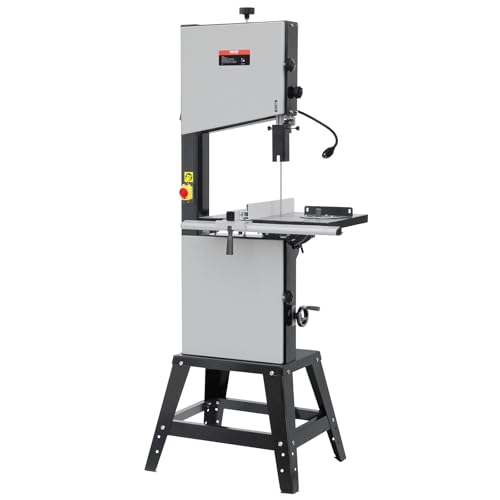
VEVOR 13.39-Inch Benchtop Band Saw
What We Like
- High-power 1-1/2HP motor for demanding cuts
- Continuously variable speed for multiple materials
- Sturdy, tilting steel table for bevels up to 45°
Trade-offs
- No direct specification for minimum resaw capacity or blade width options
- Weighs 180.3 pounds, requiring a sturdy, permanent installation surface.
A 13-inch cutting height and a 1-1/2HP motor put this benchtop saw in a class of its own for raw power in a compact footprint. It’s built for the woodworker who needs to resaw thick stock or slice through metals but doesn’t have the floor space for a full-sized cabinet saw. The continuously variable speed and tilting steel table mean you can tackle a bevel cut on aluminum as confidently as you can rip a dense hardwood. This is a serious tool for a small shop that refuses to compromise on capability.
You’ll need a dedicated, rock-solid stand or cabinet to handle it, unlike more portable options like the 40-pound Jet 9-Inch model. It bridges the gap between light-duty benchtop units and heavy-duty floor models, offering much of the performance without claiming the same permanent floor space.
Product photos
Hoteche 12-Inch Benchtop Band Saw

What We Like
- Includes a sturdy, dedicated stand for stability.
- Large 5-inch depth capacity for thicker stock.
- Tilting table allows for bevel cuts up to 45°.
Trade-offs
- At 130 pounds, it is not a portable benchtop tool.
- Its 12-inch width capacity is less than full-size floor models.
A 5-inch cutting depth and two-speed motor let you tackle hardwood resawing and switch to aluminum or plastic without needing a second machine. This makes it a serious contender for the small shop that values flexibility. The included stand provides a solid, vibration-dampening base right out of the box, which is a significant advantage for a tool in this class. It’s built for the woodworker or metal fabricator who needs a capable, multi-material saw but doesn’t have the space or need for a massive industrial unit.
The trade-off is in footprint and ultimate capacity. While stable, its 130-pound weight means you’ll pick its permanent home carefully. Compared to a compact benchtop like the Jet 9-Inch, it’s a much larger, more capable station. However, for specialized work requiring greater resaw height, you would look to deeper-throat 14-inch models like the JET or RIKON. This Hoteche finds its sweet spot right in the middle.
Product photos
How We Evaluated Band Saws For Woodworking
Our selection process focused on manufacturer specifications and documented features. We also looked at patterns in expert round-ups and owner feedback. We prioritized three core criteria: motor power and voltage requirements for cutting performance, resaw and throat capacity for project versatility, and the physical footprint and weight for shop integration. While we can detail the specs and what experienced users report, a research-led guide cannot replicate the hands-on feel of blade tracking or the nuanced setup that comes from using a band saw in your own workshop.
What To Look For In Band Saws For Woodworking
Choosing a bandsaw involves balancing the cutting tasks you perform most with the space you have available. For resawing lumber or cutting intricate curves, key specifications like motor horsepower, table size, and frame design determine a saw’s capabilities and limitations.
Key buying criteria include motor power, with a 1 HP minimum often recommended for serious resawing. Also important are resaw capacity, which is the maximum height you can cut, and throat depth for width capacity. Finally, consider the saw’s physical footprint: a benchtop model saves space, while a floor-standing one suits heavy-duty work.
Motor Power and Voltage
Motor horsepower directly dictates a bandsaw’s ability to cut dense hardwoods and resaw thick stock without bogging down. Benchtop models often use motors under 1 HP, suitable for curves and thinner stock, while serious resawing typically requires at least a 1.75 HP motor. Note that high-power motors, like the 3 HP unit on the Laguna 18|bx, often require a 220V outlet, which may not be available in all home workshops. This is a crucial infrastructure check before purchasing.
Capacity: Resaw and Throat
Resaw capacity is the maximum height of stock you can slice vertically, critical for creating veneer or bookmatched panels. Floor-standing models offer capacities from 5 inches up to 16 inches. Throat depth is the distance from the blade to the vertical frame, limiting the width of a board you can cut. A common 14-inch saw has a 14-inch throat. Your typical project dimensions should guide which wood bandsaws you consider. For deep, precise cuts in thick lumber, mastering resawing with a bandsaw is a fundamental skill.
Footprint and Shop Integration
Consider where the saw will live. Heavy cast-iron floor models like the Jet can weigh hundreds of pounds, demanding a permanent shop footprint. Benchtop saws save floor space but require a sturdy workbench and offer less capacity. Also, consider dust collection ports and whether the saw comes with a stand. For small shops, compact bandsaws are a popular solution, though they can’t match the power of a floor-standing unit.
- Check the assembled dimensions against your available floor or bench space.
- Verify the weight and whether you’ll need help moving and installing it.
- Ensure your shop’s electrical system matches the saw’s voltage requirement (110V or 220V).
- Look for features that aid setup, like tool-less blade guides or a quick-tension lever.
Your most frequent cutting task, whether delicate curves or resawing wide boards, should be the primary driver of your bandsaw choice.
Band Saws For Woodworking Compared
The following table compares the key specifications of our top picks to highlight their differences in power, capacity, and design at a glance.
| Product | Motor Power | Resaw Capacity | Weight |
|---|---|---|---|
| Jet 14-Inch Woodworking Band Saw | 1.75 HP | 13 inches | 272.0 pounds |
| RIKON Power Tools 10-1414 Band Saw | 1-3/4 HP | 14 inches | N/A |
| Laguna 18|bx Bandsaw | 3 HP | 16 inches | 410.0 pounds |
| RIKON Power Tools 10-3062S Band Saw | 1/2 HP | 5 inches | 77.5 Pounds |
| SKIL 9-Inch Benchtop Band Saw | 2.8 Amp | N/A | N/A |
| WEN 9-Inch Benchtop Band Saw | 2.8-amp | 3-1/2 inches | 40.0 pounds |
| Jet 9-Inch Benchtop Band Saw | N/A | 3-1/2 inches | 40.0 pounds |
| DeWalt 9-Inch Band Saw | 3.5 AMP | N/A | 40.0 Pounds |
| VEVOR 13.39-Inch Benchtop Band Saw | 1-1/2HP 1100W | 13 in | 180.3 pounds |
| Hoteche 12-Inch Benchtop Band Saw | 1HP | 5 inches | 130.0 Pounds |
Frequently Asked Questions
Who makes the best bandsaw for woodworking?
Several brands are highly regarded for different needs. Jet and Laguna are known for premium, powerful shop saws, while RIKON offers strong value in both compact and high-capacity models. For benchtop use, brands like JET, DeWalt, and WEN provide capable, feature-rich options. The “best” brand depends entirely on your required power, capacity, and budget.
What is a high-quality bandsaw?
A high-quality bandsaw features a powerful motor matched to its frame, a large, flat cast-iron table that tilts smoothly, and precise, durable blade guides (often ceramic or ball-bearing). It should have ample resaw capacity for its class, solid construction that minimizes vibration, and thoughtful details like easy-adjustment mechanisms and effective dust ports. It’s one of the essential woodworking saws for a versatile shop.
Are Harbor Freight bandsaws any good?
Harbor Freight bandsaws, often sold under the Central Machinery brand, are budget-oriented tools. They are generally considered suitable for light, occasional use by hobbyists, particularly for simple curved cuts. However, they typically lack the power, precision, and durability of models from dedicated woodworking tool brands, especially for demanding tasks like resawing thick hardwood.
What is a good size bandsaw for woodworking?
A 14-inch floor-standing bandsaw is widely considered the ideal starting size for a dedicated home workshop, offering a good balance of power, resaw capacity (often around 6-13 inches), and throat width for most projects. For those with severe space or budget constraints, a 9 or 10-inch benchtop model can handle curves and smaller stock. Your choice between these and other top band saw models depends on your primary work.
Should I get a bandsaw or a table saw first?
This depends on your projects. A table saw is unparalleled for breaking down sheet goods and making precise, repeatable rip and crosscuts. A bandsaw excels at curved cuts, resawing thick lumber, and cutting irregular shapes. For a first major stationary tool, many woodworkers start with a table saw for its versatility in construction, then add a bandsaw later for its unique capabilities in shaping and processing solid wood.
The Bottom Line
The Jet 14-Inch Woodworking Band Saw is a leading choice for woodworkers ready for a serious, shop-bound tool. Its 1.75 HP motor and substantial 13-inch resaw capacity can process thick stock. If you are on a tight budget or need maximum portability, the SKIL 9-Inch Benchtop Band Saw offers a capable entry point. Those needing to resaw very wide boards should look directly at the high-capacity RIKON 10-1414.
Ultimately, let your most common project needs and your available shop space guide your decision. Prioritize sufficient motor power and resaw capacity for the work you actually do, ensuring your new bandsaw becomes a versatile asset, not a space-consuming limitation.
