
10 Best Belt Sanders For Knife Making in 2026
This post contains affiliate links. As an Amazon Associate, we earn from qualifying purchases.
For knifemakers seeking a versatile, stationary shop tool, our best overall pick is the VEVOR Belt Grinder Sander 2×72 Inch for its variable speed control and rugged welded frame. We also highlight the Jinlida Professional for premium performance and the Bucktool 2×48 Inch as a top fixed-speed workhorse.
Choosing the right belt sander means matching its power, belt size, and features to your shop space and the tasks you perform most. This guide is based on evaluating specifications, manufacturer data, and patterns in expert and owner feedback across ten top models.
Top 10 Belt Sanders For Knife Making in the Market
Certain content that appears on this site comes from Amazon. This content is provided "as is" and is subject to change or removal at any time.
The Best Belt Sanders For Knife Making, Reviewed
VEVOR Belt Grinder Sander 2×72 Inch

What We Like
- Variable speed VFD for precise control.
- Powerful, durable 1500W pure copper motor.
- Rugged all-welded steel frame construction.
- Includes three grit belts and grinding modes.
Trade-offs
- At 110.7 lb, it requires a permanent, sturdy bench.
- Its 33.5-inch length demands significant shop floor space.
A 1500W motor powers a 2×72-inch belt, which provides the surface area and muscle for extended grinding and polishing tasks on materials like metal, wood, and glass. Its variable frequency drive allows stepless speed regulation, so you can switch between high-speed and low-speed work as needed. The welded steel frame and three included grinding modes, circular, arc, and flat, support versatile material work with a stable platform.
The trade-off for that capability is a substantial footprint and a weight of 110.7 pounds; this isn’t a tool you’ll be moving around the shop often. It’s a bench anchor. Among full-size 2×72-inch grinders, the VEVOR model shares a similar motor power with the Jinlida Professional model. If your space is tighter, a model like the Bucktool 2×48 Inch offers a more compact alternative.
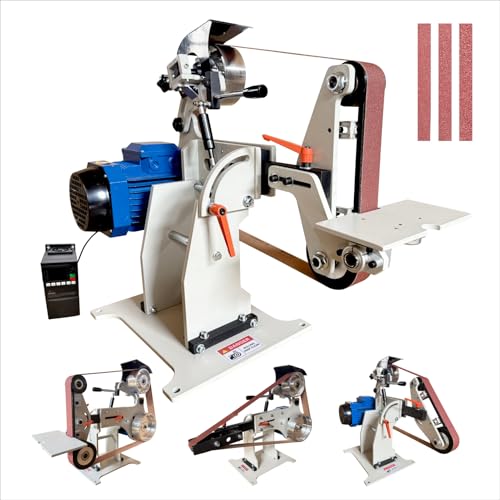
Jinlida Professional Belt Grinder Sander 2×72 Inch
What We Like
- Smooth stepless speed control via 2.2kW VFD
- Three distinct grinding methods in one kit
- Industrial-grade one-piece steel frame for stability
- Comes with full-stage grit belts for start-to-finish work
Trade-offs
- Large 30 x 24 inch footprint demands dedicated shop space
- Industrial weight and build exceed casual DIY needs
A 1500W motor paired with a 2.2kW variable frequency drive means you can dial in the exact speed, from a crawl for delicate bevels to full tilt for hogging off steel, without losing torque. This is the core of its premium performance, built for a maker who spends hours at the grinder and needs that precise control for everything from hardened knife steel to finishing touches. The included kits for circular, flat, and arc grinding let you tackle complex profiles without swapping machines, turning a single sander into a complete grinding station.
The industrial-grade stability comes from a thickened one-piece steel frame with a powder-coated finish, which provides impact resistance and keeps the machine vibration-free during prolonged operation. Its dimensions require a sturdy, permanent mounting surface. Among other 2×72 inch models, the VEVOR belt grinder has a similar 1500W motor and VFD but uses a different chassis width of 11.8 inches.
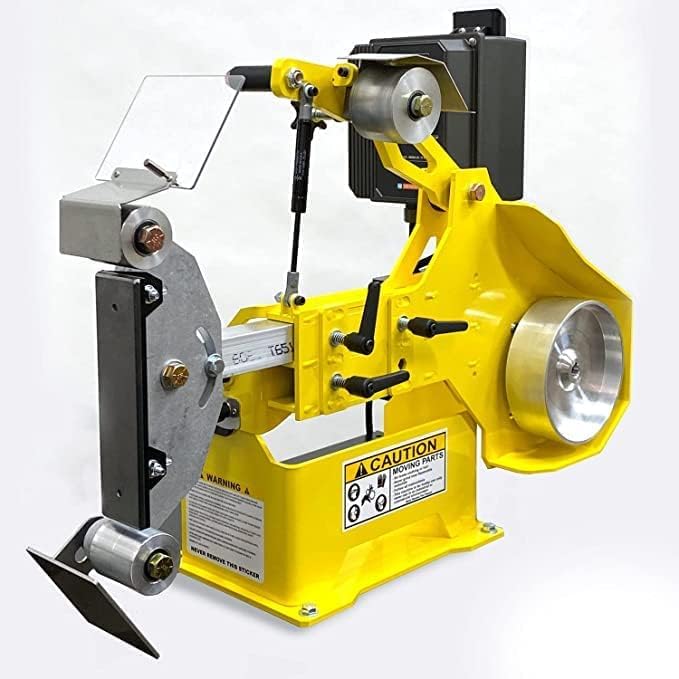
OBM Dominator Belt Grinder 2×72 Inch
What We Like
- Fully welded steel frame for consistent alignment.
- Integrated 2HP motor and VFD for variable speed control.
- Accepts standard 1.5" tooling arms for customization.
- Complete kit includes stand, motor, VFD, and chassis.
Trade-offs
- Configuration is a chassis, requiring user assembly of components.
A fully welded steel frame provides consistent alignment during long sessions, which helps maintain precision for tasks like knife sharpening. This 2×72 belt grinder chassis accepts any standard 1.5-inch tooling arm, allowing smooth integration with existing workshop setups. Its included 2HP motor and VFD enable accurate speed adjustments for controlled grinding, from edge shaping to bevel work.
The unit arrives as a core chassis with motor, VFD, stand, and drive wheel, requiring the user to source and attach tooling arms and a platen for a complete system. This bolt-free, welded design is intended to reduce vibration for long-term use in a metal shop. It is built as a stable addition to a high-use workspace, compatible with a wide range of commercial belts and tooling.
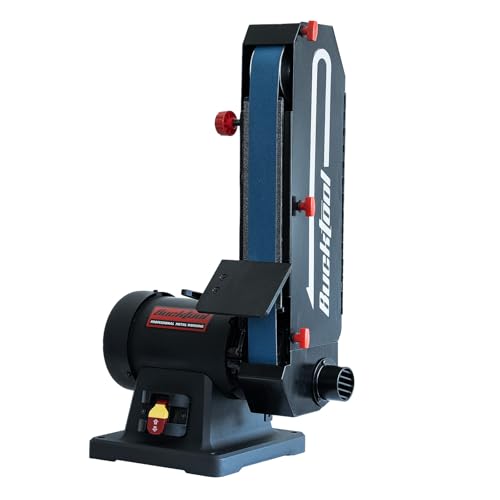
Bucktool 2×48 Inch Belt Sander
What We Like
- Strong 1 HP induction motor for sustained heavy-duty use
- Quick-release handle for tool-free belt changes
- Dual-wheel design for flat and curved sanding
- Solid cast-iron platen and frame for stability
Trade-offs
- Fixed 4500 FPM speed limits material and finish options
- No variable speed control for delicate finishing work
A 1 HP induction motor and 4500 FPM belt speed deliver consistent, heavy-duty material removal, making this a sander built for long sessions of grinding bevels and shaping steel without bogging down. The cast-iron worktable and frame provide a rock-solid platform for precise control, while the dual-wheel system lets you switch quickly from flat grinding on the platen to working curves on the contact wheel. This is a straightforward, durable machine for the knifemaker who values relentless power and simple operation over finesse features.
This sander runs at a fixed belt speed of 4500 feet per minute, driven by a 1 HP induction motor. That constant high speed delivers powerful, consistent material removal for tasks like rough grinding and shaping, but it cannot be slowed for heat-sensitive work or intricate polishing. Compared to variable-speed models like the VEVOR 2×72, this fixed operation is a significant limitation for detailed finishing.
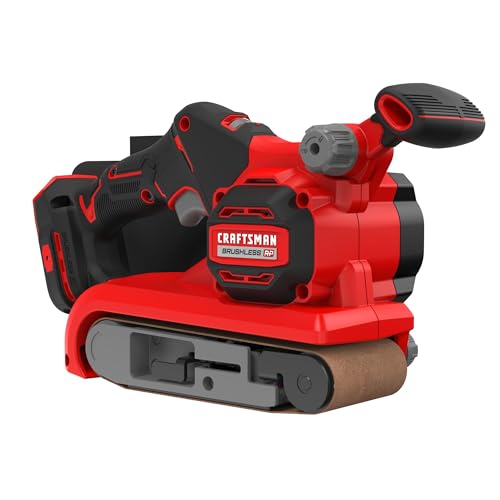
CRAFTSMAN V20 Brushless Belt Sander
What We Like
- Brushless motor for fast material removal.
- Variable speed settings suit multiple tasks.
- Three-position handle improves control and comfort.
- Dust collection compatible for a cleaner shop.
Trade-offs
- 8-pound weight might feel heavy for extended one-handed use.
- Cordless system requires owning the V20 battery platform.
A brushless motor pushes the belt to 950 surface feet per minute, delivering serious grinding power without a cord. This makes it a natural pick for knife makers who value a clean bench and need to move freely around a project. The five speed settings and tool-free belt tracking let you switch between aggressive bevel setting and finer finish work quickly. A three-position handle also locks in for a secure grip in any orientation. This is the sander for detailed handle shaping, profiling smaller blades, and shop tasks where an outlet is just out of reach.
CRAFTSMAN’s brushless motor delivers up to 950 feet per minute, providing a fast material removal rate that handles sanding tasks efficiently. Five variable speed settings allow for control across different materials, from aggressive stock removal to finer finishing work. An auxiliary handle with three positions improves control and ease of use during operation. For workshop cleanliness, the design is compatible with an airlock or dust bag to help manage debris.
MULTITOOL GRINDERS MT8CW Belt Sander
What We Like
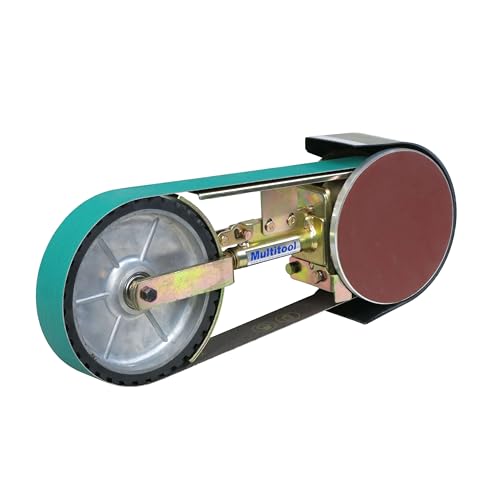
- Fits most existing bench grinders.
- Quick-change belt system with automatic tensioning.
- Includes a large 8-inch contact wheel for shaping.
Trade-offs
- Requires you to already own a compatible bench grinder.
- Uses a 2×48 belt, not the wider 2×72 common for full-size knife grinders.
- Does not include a motor or variable speed control.
The MT8CW bolts onto most bench grinders with a half-inch or five-eighths shaft, turning that common shop tool into a dedicated belt sander. This design saves both shop space and the cost of a whole new machine, offering a two-inch belt and a large contact wheel specifically for blade work. Its quick-change belt system with automatic tensioning lets users swap grits in seconds, a key feature for moving efficiently from rough shaping to final finishing. The attachment is noted as a favorite among knifemakers, blade sharpeners, and axe grinders.
Performance is tied directly to the host bench grinder’s power and speed, since this is an attachment rather than a standalone unit. Compared to dedicated machines like a 2×72 inch grinder, the 2×48 inch belt provides a shorter working surface. This makes the MT8CW a focused tool for its intended grinding tasks, not a full-fledged, variable-speed system for every metalworking application.
Product photos
Goldsand 1×30 Belt Sander Professional
What We Like
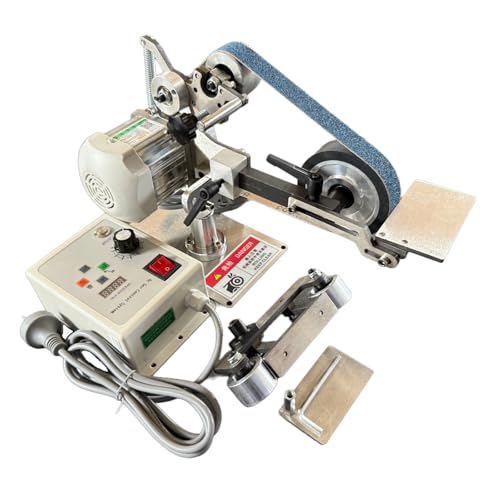
- Includes three zirconia belts for coarse to fine work
- Stepless variable speed for control on different materials
- 550W motor offers stable tracking and reverse function
- Converts quickly between vertical and horizontal use
Trade-offs
- The 1×30 belt size limits work area compared to 2×72 models
Coming with three different grit belts, this sander handles everything from rough shaping to final finishing right away. Its 550-watt motor spins the belt at 5500 RPM, providing strong grinding power for metals and wood. You can fine-tune the speed with a stepless dial, which is key for controlling heat when sharpening tools or working on delicate materials. Switching between vertical and horizontal modes lets you tackle edges and flat surfaces from the most effective angle.
You’ll feel the limitations of the 1-inch belt width when trying to flatten a large blade blank, as it simply can’t remove material as quickly as a 2-inch belt. For that kind of heavy grinding, a machine like the VEVOR 2×72 is built for the task. But for detailed handle shaping, sharpening, and working on smaller knives, the Goldsand bundles the essentials into a compact, ready-to-run package that gets you started right away.
Product photos
KFMK 1×30 Variable Speed Belt Sander
What We Like
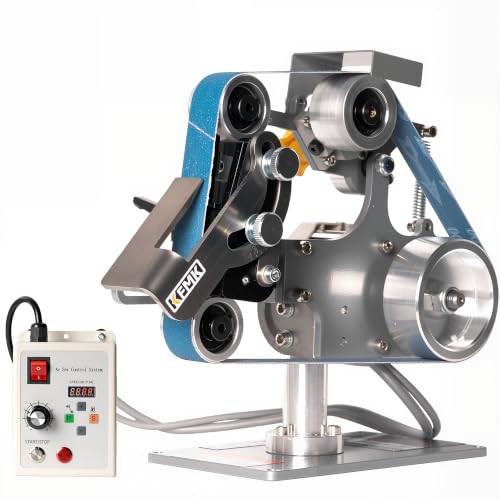
- Forward/reverse belt for better burr control
- Included angle guide for repeatable bevels
- VFD allows precise speed for each task
- All-steel frame reduces vibration
Trade-offs
- 1-inch belt width limits material removal rate
- Smaller platen area than 2-inch wide models
Forward and reverse belt rotation allows instant switching to match different grinding operations, which improves visibility and reduces burr formation during sharpening. The included KSAG-5 angle guide aids in maintaining consistent angles for repeatable bevel grinding. Powered by a Variable Frequency Drive, it provides smooth speed adjustment for tasks from stock removal to polishing.
Its 1×30 inch belt is narrower and shorter than the 2×72 inch belts found on models like the VEVOR or Jinlida. This provides less grinding surface area compared to those larger machines. The multi-function system supports interchangeable attachments and both horizontal and vertical operation for flat grinding, hollow grinding, and tool making.
Product photos
LuYuLTONG 2×36 Variable Speed Belt Sander

What We Like
- Adjustable height and retraction length for custom work positioning.
- Variable speed control from 0-5000 RPM for precision work.
- Can be mounted vertically or horizontally for flexible installation.
- Includes overload and short circuit protection for safe operation.
Trade-offs
- A 2×36 belt offers less work surface than a 2×72 machine.
- The 750W motor has less power than larger 1500W+ knife-making grinders.
- Requires separate assembly into different shapes for various grinding tasks.
A protective baffle adjustable by about 3.15 inches allows precise control over where the belt contacts a workpiece, which is critical for detailed knife grinding and polishing. This height adjustment, paired with a pull rod that retracts up to 5.51 inches, lets you configure the machine’s geometry to fit your specific hand position and grinding task. Variable speed control via buttons on the panel, which can be set from 0 to 5000 RPM, and the ability to reverse the belt’s rotation via the same panel support this level of fine-tuned operation.
The 750W motor and 2×36 inch belt size provide a maximum linear speed of 78.74 feet per second, which is suitable for grinding and polishing tasks on materials like metal, wood, and ceramics. For rapid, heavy material removal, a machine like the VEVOR Belt Grinder Sander with a 1500W motor and a larger 2×72 inch belt would offer greater power and a longer grinding surface.
Product photos
KFMK 2×42 Belt & Disc Sander Combo

What We Like
- Direct-drive 1/2HP motor for metalworking tasks
- Belt sander tilts for vertical or horizontal use
- Includes both belt and disc with large work tables
- Comes with tool rest, miter gauge, and wrenches
Trade-offs
- 34.3-pound weight requires a sturdy bench for mounting
- Less belt length than a 2×72-inch grinder for heat dissipation
With a 1/2HP direct-drive motor, a 2×42-inch belt, and a separate 6-inch disc, this KFMK combo provides two dedicated sanding stations. The belt sander can be positioned vertically or horizontally to suit different tasks like profiling or flattening. An adjustable disc sander table allows for work at a 45-degree angle, which aids in precise detail work.
The 2×42-inch belt size is smaller than the 2×72-inch belts found on other products like the VEVOR or Jinlida models. According to common workshop knowledge, longer belts offer more surface area to dissipate heat and can last longer between changes.
Product photos
How We Evaluated Belt Sanders For Knife Making
Our evaluation began with a deep dive into manufacturer specifications and documentation to establish baseline performance metrics like motor power, belt dimensions, and frame construction. We then cross-referenced these specs with expert round-up recommendations and synthesized common themes from owner feedback across forums and retailer reviews to identify which features translate to real-world satisfaction and which trade-offs cause frustration.
For this category, we prioritized motor power and type for effective stock removal, belt size and speed control for task versatility, and frame stability for precise grinding. We also considered practical factors like assembly requirements and compatibility with existing tooling or battery platforms. The key limitation of a research-led evaluation is that we cannot provide hands-on performance data on heat management, vibration, or long-term durability under sustained use.
What To Look For In Belt Sanders For Knife Making
Knifemaking places unique demands on a belt sander, pushing it beyond typical wood or metal sanding tasks. The right machine balances raw power for shaping steel with the finesse needed for clean bevels and a polished finish.
Look for a powerful motor (1/2 HP or more), variable speed control for material versatility, and a stable, vibration-resistant frame. Belt size dictates work area and heat dissipation, with 2×72 inches being the professional knifemaker’s standard for a reason.
Motor Power and Speed Control
A strong motor is important for grinding hardened steel. Look for at least a half horsepower motor for occasional work, but serious stock removal demands one horsepower or more, like the 1500W motor on our top pick. Induction motors offer sustained power for long sessions, while brushless cordless motors provide mobility for detail work.
Crucially, variable speed control, often via a Variable Frequency Drive (VFD), is essential. It allows you to slow the belt for delicate finishing on hardened steel or speed it up for aggressive shaping on softer materials, making it a key feature in many top belt grinders for finishing.
Belt Size and Frame Construction
Belt dimensions directly impact your workflow. A 2×72-inch belt is the industry benchmark, offering a large work surface, excellent heat dissipation to prevent blade warping, and the widest selection of abrasive belts. Smaller sizes like 1×30 or 2×48 are more affordable and space-efficient but limit your options and efficiency.
The frame must be rigid to maintain belt alignment and dampen vibration; all-welded steel construction, as seen on the VEVOR and OBM models, is ideal. A flimsy frame will flex under pressure, ruining bevel consistency. For a deep dive on the most popular professional size, our guide to 2×72 belt grinders explains the benefits in detail.
Versatility and Practical Considerations
Consider how the sander integrates into your existing shop. Does it offer multiple grinding positions (horizontal, vertical, slack belt) for different tasks? Can it accept standard tooling arms for future jigs and attachments? Also, assess the practical setup: a complete, ready-to-run machine versus a chassis kit you must assemble. Your available space is critical; a 2×72 grinder like the Jinlida needs a permanent, sturdy bench and significant floor space. For those new to the craft, understanding proper belt sander technique is as important as the tool itself.
- Check the machine’s weight and footprint against your bench strength and shop layout.
- Verify belt availability and cost for the model’s specific size.
- Determine if it includes useful accessories like a tool rest, platen, or starter set of belts.
Ultimately, investing in the most capable grinder your space and budget allow will accelerate your skills and improve your results.
Belt Sanders For Knife Making Compared
The table below provides a quick overview of how these ten belt sanders compare across the key specs for knife making.
| Product | Motor Power | Belt Size | Variable Speed |
|---|---|---|---|
| VEVOR Belt Grinder Sander 2×72 Inch | 1500W 2HP | 2 x 72 inch | VFD stepless |
| Jinlida Professional Belt Grinder Sander 2×72 Inch | 1500W | 2×72 Inch | VFD 0-2800 rpm |
| OBM Dominator Belt Grinder 2×72 Inch | 2HP electric | 2" x 72" | VFD |
| Bucktool 2×48 Inch Belt Sander | 1 HP induction | 2×48 inch | N/A |
| CRAFTSMAN V20 Brushless Belt Sander | Brushless | N/A | 5 variable |
| MULTITOOL GRINDERS MT8CW Belt Sander | N/A | 2" x 48" | N/A |
| Goldsand 1×30 Belt Sander Professional | 550W pure copper | 1 x 30 inches | VFD variable |
| KFMK 1×30 Variable Speed Belt Sander | N/A | 1×30 inches | VFD control |
| LuYuLTONG 2×36 Variable Speed Belt Sander | 750W | 2 x 36 Inch | 0-5000 RPM |
| KFMK 2×42 Belt & Disc Sander Combo | 1/2HP induction | 2×42 in. | N/A |
Frequently Asked Questions
What is the best belt sander for making knives?
For most knifemakers, the best sander is a 2×72-inch belt grinder with a variable speed drive, like our best overall VEVOR model. This size offers the ideal balance of work area, belt life, heat dissipation, and accessory availability, making it the professional standard for everything from heavy stock removal to fine finishing.
What kind of sanding belts for knife making?
Knifemaking requires durable, sharp abrasives designed for metal. Zirconia alumina belts are a popular, cost-effective choice for general grinding and shaping. Ceramic belts last longer under high pressure and heat for aggressive stock removal. For finishing, use finer-grit silicon carbide or cloth-backed polishing belts. Always match the belt material and grit to your specific steel and the grinding stage.
What is a good, affordable belt grinder for knife making?
Good affordable options often involve trade-offs. The Bucktool 2×48 Inch offers a powerful, simple fixed-speed design for budget-conscious makers focused on shaping. For beginners, the Goldsand 1×30 provides a complete variable-speed kit for small projects. True 2×72 belt grinders represent a larger investment but are considered the most cost-effective long-term tool for serious knifemaking.
Is a 2×72 belt grinder necessary for a beginner?
While not strictly necessary, a 2×72 grinder dramatically accelerates learning and improves results. It provides more control, less heat buildup, and better belt selection. Many professionals advise beginners to start with files or a smaller sander to build fundamental skills. They suggest upgrading to a 2×72 as soon as commitment and budget allow, as it is the tool that will grow with them.
What should I look for in a used belt grinder?
Inspect the frame for cracks or welds, ensure the tracking mechanism works smoothly, and check the motor and bearings for unusual noise or play. Verify the model can still get parts, like platens and wheels. Test any variable speed control for consistent operation. A used industrial grinder like an older Burr King can be an excellent value if it’s in sound mechanical condition.
The Bottom Line
For knifemakers ready for a serious, stationary shop grinder, the VEVOR Belt Grinder Sander 2×72 Inch is our best overall choice. Its combination of variable speed control, powerful motor, and solid construction makes it a versatile foundation for most grinding tasks.
If your budget is tight, consider the capable fixed-speed Bucktool 2×48 Inch. For those with a dedicated shop seeking top-tier performance, the Jinlida Professional is the premium pick. Regardless of your choice, prioritize a stable frame and sufficient power; these fundamentals matter more than any single feature for turning raw steel into a refined blade.
