
10 Best Benchtop Metal Lathes in 2026
This post contains affiliate links. As an Amazon Associate, we earn from qualifying purchases.
Our top pick for a benchtop metal lathe is the WEN 7×12 Variable Speed Benchtop Metal Lathe for its full variable speed control and threading capability. For large-diameter work, the VEVOR 10×30 with DRO excels, while the JET 9×19 is ideal for quick-change threading. Choosing the right lathe for a home shop means balancing power, precision, and physical space. These machines must handle metal’s demands without overwhelming your workbench. Our research compared specifications, key features, and owner feedback across ten models to help you find the right fit.
Top 10 Benchtop Metal Lathes in the Market
Certain content that appears on this site comes from Amazon. This content is provided "as is" and is subject to change or removal at any time.
The Best Benchtop Metal Lathes, Reviewed
WEN 7×12 Variable Speed Benchtop Metal Lathe

What We Like
- Full variable speed in both forward and reverse
- Includes threading dial for 18 different thread sizes
- Offers both manual operation and adjustable auto feed
- Comes with a two-year warranty
Trade-offs
- 12-inch maximum workpiece length limits longer projects
- Smaller 4-amp motor compared to larger 1HP+ models
A 7-inch swing and 12-inch capacity hit the sweet spot for most benchtop projects, letting you handle everything from small bushings to modest spindle work. Its two full variable speed ranges go from a slow 100 RPM for facing large diameters up to 2500 RPM for finishing cuts, giving you precise control for different materials without changing belts. This combination of core capacity and versatile speed control, along with features like the threading dial, makes a remarkably complete package for its class. It’s well suited for a hobbyist setting up their first real metal shop or a maker needing reliable precision.
Its capacity and 4-amp motor place it between miniature soft-metal lathes and larger, heavier benchtop models like the JET 9×19. This makes the WEN a foundational tool for general machining tasks on aluminum, steel, and brass, rather than for the largest diameters or most demanding cuts.
JET 9×19 Belt Drive Bench Lathe

What We Like
- Quick-change gearbox for inch and metric threads
- Power longitudinal feed for threading
- Reversing switch for added versatility
- Emergency stop within easy reach
Trade-offs
- At 250 pounds, it requires a very sturdy, dedicated bench
- Lacks the digital readout found on models like the VEVOR 10×30
Its quick-change gearbox stands out by providing a wide range of inch and metric threads, which saves considerable setup time on projects that mix thread types. With a 19-inch distance between centers, the lathe can handle longer shafts or multiple parts in sequence. The machine’s 250-pound mass gives it a stable, vibration-resistant feel during operation, a foundation supported by features like backlash adjustments throughout the carriage for fine-tuning.
The 3/4 HP motor suits the lathe’s size, though it operates within the context of a traditional mechanical design. Unlike a gearless model such as the INTSUPERMAI 8×32, this one uses a quick-change gearbox and power longitudinal feed for threading and reverse threading. A reversing switch adds versatility, while an emergency stop is placed within easy reach of the operator for safety.
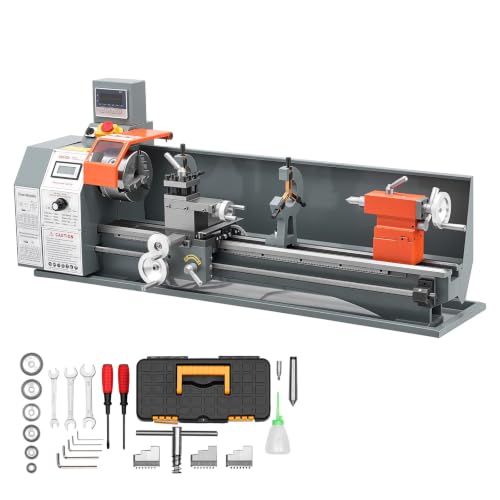
VEVOR 10×30 Benchtop Lathe with DRO
What We Like
- Large 10×30 inch work capacity for long shafts
- Precise 2-axis digital readout for tool positioning
- Powerful 1100W motor with dual speed ranges
- Includes emergency stop and chuck guard interlock
Trade-offs
- Its 48-inch length demands significant workshop floor space
A 10-inch swing and 30 inches between centers lets you handle workpieces most benchtop lathes simply can’t, like long drive shafts or large-diameter stock. This VEVOR is for the serious home machinist or small shop that regularly needs that extra real estate. The integrated 2-axis DRO is a major advantage, swapping dial guessing for direct digital feedback to hit precise dimensions consistently. Combine that with the 1100W motor’s dual speed ranges, and you have a machine built for both heavy roughing cuts and fine finishing work on metals, plastics, and wood.
You pay for that capacity with a substantial footprint and heft. It commands a dedicated, rock-solid stand. Compared to a more compact option like the JET 9×19, you gain significant workpiece length and the convenience of the DRO, but you surrender portability and need the room to accommodate it. For the right workshop, however, that trade-off is the whole point.
Product photos
ZHRUI 4-Axis Precision Micro Lathe
What We Like
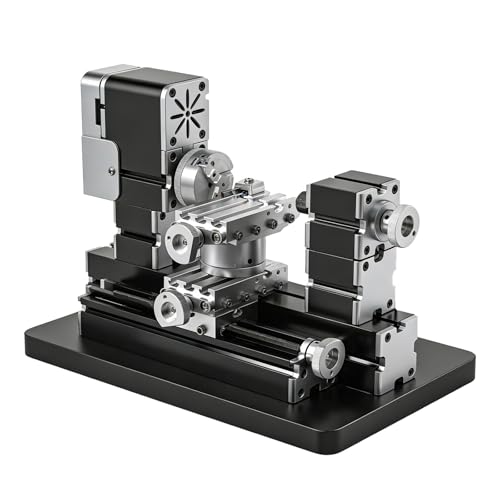
- 4-axis machining with quick indexer for multi-angle work.
- All-metal construction with dovetail T-slot structure.
- Safety features include crash guard and low-voltage operation.
Trade-offs
- 60W motor limits it to soft metals, wood, and plastics.
- 150mm turning capacity restricts workpiece size.
- Lacks the mass for heavy-duty vibration damping.
The ZHRUI’s 4-axis capability, with an A-axis that rotates and indexes, lets you machine multiple faces and angles without realigning the workpiece every time. That makes it a compelling choice for intricate model-making, detailed jewelry work, or any project demanding precise, multi-directional cuts on small-scale parts. Its all-metal build and 0.02mm precision handwheels provide the solid feel and fine control needed for such delicate operations, while the 12V system keeps it safe and approachable for beginners or educational settings.
The trade-off is its capacity. The 60W motor and 150mm swing mean you’re working exclusively with soft metals like aluminum and brass, plus woods and plastics. It’s built for finesse, not force. For turning larger diameters or harder materials, you’d need to step up to a more substantial machine like the VEVOR 10×30 Benchtop Lathe. That model offers far more power and a larger work envelope, but it lacks this model’s multi-axis versatility in a compact package.
Product photos
MechMaxx 8×16 Metal Lathe with DRO
What We Like
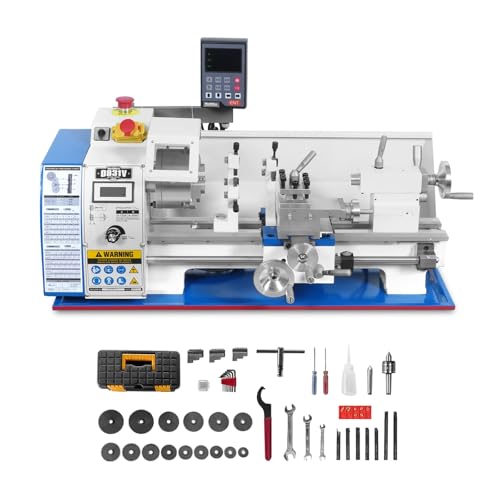
- Digital Readout (DRO) for precise real-time measurement
- Cuts both metric and inch threads with thread dial
- Powerful 1.5 HP brushless motor for consistent power
- Large 1.5-inch spindle bore for handling thicker stock
Trade-offs
- Compact 15-3/4" center distance limits longer workpiece projects
- No stand included, requiring a separate purchase and setup
- Swing over bed is smaller than larger benchtop models
A 1.5-inch spindle bore lets you feed larger bar stock straight through, a capability often reserved for bigger machines. The digital readout provides real-time measurements across both axes, which means quicker setups and less manual calculation for precise cuts. This combination suits a compact workshop tackling medium-sized projects, supported by the variable-speed brushless motor and its ability to cut both metric and inch threads.
The trade-off for its packed feature set is its physical capacity. While the spindle bore is generous, the 15-3/4 inches between centers means you’re limited on overall part length. For someone regularly needing to turn parts longer than about 16 inches, a model like the VEVOR 10×30 Benchtop Lathe offers more bed length, though it will occupy significantly more floor space. This MechMaxx finds its sweet spot by offering advanced features in a footprint that still fits on a sturdy bench.
Product photos
Shop Fox 6×10 Mini Metal Lathe
What We Like
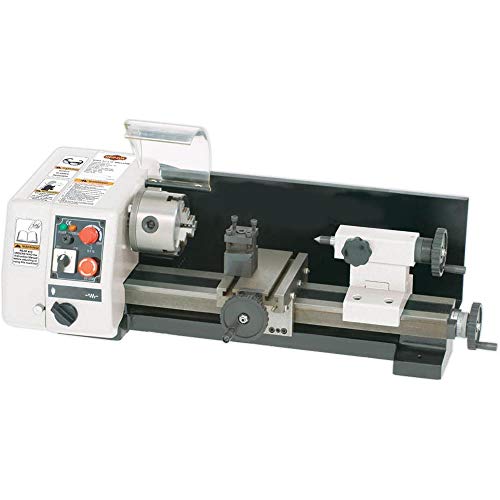
- Compact 48-inch square footprint fits tight spaces.
- 71-pound weight allows for manageable benchtop mounting.
- 6-inch swing handles small-diameter stock effectively.
Trade-offs
- A 10-inch work length limits longer part turning.
- Its light weight may require securing for heavy cuts.
A 6-inch swing and 10-inch work length define this as a true mini lathe, built for the precise world of small-scale projects. It’s the right fit for a hobbyist or model maker whose workshop is a corner of a garage. They can focus on intricate components for clocks, instruments, or miniature engines where its size is a feature, not a limitation. The 71-pound weight means you can set it up on a sturdy bench without a hoist, making it an accessible entry point into metal turning.
The trade-off for that compact footprint is capacity. You’ll be turning knobs and bushings, not rifle barrels or long shafts. When your projects outgrow the 10-inch bed, you’ll be looking at a step up like the JET 9×19 Belt Drive Bench Lathe, which offers nearly double the work length and substantially more mass for stability. For its intended scope of tiny, precise work, the Shop Fox M1015 delivers a focused and space-efficient platform.
TECHTONGDA 1100W Automatic Threading Lathe

What We Like
- Electronic gear-shift for metric and imperial threads
- Stepless variable speed from 50 to 2500 RPM
- Full-metal construction with taper roller bearings
- Integrated control panel with display and memory
Trade-offs
- At 160 pounds, it requires a sturdy, dedicated bench.
- No digital readout (DRO) for precision measurement.
The electronic gear-shift that switches between metric and imperial threads at the push of a button is the standout feature here. It eliminates the manual gear changes and cover removals that bog down threading work on conventional lathes. For a hobbyist or small shop regularly tackling projects requiring different thread standards, that automation is a serious time-saver. The 1100W brushless motor provides clean, maintenance-free power, and the full-metal construction promises the rigidity needed for accurate cuts.
This lathe’s electronic gear-shift system automatically switches between metric and imperial threads without manual gear changes, a feature that streamlines frequent threading work compared to conventional machines. At 160 pounds, it has enough mass for stable benchtop use while remaining more manageable to position than heavier units like the 250-pound JET model. The integrated control panel with a display screen supports parameter memory and one-click tool indexing, simplifying complex machining workflows directly from the operator’s station.
Product photos
VEVOR 8.3×29.5 Brushless Motor Lathe

What We Like
- Wide 50-2500 RPM continuously variable speed range
- Brushless motor avoids maintenance and provides consistent power
- Comprehensive set of safety switches and overload protection
- Heavy-duty HT200 cast iron and metal gear construction
Trade-offs
- At 197 pounds, it requires a very sturdy benchtop for mounting
- No digital readout (DRO) like the VEVOR 10×30 model offers
A continuously variable speed range from 50 to 2500 RPM gives you fingertip control for everything from heavy roughing cuts to fine finishing work on small parts. That, combined with the 750W brushless motor, makes this VEVOR lathe a strong fit for a hobbyist or small shop needing precise speed adjustment without gear changes. The 8.3-inch swing and 29.5-inch between-centers capacity handle a solid range of common projects, and the ability to cut 24 different thread types adds serious versatility. It’s built for the long haul with its cast iron frame and metal gears.
That capability comes with significant heft, as the lathe weighs 197 pounds. You’ll need a dedicated, sturdy workbench for it. While models like the MechMaxx 8×16 offer a digital readout, this VEVOR prioritizes core features like its cast iron frame and metal gears for long-term durability, focusing machining performance where it counts for the price.
ZHRUI ZRCC01036 Benchtop Metal Lathe
What We Like
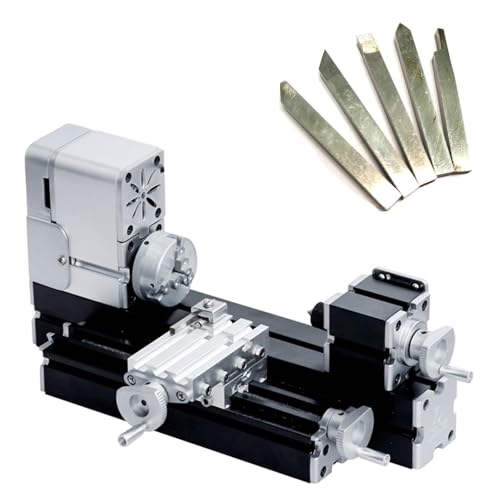
- Complete kit includes five carbide tipped cutters
- Ultra-quiet 55dB motor with triple electrical protection
- Industrial all-metal construction for zero shake
- Universal 110V-240V power adapter for global use
Trade-offs
- 150mm max length limits work to very small components
- 50mm max diameter restricts material stock size significantly
Ready to use out of the box with a 5-piece carbide cutter set, this mini lathe eliminates the initial tool hunt for beginners. Its permanently etched 0.02mm precision scale enables micron-level control for detailed work on small components like model parts and pens. An all-metal construction provides industrial rigidity, while the motor’s library-quiet operation at about 55dB allows for use in spaces like apartments without creating a disturbance.
That capability comes with a clear size limitation. With a maximum workpiece diameter of 50mm and length of 150mm, you are firmly in the realm of micro-machining. It will handle soft metals, acrylic, and wood for small crafts beautifully, but it lacks the mass and lower speed range for more substantial metal projects. If your ambitions grow to include threading or turning steel stock larger than a couple of inches, you will quickly outgrow it. At that point, you’d need to step up to a model like the WEN 7×12 Variable Speed Benchtop Metal Lathe.
Product photos
INTSUPERMAI 8×32 Gearless Metal Lathe
What We Like
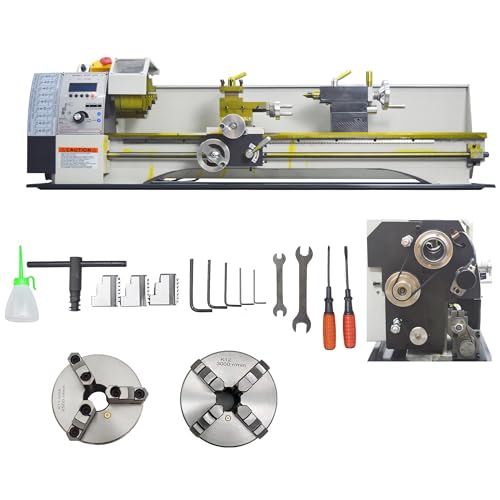
- Gearless design eliminates manual gear changes for threading
- Electronic panel controls both imperial and metric threading
- Includes both 3-jaw and 4-jaw chucks for flexibility
- 1100W brushless motor offers wide 50-2500 rpm speed range
Trade-offs
- Gearless electronic system requires learning digital controls
- No physical gearbox for traditional machinists
The gearless electronic leadscrew is the defining feature here. It lets you switch between imperial and metric threads without ever touching a physical gear, making this lathe a natural fit for a hobbyist who wants to tackle threading projects without the setup time of a traditional gearhead lathe. The 1100W brushless motor provides a solid speed range from a slow 50 rpm for heavy cuts up to 2500 rpm for finishing work. Reviewers report it arrives ready for both concentric and off-center work, as it includes both a 3-jaw and a 4-jaw chuck.
You trade the mechanical process of changing gears for the convenience of digital control, which streamlines operation but ties your workflow to the panel’s interface. This design positions the INTSUPERMAI lathe for the tinkerer who values modern electronic convenience in a classic benchtop form, focusing on simplified setup over traditional gear-driven feedback.
Product photos
How We Evaluated Benchtop Metal Lathes
We based our evaluation on manufacturer specifications, technical documentation, and patterns in owner feedback from machining communities. We prioritized criteria that matter most for turning metal at home: work capacity (swing and length), motor power for material hardness, and the threading system’s convenience for common projects. We also considered the stability offered by bed construction and the value of modern features like digital readouts.
This guide is based on documented specifications and user reports about performance and reliability. It serves as a starting point for matching a lathe’s capabilities to your project requirements.
What To Look For In Benchtop Metal Lathes
Your lathe’s specifications determine what you can make. Focus on the machine’s physical limits, its power to cut your chosen materials, and the systems that control precision work like threading. Understanding these specs will prevent buying a lathe that’s too small or overly complex for your shop.
Key specs are swing (max diameter), distance between centers (max length), motor power (for material hardness), and the threading system (gear vs electronic). Bed mass and construction affect stability and finish quality.
Work Capacity: Swing and Distance Between Centers
“Swing” is the maximum diameter of a workpiece that can clear the lathe bed, typically measured in inches. “Distance between centers” is the longest piece you can mount between the headstock and tailstock. A lathe listed as “7×12” has a 7-inch swing and a 12-inch center distance. For example, a guide to the best metal lathes will always list these dimensions first. Choose a swing that accommodates your typical stock diameter, and a length that exceeds your longest planned part by several inches for tool clearance.
Motor Power and Speed Control
Motor power, often listed in amps or horsepower, dictates the hardness of material you can cut effectively and the depth of cut possible. A motor with higher horsepower can handle tougher steels better than one with lower power. Equally important is speed control: variable speed, either via belts or electronically, lets you match RPM to the workpiece diameter and material. For a wide range of materials, a guide to metal lathe operation will emphasize starting with lower RPMs for larger, harder stock.
Threading System and Precision Features
The method for cutting threads is a major differentiator. Traditional lathes use a gearbox or change gears, offering a tactile, mechanical process. Modern electronic or “gearless” models use digital controls to select thread pitches, eliminating manual gear changes. Consider which system suits your workflow. For ultimate precision, a lathe digital readout (DRO) provides real-time tool positioning measurements, drastically reducing errors on critical dimensions.
Stability and Construction
A lathe’s bed, often made of cast iron, provides the rigid foundation necessary for accurate cuts. Greater mass absorbs vibration, leading to a better surface finish. When comparing benchtop metal lathes, note the machine’s weight, as a heavier lathe generally indicates a more stable platform. This is crucial when you’re evaluating the differences between lathe types, as metal lathes are built for much higher forces than their wood-turning counterparts.
- Check the bed construction: cast iron is preferred for its vibration-damping properties.
- Ensure your workbench is stout enough to support the lathe’s weight without flexing.
- Look for a solid spindle and bearing assembly, as this affects long-term accuracy.
- Verify the included tooling, such as chucks and centers, is adequate for your starting projects.
- Consider future needs, like adding a milling attachment or other accessories.
A sturdy, well-built lathe on a solid bench is the foundation of good work.
Benchtop Metal Lathes Compared
The table below compares the core specifications of our top picks side-by-side to highlight their key differences at a glance.
| Product | Swing over bed | Distance between centers | Motor power | Speed range |
|---|---|---|---|---|
| WEN 7×12 Variable Speed Benchtop Metal Lathe | 7 inches | 12 inches | 4-amp | 100-2500 RPM |
| JET 9×19 Belt Drive Bench Lathe | 9 inches | 19 inches | 3/4 HP | N/A |
| VEVOR 10×30 Benchtop Lathe with DRO | 10 inches | 30 inches | 1100W | 0-1500 & 0-3000 RPM |
| ZHRUI 4-Axis Precision Micro Lathe | 150mm diameter | 150mm length | 60W | 12,000 RPM |
| MechMaxx 8×16 Metal Lathe with DRO | 8-1/4 inches | 15-3/4 inches | 1.5 HP | 0-2500 RPM |
| Shop Fox 6×10 Mini Metal Lathe | 6 inches | 10 inches | N/A | N/A |
| TECHTONGDA 1100W Automatic Threading Lathe | N/A | N/A | 1100W brushless | 50-2500 RPM |
| VEVOR 8.3×29.5 Brushless Motor Lathe | 8.3 inches | 29.5 inches | 750W brushless | 50-2500 RPM |
| ZHRUI ZRCC01036 Benchtop Metal Lathe | 50mm | 150mm | N/A | 20000 RPM |
| INTSUPERMAI 8×32 Gearless Metal Lathe | 8.27 inches | 31.50 inches | 1100W brushless | 50-2500 rpm |
Frequently Asked Questions
What is the best benchtop metal lathe?
The best overall benchtop metal lathe for most home workshops is the WEN 7×12 Variable Speed model. It offers full variable speed control, can cut a variety of threads, and includes a two-year warranty, making it a versatile and reliable choice for general small to medium projects.
What company makes the best lathes?
Many reputable companies manufacture quality benchtop lathes, including WEN, JET, and Shop Fox, each serving different needs. “Best” depends entirely on your specific requirements for capacity, features, and budget, as seen in our list of top metal lathe models.
What is the best metal lathe for threading?
For convenient threading, the JET 9×19 Belt Drive Bench Lathe with its quick-change gearbox is an excellent choice for both inch and metric threads. If you prefer electronic control, the TECHTONGDA 1100W or INTSUPERMAI 8×32 offer gearless designs to avoid manual gear changes.
What should I look for in a mini metal lathe?
When choosing a mini metal lathe, pay close attention to the work capacity (often 6-7 inch swing and under 12 inches long), motor power for your materials, and the included tooling. Their light weight means securing them firmly to your bench is critical for good results.
Can a benchtop lathe handle steel?
Yes, many benchtop lathes can handle steel, but their capability depends on motor power, rigidity, and using appropriate cutting speeds and tools. A model with at least a 3/4 HP motor and a cast-iron bed, like the MechMaxx 8×16, is better suited for steel than a very low-power mini lathe designed for soft metals.
The Bottom Line
The WEN 7×12 Variable Speed Benchtop Metal Lathe is our best overall pick, ideal for the home workshop enthusiast tackling a wide range of small to medium precision metal projects. If your budget is tight and your projects are very small, consider the ZHRUI ZRCC01036; for machining long shafts, the large-capacity VEVOR 10×30 is the clear choice.
Before deciding, honestly assess the longest and largest-diameter parts you plan to make. Matching your lathe’s swing and center distance to your actual project needs is the single most important step to avoid immediate buyer’s remorse.
