
7 Best Cabinet Table Saws For Woodworking in 2026
This post contains affiliate links. As an Amazon Associate, we earn from qualifying purchases.
For a cabinet saw that blends professional-grade precision with an industry-leading safety system, the SawStop PCS175 Professional Cabinet Saw is our best overall pick. For pure industrial power, consider the SawStop ICS 5HP, while the Jet ProShop II offers a compact value. These machines form the backbone of a serious woodworking shop, but their significant weight and power requirements demand careful planning. We researched specifications, manufacturer data, and patterns in owner feedback to identify the models that deliver the stability, accuracy, and durability cabinet makers and furniture builders need most.
Top 7 Cabinet Table Saws For Woodworking in the Market
Certain content that appears on this site comes from Amazon. This content is provided "as is" and is subject to change or removal at any time.
The Best Cabinet Table Saws For Woodworking, Reviewed
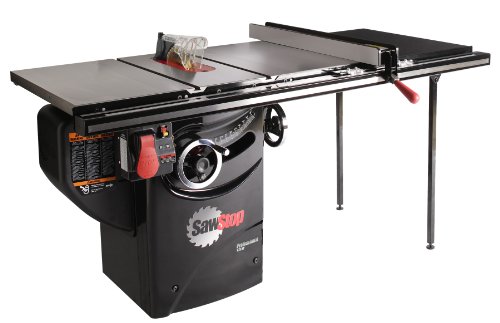
SawStop PCS175 Professional Cabinet Saw
What We Like
- Patented safety system stops blade on skin contact
- 36-inch T-Glide fence provides reliable, square cuts
- Trunnion and arbor built for precision and stability
- Gas piston elevation allows for smooth adjustments
Trade-offs
- Weighs 471.4 pounds, requiring a permanent shop placement
- Overarm dust collection guard is a separate purchase
A blade that stops in less than 5 milliseconds on contact with skin is the single most decisive feature for any woodworker prioritizing safety. This SawStop system turns a potential life-altering injury into a minor scratch, providing peace of mind that’s hard to quantify. Combined with a rock-solid 36-inch T-Glide fence and a trunnion built for precision, the PCS175 delivers the accuracy and reliability a serious hobbyist or professional demands. It’s the cabinet saw for those who won’t compromise on safety in their shop routine.
It demands a dedicated, grounded outlet and a commitment to its space. However, for the vast majority of shop tasks, its power is ample, and the safety system is an unmatched layer of protection that defines its value.
SawStop ICS 5HP Industrial Cabinet Saw

What We Like
- Patented safety system stops blade on skin contact
- Nearly 700-pound iron and steel construction for stability
- Integrated lock-out tag-out switch for authorized use only
- Advanced shrouding provides excellent below-table dust collection
Trade-offs
- Massive 717.9-pound weight demands a permanent workshop footprint
- 36.5-inch depth and 69.2-inch width consumes significant floor space
The 5-horsepower motor and 717.9-pound mass of iron and steel deliver unwavering power and vibration-dampening stability for all-day production ripping. This is a saw built for a demanding industrial environment where consistent, reliable cuts are non-negotiable. Its defining feature is the revolutionary safety system that stops the blade on contact with skin, transforming a potential catastrophe into a minor incident. That, combined with interlock switches on access panels, makes it a compelling choice for any shop prioritizing operator safety alongside brute-force performance.
You pay for that industrial capability with immense size and weight, requiring a dedicated, spacious shop floor. Compared to a more compact model like the SawStop PCS175, the ICS is a true stationary beast. For a high-volume professional shop where safety, power, and durability are paramount, this saw stands apart. In a smaller or mobile operation, its physical demands could be a significant constraint.
Powermatic PM2000B Cabinet Table Saw

What We Like
- Digital readout on blade tilt scale for precision
- One-piece cast iron trunnion for exceptional stability
- Hydraulic caster system for shop mobility
- Quick-release lever for riving knife changes
Trade-offs
- 30-inch rip capacity is shorter than many cabinet saws
- Requires a 230V single-phase electrical circuit
A 3 HP motor and one-piece cast iron box trunnion provide the strongest stability of any Powermatic table saw, which creates a solid base for cutting. The blade tilt scale includes a digital readout and adjustable angle indicators for repetitive bevel cuts. This setup is designed for woodworkers who need to set and return to specific angles.
The saw weighs 605.5 pounds, so it is a permanent shop fixture, though an integrated hydraulic caster system allows for movement. Its 30-inch rip capacity handles many cabinet and furniture parts, but it offers less rip capacity than the 50-inch Jet XACTA Deluxe cabinet saw.
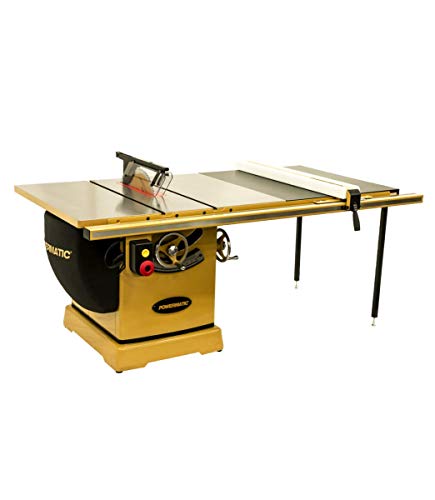
Powermatic PM3000B 14-Inch Cabinet Saw
What We Like
- One-piece cast iron trunnion for superior stability
- Industrial-duty Accu-Fence System ensures accuracy
- Quick-release riving knife lever for fast changes
Trade-offs
- Requires 230/460V 3-phase power
- Weight of 738 pounds
The Powermatic PM3000B’s 7-1/2 HP motor and 50-inch rip capacity indicate a tool for heavy-duty applications. Its one-piece cast iron trunnion is described as providing the strongest stability of any Powermatic table saw, while the poly-V drive belt system is noted for efficient, quiet operation. These industrial-grade components are typical of machinery intended for high-volume, demanding workshop environments.
That capability comes with real physical requirements. At 738 pounds, moving it is a multi-person event, and its 3-phase power needs rule out most residential garages. Compared to a more compact cabinet saw like the Powermatic PM2000B, the PM3000B demands a significant commitment in both shop space and electrical infrastructure. You’re not just buying a saw; you’re installing a cornerstone of a high-output workshop.
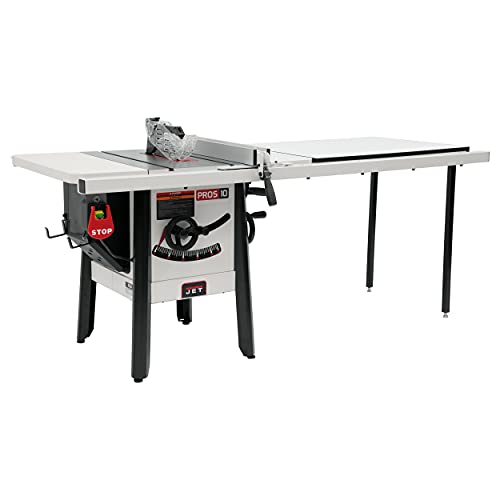
Jet ProShop II Cabinet Table Saw
What We Like
- Quick-release riving knife for hassle-free changes
- Magnetic paddle switch for safe operation
- Onboard storage for all included accessories
- Single-belt design reduces vibration
Trade-offs
- 1-3/4 HP motor is less powerful than 3HP or 5HP cabinet saws
A 52-inch rip capacity on a cabinet saw with a 40-inch wide footprint makes this a space-efficient choice for a home shop. The 1-3/4 HP motor runs on standard 120-volt power, so a new circuit isn’t required for garage workshops. The redesigned arbor lock and a motor reset switch relocated to the power switch are features aimed at simplifying daily use.
You trade raw power and mass for that compact size and standard outlet compatibility. The improved dust shroud and innovative single-belt design are listed features for dust collection and reduced vibration. For building cabinets and furniture in a confined space, it presents a specific configuration of size and capability.
Product photos
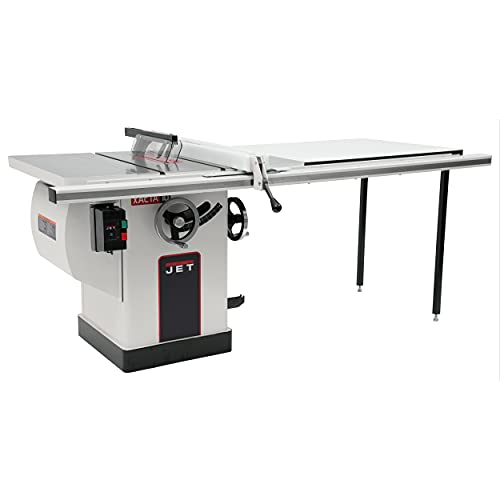
Jet XACTA Deluxe Cabinet Table Saw
What We Like
- 50-inch commercial XACTA fence for precise wide cuts
- Large 85-inch table with cast iron extension wings
- Heavy 510-pound weight and wide trunnion for stability
- Quick-release riving knife reduces kickback risk
Trade-offs
- At 510 pounds, moving it requires significant planning and space
- 85-inch length demands a very large workshop footprint
- 3 HP motor requires a dedicated 230V electrical circuit
An 85-inch long table with cast iron wings provides a massive, stable work surface, a clear advantage when handling sheet goods or long timbers. This saw is built for the woodworker who needs room to maneuver large projects, and the exclusive 50-inch fence ensures precision across that entire span. The 510-pound weight and wide-stance trunnion mean this machine stays planted, eliminating chatter and vibration during demanding cuts. It’s a serious tool for a shop where space isn’t a constraint and precision on a grand scale is the daily goal.
At 85 inches long, the Jet XACTA Deluxe demands a dedicated, spacious workshop bay. Its 50-inch rip capacity and large cast iron table provide professional-grade material support, but the 510-pound cabinet isn’t moving easily. This saw is built as a permanent, high-capacity station, unlike more compact cabinet saws designed for tighter spaces.
Product photos
Grizzly Industrial G0651 Cabinet Table Saw

What We Like
- 3 HP motor provides substantial cutting power
- Large 75-inch table supports big sheet goods
- Heavy 435-pound cabinet ensures stability
- Left-tilting blade design is a common preference
Trade-offs
- Requires a dedicated 220V electrical circuit
- At 435 pounds, moving it requires significant effort
A 3 HP motor on a 220V circuit delivers the core power needed for hardwoods and repeated rips, placing serious capability within reach. The substantial 75-inch table gives you real estate to manage full sheets of plywood, while the heft of the 435-pound cabinet soaks up vibration for cleaner cuts. This is the saw for the woodworker ready to move beyond contractor models, who needs industrial-grade fundamentals without the premium brand price tag.
The trade-off is in the setup and space. You’ll need to wire a 220V outlet and have a couple of strong friends to maneuver it into place. Compared to a saw like the lighter-duty Jet ProShop II, the Grizzly is a permanent workshop fixture. It forgoes some refinement for raw capability, making it a foundational tool you build a shop around, not one you tuck away after a weekend project.
Product photos
How We Evaluated Cabinet Table Saws
Our selection is based on research into manufacturer specifications, expert round-up comparisons, and consistent patterns in professional and advanced hobbyist owner feedback. We prioritized a saw’s foundational stability, the accuracy and capacity of its rip fence, and the power and electrical requirements of its motor.
A cabinet saw is a major investment, so long-term durability and specialized features like advanced safety systems are also important considerations. This evaluation focuses on the engineering and design choices that directly influence performance in a workshop.
What To Look For In Cabinet Table Saws
A cabinet saw is the centerpiece of a woodworking shop, built for precision and daily use. Your choice hinges on matching the machine’s capabilities to your shop’s space, power, and the work you do.
Key factors include motor power, ranging from 1.75HP to 5HP, which dictates the saw’s ability to rip hardwoods. Another is rip capacity, from 30 to over 50 inches, which determines the size of sheet goods you can handle. Finally, the saw’s total weight and footprint affect shop placement and mobility.
Motor Power & Electrical Requirements
The motor is the heart of a cabinet saw, directly influencing its ability to make smooth, unstalled cuts through thick stock. Motors range from 1.75 HP, suitable for a dedicated hobbyist, to industrial 3 HP and 5 HP models for high-volume work. More power almost always requires higher voltage: many 3 HP saws need a dedicated 220V circuit, while true industrial 5 HP and 3-phase models demand specialized shop wiring. When researching professional table saws, verify the motor’s amperage and voltage requirements against your shop’s electrical capacity before purchasing.
Rip Capacity & Fence System
Rip capacity, the maximum distance from the blade to the fence, determines the width of material you can cut. For cabinet and furniture work involving full sheets of plywood, a capacity of at least 36 inches is standard, with 50-inch systems offering greater ease for solo work.
The fence mechanism is equally critical; a precise, square, and easy-to-adjust system like a T-Glide or commercial XACTA fence is a hallmark of quality. A reliable fence is the single most important factor for repeatable accuracy, which is why it’s a central focus in reviews of cabinet table saws.
Weight, Stability & Shop Fit
Cabinet saws are heavy, with some models weighing several hundred pounds. This mass is essential for damping vibration and ensuring stability during cuts, but it also means the saw is a permanent shop fixture. You must assess the machine’s footprint against your available floor space.
Some models include mobility kits, but moving a heavy cabinet saw is never trivial. For shops with limited space, researching compact cabinet saws can highlight options that still offer a cabinet saw’s core advantages over lighter hybrid or contractor saws.
- Measure your shop’s floor space and doorways to ensure the saw can be delivered and positioned.
- Confirm your electrical panel can support a new 220V circuit if required.
- Plan for dust collection, as most cabinet saws have a 4-inch port.
- Consider future accessory needs, like overarm guards or sliding table attachments.
A cabinet saw is a long-term investment, so prioritize durable construction and a precise fence over features you may never use.
Cabinet Table Saws For Woodworking Compared
The following table summarizes the key specifications of our top picks to help you compare them at a glance.
| Product | Motor Power | Blade Size | Weight |
|---|---|---|---|
| SawStop PCS175 Professional Cabinet Saw | 1.75 HP | 10 inches | 471.4 Pounds |
| SawStop ICS 5HP Industrial Cabinet Saw | 5 HP | 10 inches | 717.9 pounds |
| Powermatic PM2000B Cabinet Table Saw | 3 HP | N/A | 605.5 pounds |
| Powermatic PM3000B 14-Inch Cabinet Saw | N/A | 14-Inch | 738 pounds |
| Jet ProShop II Cabinet Table Saw | 1-3/4 HP | 10-Inch | 285.9 Pounds |
| Jet XACTA Deluxe Cabinet Table Saw | 3 HP | 10-Inch | 510 pounds |
| Grizzly Industrial G0651 Cabinet Table Saw | 3 HP | 10" | 435.0 pounds |
Frequently Asked Questions
What is the best table saw for cabinet making?
The best table saws for cabinet making offer exceptional precision, a large, stable table, and a reliable fence system for repeatable cuts. Our best overall, the SawStop PCS175, excels here with its professional-grade T-Glide fence and stable cabinet-mounted trunnion. For shops focused on precise angled cuts, the Powermatic PM2000B with its digital tilt readout is an excellent choice. You can explore more dedicated options in our guide to table saws for cabinet making.
What is the difference between a table saw and a cabinet saw?
A cabinet saw is a specific, heavy-duty type of table saw. The key difference is construction: a true cabinet saw has a fully enclosed, heavy-gauge steel cabinet base that houses the motor and trunnion assembly, providing superior stability and dust collection. Contractor saws have an open stand, and hybrid saws are a lighter compromise. The distinction is important for vibration reduction and professional durability, which is why we focus specifically on cabinet saws in this guide.
What is the best contractor’s table saw?
Contractor’s table saws are a different category designed for job-site mobility, with lighter open stands and often less powerful motors. They are not covered in this guide, which is dedicated to stationary shop cabinet saws. If you need a saw you can move regularly, a contractor saw may be a better fit. For a detailed explanation of the trade-offs, see our comparison of cabinet vs contractor saw.
Can I use a cabinet saw in a home garage workshop?
Yes, but it requires planning. You need sufficient floor space for the saw’s large footprint, adequate electrical service for its power demands (often 220V), and the ability to manage significant weight, as these saws are not easily moved. Proper dust collection is also highly recommended. Models like the Jet ProShop II are designed to fit in limited spaces while still offering cabinet-saw performance.
Do I need special blades for a cabinet saw?
Cabinet saws typically use standard ten-inch diameter blades. While they can run any quality blade, the saw’s power and precision are best utilized with sharp, well-chosen blades for specific tasks. For fine woodworking and cabinet making, investing in a set of dedicated table saw blades for fine woodworking, like a thin-kerf rip blade and a high-tooth-count crosscut blade, will yield the cleanest results.
The Bottom Line
The SawStop PCS175 Professional Cabinet Saw is our best overall pick for its unmatched combination of a proven safety system and professional-grade precision, making it ideal for safety-conscious woodworkers and professional shops. If your budget is tighter, the Grizzly Industrial G0651 offers full-power performance at a more accessible price point, while those with limited space should look at the compact Jet ProShop II.
Ultimately, the most important factor is matching the saw’s power, size, and electrical needs to your shop’s permanent capabilities. A cabinet saw is a centerpiece tool meant to last for decades, so choose the one that provides the stability and accuracy your work demands.
