
10 Best Table Saw Blades For Fine Woodworking in 2026
This post contains affiliate links. As an Amazon Associate, we earn from qualifying purchases.
For a versatile, high-performance blade that excels at furniture-grade joinery, we recommend the Freud LU88R010 Fine Finish Crosscut Blade. For specialized tasks, the CMT Orange Tools Ultra Fine blade is best for veneers, while the WEN BL1060 offers great value. Fine woodworking demands a blade that leaves a surface ready for glue, not just the sander.
The right blade geometry, tooth count, and kerf make the difference between a splintered edge and a flawless finish. To help you choose, we researched specifications, manufacturer data, and patterns in owner feedback to compile this list of ten top-performing blades for specific fine woodworking needs.
Top 10 Table Saw Blades For Fine Woodworking in the Market
Certain content that appears on this site comes from Amazon. This content is provided "as is" and is subject to change or removal at any time.
The Best Table Saw Blades For Fine Woodworking, Reviewed
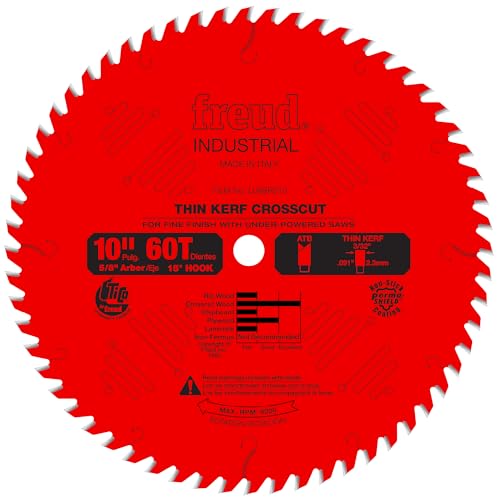
Freud LU88R010 Fine Finish Crosscut Blade
What We Like
- Premium TiCo carbide for maximum performance.
- Perma-Shield coating resists corrosion and pitch.
- 15° hook angle aids smoother, faster cutting.
Trade-offs
- Not a dedicated ripping blade for long grain cuts.
- Fine 60-tooth crosscut design is slower for rough dimensioning.
It shears fibers cleanly for a surface that needs minimal sanding, and the thin kerf puts less strain on your saw’s motor. The Perma-Shield coating is a real benefit in the shop, fighting rust and gunk buildup. This is the blade to reach for when your crosscuts, miters, and trim work need to be pristine right off the saw, saving you time at the sanding station. It’s the workhorse finish blade for the woodworker who values efficiency and a ready-to-glue edge.
The Freud LU88R010 is a fine finish crosscut blade, and its positive hook angle is noted to produce a smoother cut and allow for a faster feed rate. According to expert round-ups, the blade makes remarkably smooth cuts, though it is also noted that tablesaws are generally considered dimensioning tools, not finishing tools. This means you’ll still plane or sand, but you’ll start much closer to your final surface.
Product photos
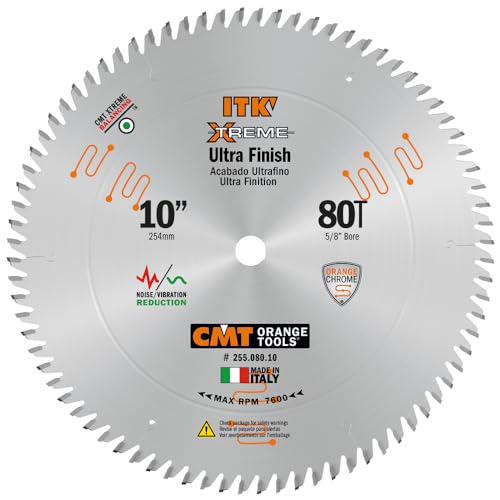
CMT Orange Tools Ultra Fine Finishing Saw Blade
What We Like
- Ultra-thin 0.110-inch kerf minimizes waste.
- Fine 0.071-inch plate reduces vibration for cleaner cuts.
- Low 5° hook angle provides controlled feed on veneers.
- Hi-ATB 30° tooth geometry shears delicate materials cleanly.
Trade-offs
- Low hook angle requires slower, more deliberate feed pressure.
A 0.110-inch kerf and a 0.071-inch plate are the core specs for a blade designed to slice through expensive veneers and melamine with almost no tear-out. The low 5° hook angle and specialized Hi-ATB 30° tooth geometry give you exceptional control, shearing the material instead of grabbing it. This is the blade you reach for when the cut face will be visible and flawless, not hidden under a trim piece. It’s built for the final pass where perfection is non-negotiable.
With a 0.110-inch kerf and a 0.071-inch plate, this blade is engineered for minimal material removal and reduced saw motor strain. That thin profile, however, trades away mass and rigidity needed for aggressive cuts in dense stock. Its 5-degree hook angle and Hi-ATB 30 tooth geometry are instead purpose-built for clean slicing in laminates and veneers, making it a specialized tool for finishing work.
Product photos
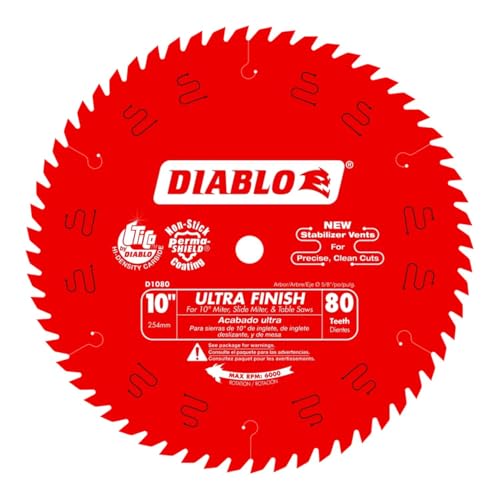
Diablo D1080X Fine Finish Saw Blade
What We Like
- 80-tooth ATB design for ultra-smooth cuts
- PermaShield coating for corrosion resistance
- Reduced vibration design for stability
- Compact and lightweight for easy handling
Trade-offs
- General-purpose design may not excel in specialized veneer work
With 80 teeth packed into a 10-inch blade, the Diablo D1080X is built to leave a polished, ready-to-finish surface on crosscuts and trim work. The high tooth count and ATB grind slice cleanly through wood and composites, minimizing tear-out on delicate moldings. It’s a solid choice for the woodworker who needs reliable, fine results across miter, table, and chop saws without swapping blades for every task. The PermaShield coating adds a layer of practical protection against pitch and rust in a humid shop.
Designed to fit most 10-inch miter, table, and chop saws, the Diablo D1080X offers broad compatibility for professionals and DIYers. Its 80-tooth configuration provides ultra-smooth, accurate cuts on wood and composite materials, ideal for fine woodworking and trim. The blade is engineered for reduced vibration, which ensures stability and improved control during operation. A compact style and package weight of 0.812 kilograms make it easy to handle and store on a jobsite.
Product photos
Freud Ultimate Plywood & Melamine Blade

What We Like
- Hi-ATB tooth design for splinter-free cuts
- Laser-cut anti-vibration slots reduce movement
- Perma-Shield coating reduces drag and corrosion
- Premium TiCo carbide for maximum performance
Trade-offs
- A 0.126-inch kerf requires more motor power than a thin-kerf blade.
- The 80-tooth design is optimized for crosscutting, not for fast rip cuts.
An 80-tooth Hi-ATB grind is the key to its splinter-free performance in sheet goods. The teeth slice cleanly through the fragile veneers of plywood and melamine, leaving a finished edge that often needs no further sanding. This blade is built for the woodworker who demands a flawless surface right off the saw, especially when working with expensive cabinet-grade materials. The laser-cut anti-vibration slots and heavy 0.087-inch plate keep everything rigid, so the blade tracks straight without deflection.
That solid construction comes with a trade-off. The full 0.126-inch kerf and substantial weight demand a saw with good power, making it less suitable for lower-powered benchtop models. For general fine crosscutting on solid wood, the thinner kerf and lighter weight of something like the Freud LU88R010 Fine Finish Crosscut Blade might be a more versatile choice. But when your project hinges on perfect plywood, this blade’ specialized design delivers.
Product photos
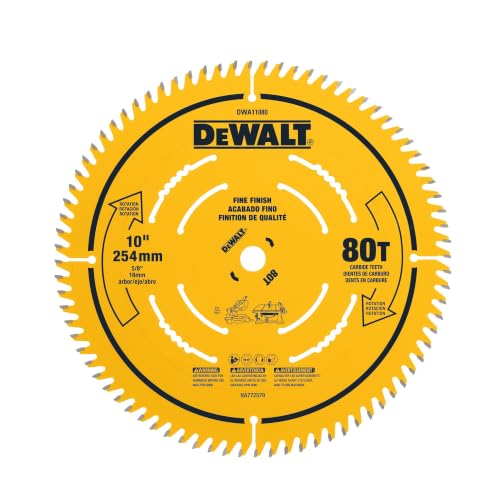
DEWALT DWA11080 Fine Finish Saw Blade
What We Like
- Patented body slot design for low vibration
- Ultra sharp carbide teeth for clean cutting
- Optimized tooth geometry for increased accuracy
Trade-offs
- No explicit coating mentioned for friction and corrosion resistance
Patented body slots dampen vibration, reducing chatter for smoother cuts in fine hardwoods and veneers. This design targets woodworkers seeking a clean finish straight from the saw to minimize sanding. Its optimized tooth geometry and ultra-sharp carbide are built for that final, presentation-ready pass.
This is a fine-finish blade, not a dedicated ripper or laminate cutter. For heavy ripping, a blade like the CMT ORANGE TOOLS 203.630.10 with its aggressive hook angle would be more suitable. The tool is engineered for a specific, critical job in the workflow, delivering through its mechanical damping.
Product photos
WEN BL1060 Fine-Finish Saw Blade
What We Like
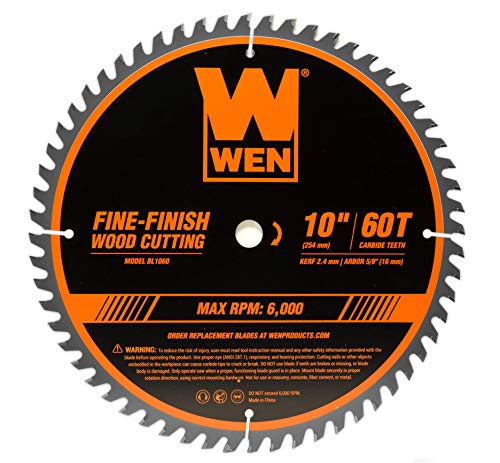
- 60 carbide teeth for fine-finish cutting
- Ultra-thin kerf for efficient, clean cuts
- Compatible with most 10-inch miter and table saws
- Handles both hard and softwoods
Trade-offs
- Heavier than some blades like the CMT Ultra Fine at 1.5 pounds
- Weighs 1.5 pounds, heavier than some fine-finish blades
With 60 carbide-tipped teeth and an ultra-thin kerf, the WEN BL1060 is designed for fine-finish cutting in both hard and softwoods. This combination can provide clean, efficient cuts, making it a versatile choice for a woodworker who needs a single finishing blade for various projects. It is compatible with most 10-inch miter saws, jobsite saws, and table saws.
The blade’s 1.5-pound weight is more than some dedicated fine-finish blades, such as the CMT Orange Tools Ultra Fine model which weighs 1.0 pound. Its packaging dimensions are also larger than the listed dimensions for several other 10-inch blades in the comparison list. For tasks demanding the highest possible polish, a blade with a different tooth configuration might be considered.
Forrest Ply Veneer Saw Blade
What We Like
- Teeth geometry ground for exceptionally clean, smooth cuts.
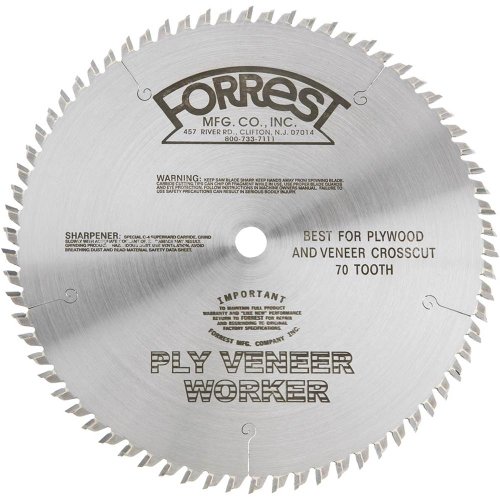
- 70-tooth configuration for fine cuts
- Forrest brand known for longevity between sharpenings
Trade-offs
- Its smooth-cutting geometry results in slower rip speeds.
- Owner reports of blade runout up to .009 inches
For cabinetmakers and furniture builders, the Forrest Ply Veneer Saw Blade is designed for a specific task where tear-out is unacceptable. Its 70-tooth configuration, noted in the model name, aligns with blades engineered for clean cuts over speed according to general research on the brand. One owner of Forrest blades reports they stay cooler, which helps prevent burn marks on woods like cherry.
Research on Forrest blades indicates a consistent trade-off: teeth ground for clean, smooth cuts do not rip quickly. For faster ripping, the Forrest Woodworker II and Ridge Carbide TS2000 are noted as better overall choices. When a super-clean cut is the absolute priority, a blade like the Freud Premier Fusion is highlighted for leaving excellent surfaces.
Product photos
FOXBC 90T Ultimate Polished Finish Blade
What We Like
- Axial Shear-face grind for clean shearing
- Ultra thin kerf reduces amp draw
- Double Side Grind for polished finish
- Proprietary carbide for long service life
Trade-offs
- 0.087-inch kerf is too thin for heavy ripping
- 90-tooth design prioritizes finish over fast cutting
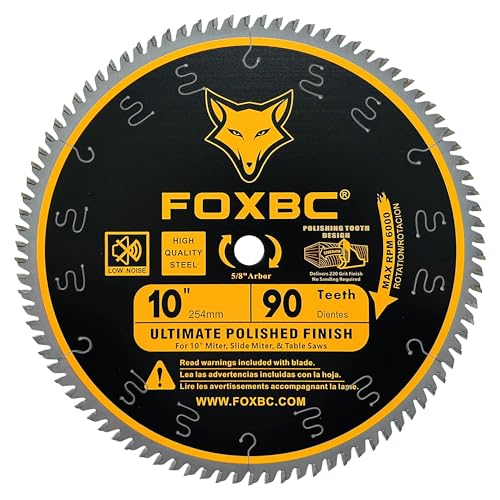
With a 90-tooth count and Double Side Grind geometry, this blade produces a polished finish equal to 220-grit sandpaper, so you can often skip a sanding step. It’s designed for final cuts where tear-out is unacceptable on materials like veneered plywood, melamine, and fine moldings. The Axial Shear-face grind design shears through wood fibers cleanly rather than tearing them, delivering a superior surface directly from your saw.
The trade-off for that glassy finish is a specialized use case. The ultra-thin 0.087-inch kerf and high tooth count make it a dedicated finishing blade, not an all-purpose workhorse. For continuous ripping of thick stock, you’d want a dedicated blade like the CMT ORANGE TOOLS 203.630.10 Heavy-Duty Glue Line Ripping Blade. The FOXBC 90T sits in your toolbox for when the project demands perfection, saving you time in the sanding phase but requiring a blade change when the task shifts from finesse to brute force.
CMT ORANGE TOOLS 203.630.10 Table Saw Blade
What We Like
- Heavy-duty design for demanding rip cuts.
- Laser-cut polymer-filled slots for vibration dampening.
- Industrial chrome carbide for durable sharp edges.
- Tri-metal brazing for strong tooth attachment.
Trade-offs
- A 0.126-inch kerf removes more material than thin-kerf blades.
- 30-tooth configuration is not suited for fine crosscutting.
- Specific glue-line rip focus limits its versatility.
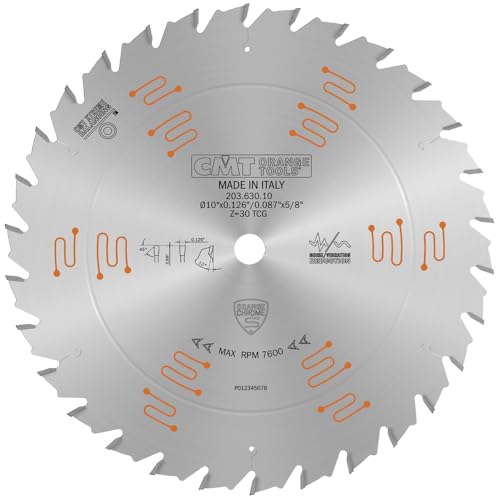
The 30-tooth configuration and heavy-duty plate are built for one job: creating a ready-to-glue edge directly from the saw. This blade is for the woodworker who needs a dead-straight, clean rip in hardwoods and sheet goods without a secondary planing pass. Its laser-cut, polymer-filled expansion slots are designed to minimize vibration, which is critical for that smooth, chatter-free cut. If your project list is dominated by ripping stock for table legs or cabinet frames, this tool delivers a workshop-ready edge.
Designed specifically for rip cuts, this blade’s 0.126-inch kerf provides stability in demanding materials but removes more material than a thin-kerf design. Its application is limited to ripping, so tasks like crosscutting or dadoing require a different blade. The CMT Orange Tools Ultra Fine Finishing Saw Blade, for example, has a different tooth geometry suited for fine crosscuts.
Product photos
FOXBC 8-1/4" Fine Finish Table Saw Blade

What We Like
- Ultra-thin kerf for fast, clean cuts
- Dense carbide construction for wear resistance
- Compact 8-1/4 inch size fits smaller saws
- Diamond knockout for arbor compatibility
Trade-offs
- Smaller diameter limits cutting depth versus 10-inch blades
- 60-tooth design is a generalist, not specialized for ultra-fine veneers
This 8-1/4 inch blade is a table saw blade, a diameter that matches many benchtop and portable saws. Its 60-tooth ATB grind and ultra-thin kerf are intended for clean, fast cuts in hardwood, softwood, and plywood. The product description suggests it for finish cuts in decking, fencing, and fascia.
With 60 teeth, it has a lower tooth count than other fine-finish blades like the 80-tooth Diablo D1080X or the 90-tooth FOXBC Ultimate Polished Finish Blade. The Amazon feature bullets position it for jobsite finish cuts in materials like OSB and stacked plywood, rather than ultra-fine veneer work.
Product photos
How We Evaluated Table Saw Blades For Fine Woodworking
Our research focused on comparing specifications from manufacturers and analyzing recurring themes in expert round-ups and owner reviews. We prioritized tooth geometry and count for finish quality, kerf width for material waste and saw compatibility, and vibration-dampening features for cut smoothness. This approach helps identify blades engineered for specific fine cuts, from glue-line rips to chip-free veneer work. Since this is a research-based evaluation, we cannot speak to the long-term durability or sharpening retention of individual blades, which depend heavily on use and maintenance.
What To Look For In Table Saw Blades For Fine Woodworking
Selecting the right blade is about matching its engineered purpose to your most common cuts. A single, well-chosen blade can transform your saw’s output from rough to ready for assembly.
Focus on tooth geometry (ATB for crosscuts, FT for rips), kerf width for your saw’s power, and vibration reduction. For fine work, a blade with a higher tooth count and specialized grind, like a Hi-ATB, will provide the cleanest shearing action on veneers and plywood.
Tooth Geometry & Count
Tooth configuration dictates a blade’s purpose. For fine crosscutting and finish work, an Alternate Top Bevel (ATB) or High-ATB (Hi-ATB) geometry is essential, as the angled teeth shear wood fibers cleanly. A higher tooth count, typically 60 to 90 for a 10-inch blade, provides a smoother finish but cuts more slowly.
For dedicated ripping in solid wood to create flat, glue-ready edges, a Flat-Top (FT) tooth geometry with a lower tooth count and large gullets is more efficient. Understanding the difference between rip and crosscut blades is the first step in building a purposeful blade collection.
Kerf & Saw Compatibility
Kerf is the width of the cut the blade makes. A full kerf is stiff and stable, best for powerful cabinet saws. A thin kerf removes less material, reduces strain on lower-powered motors, and maximizes yield from expensive lumber.
However, a thin kerf blade can be more prone to deflection and may not work with a saw’s standard riving knife. You must match the blade to your saw’s horsepower; using our comprehensive table saw blade guide can help clarify this relationship. For smaller 8-1/4 inch saws, you’ll need to specifically search for blades for the correct smaller diameter, not for a 10-inch blade.
Specialized Features for Fine Work
Beyond the basics, features like anti-vibration slots, specialized coatings, and tooth materials enhance performance. Laser-cut slots in the blade body dampen harmonic vibration, which is critical for ultra-smooth cuts in finished pieces. Non-stick coatings like Perma-Shield reduce pitch build-up and friction, helping to prevent burn marks on hardwoods. For the cleanest cuts in laminated materials, look for a blade with an ultra-thin plate and kerf, designed specifically for cutting plywood cleanly. When selecting a blade for hardwood, look for premium carbide formulations that resist wear when cutting dense species.
- Ensure the blade’s arbor hole (typically 5/8″) matches your saw.
- Check that a thin-kerf blade is compatible with your saw’s riving knife or splitter.
- Consider a dedicated blade for your primary task rather than a general-purpose compromise.
The best blade is the one engineered for your most frequent cut on your specific saw.
Table Saw Blades For Fine Woodworking Compared
The table below provides a quick comparison of key specifications to help you differentiate these top picks at a glance.
| Product | Diameter | Teeth Count | Arbor Size |
|---|---|---|---|
| Freud LU88R010 Fine Finish Crosscut Blade | 10" | 60 | 5/8" |
| CMT Orange Tools Ultra Fine Finishing Saw Blade | 10" | N/A | 5/8" |
| Diablo D1080X Fine Finish Saw Blade | 10" | 80 | 5/8" |
| Freud Ultimate Plywood & Melamine Blade | 10" | 80 | 5/8" |
| DEWALT DWA11080 Fine Finish Saw Blade | 10" | 80 | N/A |
| WEN BL1060 Fine-Finish Saw Blade | 10" | 60 | 5/8" |
| Forrest Ply Veneer Saw Blade | 10" | 70 | N/A |
| FOXBC 90T Ultimate Polished Finish Blade | 10" | 90 | 5/8" |
| CMT ORANGE TOOLS 203.630.10 Table Saw Blade | 10" | N/A | 5/8" |
| FOXBC 8-1/4" Fine Finish Table Saw Blade | 8-1/4" | 60 | 5/8" |
Frequently Asked Questions
What is the best table saw blade for fine cuts?
For most fine woodworking tasks requiring smooth crosscuts and joinery, the Freud LU88R010 is an excellent choice due to its premium carbide and optimized 60-tooth ATB geometry. For ultra-fine work on veneers and melamine, a specialized blade like the CMT Orange Tools Ultra Fine with its Hi-ATB grind and thin kerf is superior.
How many teeth for a fine cut?
For a 10-inch blade making fine finish cuts, look for a tooth count between 60 and 90. A 60-tooth blade offers a great balance of smoothness and versatility. An 80 or 90-tooth blade, like the Diablo D1080X or FOXBC 90T, is optimized for the smoothest possible crosscuts in solid wood and sheet goods.
What saw blade makes the smoothest cut?
The smoothest cut typically comes from a blade with a high Alternate Top Bevel (Hi-ATB) tooth geometry, a high tooth count (80+), and features that reduce vibration, such as laser-cut slots. Blades like the FOXBC 90T Ultimate Polished Finish Blade are explicitly designed for this cabinet-ready result.
How many teeth are best for a table saw blade?
There is no single “best” tooth count; it depends on the cut. For general-purpose use, a combination blade with a moderate tooth count is common. For fine woodworking, you will likely want dedicated blades: a rip blade with fewer teeth for efficient milling and a crosscut blade with many teeth for smooth finish work.
Should I use a thin kerf blade?
A thin kerf blade is a smart choice for lower-powered saws (under 1.75 HP) as it reduces strain and waste. However, understanding thin kerf versus full kerf blades is key, as full-kerf blades offer more stability on powerful saws and are often required for the fine work done with a thin kerf blade.
The Bottom Line
For a single, versatile blade that delivers excellent results on crosscuts and joinery in fine woodworking, the Freud LU88R010 Fine Finish Crosscut Blade is our top recommendation. If your budget is tight, the WEN BL1060 provides reliable performance at an affordable price, while those needing surgical precision on veneers should choose the CMT Orange Tools Ultra Fine blade. Ultimately, the most important factor is matching the blade’s specific geometry and kerf to your saw’s power and the primary cut you need to make flawlessly.
