
10 Best Car Polisher Machines in 2026
This post contains affiliate links. As an Amazon Associate, we earn from qualifying purchases.
Our best overall car polisher is the Chemical Guys TORQ 10FX Random Orbital Polisher for its digital speed control that ensures repeatable results. We also highlight the Rupes LHR21ES Big Foot for large-panel correction and the Griot’s Garage G9 for its high-torque motor. Choosing the right machine balances power, safety, and comfort for your specific car care tasks.
A tool that’s too weak will bog down, while one that’s too aggressive can damage clearcoat.
Top 10 Car Polisher Machines in the Market
Certain content that appears on this site comes from Amazon. This content is provided "as is" and is subject to change or removal at any time.
The Best Car Polisher Machines, Reviewed
Chemical Guys TORQ 10FX Random Orbital Polisher

What We Like
- Digital display for precise, repeatable speed control
- 8mm orbit balances correction power and safety
- 700W motor handles heavy compounds without bogging
- Ergonomic grip design reduces fatigue on long details
Trade-offs
- At 7.6 pounds, it's heavier than some competitors like the Griot's G9
- Larger footprint makes it less nimble in tight spaces
With a 700-watt motor and 8mm orbit, this polisher finds a middle ground for efficient correction with safer operation on paint. The motor delivers enough torque to drive heavy cutting compounds without bogging down on vertical panels, which is crucial for consistent results. Digital speed adjustment with an onboard display shows the exact speed, giving precise repeatability across different vehicles or correction sessions.
That capability does come with some heft. At 7.6 pounds, it demands more from your arms over a full-day detail than lighter models like the Porter-Cable 7424XP, which weighs 5.8 pounds. An updated grip design and balanced weight distribution are intended to make the machine comfortable to maneuver, aiming to reduce arm and hand fatigue during extended use.
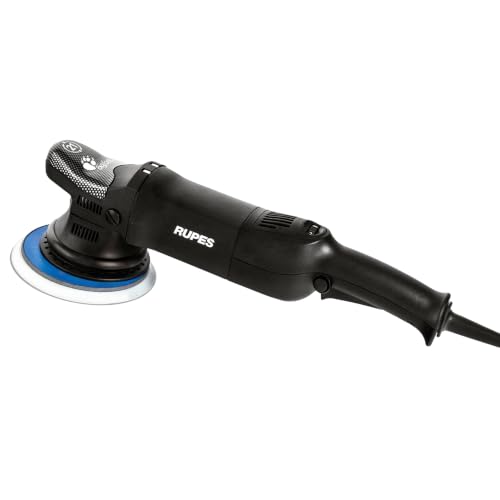
Rupes LHR21ES Big Foot Random Orbital Polisher
What We Like
- Soft start prevents product splatter
- Anti-spinning feature avoids scratches
- Quality Italian design and construction
Trade-offs
- At 7.8 lb, it's heavier than the Griot's G9
- 500W motor is less powerful than some 1000W units
- 21-inch length requires more arm room to maneuver
With a 500-watt motor, this polisher provides consistent power for extended detailing sessions. Its soft start guarantees an acceleration ramp to prevent accidental dispersion of product, which helps maintain control when first touching the pad to the surface. An anti-spinning feature prevents high speed rotations, a design choice aimed at avoiding scratches during operation. This combination of features is built for professionals or serious enthusiasts who prioritize control during paint correction.
You pay for that capability with some heft and bulk. At nearly eight pounds and over a foot and a half long, it demands more forearm stamina than a compact model like the Griot’s G9. The 500-watt motor is plenty for its design, but it’s not the highest raw power in the guide. This polisher makes its case on refined engineering for a specific task, not on being the lightest or most versatile all-rounder.
Griot's Garage G9 Random Orbital Polisher

What We Like
- High-torque 1000W motor prevents bogging under pressure.
- Well-balanced, ergonomic design with a comfortable double-shot grip.
- Fan-cooled counterbalance ensures smooth, vibration-free operation.
- Convertible from 6-inch to 5-inch pad system for versatility.
Trade-offs
- At 5.2 lb, it's heavier than cordless models like the 3.0 lb AUTIWOZ.
- Requires a power outlet, unlike cordless options.
With a 1000-watt motor, this polisher has the guts to tackle serious paint correction without stalling, even when you lean into it. That makes it a prime choice for anyone looking to efficiently remove deep scratches or heavy oxidation on larger vehicles. The 9mm orbit and variable speed dial give you the control to finesse the finish, while the contoured rubber grip means you can work all day without your hands cramping up. It’s built for the detailer who values raw correction power and ergonomics over portability.
The trade-off for that power and smooth operation is a tool that needs a cord. You’re managing a 10-foot lead, not walking freely around the car. It’s also notably heavier than the featherweight cordless options, which adds to arm fatigue over very long sessions. Compared to something like the lighter, cordless AUTIWOZ, the G9 is a shop anchor, powerful and dependable, but tethered. For garage-based correction work where outlet access isn’t an issue, its performance is hard to beat.
PORTER-CABLE 7424XP Orbital Polisher

What We Like
- Compact size for easy maneuvering around a car.
- Random orbit design prevents swirl marks.
- Variable speed dial offers control for different tasks.
- Lightweight and can be used one-handed for waxing.
Trade-offs
- AC-only power requires an outlet and cord management.
- Uses a proprietary counterbalance for its 6-inch pad system.
A 5.8-pound weight and compact footprint make this polisher easy to handle for anyone new to machine detailing. The random orbital action is inherently safe, drastically reducing the risk of burning through paint, which is why it’s been a trusted first polisher for years. It provides enough power for applying waxes and light polishing, letting a beginner build confidence without intimidation. The variable speed dial gives you the control to match the task, from gentle spreading to more aggressive work.
With a 4.5-amp AC motor, this polisher delivers variable speeds from 2,500 to 6,800 orbits per minute, giving users control for different polishing stages. Its random orbit action is designed for swirl-free sanding and polishing. Research comparing it to a similar Harbor Freight model notes that the Porter-Cable unit can have less power, which some reviewers report makes maintaining pad rotation more challenging for a beginner on demanding corrections.
Griot's Garage G8 Orbital Polisher

What We Like
- Small frame for tight contours and small areas.
- Ergonomic design with double-shot rubber dampening.
- 45% stronger gearset for long-term durability.
- Constant speed control prevents bogging under pressure.
Trade-offs
- Limited to 2-inch and 3-inch backing plates for detail work.
- Lacks the larger pad capacity of full-size polishers like the G9.
Griot’s Garage G8 Orbital Polisher uses a 700-watt motor and an 8mm orbit, which provides enough power for paint correction. The small-frame design makes it ideal for working on tight contours and small areas where larger tools can’t maneuver. Six variable speed settings and constant speed control help maintain operation under pressure, while the contoured grip and rest pads are made for comfort during extended use.
The included 2-inch and 3-inch backing plates allow for hyper-focused work, a feature suited for detailed spots rather than broad panels. Compared to other orbital polishers like the Griot’s Garage G9, the G8’s smaller plates define its role for precision tasks. Its engineered agility and double-shot rubber dampening contribute to stability when handling complex curves.
AUTIWOZ Cordless Random Orbital Polisher Kit

What We Like
- Cordless design with two included batteries.
- Lightweight and compact for easy maneuverability.
- Six speed settings for varied polishing tasks.
- Ergonomic grip reduces vibration and hand fatigue.
Trade-offs
- Maximum speed of 5800 OPM.
- Weighs 3.0 pounds with batteries.
Its cordless freedom with two batteries is the main event here, letting you move around a vehicle without hunting for an outlet or managing a cord. At just three pounds with an ergonomic grip, it’s easy to handle overhead on an SUV or across large panels without wearing out your arms. The six speeds give you decent control for spreading wax or doing light correction, making this a straightforward choice for the detailer who values convenience above raw power for regular maintenance work.
As a cordless tool, this polisher trades some raw power for total freedom from an outlet. Its maximum speed reaches 5800 orbits per minute, which handles polishing and light correction but may not match the sustained power of a high-wattage corded model for heavy compounding. The design is ideal for enthusiasts detailing one or two vehicles who value a clean, unplugged workspace over maximum cutting force.
Product photos
WORKPRO Dual Action Random Orbital Polisher

What We Like
- High-torque 1080W motor for demanding correction
- Wide 1400-5000 RPM variable speed control
- Ergonomic grip hood and auxiliary handle
- Comprehensive kit with multiple pads and tools
Trade-offs
- 7.4 lb weight may cause fatigue on large vertical panels
- High-power motor generates more vibration than lighter polishers
With a 1080-watt motor, this polisher has significant power for demanding tasks like heavy oxidation or compound work. That power, combined with a 15mm dual-action orbit, makes it a capable machine for someone tackling significant paint correction on a tight budget. The package comes with a polisher, backing pad, multiple foam and wool pads, an auxiliary handle, and maintenance parts, so you have the core components to start a job. This is a polisher for the dedicated DIYer who needs to address neglected paint, not just apply a quick coat of wax.
This power comes with extra heft and vibration. Weighing over seven pounds, it requires more arm strength during long sessions than a lighter competitor. Its 15mm orbit works well for cutting, but it cannot achieve the same ultra-fine gloss as a tool with a smaller, 8mm stroke. Consider it a workhorse rather than a surgeon’s instrument. You get professional-level torque at an entry price, but some finesse and comfort are sacrificed.
Product photos
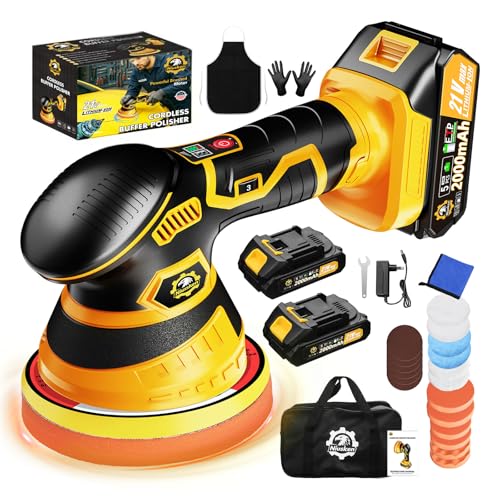
Niusken Cordless DA Polisher Kit
What We Like
- Cordless design with two batteries for extended runtime
- Real-time speed and battery level on LED display
- Lightweight and ergonomic for easy maneuverability
- Complete accessory kit for multi-surface detailing
Trade-offs
- Overheat protection may trigger after 20 minutes of high-speed use
- Battery system is proprietary, not compatible with DeWalt
The combination of a cordless design with a clear LED display makes the Niusken a standout for detailers who value clean workspaces and precise control. You get real-time feedback on speed and battery life, which is a genuine help for planning your workflow without guesswork. At just 3.3 pounds, it’s exceptionally easy to handle overhead or on vertical surfaces, reducing arm fatigue. This setup is ideal for the detailer tackling a sedan or SUV in a home garage where cord management is a hassle and visual confirmation of settings boosts confidence.
Its cordless design eliminates cable clutter, which is ideal for working freely in garages or outdoors. That lightweight freedom, however, comes with a limit on continuous high-speed use. An overheating protection system may automatically shut the unit off after about 20 minutes of such work, requiring a brief pause before restarting. As a result, it fits paced detailing sessions better than non-stop marathon corrections on large vehicles.
Product photos
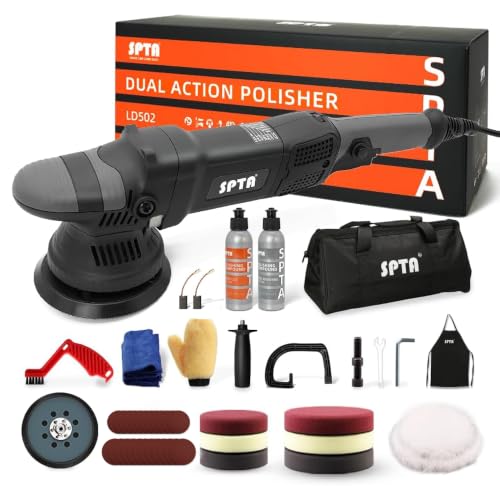
SPTA Dual Action Random Orbital Polisher Kit
What We Like
- Includes a vast array of pads and sanding discs
- Comes with both side handle and D-handle for comfort
- 750W motor provides constant power for defect removal
- Kit contains compounds, towels, and protective gear
Trade-offs
- Requires a 110V outlet, not cordless
- Kit's comprehensive nature may include unneeded items for some
The SPTA polisher’s 750-watt motor and six-speed dial allow adjustment from 2,000 to 5,200 orbits per minute, which provides power for removing defects at high speed and control for waxing at low speed. Its kit includes a 5-inch backing plate, polishing and wool pads, coarse and fine compounds, and sanding discs, so a buyer can begin multiple tasks. Two handle types, a side handle and a D-handle, offer a choice for comfortable grip during long sessions.
The tool is corded, so you must plug it in. This means you lose the free-range convenience of a cordless model. It is also a comprehensive bundle, which offers good value but includes items you might not use. For a more streamlined, professional-grade tool focused purely on polishing, you would need to buy pads and backing plates separately.
Product photos
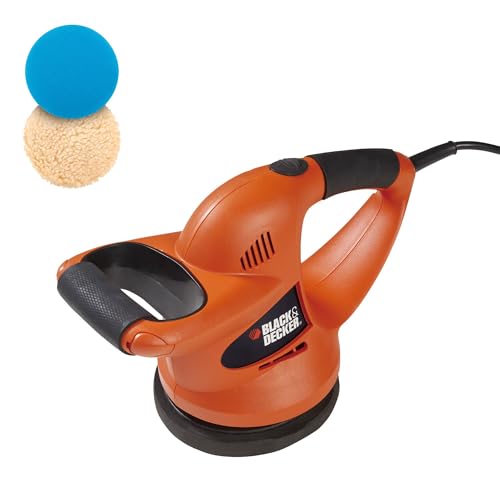
BLACK+DECKER 6-Inch Buffer Polisher
What We Like
- Extremely light weight reduces user fatigue.
- Random-orbit action for a uniform finish.
- Long power cord provides good mobility.
- Comes with both wax applicator and polishing bonnets.
Trade-offs
- Tool-only design requires a wall outlet, unlike cordless competitors.
Weighing only 2.1 pounds, the BLACK+DECKER WP900 is exceptionally light, making it easy to maneuver on vertical surfaces or hold at odd angles without fatigue. Its two-handle design provides a secure, comfortable grip for extended use. The included foam applicator and polishing bonnets support straightforward wax and polish application.
Compared to tools like the 5.2-pound Griot’s G9 or the 5.8-pound PORTER-CABLE 7424XP, the Black & Decker model is significantly lighter. This difference in mass may influence performance for certain polishing techniques. The tool operates with a 10-foot cord, which offers mobility within range of an outlet.
Product photos
How We Evaluated Car Polisher Machines
Our evaluation focused on manufacturer specifications, design documentation, and patterns in expert round-ups and owner feedback. We prioritized three key areas: motor power and torque for effective paint correction, along with orbit size and action type for safety and finish quality. We also considered ergonomic factors like weight and grip design to reduce user fatigue during long sessions. This research-led approach identifies tools with the right specs for the job, but it cannot replicate the subjective feel of a polisher in your own hands during a multi-hour detail.
What To Look For In Car Polisher Machines
The right polisher turns a labor-intensive chore into a satisfying project. Focus on the tool’s action, power delivery, and how it fits your specific vehicle and skill level.
Key criteria are the polisher’s action type (safer dual-action vs. Faster rotary), motor power (wattage or torque), and physical design (weight, grip, and pad size). Your choice should match the paint correction level you need and the contours of your vehicle.
Action Type: Dual-Action vs. Rotary
Dual-action (DA) polishers combine a spinning and oscillating motion, making them much safer for beginners and enthusiasts by drastically reducing the risk of burning through paint. They are the standard recommendation for safe paint correction. Rotary polishers spin on a single axis and offer maximum cutting power for professionals tackling severe defects, but they require significant skill to use safely without holograms or damage. Deciding between a dual-action polisher and a rotary polisher is the first and most critical choice for most home users.
Power & Performance
For corded models, look for a motor rated between 700W and 1000W for enough torque to maintain pad rotation under pressure. Cordless polishers trade outright power for convenience, so consider their battery voltage and orbital speed (OPM). A higher orbit stroke (measured in millimeters, like 8mm, 15mm, or 21mm) typically offers more aggressive defect removal but can be harder to control on curved panels. Our research into the best car polishers shows that sufficient power prevents the tool from stalling, which is key for efficient work.
Ergonomics & Design
Weight is a major factor; machines can range from 3 pounds for cordless models to nearly 8 pounds for heavy-duty units. A lighter polisher is easier on your arms for waxing, while a heavier one can feel more stable during correction. Grip design, including rubber overmolding and handle options, directly impacts control and comfort. Also, consider the backing plate size; a standard 6-inch plate is versatile, while smaller 3-inch plates or larger units are for specific tasks. Reading polisher reviews can reveal how these specs translate to real-world use.
- Check if the machine includes a side handle or D-grip for better control on vertical panels.
- Ensure the power cord or battery runtime is sufficient to work around your entire vehicle without constant interruption.
- Look for features like a soft-start function to prevent compound splatter when you first trigger the tool.
A comfortable polisher you’ll actually use is better than a powerful one that sits in the box because it’s too tiring.
Car Polisher Machines Compared
Use the table below to quickly compare the core specifications and best-use cases for our top picks.
| Product | Motor Power | Orbit Size | Speed Range | Weight |
|---|---|---|---|---|
| Chemical Guys TORQ 10FX Random Orbital Polisher | 700W | 8mm | Digital | 7.6 pounds |
| Rupes LHR21ES Big Foot Random Orbital Polisher | 500 Watt | N/A | N/A | 7.8 pounds |
| Griot's Garage G9 Random Orbital Polisher | 1000 watts | 9mm | 2000-6400 OPM | 5.2 pounds |
| PORTER-CABLE 7424XP Orbital Polisher | 4.5 Amp | Random orbit | 2,500-6,800 OPM | 5.8 pounds |
| Griot's Garage G8 Orbital Polisher | 700-watt | 8mm | 6 variable | N/A |
| AUTIWOZ Cordless Random Orbital Polisher Kit | Two 21V 2000mAh | 8mm | 2000-5800/min | 3.0 pounds |
| WORKPRO Dual Action Random Orbital Polisher | 1080W, 9 Amp | 15mm | 1400-5000 RPM | 7.4 Pounds |
| Niusken Cordless DA Polisher Kit | 2x 21V 2000mAh | 8mm | 2800-5800 RPM | 3.3 lbs |
| SPTA Dual Action Random Orbital Polisher Kit | 750W | Dual action random orbital | 2,000-5,200/MIN | N/A |
| BLACK+DECKER 6-Inch Buffer Polisher | N/A | Random-orbit action | N/A | 2.1 Pounds |
Frequently Asked Questions
What is the best car polisher machine for the money?
The best value balances capability, durability, and price. For most DIYers, a mid-range dual-action polisher from a reputable brand offers the best long-term value, providing enough power for correction without the premium cost of pro-grade tools. Our “Best Overall” and “Best Classic Beginner Choice” picks represent strong value in their respective classes.
What is the difference between a car buffer and a polisher?
The terms are often used interchangeably, but technically, a buffer is designed for applying and spreading waxes or glazes with a soft bonnet, often at lower speeds. A polisher is built for paint correction, using firmer foam pads and compounds to remove defects. Most modern dual-action polishers can perform both functions, making them the most versatile choice.
What should a beginner look for in a car polisher?
Beginners should prioritize safety and ease of use. A dual-action random orbital polisher is essential, as its design minimizes the risk of damaging your car’s paint. Look for a model with variable speed control, an ergonomic grip, and a reputation for being user-friendly. Starting with a detailed guide on car buffing is just as important as the tool itself.
Are cordless car polishers any good?
Yes, modern cordless polishers are excellent for light to medium polishing and waxing, offering fantastic maneuverability without a power cord. They are ideal for maintaining one or two vehicles. However, for extensive, multi-hour paint correction sessions, a high-power corded model is generally more reliable and won’t be limited by battery life. Our research on cordless polishers highlights several capable options.
When should I consider a rotary polisher?
Consider a rotary polisher only if you are an experienced detailer tackling severe paint defects like deep scratches or heavy oxidation on single-stage paint. They cut faster than DA polishers but require perfect technique to avoid burning through the clearcoat or leaving hologram trails. For most people, a powerful dual-action machine is the safer and more versatile choice.
The Bottom Line
For most home detailers and car enthusiasts, the Chemical Guys TORQ 10FX Random Orbital Polisher is the best overall choice, delivering precise digital speed control for effective and safe paint correction. If your primary concern is budget or you’re a first-time user, the PORTER-CABLE 7424XP remains a classic, trustworthy option for learning the basics. Ultimately, choosing the right action type, prioritizing a dual-action polisher for safety, is the single most important decision you’ll make for your vehicle’s finish.
