
4 Best Chop Saws For Woodworking in 2026
This post contains affiliate links. As an Amazon Associate, we earn from qualifying purchases.
For a single saw that tackles wood, metal, and plastic with clean cuts, the Evolution Power Tools R355CPS Chop Saw is our best overall pick. Our recommendations also include a budget-friendly option for wood and a lightweight portable model. Choosing the right saw for woodworking involves balancing cut capacity, portability, and the materials you plan to cut most often. Our research focused on specifications, design features, and patterns in owner feedback to identify the top performers for different needs.
Top 4 Chop Saws for Woodworking in the Market
Certain content that appears on this site comes from Amazon. This content is provided "as is" and is subject to change or removal at any time.
The Best Chop Saws for Woodworking, Reviewed
Evolution Power Tools R355CPS Chop Saw

What We Like
- Cuts multiple materials with one TCT blade
- Powerful 15-amp motor for demanding cuts
- Large cutting capacity for bulky stock
- Clean, cool cuts in metal with minimal burrs
Trade-offs
- At 47 pounds, it's a substantial weight for frequent transport
- Fixed chop-saw design lacks sliding capacity for wider boards
The Evolution R355CPS chop saw is built around a 15-amp motor, which is powerful enough to cut a variety of materials with a single blade. This multi-material capability means you can switch from cutting wood to mild steel without stopping to change tools. That utility, backed by a three-year warranty, defines its role as a primary saw for jobs involving mixed stock.
Its 47-pound weight means it needs a solid surface to work from, and the fixed-head design limits cross-cuts to the blade’s diameter. According to the product list, a sliding miter saw like the Evolution R185SMS+ offers a different design for different cutting needs. For tasks that specifically require cutting through materials like metal or wood with nails, this saw’s straightforward approach has clear purpose.
DEKOPRO 10-Inch Compound Miter Saw
What We Like
- Lightweight 20.5 lb design for easy portability
- Transparent blade guard for clear cut line view
- Secure clamp system stabilizes the workpiece
- Head locks down for compact storage
Trade-offs
- Single bevel design limits compound cut flexibility
- Non-sliding blade restricts maximum cut width
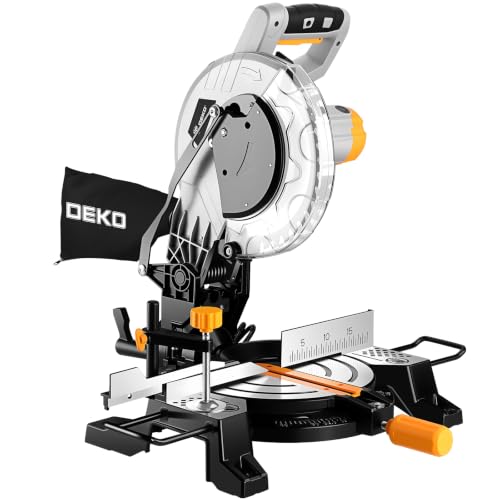
Weighing just 20.5 pounds, this saw lifts easily onto a benchtop and fits into tight storage spaces, a clear advantage for transport between job sites or in a crowded garage. Its 13-amp motor reaches up to 5,000 RPM, which provides the speed for smooth cuts in wood, plastic, and laminates as listed. The transparent blade guard offers a clear view of the cut line, a feature aimed at improving accuracy for trim and finish work.
The single bevel design allows bevel cuts from 0 to 45 degrees, and miter adjustments go 45 degrees left and right for angled crosscuts. Unlike the Evolution R185SMS+ sliding miter saw, its fixed blade path does not include a sliding mechanism for extended reach across wider material. A clamp system and large work table are included to hold the workpiece, promoting stability for cleaner results according to the design.
Product photos
Evolution R185SMS+ Sliding Miter Saw

What We Like
- Cuts wood, plastic, and metal cleanly
- Includes multi-material TCT blade
- Multi-material cutting capability
Trade-offs
- Large 48-inch length demands significant workshop space
- No weight listed suggests a two-person setup is likely
- Primarily designed for metal, overkill for wood-only shops
Its multi-material capability, cutting wood, plastic, and metal with the included blade, means a fabricator or remodeler can switch materials without tool changes. The 48-inch length provides a stable platform for long workpieces, while the sliding 210 mm capacity helps with wider boards. This design suits shops where different materials are processed, not just occasional woodworking.
The trade-off is its sheer size and focus. While the sliding action provides a 210 mm cut capacity, the saw’s design and power are optimized for metal, which might be excessive for a woodworking-only operation. If your projects are exclusively wood, a dedicated wood saw like the DEKOPRO 10-Inch Compound Miter Saw will be more compact and cost-effective for the same cuts.
Yumark 10-Inch Compound Miter Saw
What We Like
- Lightweight and compact for easy transport
- Powerful 6000 RPM all-copper motor
- Foldable design simplifies storage
- Semi-closed cover and stable base for safety
Trade-offs
- No sliding mechanism limits cut width
- 19.8 lb weight may still be heavy for some
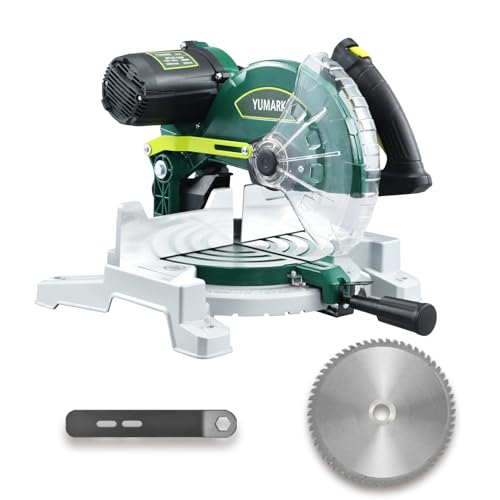
At just under twenty pounds, the Yumark 10-Inch Compound Miter Saw is easy to transport to any job site. Its compact, foldable design simplifies storage in tight spaces, like a crowded shed or the back of a vehicle. The motor reaches a no-load speed of up to 6,000 RPM, and the saw is designed for cutting wood, plastic, aluminum, and soft metals.
The trade-off for that portability is a fixed 10-inch blade and a non-sliding head. You won’t be crosscutting wide boards, a task better suited to a sliding model like the Evolution R185SMS+. For cutting standard dimensional lumber, trim, or aluminum stock at precise angles, however, the Yumark’s dual 45-degree table and stable base deliver the core functionality. It’s a straightforward tool that focuses on doing the fundamental tasks well from any temporary workstation.
Product photos
How We Evaluated Chop Saws
This guide is based on a review of manufacturer specifications, expert recommendations, and patterns in user feedback. Key considerations include motor power for demanding cuts, cutting capacity for large stock, and overall weight for portability. Specialized features like multi-material blades and space-saving designs were also evaluated. A limitation of this approach is that it cannot assess long-term durability or individual ergonomic fit.
What To Look For In Chop Saws for Woodworking
The right chop saw can transform crosscutting tasks. Key considerations include the materials you’ll cut, the size of your stock, and whether the tool will live in a shop or travel to job sites.
Focus on motor power (amps), maximum cutting capacity, and whether you need a sliding mechanism for wider boards. Weight impacts portability, and blade type determines if you can cut materials beyond wood.
Motor Power & Cutting Capacity
A powerful motor ensures smooth cuts through dense hardwoods without bogging down. Look for ratings around 15 amps for demanding work. Cutting capacity, measured in height and width at specific angles, dictates the size of lumber you can handle in a single pass. For wider boards, a sliding mechanism adds significant crosscut capacity, though it increases the tool’s footprint. Non-sliding “chop” designs are more compact but limit you to the blade’s diameter.
Portability & Workspace
Weight is a major factor if you’ll move the saw frequently. Lightweight models under 25 pounds are manageable for mobile work, while heavier saws over 45 pounds are best left stationary. Also consider the saw’s physical space requirements; some sliding designs need significant clearance behind them, while others with articulating arms can be placed flush against a wall, a crucial detail for small shops. For a mobile setup, pairing your saw with a stable chop saw stand is highly recommended.
Blade Type & Special Features
The blade defines the saw’s capability. A standard carbide-tipped wood blade is fine for lumber, but a multi-material Tungsten Carbide Tipped (TCT) blade allows clean cuts in metal and plastic without swapping. Additional features like a transparent blade guard improve cut-line visibility, while a secure workpiece clamp is essential for safety and accuracy. For fine woodworking, understanding safe miter saw techniques for short stock is as important as the tool itself.
- Check if the saw includes a blade suitable for your primary material.
- Ensure the fence is square and the table is flat for accurate cuts.
- Look for easy-to-reach controls for bevel and miter adjustments.
- Consider dust collection ports if working indoors is a priority.
- Verify the tool’s weight against your need for portability.
Ultimately, match the saw’s core strengths, be it power, portability, or material versatility, to your most common projects.
Chop Saws for Woodworking Compared
The table below compares key specifications of our top picks at a glance.
| Product | Blade Size | Motor | Weight |
|---|---|---|---|
| Evolution Power Tools R355CPS Chop Saw | 14-inch | 15 Amp | 47.0 Pounds |
| DEKOPRO 10-Inch Compound Miter Saw | 10-Inch | 13-Amp | 20.5 lbs |
| Evolution R185SMS+ Sliding Miter Saw | 7-1/4 inches | 15 amp | N/A |
| Yumark 10-Inch Compound Miter Saw | 10-inch | N/A | 19.8 pounds |
Frequently Asked Questions
What is the best chop saw for woodworking?
For general woodworking that may also involve metal or plastic, the Evolution Power Tools R355CPS offers a powerful motor and a multi-material blade. For wood-only projects on a budget, the DEKOPRO 10-Inch Compound Miter Saw is a capable and portable choice.
What’s the difference between a miter saw and a chop saw?
Technically, a “chop saw” is a simpler tool that only moves the blade vertically for straight cuts, often used for metal. In common usage, the term is interchangeable with “miter saw,” which can pivot for angled cuts. All the saws in this guide are compound miter saws, offering both miter and bevel cutting angles for woodworking.
What is the best mitre saw for woodworking?
The best miter saw depends on your needs. For maximum versatility cutting different materials, our top pick is the Evolution R355CPS. For detailed guidance focused solely on wood, our miter saws for woodworking guide explores a wider range of models and features.
Who makes a good chop saw?
Several reputable brands produce quality chop and miter saws. Evolution is known for multi-material capability, while brands like DEKOPRO and Yumark offer reliable budget and portable options. For other essential workshop tools, explore our guide on table saws for woodworking.
Should I get a sliding or non-sliding miter saw?
Choose a sliding miter saw if you regularly need to cut boards wider than the blade’s diameter, such as wide shelving or panels. A non-sliding model is more compact, lighter, and often sufficient for trim work, framing, and cutting narrower stock.
The Bottom Line
The Evolution Power Tools R355CPS Chop Saw is our top recommendation for builders and workshop owners who value one-tool versatility for wood, metal, and plastic. If your budget is tight, the DEKOPRO 10-Inch Compound Miter Saw delivers reliable performance for wood at an affordable price, while the Yumark model is ideal for those who prioritize lightweight portability.
Before deciding, honestly assess whether you need the extra width of a sliding saw or if a standard chop design will suffice for your projects. Your most common task should guide your choice.
