
10 Best Miter Saws For Woodworking in 2026
This post contains affiliate links. As an Amazon Associate, we earn from qualifying purchases.
Our best overall miter saw for woodworking is the DEWALT DWS780-QS, thanks to its XPS LED system for adjustment-free accuracy and powerful motor for demanding cuts. The Bosch CM10GD wins for its compact design, while the SKIL MS6305-00 is our favorite budget pick. Choosing the right saw balances power, precision, and your available workspace. This guide is built from manufacturer specifications, expert round-ups, and patterns in owner feedback to help you find a saw that fits your shop and your projects.
Top 10 Miter Saws For Woodworking in the Market

Certain content that appears on this site comes from Amazon. This content is provided "as is" and is subject to change or removal at any time.
The Best Miter Saws For Woodworking, Reviewed
DEWALT DWS780-QS Miter Saw

What We Like
- XPS LED system for adjustment-free cut line accuracy
- Powerful 15 amp motor handles heavy-duty applications
- Convenient top-mounted bevel tilt lever for easy access
- Preset bevel detents at 22.5° and 33.9° for crown molding
Trade-offs
- At 54.7 lb, it's a substantial tool requiring dedicated workshop space
- Large 48-inch height demands significant vertical clearance
- The dust collection, while efficient, doesn't capture everything
Reviewers report the DWS780-QS arrived perfectly calibrated, so your first cut can be accurate without tedious setup. Its XPS LED shadow line projects a blade shadow for alignment, removing the guesswork of a traditional laser. Powered by a 15 amp, 3800 rpm motor, this 12-inch sliding compound miter saw delivers the consistent power needed for heavy-duty trim and framing work.
You pay for that capability with a substantial 54.7-pound footprint; this isn’t a saw you’ll want to haul to a job site regularly. For a permanent station, however, its heft contributes to its stability. If your priority is extreme portability, the cordless Bosch GCM18V model offers a different trade-off. But for a stationary setup where dust control matters, the DWS780’s system that captures over 75% of debris is a legitimate workshop benefit, keeping your space cleaner than most.
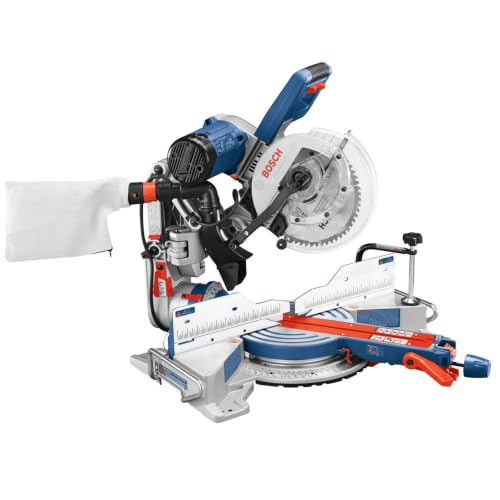
Bosch CM10GD 10-Inch Dual-Bevel Glide Miter Saw
What We Like
- Articulated arms reduce front-to-back footprint by 10 inches.
- Axial-Glide System for durable, precise cutting.
- Tall sliding fences for increased molding capacity.
- Front bevel lock and miter detents for easy setup.
Trade-offs
- At 64 pounds, it's heavy for a compact saw.
- 12-inch horizontal capacity is less than some 12-inch sliders.
The Bosch CM10GD’s articulated hinge arms shrink its front-to-back footprint by up to 10 inches compared to traditional slide saws, which is the real story here. That means you can tuck this dual-bevel slider right up against a wall in a cramped garage shop without sacrificing professional cutting capacity. It’s built for the woodworker who needs a full-featured 10-inch saw, with a wide 47-degree bevel range and tall fences for crown molding, but simply doesn’t have the space for a model with rear rails. The upfront controls and durable Axial-Glide mechanism make it a pragmatic, space-saving workhorse.
You pay for that compact innovation with some heft; at 64 pounds, it’s solidly built but not exactly portable. While its 12-inch crosscut capacity handles most trim and common boards, it gives up some reach to larger 12-inch sliders like the DEWALT DWS780. For a premium, you could step up to a Festool Kapex for its acclaimed laser and refined operation, but the Bosch delivers a uniquely clever solution for tight spaces without a staggering price tag. It’s a brilliant design that solves a specific shop layout problem.
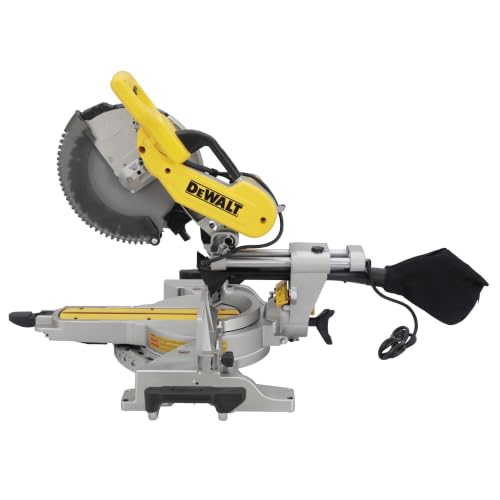
DEWALT DWS779 12-Inch Sliding Compound Miter Saw
What We Like
- Tall sliding fences for large crown molding
- Powerful 15-amp motor for demanding cuts
- Positive miter detent plate for accuracy
- Dual-bevel design for versatile compound cuts
Trade-offs
- At 67.7 lb, it's a heavy, stationary shop saw
- Dust collection bag captures only 75% of debris
A tall sliding fence that supports crown molding up to 7-1/2 inches nested means you can tackle complex trim work without flipping the stock. This saw is built for the carpenter or serious DIYer who regularly works with large baseboards and crown.
That capability comes with a 67.7-pound build, a weight that makes it better suited for a stationary stand than frequent transport. Its sliding design requires ample rear workspace, unlike more compact models. This is a tool for a workshop where its power and large cutting capacity can be fully utilized.
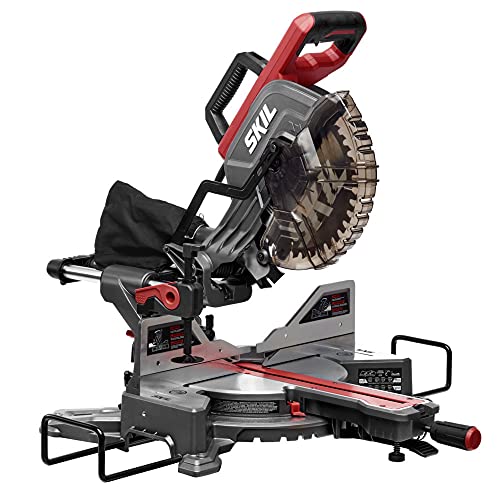
SKIL MS6305 10-Inch Sliding Compound Miter Saw
What We Like
- LED shadow line provides high-precision alignment
- Powerful 15-amp motor for quick, detailed cuts
- Dual-bevel design with four positive stop positions
- Cuts common angles with 11 positive stops
Trade-offs
- At 39.4 lb, it's heavier than some basic chop saws
- Requires significant rear clearance for its sliding mechanism
Handling most dimensional lumber for framing and decking is possible in one pass, thanks to its 2×12 crosscut capacity. A 15-amp motor spins the blade at 4,800 RPM for quick cuts, while the sliding dual-bevel design provides versatile angle options. Research notes this Skil saw offers cutting power and precision equal to those of models costing twice as much, making it a strong value for general construction and trim work.
A traditional sliding design means you’ll need ample rear clearance on your workbench. Weighing 39.4 pounds, it’s less portable than lighter single-bevel options. For a permanent shop setup where space isn’t an issue, the MS6305 delivers extensive capability at a competitive price.
Makita LS1019L 10-Inch Sliding Compound Miter Saw

What We Like
- Linear ball bearing system for dead-on accuracy
- Most compact design in its class for portability
- Unique sliding system reduces workspace footprint
- Crown molding capacity of a larger 12-inch saw
Trade-offs
- At 57.9 lb, it's heavier than some 10-inch non-sliding saws.
- Weighs 72.8 pounds for shipping.
A linear ball bearing system and a direct-drive gearbox are engineered to deliver dead-on accurate cuts, which is the core of this saw’s appeal. This makes it a serious contender for finish carpenters and cabinetmakers where a perfect seam is non-negotiable. Its innovative two-steel rail sliding mechanism pulls the saw back in a single smooth motion, a design that also lets you tuck the entire unit tight against a wall, saving precious shop space.
Makita designed the LS1019L to be the most compact sliding miter saw in its class, so it can work flush against a wall where other saws would not fit. Its 57.9-pound weight means it’s lighter than many competitors, which helps with jobsite portability. The two-steel rail sliding system reduces the saw’s footprint, allowing for single slide-glide operation.
Bosch GCM18V-12SDN 12-Inch Cordless Slide Miter Saw
What We Like
- Large 14-inch crosscut capacity for wide boards
- Dual-bevel design allows compound cuts to either side
- Shadow LED cut line for precise alignment without adjustment
- Tall 5.5-inch fences support taller material
Trade-offs
- Bare tool listing: requires separate purchase of compatible 18V battery and charger
- At 52.4 lb, it's a substantial lift despite the carry handle
- 39.5-inch length demands significant bench or jobsite space
A 12-inch cordless slide miter saw with a 14-inch crosscut capacity provides cordless freedom for cutting wide workpieces. This Bosch model is designed for mobility, featuring a dual-bevel design and tall fences to support accurate cuts on larger material. Its shadow LED cut line provides a guide for precise alignment without needing a tool to adjust.
The trade-off for this cordless capacity is weight, as the tool weighs 52.4 pounds, though a carry handle aids in moving it. It is sold as a bare tool, requiring a separate battery investment. For a stationary setup, a corded model from another brand might be an alternative, but this saw delivers pro-level cuts where AC power is unavailable.
Product photos
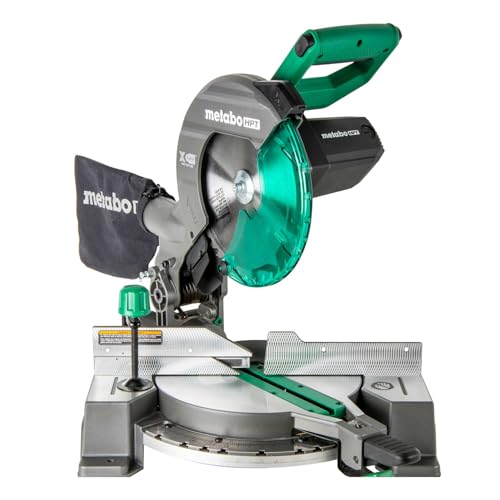
Metabo HPT C10FCG2 10-Inch Compound Miter Saw
What We Like
- Exceptionally light at 24.2 pounds for easy transport
- Powerful 15-amp motor spins blade at 5,000 RPM
- Large table provides solid workpiece support
- Includes a vice clamping system for secure cuts
Trade-offs
- Single-bevel design limits compound cutting flexibility
- Lacks the sliding mechanism for wider crosscuts
Weighing just over 24 pounds, the Metabo HPT C10FCG2 is a saw you can carry with one hand from the truck to the sawhorses without a second thought. That portability, combined with its 15-amp motor and 5,000 RPM blade speed, makes it a natural fit for contractors on the move or DIYers who need to stash their tools after every project. Its large table and vice clamp help maintain precision, even when you’re setting up on a temporary work surface. This is a tool built for jobs where setup speed and easy handling are just as important as cutting power.
Weighing only 24 pounds, this miter saw is easy to move around a job site or lift onto a workbench. Its 15-amp motor runs at up to 5,000 RPM, providing enough power for most common cuts. The compact design, however, means it uses a standard 10-inch blade without a sliding rail mechanism, so its maximum cut width is less than that of larger sliding saws.
Product photos
Makita LS1110F 10-Inch Slide Compound Miter Saw
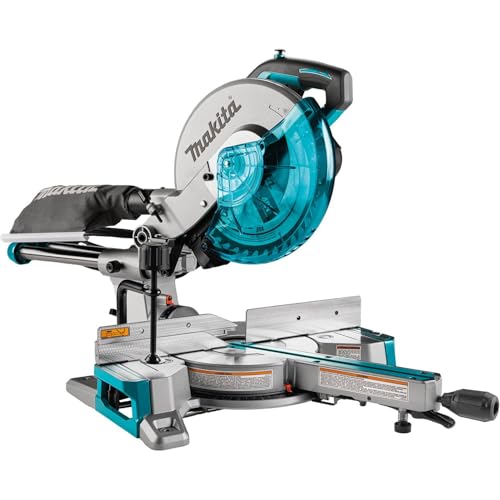
What We Like
- Compact and lightweight at 36.2 pounds
- Linear ball bearings for dead-on accurate cuts
- Built-in LED light illuminates the cut line
- Soft start feature for smooth power-up
Trade-offs
- Single-bevel design limits complex crown molding setups
- Right bevel stops at only 2 degrees
At 36.2 pounds, the Makita LS1110F is light enough for easy transport from a truck to the job site. Its sliding mechanism allows a 12-inch crosscut at 90 degrees, which handles common dimensional lumber. This combination of portability and capacity suits carpenters moving between rooms or floors. A direct-drive motor and linear ball bearing system are engineered for accurate cuts, aiding clean trim work.
The trade-off for that compact form is a single-bevel design. You’ll be flipping your workpiece for compound cuts on crown molding, which adds steps compared to a dual-bevel model like the DEWALT DWS780. Its right bevel capacity is also functionally non-existent at just 2 degrees. For a dedicated shop saw where weight doesn’t matter, a heavier model with a wider bevel range would be more versatile. But for pure jobsite agility with solid sliding crosscut power, this Makita has a clear purpose.
Product photos
VEVOR 12-Inch Sliding Compound Miter Saw
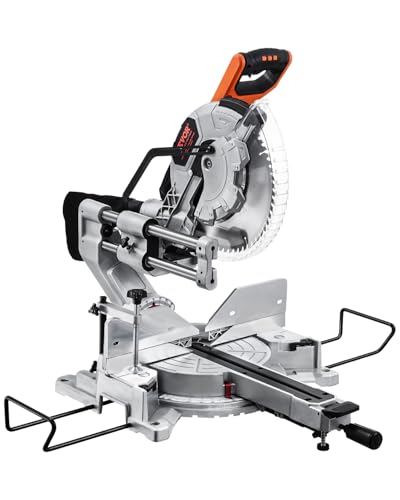
What We Like
- Advanced LED guide for precise alignment
- Axial sliding system saves workspace
- Lightweight aluminum base for portability
Trade-offs
- At 33.5 inches long, it requires a deep bench.
- No dust collection system is specified.
The axial sliding system is the key here. It lets the saw head travel forward and back without needing rear clearance, so you can push the entire unit flush against a wall. That’s a major space-saver for a permanent workshop station. This saw is built for the woodworker who needs compound angle precision in a tight corner, with its dual-bevel capability and LED cutting guide helping tackle everything from picture frames to decking without sacrificing floor space.
The axial sliding system allows this 12-inch sliding compound miter saw to be placed flush against a wall, saving valuable floor space in a workshop. While its upgraded aluminum base is lighter than cast iron, the tool remains a substantial 46.4 pounds, making it better suited for a stationary setup than frequent transport. This design provides the wide crosscut capacity of a full-sized sliding saw in a footprint that fits tighter spaces.
Product photos
DEKOPRO 10-Inch Compound Miter Saw
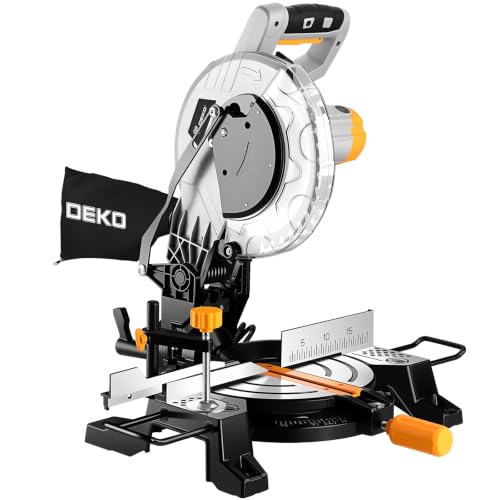
What We Like
- Lightweight 20.5 lb design for easy portability
- Transparent blade guard for clear cut-line view
- Includes material clamp for workpiece stability
- Head locks down for compact storage
Trade-offs
- Single-bevel design limits compound cut flexibility
At just 20.5 pounds, this saw is easy to carry to a jobsite or lift onto a workbench without strain. Its 13-amp motor runs at up to 5,000 RPM for smooth cuts through wood and trim. The single bevel adjusts to 45 degrees, and the miter table swings left and right, covering the essential angles for common projects like baseboard installation.
That lightweight, straightforward design does involve trade-offs. As a single-bevel, non-sliding saw, it lacks the dual-angle and extended reach features found on models like the DeWalt DWS780 or Bosch CM10GD. For a beginner building a workbench or installing baseboard, however, this focus on fundamental crosscuts and bevels is often exactly what’s needed.
Product photos
How We Evaluated Miter Saws For Woodworking
Our evaluation started with a detailed review of manufacturer specifications and documentation for each model. We then cross-referenced this data with professional round-ups from woodworking publications and analyzed recurring themes in verified owner feedback across multiple platforms.
The key criteria were cutting accuracy, capacity for common tasks like crown molding, physical footprint and portability, and overall value for the intended user. A saw’s fence height and bevel range directly impact its ability to handle tall trim. Its sliding mechanism or overall weight then determines if it’s suitable for a tight shop or a mobile professional. You can explore our broader research on best miter saws and miter saws for pros for more context.
This research-based approach identifies the tools best suited for specific scenarios, but it cannot replicate the feel of a saw in your own hands over months of use. We prioritize objective data on performance and design to guide your decision.
What To Look For In Miter Saws For Woodworking
The right miter saw turns complex angles into simple, repeatable cuts. Your choice hinges on the materials you work with, the precision you need, and the space you have available.
Focus on blade size for cut depth, sliding action for width capacity, and the saw’s footprint for your shop. A dual-bevel design saves time on compound cuts, while a good dust collection system keeps your workspace cleaner.
Cutting Capacity & Blade Size
A 10-inch blade is standard for most trim and framing, but a 12-inch blade offers greater depth for thicker stock. The real capacity boost often comes from a sliding mechanism, which allows the blade to travel forward, dramatically increasing crosscut width. For example, a 10-inch slider can often handle a 2×12, matching the capacity of a basic 12-inch chop saw.
Check the specifications for vertical and nested crown molding capacities if you install trim; taller fences are essential here. Our guides on sliding miter saws and compound miter saws detail these trade-offs further.
Accuracy & Ease of Use
Precision hinges on solid construction and thoughtful features. Look for positive miter detents that click firmly at common angles like 22.5 and 45 degrees. A clear cut-line guide, like an LED shadow or laser, is invaluable for aligning your workpiece without guesswork. Ergonomics matter too: front-mounted bevel locks and easy-to-reach miter levers make setups faster and more accurate than reaching behind the saw. For those new to the tool, understanding using a miter saw safely is the first step toward accuracy.
Workspace & Portability
Consider where the saw will live. Traditional sliding saws with rear rails need significant clearance behind them, while articulated-arm or axial-glide designs can sit flush against a wall, saving precious shop depth. Weight is the other major factor; a lightweight saw under 30 pounds is manageable for job-site travel, but a heavy, stable saw over 60 pounds is typically meant for a permanent station. Remember, even a “compact” sliding saw can weigh over 50 pounds, so check the specs if portability is key.
- Measure the depth of your bench or stand to ensure the saw will fit, especially when the slide is fully extended.
- Consider a saw’s dust port compatibility with your shop vacuum to manage debris.
- For cordless models, factor in the cost and weight of the required battery platform.
Your most frequent project should dictate your saw’s most important feature.
Miter Saws For Woodworking Compared
The following table compares key specs across our picks to help you see the differences at a glance.
| Product | Motor | Weight | Bevel Range |
|---|---|---|---|
| DEWALT DWS780-QS Miter Saw | 1100W 15 amp, 3800 rpm | 54.7 lb | 0° to 48° left/right |
| Bosch CM10GD 10-Inch Dual-Bevel Glide Miter Saw | 15 Amp, 4,800 RPM | 64.0 pounds | 47° left/right |
| DEWALT DWS779 12-Inch Sliding Compound Miter Saw | 15 Amp, 3,800 rpm | 67.7 Pounds | 49° to the right and left |
| SKIL MS6305 10-Inch Sliding Compound Miter Saw | 15 Amp, 4,800 RPM | 39.4 Pounds | 48° & 45° left, 0°, 45° right |
| Makita LS1019L 10-Inch Sliding Compound Miter Saw | N/A | 57.9 lbs. | N/A |
| Bosch GCM18V-12SDN 12-Inch Cordless Slide Miter Saw | BITURBO BRUSHLESS | 52.4 pounds | Dual-bevel design |
| Metabo HPT C10FCG2 10-Inch Compound Miter Saw | 15-Amp, 5,000 RPM | 24.2 pounds | 0-45° left |
| Makita LS1110F 10-Inch Slide Compound Miter Saw | 13.0 AMP, 4,500 RPM | 36.2 pounds | 0°-47° left, 0°-2° right |
| VEVOR 12-Inch Sliding Compound Miter Saw | 15 Amp | 46.4 Pounds | 0-45° dual |
| DEKOPRO 10-Inch Compound Miter Saw | 13-Amp, 5,000 RPM | 20.5 lbs | 0° to 45° |
Frequently Asked Questions
What is the best mitre saw for woodworking?
For most woodworking shops, the best miter saw is a sliding compound model that balances accuracy, power, and capacity. The DEWALT DWS780-QS is a leading choice, featuring a precise XPS cut-line system and a powerful motor, making it suitable for demanding trim and finish work where repeatability is important.
Which mitre saw is considered the best quality?
Quality in a miter saw is demonstrated through precise engineering, durable construction, and features that enhance accuracy and longevity. Saws with smooth-gliding carriages, solid castings, and well-designed adjustment mechanisms, like those from DEWALT, Bosch, and Makita, are consistently highlighted for their build quality in professional reviews.
Which is better, compound or sliding miter saw?
A compound miter saw can tilt the blade for bevel cuts, essential for crown molding. A sliding compound miter saw adds a sliding carriage, granting much wider crosscut capacity. For woodworking, a sliding compound miter saw is generally better because it combines angle-cutting versatility with the ability to handle wider boards, offering the most functionality in one tool.
What is the best mitre saw for fine woodworking?
Fine woodworking demands extreme accuracy. Look for a saw with a dead-on accurate sliding system, like Makita’s linear ball bearings, and a precise cut-line indicator. A stable, heavy base reduces vibration, and fine-adjustment controls help dial in perfect angles. Consistent, clean cuts are more important than raw power in this context.
How do I maintain accuracy in my miter saw over time?
Regular calibration is essential. Check that the blade is square to the fence and the table, and that the miter and bevel angle scales read true. Using sharp, high-tooth-count miter saw blades designed for finish cuts also preserves accuracy. Learn the process for how to calibrate your miter saw to keep it performing like new.
The Bottom Line
The DEWALT DWS780-QS is the best overall miter saw for the workshop-focused woodworker who values cut-line accuracy and doesn’t need to move the tool often. Its powerful motor and convenient controls make it a reliable centerpiece for trim and finish carpentry.
If your budget is tight, the SKIL MS6305-00 delivers remarkable sliding compound functionality without the premium price. For those with limited shop depth, the Bosch CM10GD offers full dual-bevel sliding capabilities in a more compact footprint. Beginners should consider the straightforward DEKOPRO 10-Inch Compound Miter Saw for its ease of use and portability.
Ultimately, matching the saw’s cutting capacity and physical footprint to your most common projects and your available space is the single most important decision you’ll make.
