
10 Best Circular Saw Blades in 2026
This post contains affiliate links. As an Amazon Associate, we earn from qualifying purchases.
Our research points to the Diablo 12-Inch 80-Tooth Hi-ATB Finish Saw Blade as the best overall for its ability to deliver exceptionally clean, tear-out-free crosscuts. For high-volume pros, the Diablo 10-Pack is our professional value pick, while the DEWALT 24-Tooth blade earns the award for durability on tough job sites. Choosing the wrong blade wastes material and leaves a rough edge, while the right one makes every cut count. We analyzed specifications, owner feedback, and expert recommendations to compare blades across tooth count, durability features, and compatibility.
Top 10 Circular Saw Blades in the Market

Certain content that appears on this site comes from Amazon. This content is provided "as is" and is subject to change or removal at any time.
The Best Circular Saw Blades, Reviewed
Diablo 12-Inch 80-Tooth Hi-ATB Finish Saw Blade

What We Like
- 80-tooth Hi-ATB geometry for clean, tear-out-free finish cuts.
- Perma-SHIELD coating reduces heat buildup and corrosion.
- Super thin kerf design minimizes material waste.
- TiCo Hi-Density carbide ensures long-lasting sharpness.
Trade-offs
- At 12 inches, it only fits saws with that capacity.
- The 80-tooth design is specialized for fine crosscuts, not ripping.
- Weighs 2.5 pounds, a heavier blade for its platform.
The Diablo 12-Inch 80-Tooth Hi-ATB Finish Saw Blade is designed for fine finish crosscuts, offering precise and clean cuts in hardwoods and softwoods. Its high tooth count with alternate top bevel geometry ensures smooth finishes with minimal tear-out, which can reduce the need for sanding. The Perma-SHIELD non-stick coating protects the blade from heat, gumming, and corrosion, a feature that helps extend the blade’s working life.
This 12-inch blade is specialized for fine finishing, so it fits larger miter and table saws rather than compact tools. Among listed alternatives, the Freud 10-Inch 50-Tooth Combination Saw Blade has a smaller diameter and different tooth count. For the woodworker whose priority is a finished look straight from the saw, this Diablo blade’s design justifies its role as a dedicated tool.
Diablo 7-1/4-Inch 24-Tooth Framing Saw Blade 10-Pack
What We Like
- Tracking Point design for straight, long-life cuts.
- Ultra-efficient for 30% more cordless saw cuts.
- Laser-cut stabilizer vents reduce vibration and warping.
- Non-stick coating resists heat, gumming, and corrosion.
Trade-offs
- 24-tooth design leaves a rougher cut than finish blades.
- Ten-pack bulk is excessive for occasional DIY use.
The ten-pack format is the core of this product’s proposition. For a professional or a crew running multiple saws on framing and treated lumber jobs, having a stack of identical, reliable blades means no downtime for resharpening and consistent performance across the board. The blade’s own design backs this up for heavy use, with an anti-stick coating and stabilizer vents that fight the heat and warp that kill cheaper blades mid-project. It’s built for the pro who burns through blades and values predictability over per-unit cost.
The 24-tooth configuration and thin kerf are pure speed demons, ripping through dimensional lumber fast while being easier on cordless tool batteries. You trade a smooth finish for that speed, so these aren’t for your trim work. Compared to something like the Makita 45-tooth blade in the guide, the Diablo will cut faster but leave a rougher edge. This pack is about pure, repetitive cutting efficiency on the job site, not finesse in the shop.
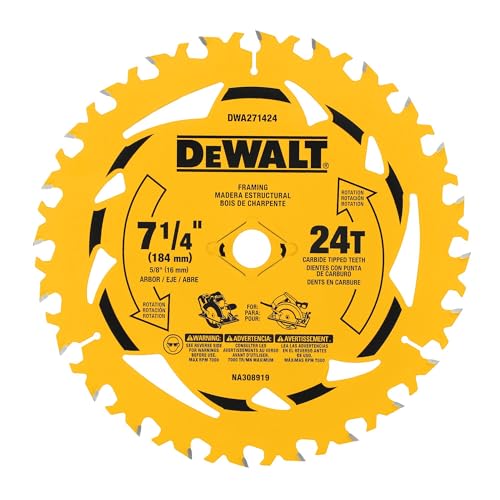
DEWALT 7-1/4-Inch 24-Tooth Circular Saw Blade
What We Like
- Thick plate promises up to 2X the life
- PTFE coating helps minimize friction for smooth cuts
- Heat-vent design limits binding and warping
- Optimized tooth geometry for wet or challenging materials
Trade-offs
- 24-tooth design leaves a rougher cut edge than finer blades
- General-purpose tooth count lacks specialization for finish work
A thick plate and engineering for up to 2X the life means this blade is built to handle the repetitive, abrasive cuts that wear out lesser blades quickly. It’s the right choice for the contractor or serious DIYer who spends days framing decks or sheathing roofs, where longevity and resistance to heat warp are more critical than a glass-smooth finish. The PTFE coating and heat vents are practical features that directly address the friction and binding you fight when pushing through pressure-treated lumber or damp plywood all day.
You’re trading a fine finish for brute endurance. For crosscuts on trim or cabinetry, you’d want a blade with a higher tooth count like the DEWALT 7-1/4-Inch 60-Tooth model. This 24-tooth DeWalt is a workhorse, not a show pony. It’s designed to be the last blade you need to buy for the rough work, letting you save the specialized blades for the jobs that truly require them.
Product photos
DEWALT 7-1/4-Inch 60-Tooth Circular Saw Blade

What We Like
- PTFE coating minimizes friction for smooth cuts
- Heat-vent design limits binding and workpiece burning
- Optimized tooth geometry for crisp cuts in challenging materials
- Thick plate contributes to long-lasting performance
Trade-offs
- 60-tooth design is slower for heavy ripping than a 24-tooth blade
- Not designed for rapid, rough framing cuts
A 60-tooth configuration delivers a noticeably finer surface finish than a framing blade, making this blade ideal for trim work, cabinetmaking, or any crosscut where you want to minimize sanding. Its PTFE coating helps minimize friction for smoother cuts and maximizes ease-of-use. The thick plate and proprietary heat-vent design are built to limit binding and warping, so you can expect that clean-cutting performance to last.
The trade-off for that smooth finish is speed. This blade will cut more slowly through thick lumber than something like the DEWALT 7-1/4-Inch 24-Tooth blade from the same brand. It’s a specialist, not a generalist. Keep it for your finish work, and you’ll appreciate the clean edges it leaves behind, especially in materials like plywood or melamine where tear-out is a constant annoyance.
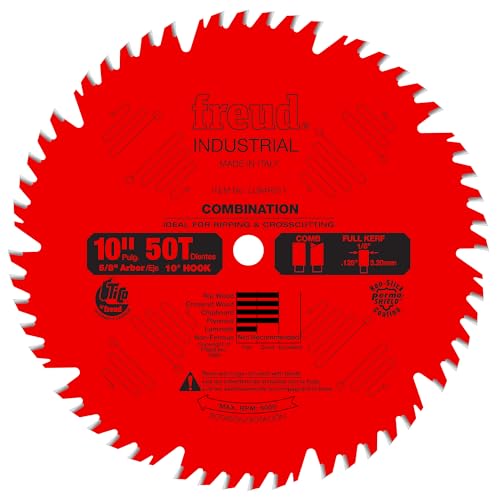
Freud 10-Inch 50-Tooth Combination Saw Blade
What We Like
- Combination tooth grind for ripping and crosscutting.
- TiCo carbide blend for durability and edge retention.
- Laser-cut anti-vibration slots for a smoother cut.
- Non-stick coating reduces friction and pitch buildup.
Trade-offs
- At 10 inches, it only fits tools with that arbor size.
- General-purpose design, not specialized for fine finish cuts.
The 50-tooth comb grind is the key here, blending flat-top rakers for fast ripping with ATB teeth for clean crosscuts. This makes it a true workshop workhorse for someone who needs one blade to handle most tasks on a table saw or miter saw, from breaking down sheet goods to cutting trim. The Perma-Shield coating and laser-cut slots are thoughtful engineering, reducing heat and chatter so the blade stays accurate and clean-cutting through long projects.
This Freud blade combines a flat tooth for ripping with four alternate top bevel teeth for crosscutting, making it a versatile single-blade solution for general woodworking. Its 10-inch diameter and 50-tooth comb grind design are common for table and miter saws, so it suits shop use rather than smaller handheld tools. For tasks demanding a dedicated finish, a specialized blade like the **Diablo 12-Inch 80-Tooth Hi-ATB Finish Saw Blade** is built for that purpose.
Product photos
Makita 7-1/4-Inch 45-Tooth Max Efficiency Saw Blade

What We Like
- Ultra-thin kerf reduces load on cordless tools
- ATAFR tooth design provides smoother, faster cuts
- Up to 75% more cuts per charge versus standard blades
- High-grade tungsten carbide ensures durability
Trade-offs
- 45-tooth design is a compromise for very rough or very fine work
- Fine crosscutting focus limits its speed for heavy framing
It dramatically reduces the strain on a cordless saw’s motor and battery, which Makita claims can deliver up to 75% more cuts per charge. That makes this blade a perfect partner for any 7-1/4-inch cordless circular saw. The 45-tooth ATAFR design also aims for a balance, offering smoother cuts than a basic framing blade while still moving material efficiently to preserve runtime. This blade is built for the cordless workshop user who needs a versatile, battery-conscious option for crosscuts and general plywood or dimensional lumber work.
The trade-off is specialization. For ripping a stack of 2x4s, a dedicated 24-tooth blade like the Makita 10-pack will be faster. For pristine finish cuts in oak, a higher-tooth-count blade like the DEWALT 60-Tooth is the better choice. This Makita sits squarely in the middle, engineered to extend your cordless tool’s capability without sacrificing one job completely for another. It’s a strategic upgrade from the basic blade that comes with your saw.
Makita 7-1/4-Inch 24-Tooth Framing Blade 10-Pack

What We Like
- ATAF tooth design for precision framing cuts
- Ultra-thin kerf minimizes motor drag and waste
- Hardened, tensioned plate ensures true tracking
- Large expansion slots reduce noise and vibration
Trade-offs
- 24-tooth grind is aggressive, leaving a rough finish
- Framing-specific design lacks versatility for fine woodworking
This 10-pack of identical 7-1/4-inch blades is built for a crew that needs replacements on hand. The ultra-thin kerf design provides smoother cuts with less drag on the motor, which can help a saw maintain its cutting pace. Combined with a fully hardened plate for stability and an ATAF tooth design for precision, the set offers contractors a ready supply of framing blades for general purpose cutting.
The 24-tooth configuration is intended for framing and general purpose use, prioritizing speed over a polished finish. For cleaner crosscuts, a separate blade with more teeth would be required, such as the Makita 7-1/4-Inch 45-Tooth model designed for fine work. This pack focuses on utility, ensuring a sharp, true-cutting blade is always available for the primary task.
Product photos
WEN 7.25-Inch 40-Tooth Finish Saw Blade

What We Like
- Ultra-thin kerf for clean, efficient cuts
- 40 carbide teeth resist wear for finish work
- Compatible with most 7-1/4 inch miter and circular saws
- Lightweight design at half a pound
Trade-offs
- 40-tooth count is lower than some finish blades
- Rated for up to 7000 RPM
The ultra-thin 1/16-inch kerf is the defining feature here. It removes less material, which puts less strain on your saw’s motor and leaves a noticeably cleaner cut in plywood, trim, and other finish materials. This blade is built for the detail-oriented woodworker who wants a smooth surface right off the saw, minimizing sanding. Its 40-tooth ATB grind and 7000 RPM rating make it a versatile performer for crosscuts and miters on common stock.
That thin design has a trade-off: it can be less stable in very thick or dense hardwoods, where a slight bend might affect your cut line. For pure, tear-out-free finishing, you’d look at a blade with more teeth, such as Diablo’s 12-inch 80-tooth model. But for a general-purpose finish blade that marries clean cuts with good efficiency on a standard 7-1/4 inch saw, this WEN model delivers solid value. It’s a smart upgrade from a basic framing blade when finesse matters.
Product photos
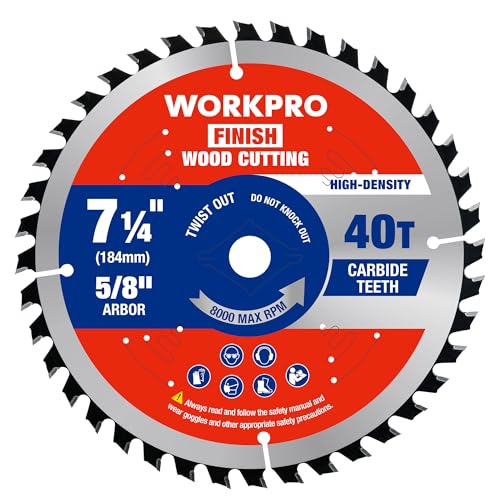
WORKPRO 7-1/4-Inch 40-Tooth Circular Saw Blade
What We Like
- Carbide-tipped teeth for long-lasting sharpness.
- Thin kerf design reduces cutting resistance and waste.
- ATB geometry provides clean cuts with minimal splintering.
- Versatile for plywood, hardwood, softwood, and trim.
Trade-offs
- Requires checking saw arbor size before purchase
- Thin kerf may not be ideal for all saw types
With a 40-tooth count, this WORKPRO blade strikes a useful balance between speed and finish quality for general woodworking. Its alternating top bevel tooth geometry delivers smooth cuts with reduced splintering across plywood, hardwood, and softwood. A thin kerf design reduces cutting resistance, which helps preserve battery life on cordless saws and minimizes strain on older motors. This combination makes it a versatile single-blade solution for users who frequently switch between different wood materials without wanting to change blades.
The trade-off is specialization. For rapid, rough framing, a 24-tooth blade like the Diablo 7-1/4-Inch would be faster. For fine furniture edges, a higher-tooth-count blade like the DEWALT 60-Tooth would deliver a smoother finish. The WORKPRO doesn’t claim to be the best at any single task, but its design ensures it’s rarely the wrong tool for the job. It’s a pragmatic, workhorse choice that gets the majority of woodworking tasks done well, which is exactly what makes a blade versatile.
Product photos
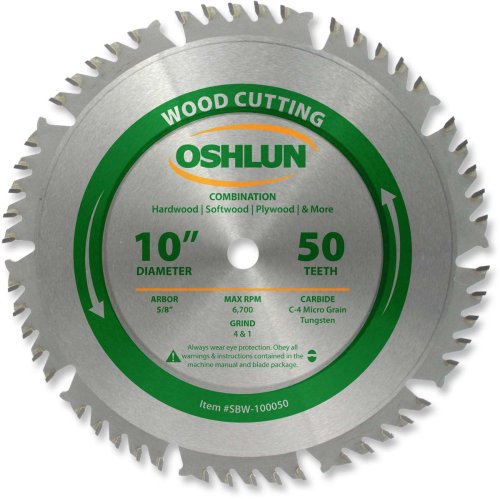
Oshlun SBW-100050 Combination Saw Blade
What We Like
- 4 and 1 grind design for multiple cut types
- Professional grade carbide for edge retention
Trade-offs
- At 10 inches, it only fits larger saws and not compact 7-1/4-inch models
- The 50-tooth count is a compromise, not optimized for pure finish or rip cuts
The blade’s 4 ATB and 1 FTG grind creates a hybrid tooth design. This combination is engineered to handle both crosscutting and ripping tasks, which provides versatility for general woodworking projects.
You trade pure specialization for that flexibility. For instance, the **Freud 10-Inch 50-Tooth Combination Saw Blade** is a direct competitor with similar specs, so the choice may come down to brand preference or specific carbide formulation details. This Oshlun is a solid mid-range workhorse, but if your work is exclusively fine finish carpentry, a dedicated high-tooth-count blade such as the **Diablo 12-Inch 80-Tooth Hi-ATB Finish Saw Blade** would yield a smoother result.
How We Evaluated Circular Saw Blades
Our research focused on manufacturer specifications, industry technical data, expert round-ups, and patterns in owner feedback. We prioritized a blade’s design for its intended cut type, focusing first on tooth count and geometry for either speed or smoothness. Next, we looked at durability features like carbide grade and coatings that fight heat and gumming. Finally, we confirmed physical compatibility, diameter and arbor size, to ensure a blade would fit common tools. This research-led approach cannot replicate years of job-site wear, but it reveals which blades are engineered for specific tasks.
What To Look For In Circular Saw Blades
The right blade is defined by the job. A pro framer needs speed and durability, while a woodworker values a flawless finish above all else.
Key criteria are tooth count for speed versus smoothness, special coatings for heat and corrosion resistance, and physical compatibility with your saw’s arbor size and capacity.
Tooth Count & Geometry
This is the primary factor. Low tooth counts (like 24) with an Alternate Top Bevel (ATB) or Framing design are for fast, aggressive ripping in construction lumber. High tooth counts (60-80) with a Hi-ATB or Triple Chip grind excel at clean, slow crosscuts in plywood and finished stock. A mid-range count around 40-50 offers a versatile balance for general-purpose use. Research shows upgrading from a 24-tooth to a 40-tooth blade makes a dramatic difference in reducing splintering on sheet goods.
Coatings & Construction
Coatings like Perma-SHIELD, PTFE, or non-stick surfaces reduce friction, heat, and resin buildup, which prolongs blade life and prevents warping. Look for thin-kerf blades to reduce strain on cordless motors and save material, though they require a saw that can run them true. High-density carbide tips, like TiCo, hold their edge longer through demanding materials, a key feature for cutting wood and tough composites with the best circular saw blades.
Compatibility & Size
First, match the blade diameter to your saw’s capacity, a 7 1/4-inch blade won’t fit a 10-inch table saw, and vice versa. Next, verify the arbor hole size (commonly 5/8-inch for 7 1/4-inch blades or 1-inch for 10-inch blades). For cordless saws, an ultra-thin kerf is especially beneficial for battery life. Finally, check the blade’s maximum RPM rating against your tool’s no-load speed.
- Confirm your saw’s arbor size before purchasing any blade.
- For handheld saws, 7 1/4-inch is the most common diameter.
- A thinner blade kerf cuts easier but can flex more during deep cuts.
Let the material and finish you need dictate the tooth count.
Circular Saw Blades Compared
Our comparison table outlines the core specifications and best uses for our picks to help you find the right match quickly.
| Product | Diameter | Tooth Count | Tooth Geometry |
|---|---|---|---|
| Diablo 12-Inch 80-Tooth Hi-ATB Finish Saw Blade | 12 inches | 80 teeth | Hi-ATB (Alternate Top Bevel) |
| Diablo 7-1/4-Inch 24-Tooth Framing Saw Blade 10-Pack | 7-1/4 inches | 24 Teeth | N/A |
| DEWALT 7-1/4-Inch 24-Tooth Circular Saw Blade | 7-1/4 inches | 24 teeth | N/A |
| DEWALT 7-1/4-Inch 60-Tooth Circular Saw Blade | 7-1/4 inches | 60 teeth | N/A |
| Freud 10-Inch 50-Tooth Combination Saw Blade | 10 inches | 50 teeth | Comb Grind (ATB + Flat Top) |
| Makita 7-1/4-Inch 45-Tooth Max Efficiency Saw Blade | 7-1/4 inches | 45 teeth | ATAFR carbide tips |
| Makita 7-1/4-Inch 24-Tooth Framing Blade 10-Pack | 7-1/4 inches | 24 teeth | ATAF (Alternate Top and Alternate Face) |
| WEN 7.25-Inch 40-Tooth Finish Saw Blade | 7.25 inches | 40 carbide-tipped ATB teeth | ATB |
| WORKPRO 7-1/4-Inch 40-Tooth Circular Saw Blade | 7-1/4 inches | 40 teeth | Alternating Top Bevel (ATB) |
| Oshlun SBW-100050 Combination Saw Blade | 10-Inch | 50 Teeth | 4 ATB and 1 FTG |
Frequently Asked Questions
What are the best quality circular saw blades?
The best quality blades use high-grade carbide tips for longevity and feature anti-vibration designs and heat-resistant coatings. Brands like Diablo, DEWALT, Freud, and Makita are consistently noted in research and owner feedback for building blades that stay sharper and run cooler. The “best” for you depends entirely on whether you need a blade for fast framing, clean finish work, or a versatile all-rounder.
Which circular saw blade is better, Milwaukee or Diablo?
Both brands produce highly regarded blades, often with different strengths. Our research indicates Diablo blades are frequently highlighted for their specialty finishes and broad range of plywood blades. Milwaukee is also praised for durability. The better choice comes down to the specific blade model’s tooth design and features for your primary cutting task, rather than the brand name alone.
Which brand of saw blades is considered the best?
No single brand is best for every purpose. Diablo is often cited for fine woodworking and finish cuts, while DEWALT and Makita are prominent in professional construction for their durability. Freud is a top choice for stationary table saws. The best brand is the one that engineers its blades to excel at the specific work you do most often.
What is the best number of teeth for a circular saw blade?
There is no single best number; it’s a trade-off. For fast, rough cuts in framing lumber, a 24-tooth blade is ideal. For clean cuts in plywood and trim, move to 40 teeth or more. A 60-tooth or higher blade is for ultra-smooth, ready-to-finish crosscuts. For a versatile blade that does a bit of everything reasonably well, a 40-tooth to 50-tooth combination blade is a common starting point.
Can I use a 10-inch blade on a 7 1/4-inch circular saw?
No. A blade’s diameter must match your saw’s stated capacity. A 10-inch blade is physically too large for the guard and arbor of a 7 1/4-inch saw, creating a serious safety hazard. Always use a blade diameter rated for your specific tool, which for most handheld circular saws means looking for 7 1/4-inch blades.
The Bottom Line
For woodworkers and finish carpenters demanding pristine crosscuts, the Diablo 12-Inch 80-Tooth Hi-ATB Finish Saw Blade is the clear best overall. If your priority is surviving harsh job-site conditions, choose the DEWALT 24-Tooth for durability; for maximum value in bulk, the Diablo 10-Pack is unmatched. Ultimately, the most important factor is matching the blade’s tooth count and specialty grind to your most frequent cutting task, it’s the fastest way to upgrade your results.
