
10 Best Compressors For Blowing Out Sprinklers in 2026
This post contains affiliate links. As an Amazon Associate, we earn from qualifying purchases.
Our best overall compressor for blowing out sprinklers is the Craftsman 10 Gallon Portable Air Compressor, which balances strong airflow with convenient dual outlets for efficient work. For higher output on a budget, the VEVOR 10 Gallon offers excellent value, while the PONO 6.3 Gallon is the top choice for compact, quiet operation. This guide helps you choose the right machine to protect your irrigation system from winter freeze damage.
Using the wrong compressor can lead to incomplete water removal or damage to your sprinkler lines. For this seasonal task, the right combination of airflow, tank size, and portability is what truly matters.
Our recommendations are based on manufacturer specifications, expert landscaping guides, and patterns in owner feedback. We’ve sorted through the options to match you with a compressor that fits your property’s needs and your storage space.
Top 10 Compressors For Blowing Out Sprinklers in the Market
Certain content that appears on this site comes from Amazon. This content is provided "as is" and is subject to change or removal at any time.
The Best Compressors For Blowing Out Sprinklers, Reviewed
Craftsman 10 Gallon Portable Air Compressor

What We Like
- Dual quick couplers for running two tools
- Wheeled, portable design with folding handle
- Delivers 4.0 CFM at 90 PSI for strong airflow
- Oil-free pump requires less maintenance
Trade-offs
- 4.0 CFM is lower than the 5.3 CFM on the VEVOR model
- At 28 inches tall, it requires moderate storage space
- 150 PSI maximum is less than some 175+ PSI models
A 10-gallon tank paired with 4.0 CFM at 90 PSI provides a solid reserve of air pressure. This is the key to effectively blowing out a medium-sized sprinkler system without constant motor cycling. This Craftsman hits a practical sweet spot for a homeowner with a typical yard. Its oil-free design means you can store it in a garage without worrying about maintenance, and the dual couplers are a thoughtful touch if you ever need to run an air tool while the compressor is recovering.
The trade-off is in pure airflow; models like the VEVOR 10-gallon offer higher CFM, which can clear lines slightly faster. However, the Craftsman’s balanced combination of capacity, portability on its built-in wheels, and user-friendly features makes it the most reliable and versatile single tool for this seasonal chore. It’s a compressor you’ll use for blowing out sprinklers that can also confidently handle a full suite of nailers for weekend projects.
VEVOR 10 Gallon Oil-Free Air Compressor

What We Like
- High 5.3 CFM output for demanding tasks.
- 78 dB operation is relatively quiet.
- Oil-free design requires less maintenance.
Trade-offs
- At 70.5 lb, it's heavy for routine carrying.
- Larger footprint than compact pancake models.
- 125 PSI max pressure is lower than some 150 PSI units.
The 5.3 CFM air delivery at 90 PSI is the key spec here, providing enough sustained airflow to quickly blow out multiple sprinkler zones without constant stops for the tank to refill. This makes the VEVOR a strong fit for homeowners with medium to large systems who want a compressor that can handle the job efficiently and also power air tools for weekend projects. Its oil-free pump means you won’t be dealing with messy maintenance, and the 78 dB noise level is a considerate feature for suburban neighborhoods.
This unit prioritizes performance over portability. At over 70 pounds with a 28-inch tall tank, this isn’t something you’ll casually toss in a car trunk; it’s a wheel-around-the-garage workhorse. For pure sprinkler duty on a smaller property, a lighter model like the Craftsman 10-gallon offers similar capacity in a more compact package, but with lower CFM. The VEVOR’s value comes from delivering higher air tool-ready performance from its 10-gallon frame, justifying its space and weight for a user who will exploit that capability.
Product photos
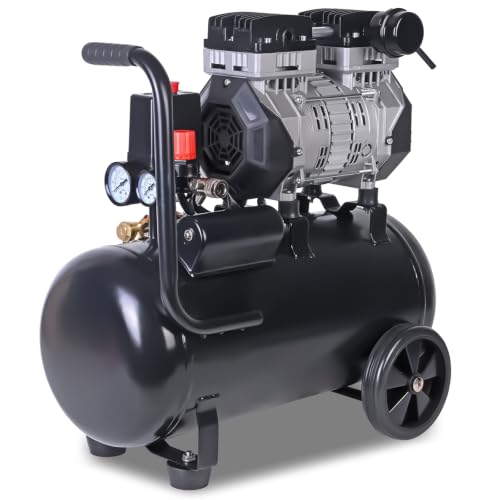
PONO 6.3 Gallon Ultra Quiet Air Compressor
What We Like
- Ultra-quiet 70 dB operation for residential use
- Fast tank refill in 2.75 minutes from empty
- Oil-free motor eliminates messy maintenance
- Triple-layer tank construction for safety and durability
Trade-offs
- Lower CFM than larger stationary compressors for high-demand tools
The 70 dB noise level is the real story here, letting you blow out a sprinkler system early on a Sunday without waking the neighbors. That quiet operation, paired with a decent 6.3-gallon tank and a solid 6 CFM air delivery, makes this a strong candidate for homeowners who need a capable but considerate compressor. Its oil-free design means you can store it in the garage over winter without worrying about maintenance, and the quick tank refill keeps you moving. This unit is built for the DIYer who values a clean, quiet workshop as much as getting the job done.
The trade-off for that compact, quiet package is air volume. While its CFM is respectable, the 6.3-gallon tank will require more frequent cycling compared to a model like the VEVOR 10 Gallon if you’re tackling a large property with many zones. For a typical suburban system, it’s perfectly sufficient, but for extensive commercial lines, you’d be better served by a larger tank. Think of it as the refined suburbanite of compressors, powerful enough for your duties and polite enough to keep the peace.
Product photos
Metabo HPT 6 Gallon Pancake Air Compressor

What We Like
- High 200 PSI max pressure for strong air delivery
- Lightweight 41-pound pancake design for easy transport
- Can run multiple nailers simultaneously for versatility
- Delivers 4 CFM at 90 PSI for consistent air flow
Trade-offs
- 6-gallon tank requires more frequent cycling on large sprinkler zones
- 4 CFM air flow is lower than some 10-gallon stationary models
- Pancake footprint trades vertical space for a wider base
A 200 PSI maximum pressure gives this pancake compressor a strong punch for blowing out sprinkler lines. It can maintain effective pressure even as the tank drains. That power, combined with a weight of just 41 pounds, makes it the most portable unit capable of handling this seasonal chore. It’s a logical choice for the contractor or serious DIYer who needs to move the compressor from a truck to a backyard without strain. They might also use it to drive nailers on job sites during the rest of the year.
A 6-gallon air tank is the compromise for its light weight. You’ll hear the motor kick on more often compared to a larger tank like the 10-gallon Craftsman, especially on bigger irrigation zones. For a typical suburban system, it’s perfectly adequate, but for sprawling properties, the frequent cycling can slow you down. Think of it as the ultimate ‘grab-and-go’ compressor for sprinkler duty, sacrificing some runtime for unmatched ease of carrying.
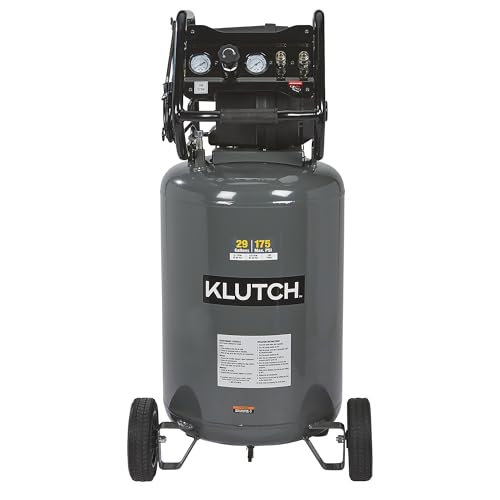
Klutch 29 Gallon Air Compressor
What We Like
- Large 29-gallon tank for extended run time
- Oil-free pump eliminates maintenance
- Quick recovery with 5.1 CFM at 90 PSI
- Large flat-free tires for easy mobility
Trade-offs
- Weighs 127 pounds, requiring a dedicated storage space
- Occupies a 23.2 x 21.1 inch footprint
- Substantial size limits portability through standard doorways
With a 29-gallon tank, this compressor stores a large volume of air. That allows for longer tool run times before the motor needs to kick back on. Its 5.1 CFM output at 90 PSI provides enough flow to maintain pressure for demanding tools like framing nailers or sanders. This combination suits intermediate to continuous tasks such as nailing, painting, or using a blow gun without frequent pauses.
Its large capacity comes with a substantial physical footprint. At 127 pounds and over 45 inches tall, this isn’t a compressor you’ll tuck into a corner of the garage; it demands floor space. Compared to a more compact option like the Craftsman 10-gallon model, the Klutch offers far more air reserve but sacrifices the easy stowability of a smaller tank. You’re committing to a semi-permanent workshop fixture for a major boost in runtime.
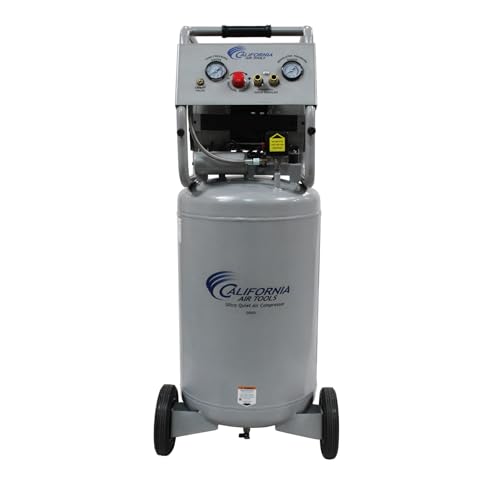
California Air Tools 20 Gallon Air Compressor
What We Like
- Ultra-quiet 70 dB operation for neighborhoods
- Oil-free pump requires minimal long-term maintenance
- Wheeled design for moving its 114 lb weight
Trade-offs
- Weighs 134 pounds for transport
- Requires a 20-inch square footprint
Operating at just 70 dB makes this the clear choice for anyone who needs to blow out sprinklers early in the morning or in noise-sensitive suburban areas without annoying the neighbors. Its 20-gallon tank is the largest you can get on a standard 110-volt circuit, providing a substantial reservoir of air to work with before the motor needs to kick back on. That combination of quiet operation and serious capacity suits the homeowner with a larger irrigation system who values discretion and doesn’t want to run a generator or a loud gas model.
A quiet, 1680 RPM motor delivers a steady CFM output that doesn’t lead its class. You’re getting reliable air, but not necessarily the fastest blow-out. For comparison, if maximum air pressure in the tank is your priority for stubborn lines, the FORTRESS 27 Gallon model stores air at a higher PSI, though it isn’t as quiet. The California Air Tools compressor wins on reducing noise and wear over the long haul, making it a durable, considerate choice for annual maintenance.
Product photos
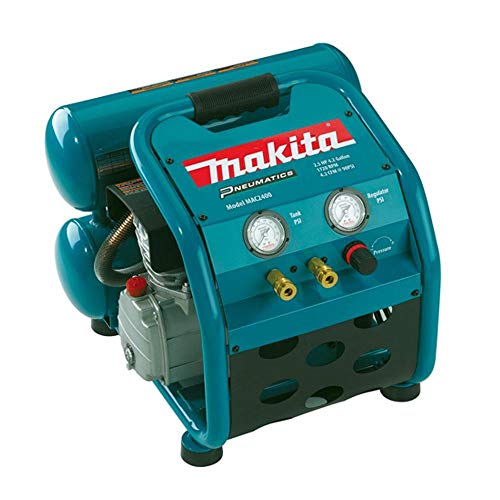
Makita MAC2400 Big Bore Air Compressor
What We Like
- Cast iron Big Bore pump for faster recovery
- Oil lubrication minimizes wear and runs cooler
- Roll-cage protects pump in tough environments
- Low AMP draw reduces breaker trips
Trade-offs
- Oil-lubricated design requires periodic maintenance
Its 2.5 HP motor delivers 4.2 CFM at 90 PSI, providing solid power for tools like framing nailers. The oil-lubricated cast iron pump is built for the long haul, which prioritizes cooler operation and reduced internal wear. Makita engineers the Big Bore cylinder and piston for faster recovery time. This means less waiting between tasks on a busy jobsite. Roll-cage construction protects the pump and motor from bumps and drops in extreme environments.
That durable, oil-lubricated design does require periodic maintenance, unlike the oil-free Craftsman or VEVOR models. While the Craftsman 10-gallon delivers 4.0 CFM at 90 PSI, the Makita’s 4.2 CFM offers a slight edge for continuous tool use. This compressor suits a user who values long-term reliability on portable jobsite duty and doesn’t mind the upkeep for extended pump life.
DEWALT 4.5 Gallon Hand Carry Compressor

What We Like
- High 225 PSI max pressure for strong air reserve
- Oil-free pump eliminates routine maintenance
- Large pneumatic tires for rough jobsite transport
- Protected console with large, clear gauges
Trade-offs
- At 88 pounds, it's heavy for frequent lifting
- 4.5-gallon tank requires frequent compressor cycling for large sprinkler zones
- Lower CFM output than dedicated 25-gallon models for this task
With a 225 PSI maximum tank pressure, the DEWALT D55146 stores a high-pressure air reserve for demanding pneumatic tools. Its 10-inch non-flat pneumatic tires and hand-carry design allow it to be rolled over rough terrain on a jobsite. The oil-free, maintenance-free pump requires no upkeep between uses, and a protective metal console houses large 2-inch gauges for clear viewing.
The 4.5-gallon tank provides less air storage than larger stationary compressors, so the pump will cycle on more frequently during extended tasks. For context, research notes that a different 25-gallon DEWALT model is recommended for blowing out sprinkler systems at a typical home. This hand-carry unit’s combination of high pressure and portability suits it for general construction and inflation jobs where mobility is key.
Pulsar GYC6100S Compressors

What We Like
- Oil-free, maintenance-free design
- High 5.0 SCFM output at 40 PSI
- 8-inch wheels and handle for portability
- Dual gauges and quick-connect coupler
Trade-offs
- At 68 pounds, it's heavy for a 10-gallon unit
- Tall 33.9-inch height complicates truck-bed storage
A 10-gallon tank at 150 PSI gives you the reserve volume to clear multiple sprinkler zones without constantly waiting for the pump to cycle. The 4.0 SCFM at 90 PSI is the core spec for blowing out lines, and this Pulsar delivers that reliably in a no-fuss, oil-free package. It’s the right fit for the homeowner who needs dependable, season-after-season performance without the complexity or cost of a pro-grade model. The cold-weather engineering means it will fire up on that first chilly fall day when you need it most.
Its taller and heavier build makes maneuvering through a tight garage or lifting it solo a chore compared to the similarly specced Craftsman. For blowing out a typical residential system, its performance is essentially identical to that Craftsman. Step up to the VEVOR if your primary need is faster cycle recovery, as it pushes more air at the crucial 90 PSI benchmark, but you’ll give up some maximum pressure for that extra flow.
Product photos
ECOMAX Pancake Air Compressor

What We Like
- Lightweight 27.6-pound pancake design
- Dual couplers for simultaneous tool use
- Oil-free and maintenance-free motor
- Winding bracket for cord storage
Trade-offs
- Lower 2.6 CFM output limits continuous tool use
- 6-gallon tank requires frequent recovery cycles
- 27.6 pounds is light but not wheeled for transport
At 27.6 pounds, this is one of the easiest pancake compressors to lift into a truck or carry across a yard. Its 6-gallon tank and 150 PSI maximum are sufficient for blowing out a few sprinkler zones, and the dual couplers let you run two blow-out guns if you have a helper. The oil-free motor means no maintenance, and the low-voltage start is a genuine benefit for those older outdoor outlets. This unit suits the homeowner who needs to winterize their own system and values easy storage in a garage corner more than raw power.
Its air delivery of 2.6 CFM at 90 PSI is lower than some larger compressors, such as the Craftsman 10-gallon model rated for 4.0 CFM at the same pressure. This means tools that require a continuous high airflow may pause more frequently as the tank refills. The unit is designed for lighter pneumatic tasks like trim work, inflation, and cleaning.
Product photos
How We Evaluated Compressors For Blowing Out Sprinklers
Our research focused on specs from manufacturers and professional irrigation guides, which emphasize using a pressure regulator and specific airflow (CFM) for safe, effective blowouts. We studied expert round-ups and patterns in owner feedback to understand real-world performance and durability.
The key criteria were airflow (CFM) and tank capacity for handling sprinkler zones, maximum pressure (PSI) for a strong air reserve, and the unit’s portability and noise level for homeowner use. We also weighed maintenance needs, like oil-free versus oil-lubricated pumps, which affect long-term upkeep. For a deeper dive into the specific models and requirements, our full guide on air compressors for sprinklers covers all the details.
A research-led evaluation has limits. We cannot replicate long-term durability tests or measure the exact noise in a backyard. Our aim is to equip you with the key factors to compare, so you can select a reliable tool for annual winterization. Properly preparing your equipment also includes storing a compressor correctly during the off-season.
What To Look For In Compressors For Blowing Out Sprinklers
Choosing the right compressor prevents pipe bursts and saves money on repairs. Focus on airflow, tank size, and pressure to match your largest sprinkler zone.
Look for a compressor that delivers at least 4-6 CFM at 90 PSI for most home systems. A 10-30 gallon tank reduces cycling, and a maximum PSI over 150 provides a good air reserve. Always use a pressure regulator set to 50 PSI or less to protect your sprinkler lines.
Airflow (CFM) and Tank Capacity
Cubic Feet per Minute (CFM) is the volume of air the compressor can deliver. A higher CFM helps keep sprinkler heads open to push water out completely. For a typical residential zone, a compressor delivering 4 to 6 CFM at 90 PSI is a common starting point.
Tank capacity determines how long you can blow air before the pump must kick on to refill. A larger tank (like 10-30 gallons) means less frequent cycling, which is helpful for bigger zones. Professional landscapers often use units with 20+ CFM and may not need a large tank if the compressor can produce air continuously.
Maximum Pressure (PSI) and Portability
Maximum PSI is the highest pressure the tank can hold, not the pressure you use for the blowout. A higher max PSI, like 150 or 200, means a larger air reserve in the tank. This allows for longer run times between pump cycles when the regulated output is set to a safe 50 PSI or lower.
Portability is crucial for moving the compressor around your property. Consider weight, whether it has wheels, and its footprint. A lightweight pancake compressor is easy to carry but may cycle often, while a large wheeled unit is stable but requires dedicated storage. Your air hose selection also impacts portability and reach during the job.
Noise Level and Maintenance
Noise, measured in decibels (dB), matters in residential neighborhoods. Compressors labeled “ultra-quiet” often operate around 70-75 dB, similar to a vacuum cleaner, while standard models can be over 80 dB. Maintenance involves choosing between oil-free and oil-lubricated pumps. Oil-free models are virtually maintenance-free but may have a shorter lifespan under heavy use. Oil-lubricated pumps, like the Makita Big Bore, often run cooler and last longer but require periodic oil changes. Understanding the CFM requirements for blowout will help you balance power with these practical considerations.
- Always use an in-line pressure regulator set to 50 PSI or less to prevent damage to PVC pipes and sprinkler heads.
- Check that the unit has a standard 1/4″ NPT quick-connect coupler for your blowout hose.
- Ensure you have the proper electrical circuit (120V for most home models; some need 220V).
- Consider storage space for the unit’s height and footprint during the off-season.
- Verify the unit’s duty cycle if you have a very large system; continuous run models are for professionals.
The most important rule: Never connect a compressor directly to your sprinkler system without a pressure regulator.
Compressors For Blowing Out Sprinklers Compared
The table below compares our top picks across the key specifications for blowing out sprinklers.
| Product | Tank Capacity | Maximum Pressure | Airflow @ 90 PSI | Motor Type |
|---|---|---|---|---|
| Craftsman 10 Gallon Portable Air Compressor | 10 gallons | 150 PSI | 4.0 CFM | Oil-free |
| VEVOR 10 Gallon Oil-Free Air Compressor | 10 Gallon | 125 PSI | 5.3 CFM @ 90 PSI | Oil Free |
| PONO 6.3 Gallon Ultra Quiet Air Compressor | 6.3 gallons | 174 PSI | 5.5-6 CFM @ 116 PSI | Oil-free |
| Metabo HPT 6 Gallon Pancake Air Compressor | 6 gallons | 200 PSI | 4 CFM at 90 PSI | N/A |
| Klutch 29 Gallon Air Compressor | 29 gallons | 175 PSI | 5.1 CFM at 90 PSI | Oil-free |
| California Air Tools 20 Gallon Air Compressor | 20 Gallon | N/A | N/A | Oil-Free |
| Makita MAC2400 Big Bore Air Compressor | N/A | N/A | 4.2 CFM at 90 PSI | Oil-lubricated |
| DEWALT 4.5 Gallon Hand Carry Compressor | 4.5 Gallon | 225 PSI | N/A | Oil-free |
| Pulsar GYC6100S Compressors | 10 gallons | 150 PSI | 4.0 SCFM | Oil Free |
| ECOMAX Pancake Air Compressor | 6 gallon | 150 PSI | 2.6 CFM @ 90 PSI | Oil-Free |
Frequently Asked Questions
What is the best air compressor for blowing out sprinklers?
The best overall compressor for most homeowners is the Craftsman 10 Gallon Portable Air Compressor. It offers a good balance of 4.0 CFM airflow, a 10-gallon tank to reduce cycling, and dual couplers for flexibility. For larger properties or more demanding use, consider a model with higher CFM and a bigger tank.
What type of air compressor is best for blowing out water lines?
A portable electric air compressor with a piston (reciprocating) pump is best for most homeowners. Look for an oil-free model for low maintenance or an oil-lubricated one for greater durability. The unit must deliver sufficient CFM and have a tank large enough for your sprinkler zones, as outlined in any thorough blowout compressor guide.
How much CFM do I need to blow out my sprinklers?
A common guideline is to divide the gallons per minute (GPM) of your largest sprinkler zone by 7.5 to estimate the required CFM. For most residential zones, a compressor delivering 4 to 6 CFM at 90 PSI is adequate. Larger commercial systems require 20-50 CFM, typically from a tow-behind or rotary screw compressor.
Can I use a small 6-gallon pancake compressor?
Yes, you can use a small 6-gallon pancake compressor like the Metabo HPT model, but be prepared for frequent cycling. The pump will need to turn on often to refill the small tank, which can extend the time it takes to clear a zone. It’s suitable for small to medium systems but less ideal for large zones.
What PSI should I use for a sprinkler blowout?
You should always use a pressure regulator to limit the air pressure entering your sprinkler system to 50 PSI or less. Higher pressure can damage PVC pipes, fittings, and sprinkler heads. The compressor’s maximum tank pressure (e.g., 150 PSI) is just the air reserve, not the operating pressure for the blowout.
The Bottom Line
For most homeowners tackling their own sprinkler winterization, the Craftsman 10 Gallon Portable Air Compressor is the best overall choice. It provides reliable airflow, a practical tank size, and the portability needed to move around the yard, making it a versatile and dependable tool.
If you’re on a tight budget, the Pulsar GYC6100S offers capable performance without fuss. For those with large properties or who prioritize minimal noise, the California Air Tools 20 Gallon model is worth the investment. Always remember the single most important factor: use a pressure regulator set to 50 PSI or less to safely and effectively protect your irrigation system.
