
10 Best Cordless Finish Nailers in 2026
This post contains affiliate links. As an Amazon Associate, we earn from qualifying purchases.
For a powerful and reliable cordless finish nailer suitable for a wide range of professional and serious DIY applications, the DeWalt 20V MAX XR 15-Gauge Angled Finish Nailer is our best overall pick. Users committed to a specific battery platform should consider the system-focused Milwaukee M18 Fuel, while those needing maximum maneuverability might prefer the compact Ryobi ONE+ AirStrike.
Choosing the right tool means balancing power, weight, and compatibility with your existing workshop batteries.
Top 10 Cordless Finish Nailers in the Market
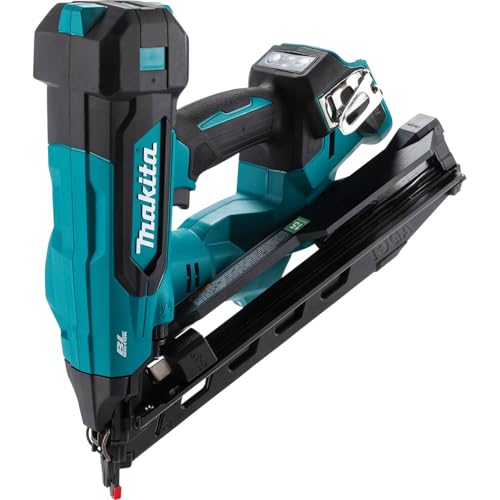
Certain content that appears on this site comes from Amazon. This content is provided "as is" and is subject to change or removal at any time.
The Best Cordless Finish Nailers, Reviewed
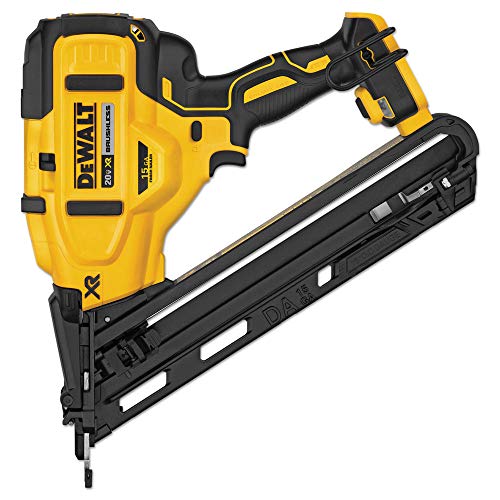
DeWalt 20V MAX XR 15-Gauge Angled Finish Nailer
What We Like
- Brushless motor maximizes runtime and durability.
- Micro nose improves line of sight and accuracy.
- Tool-free selectable trigger and depth adjustment.
- Multi-functional LED lights for illumination and diagnostics.
Trade-offs
- Tool-only: battery and charger sold separately.
A 15-gauge finish nailer that reliably sinks nails flush in hardwoods like oak and maple is a serious advantage on a job site. That consistent driving power, combined with a tool-free jam release and stall reset, means you spend less time fighting the tool and more time getting trim work done. For pros who need dependable, cordless performance without a compressor, this DeWalt delivers the core functionality with a solid feature set, earning its place as a top-tier choice.
DeWalt’s cordless finish nailers are among the lightest in the 18V/20V Max class, making them easier to handle for extended periods. They do have a bit of bulk in the head and a slight firing delay, which can affect rhythm on long runs. According to research, the model consistently sinks nails in tough woods like red oak and maple, a critical performance trait for finish work.
Bosch 18V Brushless 16-Gauge Angled Finish Nailer

What We Like
- One-handed activation for streamlined work
- Tool-free jam clearing for quick fixes
- Low recoil for enhanced control and comfort
- Wide view contact tip for precise positioning
Trade-offs
- Bare tool: requires separate purchase of Bosch 18V battery and charger
- At 6.6 lb, it is heavier than the 5.9 lb Metabo HPT model
One-handed activation changes how you work with a finish nailer, letting you hold a workpiece steady with your free hand or brace yourself on a ladder without fumbling for a second trigger. That, combined with the low recoil and clear sightline from the wide contact tip, makes this Bosch uniquely suited for detailed trim work in tight spaces or overhead. Its pneumatic-like performance and claimed 1,600 nails per charge mean you can leave the compressor in the garage for most jobs.
This bare tool requires the Bosch 18V battery system, so it makes the most sense for users already invested in that platform. Its one-handed activation helps streamline work without interruption, and the wide-view contact tip provides a superior line of sight for precise nail placement. Pneumatic-like performance eliminates the need for a compressor and hoses, offering unmatched productivity gains.
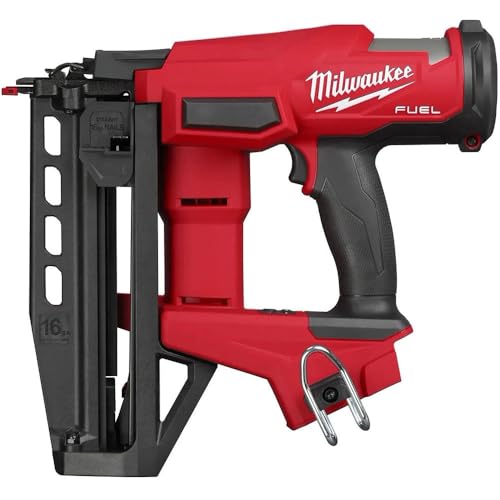
Milwaukee M18 Fuel 16-Gauge Straight Finish Nailer
What We Like
- No gas cartridge required for operation
- Tool-free depth adjustment and jam clearing
- Fires up to 700 nails per charge on CP2.0 battery
- Sequential and contact actuation firing modes
Trade-offs
- Tool-only package: requires separate M18 battery purchase
- Straight magazine design limits access in tight corners
Firing 3 nails per second with the power to sink them into hardwoods, this nailer doesn’t ask you to compromise for cordless convenience. It’s part of the M18 system, which features over 200 other tools, so users with those batteries can share a single platform. The brushless motor and system intelligence deliver longer life and overload protection, making it a reliable tool for trim, cabinetry, and millwork where stopping to recharge or clear jams kills productivity.
The trade-off for that sturdy performance and system compatibility is heft. It’s a straight magazine design, so it won’t maneuver into tight corners as easily as an angled nailer. But if you need driving power for demanding material and value a unified battery platform, this is the finish nailer that pulls duty like a pneumatic.
Ryobi ONE+ 18V 16-Gauge AirStrike Finish Nailer

What We Like
- Compact nose excels in tight corners
- Eliminates compressor, hose, and gas
- Adjustable drive for optimal performance
- Uses extensive Ryobi ONE+ battery system
Trade-offs
- Tool only: requires separate battery purchase
- 16-gauge nail limits holding power for some trim
Ryobi’s AirStrike Technology eliminates the need for noisy compressors, hoses, or gas cartridges, allowing you to work anywhere your 18V battery can go. Compared to its predecessor, the P325, the tool has a 78% smaller nose for better access in tight spots like crown molding corners. Research indicates Ryobi’s 18V finish nailers offer excellent performance at a high value price.
The trade-off is that it’s a 16-gauge tool, which is perfect for most trim but doesn’t have the holding power of a 15-gauge nailer like the DeWalt for heavier exterior work. While it drives like a pro tool, remember it’s sold bare, so factor in the cost of a battery if you’re new to the system. For general interior finish work where access is tricky, its compact design and cordless convenience are hard to beat, especially compared to bulkier angled models like the Bosch.
Metabo HPT 18V Brushless 15-Gauge Finish Nailer Kit

What We Like
- Compact, narrow tip for tight corners
- Fuel gauge on tool for battery status
- Tool-less depth and firing mode changes
Trade-offs
- Up to 700 nails per charge
At just 5.9 pounds, this nailer is a genuine relief for overhead work and long days of trim installation. Its compact profile and narrow nose get into corners where bulkier guns simply won’t fit. The brushless motor and air spring drive provide consistent, pneumatic-like power for driving nails flush in hardwoods, and the tool-mounted fuel gauge is a smart touch that keeps you from guessing about battery life. It’s the clear choice for finish carpenters and dedicated DIYers who prioritize reducing arm fatigue without sacrificing driving power.
The trade-off for that featherweight feel is runtime. At a claimed 700 nails per charge, you’ll be swapping batteries more often on big crown molding or siding jobs than you would with something like the Bosch, which claims nearly 1,600 nails. Since the listing doesn’t clarify if a battery is included, you’ll need to check the kit details carefully. For trim work where you’re moving constantly and lifting the tool hundreds of times a day, however, the Metabo HPT’s lightweight design pays off in spades by the end of the shift.
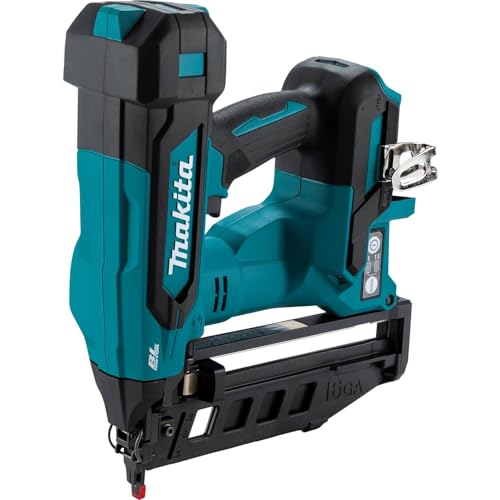
Makita 18V LXT Brushless 16-Gauge Straight Finish Nailer
What We Like
- Ultra-compact, ergonomic design for tight spaces
- Slim nose design for accurate nail placement
- Tool-less depth adjustment and jam clearing
- Class-leading cordless nailing speed
Trade-offs
- Tool only: requires separate Makita 18V LXT battery purchase
- 16-gauge nail limits holding power versus 15-gauge models
You can drive up to 2,750 nails on a single charge with a 5.0Ah battery. This means you can spend a full day on trim work without stopping to swap batteries. The nailer is built for precision and access, with a slim nose and compact body that let you get into corners and tight spots where bulkier tools simply won’t fit. It’s a clear choice for finish carpenters and detail-oriented DIYers who value maneuverability and runtime over raw driving power.
Choosing the 16-gauge nail means slightly less holding power than a 15-gauge tool, which is a trade-off for interior trim where the thinner nail hole is preferable. This straight-finish nailer drives nails up to 2-1/2 inches long, covering many common trim and molding tasks. Its slim nose design allows for easier access in confined spaces and more accurate nail placement.
Product photos
Craftsman V20 16-Gauge Cordless Finish Nailer

What We Like
- Fully cordless, no compressor needed
- Fires in various climate conditions
- Lightweight with optimal balance
- Includes belt hook for convenience
Trade-offs
- Battery and charger sold separately
- At 7.6 lb, it's heavier than the Bosch model
It drives up to 375 nails per charge, which is enough for most small to mid-sized trim jobs without needing a compressor or gas cartridge. This Craftsman is built for the unpredictable. Its design provides firing power in various climate conditions and materials, making it a reliable choice for work that moves from a dry basement to a humid garage. The tool-free jam clearing and comfortable balance mean you can focus on the cut, not the tool.
The trade-off is that you need to already own, or separately purchase, the V20 battery platform. At 7.6 pounds, it has some heft compared to options like the Bosch, which can affect fatigue over a full day of overhead work. For a dedicated finish carpenter, the nail capacity per charge might require a battery swap on bigger projects, but for the versatile DIYer or remodeler tackling mixed materials, its consistent performance is the key feature.
Product photos
FLEX 24V Brushless 15-Gauge Angled Finish Nailer

What We Like
- Exceptionally high capacity of 1,200 nails per charge
- Fast three-nail-per-second firing with no ramp-up
- Tool-free jam clearance for quick fixes
- Triple LED light for shadow-free illumination
Trade-offs
- Heaviest in the guide at 10.3 pounds
- Tool-only listing requires separate battery purchase
A single charge can drive up to 1,200 nails, which lets you handle extensive trim installations without pausing for a battery change. Its high-speed power drives up to three nails per second, a rate that speeds up attaching crown molding or baseboards. The dry fire lockout eliminates blank firing once the magazine is empty, a feature that stops unnecessary actuations.
You pay for that endurance and speed with weight; at over ten pounds, it’s noticeably heftier than options like the DeWalt or Metabo HPT, which can lead to fatigue on overhead work. The compact design does help in corners, but the trade-off is clear. If your projects involve marathon sessions of finish work, this tool’s runtime is a major advantage. For lighter, more frequent overhead tasks, a lighter 16-gauge model like the Bosch might be less taxing.
Product photos
Makita 18V LXT Brushless 15-Gauge Angled Finish Nailer
What We Like
- Drives long 2-1/2" nails for strong holding power.
- Slim nose design for precise placement in tight corners.
- Ultra-compact, ergonomic design improves maneuverability.
- Tool-less depth and jam clearing for efficient workflow.
Trade-offs
- Tool only: requires separate purchase of battery and charger.
The ability to drive 2-1/2″ 15-gauge nails gives this nailer serious holding power in hardwoods and thick trim. That makes it a natural fit for installing crown molding, door jambs, and heavy casings where a smaller nail just won’t hold. The slim nose helps you get into corners, and the tool-less adjustments keep you working instead of fiddling. It’s built for the contractor or serious DIYer who regularly tackles substantial trim work and needs a cordless tool that won’t quit before the job is done.
Designed for heavier applications like door jambs and hardwoods, this nailer drives 15-gauge angled nails up to two and a half inches. Its motor and mechanism add functional heft, so the tool weighs 7.3 pounds with a battery. That bulk can become noticeable during extended overhead work or in confined spaces like a tight closet. For lighter trim tasks, a 16-gauge model could be easier to manage.
Product photos
DeWalt 20V MAX 16GA Angled Finish Nailer
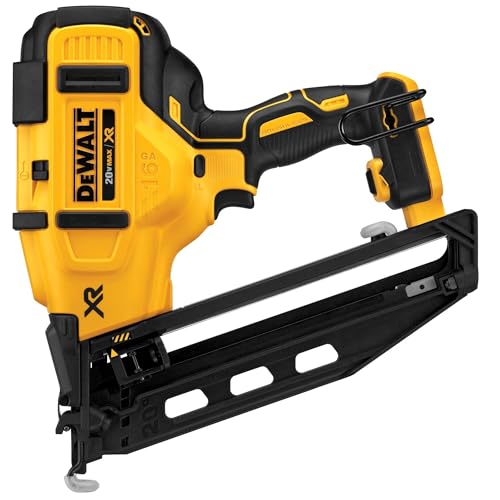
What We Like
- Tool-free depth adjustment for precise countersinking
- Tool-free selectable trigger for firing mode flexibility
- Integrated stall release lever for quick resets
- Multi-functional LED lights for illumination and diagnostics
Trade-offs
- Noticeable firing delay reported by users
- Tool-only: requires separate battery and charger purchase
Where this nailer truly stands out is in its complete suite of tool-free controls, letting you switch firing modes, adjust depth, and clear jams without fumbling for a hex key. That makes it a natural fit for finish carpenters or dedicated DIYers who value on-the-job adaptability and minimal downtime. Its brushless motor maximizes runtime, and research confirms it consistently sinks nails flush in hardwoods like oak and maple, a critical benchmark for professional results.
DeWalt’s cordless finish nailers are noted as some of the lightest in the 18V/20V Max class, which makes this tool easier to handle all day without a compressor hose to manage. Research mentions the design has a bulkier head and a slight firing delay, factors that can affect maneuverability and rhythm. For professionals already using DeWalt 20V batteries, this nailer offers reliable, cord-free fastening with a set of user-friendly, tool-free controls.
Product photos
How We Evaluated Cordless Finish Nailers
Our evaluation is based on manufacturer specifications, analysis of expert round-ups, and patterns in owner feedback. We focused on criteria that directly impact real-world performance. This includes driving power and consistency across different wood types, overall tool weight and balance for reduced fatigue, and the physical design of the nose and magazine for access in tight corners.
We also prioritized features that enhance workflow, such as tool-free depth adjustment and jam clearing, and considered the practical implications of battery platform compatibility. This research-based approach allows us to compare specifications and reported performance, but cannot replicate the hands-on feel of a tool or predict long-term durability for every individual user.
What To Look For In Cordless Finish Nailers
Choosing a cordless finish nailer involves more than just matching a battery. You need a tool with enough power for your materials, a comfortable weight for all-day use, and a design that fits your workspace.
Key factors are nail gauge (15 for heavier trim, 16 for lighter work), tool weight and balance, nose design for visibility and access, and compatibility with your existing cordless tool batteries.
Nail Gauge and Holding Power
The nail gauge determines the fastener’s thickness and holding strength. A 15-gauge nail is thicker and provides a stronger hold, ideal for heavier crown molding, door casings, and stair treads. A 16-gauge nail is thinner, leaving a smaller hole that’s easier to fill, making it better suited for lighter trim, baseboards, and cabinet assembly. Some of the best cordless trim nailers are 16-gauge models designed specifically for this precise work. Consider the holding power you need for your typical projects, as this is the fundamental choice that narrows your options.
Tool Weight and Balance
Cordless nailers are heavier than their pneumatic counterparts due to the motor and battery. Weight directly impacts user fatigue, especially during overhead work or long sessions. Models vary in weight, with some being significantly heavier than others. A well-balanced tool, where the weight is distributed comfortably in hand, can feel lighter than its actual weight. For many users, the convenience of a cordless tool is worth the trade-off, but minimizing arm strain is a key ergonomic consideration when comparing cordless vs pneumatic nailers.
Nose Design and Magazine Angle
The tool’s front-end design affects precision and accessibility. A narrow, low-profile nose improves the line of sight for accurate nail placement. An angled magazine, common on 15-gauge models, allows the tool head to fit into tight corners more easily than a straight magazine. For intricate cabinet work or confined spaces, a compact nose is a major advantage. This focus on precision placement is a key difference in their applications, as finish nailing often demands greater accuracy than brad nailing.
- Check the tool’s dimensions to see if it will fit in the spaces you commonly work.
- Look for a clear, unobstructed view of the nail tip from the operating position.
- Consider whether an angled or straight magazine better suits your projects.
Choose a nail gauge first, then find the lightest, best-balanced tool in that category that fits your battery system.
Cordless Finish Nailers Compared
To see how these nailers stack up side-by-side, the comparison table below outlines their key specifications and features.
| Product | Gauge | Weight | Depth Adjustment |
|---|---|---|---|
| DeWalt 20V MAX XR 15-Gauge Angled Finish Nailer | 15-gauge angled | 6.6 pounds | Tool-free |
| Bosch 18V Brushless 16-Gauge Angled Finish Nailer | 16-Gauge | 6.6 Pounds | N/A |
| Milwaukee M18 Fuel 16-Gauge Straight Finish Nailer | 16GA Straight | 8.1 pounds | Tool Free Depth Adjustment |
| Ryobi ONE+ 18V 16-Gauge AirStrike Finish Nailer | 16-gauge | N/A | Air pressure dial |
| Metabo HPT 18V Brushless 15-Gauge Finish Nailer Kit | 15 Gauge | 5.9 pounds | Tool-less |
| Makita 18V LXT Brushless 16-Gauge Straight Finish Nailer | 16 Ga. | 6.6 lbs. | N/A |
| Craftsman V20 16-Gauge Cordless Finish Nailer | 16-gauge | 7.6 pounds | N/A |
| FLEX 24V Brushless 15-Gauge Angled Finish Nailer | 15 Gauge | 10.3 pounds | Quick lever |
| Makita 18V LXT Brushless 15-Gauge Angled Finish Nailer | 15-Gauge | 7.3 lbs | Tool-less dial |
| DeWalt 20V MAX 16GA Angled Finish Nailer | 16GA | 1.0 Pounds | Tool-free |
Frequently Asked Questions
Which cordless finish nailer is best rated?
Our research identifies the DeWalt 20V MAX XR 15-Gauge Angled Finish Nailer as the best overall due to its powerful brushless motor, excellent runtime, and features like tool-free adjustments and diagnostic LED lights. It is consistently highlighted for professional reliability in expert analyses and owner feedback among the wide field of battery-powered finish nailers.
What is the best nail gun for finish work?
The best nail gun for finish work depends on the specific task. For maximum holding power on heavy trim, a 15-gauge angled nailer like the Makita 18V LXT is ideal. For faster, lighter trim and cabinetry, a 16-gauge model like the compact Makita 18V LXT Brushless Straight Finish Nailer offers excellent control. For the smallest, most discreet fastening, you would look at dedicated cordless pin nailers.
What’s better, a 15 gauge or 16 gauge finish nailer?
A 15-gauge nailer is better for strength, using thicker nails ideal for structural trim like crown molding and stair treads. A 16-gauge nailer is better for finesse, using thinner nails that leave smaller holes, making it perfect for baseboards, window casing, and cabinet face frames. Your project’s required holding power should guide this fundamental choice.
Can a cordless finish nailer replace a pneumatic one?
Modern cordless finish nailers can effectively replace pneumatic models for most finish carpentry, eliminating the compressor and hose. They offer excellent convenience and portability. However, some professionals note a slight firing delay compared to instant pneumatic response, and the tools are heavier. For high-volume production shops, traditional pneumatic finish nailers might still be preferred for their lighter weight and relentless pace.
What should I look for in a cordless brad nailer?
When selecting a cordless brad nailer, prioritize consistent driving depth in hardwoods, a lightweight and ergonomic design, and a clear sight line to the tip for precision. Many of the top cordless brad nailers also feature tool-free depth adjustment and easy jam clearing to maintain workflow.
The Bottom Line
The DeWalt 20V MAX XR 15-Gauge Angled Finish Nailer earns our best overall recommendation for its proven power, durability, and thoughtful features. It is a top choice for contractors and serious DIYers who need reliable cordless performance. For those on a budget or who need a tool for tight spaces, the Ryobi ONE+ AirStrike is a good option. Users with existing battery systems should also consider their brand’s offering, like the capable Milwaukee M18 Fuel.
Ultimately, your decision should start with the nail gauge required for your work, then find the most comfortable and compatible tool in that class. Investing in a cordless finish nailer that matches your most common projects will pay off in saved time and reduced frustration on every job.
