
10 Best Da Sanders in 2026
This post contains affiliate links. As an Amazon Associate, we earn from qualifying purchases.
Our best overall dual action sander is the DEWALT DWE6423, which balances durability and a vibration-damped design for extended workshop use. For aggressive material removal, the BOSCH GET75-6N earns the title Best For Heavy Stock Removal, while the compact Milwaukee M12 Fuel excels for detail work. Choosing the right DA sander means matching its power type, size, and features to your specific tasks, whether that’s smoothing car panels or refinishing a table.
This guide is based on a review of product specifications, expert recommendations, and common themes in user reviews to provide a clear and informative starting point.
Top 10 Dual Action Sanders in the Market
Certain content that appears on this site comes from Amazon. This content is provided "as is" and is subject to change or removal at any time.
The Best Dual Action Sanders, Reviewed
DEWALT DWE6423 Random Orbit Sander

What We Like
- Separate counterweight design reduces vibration
- Improved dust-sealed switch for longer life
- Shorter height for better workpiece access
- Rubber overmold improves grip in critical areas
Trade-offs
- Corded electric power source limits mobility
- Dust bag is one-handed but still requires emptying
A 3-amp motor spinning between 8,000 and 12,000 orbits per minute gives you the controlled muscle to move from aggressive stock removal to fine finish work without bogging down. This sander is built for the shop user who values endurance and control, with a design that prioritizes operator comfort. The separate counterweight cuts down on the fatigue-inducing buzz, and the shorter profile lets you get into corners without straining your wrist. It’s a tool that disappears in your hand during long sessions, making it a reliable anchor for any woodworking project.
The trade-off for that smooth, corded power is obviously a tether. You’re working within reach of an outlet, which makes it less suited for quick jobs around the house or on a jobsite without easy power. For true cordless freedom in a similar form, you’d look at something like the DEWALT DCW230B. Where this model truly shines is in its integrated dust management; the port locks directly onto DEWALT’s vacuum system, and the sealed switch is built to survive the fine particulate that eventually kills lesser tools.
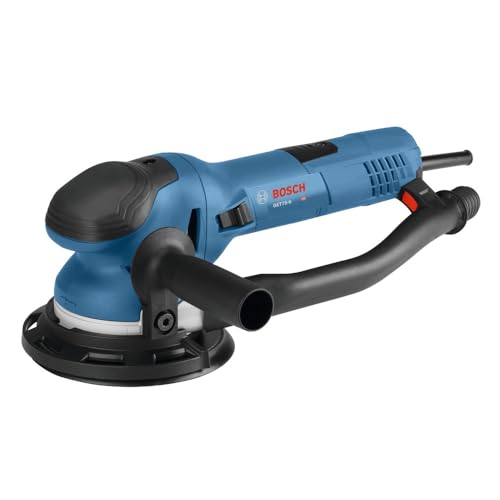
BOSCH GET75-6N Electric Orbital Sander
What We Like
- Turbo mode for aggressive stock removal
- Powerful 7.5 amp variable speed motor
- Multi-hole pad for wide abrasive compatibility
- Includes vacuum hose adapters
Trade-offs
- Dust collection requires a separate shop vacuum
- Front handle is removable, not integral
A direct-drive turbo mode that removes material three times faster than its standard orbital setting is the core of this sander’s purpose. That 7.5-amp motor driving up to 7300 orbits per minute is built for serious work, making it a legitimate alternative to breaking out a belt sander for leveling tasks. It’s the right choice when your project starts with rough stock that needs significant flattening or when you’re refinishing a heavily weathered surface and need to strip material down fast before moving to finer grits.
That capability comes with some heft and specific needs. At nearly six pounds, it demands more arm stamina over long sessions than a lighter model like the Makita BO5030K. The passive dust collection is effective but tethers you to a shop vacuum, which is a necessary trade-off for managing the substantial debris it creates. For pure finishing work, its turbo power is overkill, but for the heavy lifting phase of a major project, it’s a dedicated workhorse that saves time and effort.
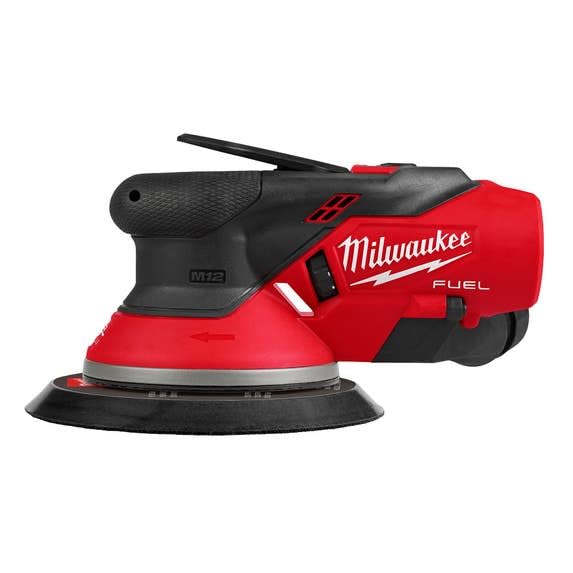
Milwaukee M12 Fuel Random Orbital Sander
What We Like
- Extremely compact and lightweight at 1 pound.
- Optimized battery isolation reduces vibration.
- POWERSTATE brushless motor for efficiency.
- Sands up to 5 doors per charge.
Trade-offs
- Tool only: requires separate purchase of M12 battery and charger.
The Milwaukee M12 Fuel Random Orbital Sander weighs one pound, a lighter load than most sanders, so it’s easier to maneuver for extended periods. Its 7-inch length and 2-inch height also contribute to a compact profile. An optimized battery isolation system is included to reduce vibration during operation.
This cordless sander uses the M12 battery system, so a compatible battery and charger are required and sold separately. Under ideal conditions, it can sand up to five doors per charge with a specified battery. For continuous, high-volume sanding, corded models from the other-products list do not have this runtime limitation.
PORTER-CABLE 7424XP Polisher Sander

What We Like
- Electronic variable-speed dial for precise control.
- Random orbit action prevents swirl marks.
- Includes a 5-inch counterweight for 6-inch pads.
- Solid 4.5-amp AC motor provides consistent power.
Trade-offs
- Corded, AC-only design limits mobility.
- At 5.8 pounds, it's heavier than most cordless sanders.
This is a corded, 4.5-amp orbital polisher-sander, so it requires a nearby outlet. Its electronic variable-speed dial operates from 2,500 to 6,800 opm. The tool uses a random orbit action that the manufacturer describes as swirl-free for sanding and polishing.
You get a smooth, controlled finish, but that comes with some heft and a cord. At 5.8 pounds, it demands more arm stamina over long sessions compared to a lightweight like the Milwaukee M12 Fuel. This is a dedicated bench or garage tool, not something you’d toss in a bag for a quick job across the shop. For heavy stock removal, a more aggressive sander like the BOSCH GET75-6N would be faster, but for finishing work where every scratch counts, the Porter-Cable’s design shines.
Makita BO5030K Random Orbit Sander

What We Like
- Rubberized grip for operator comfort
- Pad control system for smooth start-up
- Super lightweight at under 3 pounds
- Includes case, abrasive disc, and dust bag
Trade-offs
- Fixed-speed 12,000 OPM lacks variable control
At just 2.9 pounds, this sander is easy to handle during long sessions of overhead or vertical sanding without wearing out your arm. That featherweight feel, combined with its rubberized grip, makes it a standout choice for anyone tackling big projects like refinishing cabinets or furniture where fatigue is the real enemy. The 3-amp motor and large 1/8-inch orbit deliver plenty of power for fast stock removal while still leaving a smooth finish, ideal for the detail-oriented woodworker.
Its lightness is a major advantage, though you do give up variable speed control, which limits your finesse on more delicate materials. For heavy-duty material removal on a flat surface, the extra heft and power of a tool like the BOSCH GET75-6N might be more efficient. But for general woodworking and finishing tasks where comfort and control are paramount, the Makita’s design is exceptionally well-considered.
KUIMIT 5-Inch Air Sander Kit

What We Like
- Compact, palm-sized design for single-handed control
- On-the-fly speed adjustment from 2,500 to 12,000 RPM
- Complete kit includes multiple pads and finishing accessories
- Balanced motor minimizes vibration during use
Trade-offs
- Requires a separate air compressor to operate
The 2.9-pound, palm-sized design and complete accessory kit make this air sander a ready-to-work solution right out of the box. It’s built for the detail-oriented user who needs immediate control over a range of tasks, from automotive finishing to wood surface prep. The included regulator allows for real-time speed adjustments without stopping, which is crucial when switching between delicate polishing and aggressive material removal. This combination of a lightweight tool and a thoughtful selection of pads and cloths suits a garage workshop where space is tight and versatility is key.
This sander runs on shop air, so it stays connected to a compressor hose. Compared to cordless models like the Milwaukee M12, it’s not for mobile work away from an air source. Its balanced motor and included quick-connect fitting are designed to reduce fatigue, which helps during long automotive or woodworking sessions.
Product photos
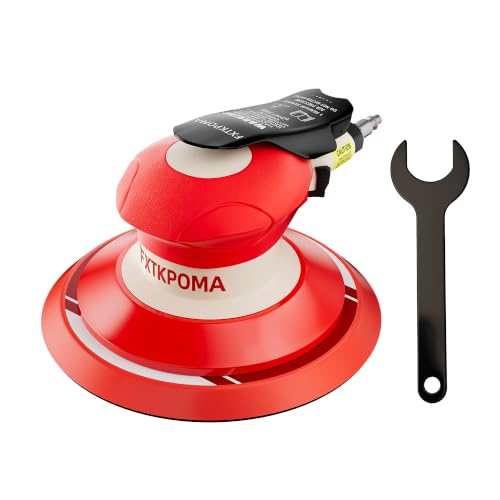
FXTKPOMA 6-Inch Dual Action Air Sander
What We Like
- Lightweight 2.5-pound design reduces wrist strain
- Low noise and vibration for reduced operator fatigue
- 5mm orbit minimizes swirl marks for fine finishing
- High 13000 RPM speed allows for fast material removal
Trade-offs
- Requires a substantial 15-gallon or larger air compressor
- Pneumatic power ties you to an air hose, limiting mobility
Weighing just 2.5 pounds, this tool is designed for the long haul, letting you tackle multi-hour paint prep sessions without the usual arm fatigue. Its 5mm random orbit and 13000 RPM pneumatic motor deliver the consistent, swirl-free finish you need for bodywork. Noise and vibration reduction engineering also makes it a noticeably smoother operator, which hits the sweet spot of power and comfort for a professional in a shop or a dedicated DIYer with a fixed workstation.
This pneumatic sander requires a 15-gallon or larger air compressor and a hose, so it’s best suited for a fixed workshop rather than mobile jobs. That air dependence makes it less flexible for quick touch-ups than a cordless tool like the Milwaukee M12. It delivers the high-speed performance typical of air tools, operating at 12000-13000 RPM, which enables fast material removal for tasks like auto body repair.
Product photos
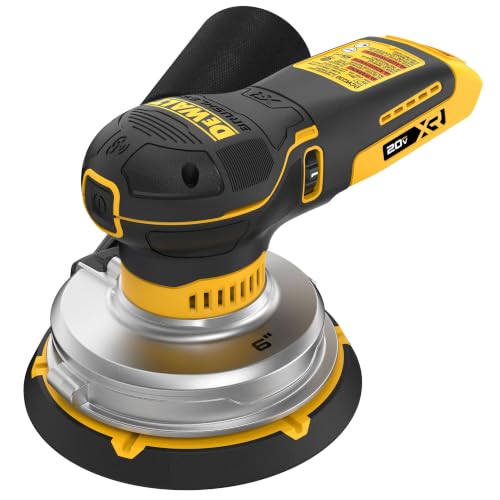
DEWALT DCW230B Cordless Orbital Sander
What We Like
- Up to 41 minutes of cordless runtime
- Industry-leading low vibration for less fatigue
- Five variable speeds for finish and removal
Trade-offs
- Tool only: requires separate 20V MAX XR battery and charger
- At 4.8 lb, it's heavier than many corded orbital sanders
- Dust extractor and Tool Connect chip are sold separately
A sanding run that lasts up to 41 minutes on a single charge means you can tackle large projects, like refinishing a tabletop or a set of cabinets, without constantly stopping to swap batteries. This design suits the pro or serious DIYer who needs to move freely around a job site or shop without hunting for an outlet. Its low-vibration design lets you work longer without the numb hands that plague so many sanding tasks, and the ability to sand up to 200 square feet per charge translates to real productivity. Variable speed control gives you the finesse for fine finishes or the aggression for stock removal.
Cordless freedom and runtime do come with a weight penalty. At 4.8 pounds, it feels more substantial in the hand than a corded workhorse like the DEWALT DWE6423. You’re carrying the battery, and that mass becomes noticeable on vertical surfaces or overhead work. It’s a pure tool-only package, so you’ll need to already own DEWALT’s 20V ecosystem or be ready to invest in batteries separately. For big, flat surfaces where cordless convenience is king, this sander is a standout. For detailed, all-day overhead work, the heft is a real consideration.
Product photos
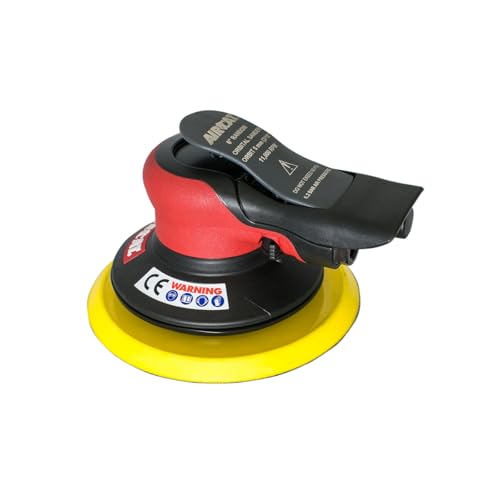
AIRCAT 6700-6-336 Orbital Palm Sander
What We Like
- Exceptionally quiet operation at 75 dBA.
- Lightweight and compact ergonomic grip design.
- Lubrication-free air motor for low maintenance.
- Double-sealed motor for dust protection.
Trade-offs
- Requires a dedicated air compressor supply.
- Non-vacuum model lacks integrated dust collection.
- Smaller 3/16" orbit may cut slower than larger models.
AIRCAT designed this orbital palm sander to operate at 75 dBA, a notably quiet level for a pneumatic tool that allows for extended use in a shop without disturbing others. Its 1.8-pound build and ergonomic grip promote comfortable handheld operation, a key feature for detailed finishing tasks. This sander offers the smooth performance of an air tool without the typical high-pitched noise, trading the cordless portability of options like the Milwaukee M12 for near-silent pneumatic power when connected to a compressor.
This is a dedicated air tool, so it requires a connected compressor and lacks a built-in vacuum port for dust collection. The lubrication-free air motor is engineered for professional use and DIY applications like auto body work and industrial finishing. Its patented muffler technology provides power and torque while maintaining reduced noise levels, as stated for the AIRCAT product line.
Product photos
Astro Pneumatic Tool 3008 Da Sander

What We Like
- Gear driven for heavy material removal
- 8-inch pad covers large areas quickly
- Dual action leaves a swirl-free finish
- Balanced ball bearing construction reduces vibration
Trade-offs
- Requires a capable air compressor to operate
- At 4.8 lb, it's heavier than most palm-sized air sanders
An 8-inch gear-driven pad is the key spec here, delivering the muscle to flatten body filler or level large wood panels far faster than a standard 5 or 6-inch sander. This tool is engineered for the shop tackling big, flat surfaces where removal rate trumps portability. The dual-action motion and balanced bearings mean it won’t leave behind a mess of swirls, letting you move directly to finer grits.
This gear-driven sander is built for removing heavy material on large, flat surfaces, which suits it for automotive body filler or woodworking panels. Weighing 4.8 pounds, it is heavier than many palm-sized sanders and requires a connection to an air compressor. Its dual-action pad motion is designed to leave a swirl-free finish.
Product photos
How We Evaluated Dual Action Sanders
Our research centered on detailed specifications and manufacturer documentation for corded, cordless, and pneumatic models, ensuring we compared fundamental metrics like pad size, orbit diameter, motor power, and weight. We cross-referenced this data with recommendations from multiple expert round-ups focused on workshop, woodworking, and automotive use to identify consensus picks. We also analyzed widespread owner feedback patterns, prioritizing reports about durability, vibration dampening effectiveness, and the real-world usability of dust collection systems.
The key criteria were the suitability of the power source for the intended job, effective vibration control to reduce operator fatigue, and whether the sander is designed for aggressive stock removal or fine finishing. These factors directly impact both the finish quality and user comfort during long projects. This evaluation focuses on the stated design strengths and intended applications of each tool.
What To Look For In Dual Action Sanders
Dual action sanders combine a spinning and orbital motion to prevent unsightly swirl marks, making them a staple for woodworking and auto body finishing. Your choice depends heavily on your work environment, project size, and finish quality goals.
The key factors are power source (corded, cordless, or pneumatic), pad size and orbit for balancing speed and finish, and features for operator comfort like vibration dampening and variable speed control.
Power Source: Corded, Cordless, or Pneumatic
Your workshop setup dictates the best power type. Corded electric models, like our best overall DEWALT, offer unlimited runtime and consistent power for stationary workshop tasks. Cordless sanders provide excellent mobility for overhead or remote work, but you must factor in battery platform compatibility and runtime, as seen with the marathon-capable DEWALT DCW230B. Pneumatic, or air-powered, sanders such as the FXTKPOMA require a substantial air compressor but are favored in automotive shops for their smooth operation and low maintenance.
Pad Size, Orbit & Speed
Pad diameter directly affects your working speed and finish quality. A larger pad, like the 8-inch one on the Astro Pneumatic Tool 3008, covers more surface area quickly, ideal for large flat panels. A smaller 5-inch pad offers better control for detail work and contours.
The orbit size, typically ranging from 3/16-inch to 5mm, influences the aggressiveness of the cut and the final scratch pattern; a smaller orbit is better for fine finishing. Variable speed control allows you to match the tool’s action to the material, from fast removal to delicate polishing.
Features for Control & Comfort
Since sanding can be a lengthy process, features that reduce fatigue are critical. Effective vibration dampening, often achieved through counterweight designs or isolated grips, makes a noticeable difference during extended use. A tool’s weight and grip ergonomics also matter, especially for overhead applications where a lightweight model like the Makita BO5030K shines. For dust management, look for models with effective dust-sealed switches and good vacuum hose compatibility to keep your workspace clean and visibility high.
- Check the tool’s grip shape and weight distribution by holding it if possible before buying.
- Ensure the dust collection port matches your shop vacuum hoses or that adapters are included.
- For cordless models, verify you have (or are willing to buy) the required battery platform.
- For pneumatic models, confirm your air compressor’s CFM output meets the tool’s requirements.
The most important rule is to choose a power source you can reliably support in your workspace.
Dual Action Sanders Compared
The table below provides a quick, side-by-side comparison of key specifications for all ten featured sanders to help you see the differences at a glance.
| Product | Power Source | Weight | Pad Size |
|---|---|---|---|
| DEWALT DWE6423 Random Orbit Sander | Corded Electric | 3.4 pounds | 5-Inch |
| BOSCH GET75-6N Electric Orbital Sander | Corded Electric | 5.7 pounds | 6 Inch Disc |
| Milwaukee M12 Fuel Random Orbital Sander | M12 REDLITHIUM | 1.0 Pounds | N/A |
| PORTER-CABLE 7424XP Polisher Sander | AC only | 5.8 pounds | 6-inch |
| Makita BO5030K Random Orbit Sander | 3.0 AMP | 2.9 pounds | 5" |
| KUIMIT 5-Inch Air Sander Kit | Pneumatic | 2.9 Pounds | 5-inch |
| FXTKPOMA 6-Inch Dual Action Air Sander | Pneumatic | 2.5 pounds | 5 inch |
| DEWALT DCW230B Cordless Orbital Sander | 20V MAX XR | 4.8 pounds | 6 in. |
| AIRCAT 6700-6-336 Orbital Palm Sander | Pneumatic (air) | 1.8 pounds | N/A |
| Astro Pneumatic Tool 3008 Da Sander | Pneumatic | 4.8 pounds | 8 inches |
Frequently Asked Questions
What’s the best Da sander for a beginner?
For a beginner with a standard workshop outlet, a lightweight, corded sander like the Makita BO5030K offers simplicity and reliability without the complexity of batteries or an air compressor. Its fixed high speed is effective for many common tasks, and it comes with a case and abrasives to get you started. As you explore the world of dual-action sanders, you’ll find that starting with an easy-to-manage tool builds confidence. For top picks, see our guide to the best dual-action sanders.
Which Milwaukee da sander is best for detail work?
The Milwaukee M12 Fuel Random Orbital Sander is their standout model for detail work due to its exceptional compactness and light weight. At just one pound, it’s highly maneuverable for sanding contours, edges, and overhead surfaces without causing arm fatigue. It’s designed for users already invested in the M12 battery platform who need a sander for finishing, not heavy stock removal.
What should I look for in a sander for auto body work?
For auto body work, look for a sander that delivers a swirl-free finish and operates smoothly over large, curved panels. Pneumatic models are popular in this field for their consistent power and low vibration; the FXTKPOMA 6-Inch model is a strong candidate. Key features include variable speed for controlling material removal and a pad size (typically 6-inch) that balances coverage and control. You can explore dedicated sanders for auto body work for more specialized options.
Can I use a polisher/sander for sanding car paint?
Yes, a tool like the PORTER-CABLE 7424XP, which is marketed as a polisher/sander, is specifically designed for swirl-free finishing on automotive paint. Its random orbit action prevents the circular scratches that a standard rotary polisher can create. This makes it excellent for final sanding before polishing or for applying compounds, but it is not ideal for aggressive paint or primer removal due to its designed orbit and speed range.
What’s the difference between a DA sander and a random orbital sander?
In common workshop parlance, “DA sander” and “random orbital sander” are often used interchangeably for electric tools. Technically, a true dual-action sander uses a gear-driven mechanism to create its combined spinning and orbiting motion, which is more common in pneumatic tools for auto body work. The electric versions, like our best overall DEWALT, are random orbital sanders. Both types aim to prevent swirl marks, making them excellent for finish work across automotive and woodworking projects. For vehicle-specific tools, see our list of the best automotive sanders.
The Bottom Line
The DEWALT DWE6423 is the best overall dual action sander for its durable build and effective vibration control. This makes it a top choice for woodworkers who spend hours sanding furniture or cabinetry. For users on a budget or those needing a dedicated tool for large-scale material removal, consider the lightweight Makita BO5030K or the BOSCH GET75-6N with its turbo mode. The most important factor is to assess your workspace’s power capabilities, whether you have reliable outlets, a capable air system, or a cordless battery platform, to ensure your sander is a practical addition to your toolkit.
