
10 Best Drills For Concrete Walls in 2026
This post contains affiliate links. As an Amazon Associate, we earn from qualifying purchases.
For drilling into concrete walls, the best overall tool is the DEWALT 20V MAX SDS Plus Rotary Hammer, thanks to its effective 2.6-joule impact in a lightweight, 5-pound cordless design. For a complete premium kit, consider the Milwaukee M18 FUEL kit, while users prioritizing comfort should look at the DEWALT model with Active Vibration Control.
Drilling concrete demands more power than wood or drywall, and the wrong tool will lead to frustration, damaged bits, and unfinished projects. This guide is based on researching specifications, manufacturer data, and patterns in expert and user feedback to help you choose a capable drill matched to your specific concrete tasks and workspace needs.
Top 10 Drills For Concrete Walls in the Market
Certain content that appears on this site comes from Amazon. This content is provided "as is" and is subject to change or removal at any time.
The Best Drills For Concrete Walls, Reviewed
DEWALT 20V MAX SDS Plus Rotary Hammer

What We Like
- Lightweight 5-pound design reduces user fatigue.
- 2.6 Joules of impact energy for fast concrete drilling.
- Brushless motor for efficient performance and runtime.
- Three-mode dial for specific drilling and chipping tasks.
Trade-offs
- Bare tool only: requires separate purchase of 20V MAX battery and charger.
- No integrated vibration control system mentioned for extended use.
With 2.6 Joules of impact energy in a 5-pound body, the DEWALT DCH133B delivers serious concrete-boring power without the arm strain. That balance suits the tradesperson or dedicated DIYer facing all-day anchor installations or structural connections. Its rotating dial selects Drill, Hammer Drill, or Chip mode, covering clean drilling to light chipping from a single tool. Research mentions that DeWalt, as a brand, is generally considered reliable, though no specific claims are made about this model’s mechanism.
The tool ships without a battery or charger, so you must factor in the cost of DEWALT’s 20V system if you aren’t already invested. For marathon drilling sessions, the lack of a dedicated vibration control feature might be a consideration, though its light weight helps mitigate fatigue. When you need maximum power and runtime in a cordless package and already own the batteries, this hammer is a strong contender.
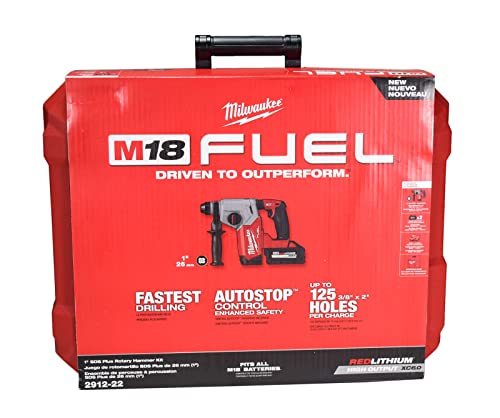
Milwaukee M18 FUEL SDS Plus Rotary Hammer Kit
What We Like
- Includes two high-capacity 6.0 Ah batteries
- Complete kit with batteries and fast charger
- Brushless motor for efficient power delivery
- Cordless design offers full jobsite mobility
Trade-offs
- Kit weighs 21.8 pounds, heavy for overhead work
- 22.5-inch length can be cumbersome in tight spaces
- Bare tool not available in this kit configuration
This is a complete cordless system ready to work right out of the box, with two high-output batteries that mean you can drill dozens of anchor holes on a single charge swap. For the professional or serious DIYer who needs to move freely around a site without hunting for an outlet, that cordless convenience backed by Milwaukee’s M18 platform is a major advantage. It’s the kit you grab when you have a full day of concrete work and don’t want to be tethered to a generator or extension cord.
That convenience comes with a physical trade-off. For lighter, more occasional concrete tasks, a more compact corded option like the Bosch GBH2-28L Bulldog might be easier to manage. But if your priority is untethered power and runtime for sustained drilling, this Milwaukee kit delivers a premium, no-compromise experience.
DEWALT SDS Rotary Hammer with Vibration Control

What We Like
- Active Vibration Control reduces user fatigue
- 3.0-joule impact energy for fast concrete drilling
- Integral clutch protects against sudden bit jams
- Compatible with dedicated dust extraction system
Trade-offs
- Corded design limits mobility on large job sites
- At 19.2 inches long, it's bulkier than some cordless options
- Requires a separate purchase for the dust extraction accessory
This rotary hammer delivers 3.0 joules of impact energy, a measure of its striking force for drilling and chipping. Its Active Vibration Control system is a Perform and Protect feature designed to reduce vibration felt at the handles. This can be a significant factor for user comfort during extended use. The corded, 8.5-amp motor provides consistent power without the runtime concerns of a battery.
The tool’s corded design and larger footprint mean it requires access to a power outlet and is less portable than a cordless model. For stationary shop work or renovations with ready power access, its consistent output and vibration control are key benefits. The included two-year free service plan offers support after the purchase.
Makita HR2811F SDS-PLUS Rotary Hammer

What We Like
- Vibration-absorbing back handle for operator comfort
- LED light illuminates low-light work surfaces
- No-hammering-at-idle function increases tool life
- Relatively lightweight for a corded rotary hammer
Trade-offs
- Corded design limits mobility compared to battery models
- At 7.3 lb, it is heavier than some cordless options like the DEWALT DCH133B
- Lacks integrated dust extraction like higher-end Makita models
It’s a sensible choice for the serious DIYer or contractor who has a reliable outlet nearby and needs a dependable, hard-hitting drill for anchors, medium-duty chiseling, or running conduit. The three-mode operation and SDS-PLUS chuck make it versatile for drilling in masonry, chipping tile, or even boring into wood when needed.
You trade cordless convenience for consistent, unlimited runtime and a simpler design that’s easy to maintain. That 7.3-pound weight is manageable for overhead work, but you’ll feel it after a full day compared to a lighter tool. While it doesn’t have the advanced vibration control of some models, the padded back handle does a decent job taking the edge off. This makes it a solid, no-frills workhorse for anyone who values proven performance over the latest battery technology.
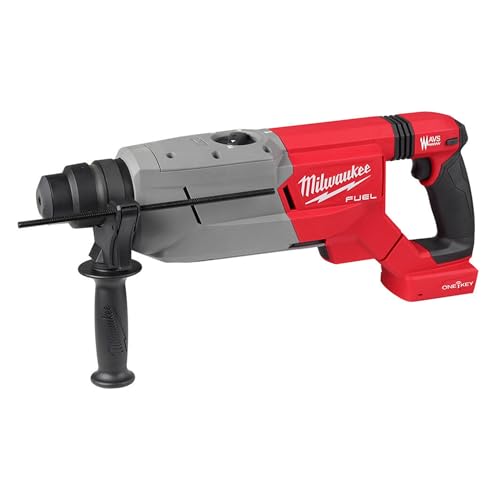
Milwaukee M18 Fuel SDS Plus D-Handle Rotary Hammer
What We Like
- Delivers 3.65 ft-lbs of cordless impact energy
- AVS system significantly minimizes user vibration
- D-handle design provides stable, two-handed control
- Part of extensive M18 cordless platform
Trade-offs
- Tool only; requires separate M18 battery and charger
With 3.65 ft-lbs of impact energy, this cordless hammer delivers power for drilling into concrete. That makes it a choice for contractors or serious DIYers who need cordless operation for tasks like overhead work or on sites without ready power. Its AVS anti-vibration system minimizes vibration, which can help reduce user fatigue during extended use.
The tool’s cordless design means runtime depends on battery capacity, and its size may be substantial for small jobs. At 19.0 inches long, it is longer than the 16.2-inch DEWALT 20V MAX SDS Plus rotary hammer. For most framing, anchoring, and remodeling tasks, this M18 Fuel model offers cordless convenience with hammer drill power.
ENEACRO SDS-Plus Heavy Duty Rotary Hammer

What We Like
- High 7.4-joule impact energy for heavy concrete
- Four distinct functions for versatile material handling
- Double-layer anti-vibration system reduces user fatigue
- Comprehensive kit includes bits, chisels, and case
Trade-offs
- At 12.6 pounds, it's heavier than most cordless models
- Corded operation limits mobility compared to battery tools
- Larger footprint than compact models like the Bosch Bulldog
With 7.4 joules of impact energy from its 13-amp motor, the ENEACRO ENRH3201 is rated for heavy-duty concrete work. The motor features heat-resistant copper wire, which the manufacturer states ensures long working periods without overheating. Its four functions, drill only, hammer only, hammer drill, and chisel adjustment, allow it to handle different materials, and the kit includes drill bits and chisels for masonry tasks.
The bare tool weighs 12.58 pounds, which requires more physical handling than some lighter models. For example, the cordless DEWALT DCH133B is listed at 5.0 pounds. Design features like a safety clutch to protect against high torque and a 360-degree adjustable handle are intended to improve safety and comfort during use.
Product photos
DongCheng SDS-Plus Rotary Hammer Kit

What We Like
- Complete kit includes bits, chisels, and case
- Mechanical safety clutch prevents kickback
- Anti-vibration handle improves comfort
- Dual-mode operation for drilling and chipping
Trade-offs
- At 11 lbs, it's heavier than many cordless SDS models
- Corded design limits mobility on large job sites
Driven by a 9.2A motor with 3.6J of impact energy, the DongCheng hammer powers through reinforced concrete and solid brick, allowing you to drill heavy-duty anchor holes without the tool stalling. This corded kit includes the hammer, three drill bits, two chisels, and a case, so you can start drilling and chipping immediately. For a contractor or serious DIYer handling home renovations like removing bathroom tiles, it provides this performance without requiring a battery system.
The trade-off is in heft and convenience. At 11 pounds, it demands more arm strength over long sessions compared to a tool like the 5-pound DeWalt DCH133B. You’re trading the freedom of cordless for the relentless power of a corded motor and a lower upfront investment. It’s a classic value proposition: you get a lot of capable tool and a full accessory set for the money, but you’ll be managing a power cord and its substantial weight.
Product photos
Makita SDS-PLUS Rotary Hammer with Dust Extractor

What We Like
- On-board OSHA-compliant HEPA dust extractor
- Anti-Vibration Technology reduces operator fatigue
- Powerful 8 AMP motor for demanding concrete work
- Clear container shows when to empty dust
Trade-offs
- At 9.7 lb, it's heavier than cordless options like the 5.0 lb DEWALT DCH133B
- Corded design limits mobility on large, outlet-sparse sites
- 18.9-inch length can be cumbersome in tight spaces
With an efficient HEPA filtration system that captures 99.97% of particulates .3 microns and larger, this tool is designed for drilling in environments where containing fine dust is necessary. Its powerful 8 AMP motor provides 2.1 ft.lbs. of force for demanding applications like drilling into concrete or brick. One carpenter reported the hammer function was essential for mounting shelving or TVs to masonry walls in residential and commercial work.
You trade some maneuverability for that dust control. The corded design and 9.7-pound weight make it less agile than a compact cordless model. For comparison, the cordless DEWALT 20V MAX SDS Plus Rotary Hammer is listed at 5.0 pounds. When the task requires a clean hole, however, this Makita system with its on-board extractor is purpose-built to deliver it.
Product photos
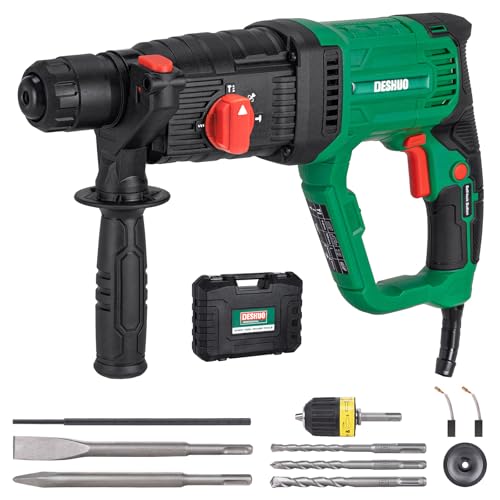
Deshuo Lightweight SDS-Plus Rotary Hammer
What We Like
- Weighs only 7.2 pounds for overhead work.
- Four modes for drilling, hammering, and chiseling.
- Includes adapter for standard drill bits.
- Safety clutch and vibration control for comfort.
Trade-offs
- 3 Joules of impact energy is light for heavy demolition.
- Corded design limits mobility versus battery-powered rivals.
At just over seven pounds, the Deshuo rotary hammer is built for jobs where you’re fighting gravity. That lightweight design makes it a natural choice for drilling anchor holes in a ceiling or working on a ladder, where every ounce adds to fatigue over a day. Its 3 Joules of impact energy and 9-amp motor are perfectly adequate for drilling into concrete and brick, and the four operating modes cover everything from tile removal to basic chiseling. This is a tool for the DIYer or handyman who needs to get concrete work done without the arm strain.
With an impact energy of 2.21 ft.lbs., the Deshuo is designed for fast drilling in concrete, brick, and masonry, not heavy demolition. Its 7.2-pound weight makes it ideal for overhead or downward DIY applications where control and comfort are priorities. The tool’s 3 Joules of force is suitable for common tasks like drilling for anchors or tile removal, but it lacks the power for intensive, all-day professional jobs.
Product photos
Bosch GBH2-28L Bulldog Rotary Hammer

What We Like
- KickBack Control sensor stops rotation during bit bind-up
- Counter-balanced Vibration Control improves user comfort
- D-handle design suits overhead and downward drilling
- HammerHook allows for quick on-site tool storage
Trade-offs
- Corded design limits mobility compared to battery-powered models
An integrated sensor for KickBack Control stops rotation if the bit binds, a major safety advantage when hitting hidden rebar in concrete. Its 8.5-amp motor provides reliable power for drilling anchor holes, delivering 2.4 ft.-lbs. of force. The D-handle design and Vibration Control improve comfort for prolonged vertical or overhead work, built for users who value control and safety alongside power.
The trade-off is the cord. You get consistent, unlimited runtime, but you sacrifice the free-range convenience of a cordless model like the DEWALT DCH133B. At 6.4 pounds, it’s also not the lightest tool in the category, though the vibration damping helps manage that heft. For repetitive drilling in concrete where kickback is a genuine concern, this Bulldog’s dedicated safety feature provides a layer of protection that simpler rotary hammers lack. It’s a purpose-built tool for making controlled, precise holes without the sudden, wrist-jarring surprise of a bound bit.
Product photos
How We Evaluated Drills For Concrete Walls
Our evaluation is research-based. We analyzed product specifications from manufacturers and studied patterns in expert round-ups and owner feedback. We focused on impact energy, measured in joules, which determines how effectively the tool can fracture concrete. We also considered tool weight and ergonomics, which affect control and user fatigue over time, along with key features like vibration reduction, operational modes, and power type.
This approach identifies tools with proven performance in their class. A limitation of research is that we cannot personally verify long-term durability or feel-in-hand balance, so we prioritized consistent reports from professional and DIY users.
What To Look For In Drills For Concrete Walls
Concrete is unforgiving, so choosing the right tool requires matching its capabilities to your specific wall. The core factors are impact force, power source, and features that make the work manageable.
Look for a rotary hammer (not a standard hammer drill) for efficient concrete drilling. Prioritize impact energy (joules) for power, and consider weight and vibration control for comfort, especially for overhead work or long sessions.
Impact Energy
This is the single most important specification for a hammer drill, measured in joules (J) or sometimes foot-pounds. It quantifies the force of each hammer blow. For occasional small holes for plastic anchors, a tool with 1 to 2 J may suffice.
For frequent drilling of larger holes for wedge anchors or through rebar, look for 3 J or more. Our research shows models like the ENEACRO deliver 7.4 J for heavy-duty work, while the lightweight Deshuo offers 3 J for lighter tasks. Higher impact energy translates directly to faster drilling through dense material.
Power Source: Corded vs. Cordless
Your choice here dictates mobility versus runtime. Corded models like the Makita HR2811F offer unlimited run time and consistent power, ideal for stationary jobs near an outlet. Cordless SDS tools, like our top pick from DEWALT, provide complete site mobility but require investment in a battery ecosystem. For high-impact cordless work, the Milwaukee M18 Fuel D-Handle delivers 3.65 ft-lbs of energy. Consider where your walls are: a second-story deck or a remote basement corner may make a cordless tool worth the premium.
Weight, Vibration, and Control
Concrete drilling generates significant vibration, which can cause hand fatigue. Tools with dedicated anti-vibration systems, like the DEWALT with Active Vibration Control or the Bosch Bulldog with Counter-balanced Vibration Control, make a noticeable difference for user comfort. Weight is equally critical; a 5-pound cordless hammer is far easier to manage for overhead drilling than a 12-pound corded model. Look for a secure side handle or D-handle for two-handed control, a feature highlighted on the Bosch GBH2-28L and Milwaukee D-Handle models for stability.
- Check for a safety clutch to prevent violent kickback if the bit binds.
- Ensure the handle design feels secure for your primary drilling angle (overhead, downward).
- Consider if an integrated work light or dust extraction is valuable for your common work environment.
For most DIY concrete projects, a rotary hammer in the 2-4 joule range offers the best balance of capability and manageability.
Drills For Concrete Walls Compared
The table below provides a quick comparison of our picks across key specifications to help you see the differences at a glance.
| Product | Impact Energy | Motor | Weight |
|---|---|---|---|
| DEWALT 20V MAX SDS Plus Rotary Hammer | 2.6 Joules | N/A | 5.0 pounds |
| Milwaukee M18 FUEL SDS Plus Rotary Hammer Kit | N/A | N/A | 21.8 pounds |
| DEWALT SDS Rotary Hammer with Vibration Control | 3.0 joules | 8.5 amp | N/A |
| Makita HR2811F SDS-PLUS Rotary Hammer | N/A | 7.0 AMP | 7.3 pounds |
| Milwaukee M18 Fuel SDS Plus D-Handle Rotary Hammer | 3.65 ft-lbs | N/A | N/A |
| ENEACRO SDS-Plus Heavy Duty Rotary Hammer | 7.4 joules (5.5 ft/lbs) | 13 Amp industrial | 12.58 lbs |
| DongCheng SDS-Plus Rotary Hammer Kit | 3.6J | 9.2A (1100W) | 11.0 pounds |
| Makita SDS-PLUS Rotary Hammer with Dust Extractor | 2.1 ft.lbs. | 8 AMP | 9.7 pounds |
| Deshuo Lightweight SDS-Plus Rotary Hammer | 2.21 ft.lbs. (3 Joules) | 9 AMP | 7.2 pounds |
| Bosch GBH2-28L Bulldog Rotary Hammer | 2.4 Ft.-Lbs. | 8.5 Amp | 6.4 pounds |
Frequently Asked Questions
What drill is best for concrete walls?
For most drilling into concrete walls, an SDS-Plus rotary hammer is the best tool. They use a dedicated hammering mechanism much more effective than a standard hammer drill. Our top overall pick is the cordless DEWALT 20V MAX SDS Plus Rotary Hammer for its blend of power, light weight, and three-mode versatility.
What is the best drill bit for drilling into concrete walls?
You need a masonry drill bit designed for rotary hammers, typically with an SDS-Plus shank. For good performance and durability, look for bits with a full carbide head, which are more durable and can handle reinforced concrete. Using the correct concrete drill bits is as critical as choosing the right tool.
What is the best way to drill through a concrete wall?
Start by marking your hole and using a center punch to create a dimple. Secure the correct SDS masonry bit in your rotary hammer. Begin drilling at a slow speed to establish the hole, then apply steady, firm pressure. Let the tool’s impact action do the work, don’t force it. For a complete guide to drilling concrete walls, follow step-by-step techniques for best results.
What is the best drill machine for concrete walls?
The best machine depends on your needs. For all-around balance, our best overall DEWALT cordless rotary hammer excels. For maximum power in a corded tool, the ENEACRO is a strong choice. For critical safety in tough material, the Bosch Bulldog with KickBack Control is excellent. Understanding the difference between drill types is key to selecting the right machine.
Can I use a regular drill for concrete walls?
It is not recommended. A standard drill lacks the impacting mechanism needed to efficiently fracture concrete. While a hammer drill setting on a combo tool can work for a few small holes in soft masonry, it will be slow, wear bits quickly, and struggle with any rebar. For reliable results, a dedicated rotary hammer is the proper tool for concrete walls.
The Bottom Line
The DEWALT 20V MAX SDS Plus Rotary Hammer is our best overall choice for its potent 2.6-joule impact in a lightweight, cordless package, ideal for pros and serious DIYers already invested in the 20V system. For budget-focused buyers needing a complete kit, the DongCheng offers substantial value, while those drilling indoors should prioritize the Makita with integrated dust extraction. When selecting a drill for concrete walls, prioritize sufficient impact energy first, it’s the non-negotiable factor that separates a frustrating effort from a job well done.
