
5 Best Drum Sanders in 2026
This post contains affiliate links. As an Amazon Associate, we earn from qualifying purchases.
Our best overall drum sander is the Jet 22-Inch Drum Sander for its SandSmart control that prevents burning and its tool-free setup. The Powermatic 37-Inch Dual Drum Sander is the best industrial option, while the Onfloor 16 Inch Floor Sander excels at quick tool changes. Choosing the wrong type can waste space and money or leave you underpowered for your projects.
We built this guide to help you match a machine to your shop’s footprint and your most common tasks. By comparing specs and owner feedback, we identified the key differences between stationary shop sanders and portable floor models.
Top 5 Drum Sanders in the Market
Certain content that appears on this site comes from Amazon. This content is provided "as is" and is subject to change or removal at any time.
The Best Drum Sanders, Reviewed
Jet 22-Inch Drum Sander

What We Like
- Sandsmart control prevents burning and chatter
- Tool-free conveyor bed parallelism adjustment
- Patented dust hood directs chips efficiently
- Redesigned conveyor pulls workpiece for stability
Trade-offs
- At 177 lb, requires a dedicated shop floor space
- 44.3-inch length demands significant shop footprint
The 22-inch drum width lets you sand wide panels and glued-up tabletops in a single pass, which is the core reason this machine stands out for serious woodworkers. Its Sandsmart control continuously monitors motor load to adjust feed speed, giving you a consistent, burn-free finish that minimizes hand-sanding afterward. This combination of capacity and automated precision makes it the reliable workhorse for a shop focused on furniture and cabinetry, where repeatable results matter more than raw speed.
Precision on wide panels is a core strength of this 22-inch drum sander, making it suited for projects where finish quality and repeatability matter most. Its 177-pound weight and sizable frame anchor it to a permanent workshop spot. Compared to a more industrial machine like the 37-inch dual-drum Powermatic, this Jet model offers a balance of power and control for work up to two feet wide without that larger scale.
Powermatic 37-Inch Dual Drum Sander

What We Like
- Full-size cast iron table provides solid support.
- Two-speed gearbox for a wide sanding range.
- Heavy-duty construction for industrial stability.
Trade-offs
- Requires a 3-phase power connection (230/460V).
- At 962 pounds, it demands permanent shop floor space.
- Its 60-inch length needs a large workshop footprint.
A 37-inch width and 10 HP three-phase motor mean this sander can flatten large panels and handle high-volume stock removal without bogging down. It’s built for the professional shop that needs to process wide boards or full sheets day in and day out. The dual-drum design, with an independently adjustable rear drum, allows for a roughing and finishing pass in one feed, while the forward/reverse conveyor belt provides excellent control for tricky grain.
The trade-off is its substantial physical and electrical requirements. You need a dedicated, heavy-duty 3-phase circuit and a shop floor that can permanently support nearly half a ton of cast iron and steel. For a smaller cabinet shop, the Jet 25-Inch model offers a more manageable single-phase footprint while still handling most furniture-scale components.
Jet 25-Inch Drum Sander

What We Like
- 25-inch drum handles wide panels in a single pass
- SandSmart control prevents motor overload automatically
- Tool-free conveyor bed parallelism adjustment dial
- Integrated dust hood directs debris efficiently to port
Trade-offs
- At 234 pounds, it requires a dedicated, sturdy shop space
- 51.8-inch length demands significant floor space
- Open stand design offers less chip containment than a cabinet
A 25-inch wide drum lets you surface sand full-width cabinet panels and tabletops without multiple offset passes. This machine suits woodworkers whose projects regularly exceed 20 inches and who value a consistently flat finish. Its SandSmart control monitors drum motor load to prevent overloads, while the precision-machined, dynamically-balanced aluminum drum is designed to dissipate heat.
You gain capacity but trade some portability, with the unit weighing 234 pounds on its open stand. For higher power and larger capacity, the Powermatic 37-Inch Dual Drum Sander offers a 10 HP motor and a 60-inch length. The Jet’s tool-free conveyor bed adjustment, via an external dial, means less time tuning and more time sanding.
Product photos
Onfloor 16 Inch Floor Sander

What We Like
- Quick-change tooling for fast swaps.
- Onboard 1 HP vacuum for dust control.
- Pivoting tool heads for even floor results.
Trade-offs
- 16-inch width is narrower than 22-inch or 37-inch drum sanders.
A 16-inch sanding width combined with quick-change tooling allows rapid transitions between tasks, which reduces downtime on job sites. The integrated 1 HP vacuum and a pivoting head system control dust and help maintain an even finish across uneven surfaces. This design prioritizes operational flexibility and on-site dust management.
The machine’s 16-inch width is narrower than the 22-inch and 37-inch drum sanders listed, covering less area per pass. Its compact, cube-like form is well-suited for the deck and hardwood floor restoration mentioned in its title. The dual-motor system includes thermal and manual overload protectors for the sander and vacuum components.
Product photos
Essex SL-8V Drum Sander
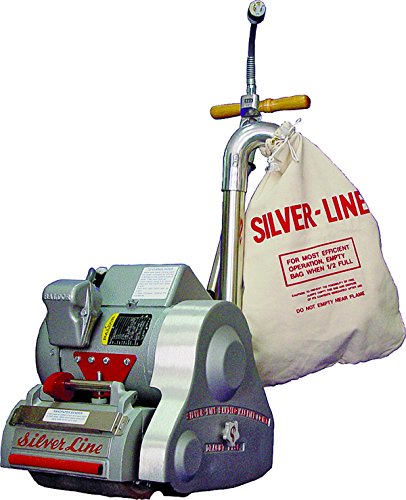
What We Like
- Compact 3-inch footprint for easy storage
- 115V motor runs on standard household current
- 1 HP provides core sanding power
- Simple Essex Silver Line design
Trade-offs
- Extremely compact footprint suggests a much smaller tool than typical floor sanders.
- Listed dimensions suggest a very small packaged size.
A 1 HP motor running on standard 115V household current makes this sander a fundamentally accessible machine for basic floor work. It’s a straightforward choice for a homeowner or a small shop tackling a modest floor refinishing project where the primary goal is functionality without complex setup. The compact dimensions point to a tool designed for practicality and storage in spaces where a larger industrial sander would be impossible to keep.
The critical trade-off is scale. Comparing its listed 3.0-inch length to the Jet JWDS-2244’s 44.3-inch frame reveals this is not a wide-belt drum sander for panel work, but a dedicated, single-purpose floor unit. You’re getting a focused tool for its specific job. It won’t handle wide stock or serve as a shop sander, but for the right floor task, it provides the essential power in a manageable package.
How We Evaluated Drum Sanders
Our evaluation is based on manufacturer specifications, expert round-ups, and patterns in experienced owner feedback. We focused on criteria that directly impact real-world use in a workshop or on a job site, rather than marketing claims.
The most critical factors were sanding capacity, power and feed control, dust management, and physical footprint. Capacity determines what you can sand in one pass, while proper feed control is essential to prevent damaging the workpiece. Effective dust collection systems are non-negotiable for shop cleanliness and health.
A research-led evaluation has limits; we cannot replicate the long-term durability testing of years of shop use. Our goal is to provide a clear, comparative framework so you can invest confidently.
What To Look For In Drum Sanders
Drum sanders fall into two broad categories: stationary machines for shop work on panels and stock, and portable units for refinishing floors. Your primary project type dictates which path to take.
Key differences include capacity, power source, and dust control. Stationary models prioritize width for panels and integrate with shop dust collectors. Floor models are mobile, often include a vacuum, and are built for abrasion on horizontal surfaces.
Capacity and Workspace
The width of the sanding drum dictates your workflow. A 22-inch model can handle most cabinet doors and tabletops in one pass, while a 37-inch model is for milling wide rough lumber, as found in an industrial workshop. Consider both the machine’s physical length and its operational width; a large open-end sander needs significant floor space around it for feeding long boards.
Your shop’s available space is as important as the sander’s capacity. A compact drum sander is a necessity for a small workshop, while a full-size floor model requires clear access across an entire room. Measure your doorway and intended placement area before deciding.
Power and Feed Control
A motor’s horsepower must match the intended material removal. For dimensioning rough hardwood, look for industrial-grade motors of 2 HP or more. For final finishing passes on already-flat panels, a 1.5 HP motor may suffice. The ability to control the conveyor feed rate is crucial to avoid burning the wood or overloading the motor.
Some advanced systems automatically adjust the feed speed based on motor load, which is a valuable safeguard. This is a key feature to look for in a machine designed for a smooth finish. Without variable feed, you risk chatter marks or having to make excessively light passes.
Dust Collection and Design
Drum sanding creates a large amount of fine dust. Stationary shop sanders require a well-sealed dust hood that connects to a high-volume dust collector, not just a shop vacuum. For floor sanding, an integrated vacuum system is important for containing the mess and protecting your lungs.
The machine’s overall design impacts usability. Look for features like tool-free bed adjustments for parallelism and easy sandpaper changes. A closed-cabinet stand on a shop sander contains debris better than an open stand. For contour work on furniture, a spindle sander is a better choice for curves and edges.
- Check the dust port size to ensure compatibility with your existing collector hose.
- Verify the machine’s weight and whether it requires a dedicated power connection.
- For floor models, assess the sandpaper changing mechanism and availability of abrasives.
Ultimately, buy for your most frequent task. A machine too small frustrates, while one too large consumes budget and space better used elsewhere.
Drum Sanders Compared
The table below summarizes the core specifications and best uses for each of our top picks to help you compare them at a glance.
| Product | Drum Width | Motor | Weight |
|---|---|---|---|
| Jet 22-Inch Drum Sander | 22 inches | 1-3/4 HP, 1Ph 115V | 177 pounds |
| Powermatic 37-Inch Dual Drum Sander | 37 inches | 10 HP, 230/460V 3Ph | 962 pounds |
| Jet 25-Inch Drum Sander | 25 inches | 1-3/4 HP, 115V | 234 pounds |
| Onfloor 16 Inch Floor Sander | 16 inches | 1.5 HP | N/A |
| Essex SL-8V Drum Sander | N/A | 1 HP | N/A |
Frequently Asked Questions
What is the difference between a drum sander and a planer?
A planer is for removing significant material to achieve a uniform thickness, but it can tear out figured wood. A drum sander removes minimal material, providing a smooth finish and perfect final thickness on delicate surfaces, glued-up panels, or veneer without tear-out.
Can I use a drum sander on hardwood floors?
Yes, but you need the right tool. A portable machine designed for the job is essential. Using a drum sander for hardwood floors requires proper technique to avoid gouging, so it’s wise to practice on an inconspicuous area first.
What size drum sander do I need for a small shop?
For a small shop, prioritize a compact footprint. Look for a benchtop model or a drum sander for a small workshop with a capacity around 16 inches. This width handles many common panels while conserving precious floor space for other essential tools.
Is a drum sander or orbital sander better for floors?
For fast, aggressive stock removal on flat floors, a drum sander is more efficient. For final smoothing and easier handling, especially for beginners, an orbital floor sander is less likely to gouge. Our guide on the drum sander vs orbital debate details the pros and cons.
How do I avoid gouges when using a drum sander?
The key is to keep the machine moving. Never stop its forward motion while the drum is in contact with the floor. Always tilt the drum up at the start and end of each pass. Learning proper drum sander technique is essential before starting a major project.
The Bottom Line
The Jet 22-Inch Drum Sander is the best overall choice for woodworkers who need precise, repeatable finishes on panels up to 22 inches wide. Its smart feed control and effective dust management make it a reliable centerpiece for a serious hobbyist or small professional shop.
For those on a strict budget focused on floor work, the Essex SL-8V offers a core starting point. The Onfloor 16 Inch Floor Sander is the better pick for contractors who value quick tool changes. High-volume shops should look directly at the Powermatic industrial model.
Your decision should start with a clear assessment of your shop’s space and power, then match the machine’s capacity to your most common project sizes. Getting this match right is more important than any single premium feature.
