
5 Best Floor Sanders For Hardwood Floors in 2026
This post contains affiliate links. As an Amazon Associate, we earn from qualifying purchases.
For refinishing hardwood floors, our best overall pick is the Onfloor 16 Inch Wood Floor Sander for its integrated dust control and forgiving pivot system. For large rooms, consider the XtremepowerUS 10″ Commercial Floor Polisher with its extra-long cord, and for heavy-duty sanding jobs, the Powr-Flite Millennium Floor Machine offers a powerful motor that starts under load.
Choosing the wrong tool can leave swirl marks, uneven surfaces, or leave you exhausted from managing dust. You need a machine that matches your project’s size and your experience level. We researched specifications, manufacturer data, and patterns in expert and owner feedback to compare five distinct models.
This guide will help you find the right balance of power, control, and cleanup for your floor.
Top 5 Floor Sanders For Hardwood Floors in the Market
Certain content that appears on this site comes from Amazon. This content is provided "as is" and is subject to change or removal at any time.
The Best Floor Sanders For Hardwood Floors, Reviewed
Onfloor 16 Inch Wood Floor Sander

What We Like
- Combined sander and vacuum system for dust control
- Quick-change tooling for fast maintenance
- Forgiving pivot system for even floor results
- Built-in wheels for easy maneuverability
Trade-offs
- 16-inch width may be cumbersome in tight rooms
- No cord length specified for large room mobility
A 16-inch sanding width combined with a 1 HP onboard vacuum creates a self-contained system for hardwood floor restoration, allowing a user to cover large areas while controlling dust in a single pass. Its design suits contractors or serious DIYers aiming to minimize airborne particles during resurfacing. The three-head planetary drive targets a smooth finish, and quick-change tooling aims to reduce downtime when switching grits.
That 16-inch square footprint, while stable, means it won’t navigate tight corners or staircases as easily as a smaller orbital machine like the HHQ Commercial Orbital Floor Scrubber. You’re trading some agility for raw sanding power and dust containment. For sanding large, unobstructed floors, this Onfloor model simplifies the job. For a complex layout with many obstacles, a more compact machine might prove less frustrating despite requiring more passes.
XtremepowerUS 10" Commercial Floor Polisher

What We Like
- 39 ft cord reduces outlet hunting
- Random orbital action prevents swirl marks
- Drive pad holder for accessory compatibility
- Multi-surface capability for sanding and polishing
Trade-offs
- All sanding and buffing pads are sold separately
- 10-inch path is narrow for large, open floors
- 36.7 lb weight requires strength to transport
A 39-foot cord lets you move between rooms without unplugging, which simplifies cleaning larger areas or a series of smaller spaces. This XtremepowerUS polisher uses a random orbital pattern that glides over floors to prevent brush marks and swirls. Its commercial-grade design is listed for tasks like sanding, refinishing, scrubbing, waxing, and polishing on all flooring types, and it can dry clean carpets without leaving a soapy residue. The machine includes a drive pad holder for use with various pads and brushes sold separately.
You need to factor in the cost of separate pads and brushes for sanding, as it arrives ready to accept them but not with them. The 10-inch width is efficient for detail work and maneuvering around furniture, but it means more passes on a vast, open floor compared to a wider machine. For its intended use as a multi-purpose floor maintainer, the long cord and orbital design offer genuine convenience. It is not a replacement for a dedicated, aggressive sander when you’re starting a project from bare wood.
HHQ Commercial Orbital Floor Scrubber

What We Like
- Versatile orbital action for scrubbing and polishing
- Wide 175-1950 RPM speed range for different tasks
- Includes a full kit of brushes and pads
- Long 5-year warranty on the motor
Trade-offs
- At 39 pounds, it's heavy for a multi-purpose orbital machine
- Weighs 39 pounds
The 1.5 HP motor and variable speed up to 1950 RPM give this orbital machine the muscle to scrub and polish a variety of hard surfaces effectively. Its kit includes brushes and pads for immediate use on tile, grout, hardwood, and more, so users can avoid hand-scrubbing. The manufacturer provides a 5-year warranty on the motor and a 2-year warranty on all other components.
Its 39-pound weight is described as aiding deep cleaning, though the rubber wheels are intended to make transport easier. The unit is compatible with Oreck Orbiter pads and brushes, which can simplify accessory sourcing. A machine like the VEVOR 22″ Drum Sander offers a different approach for dedicated, large-scale floor sanding.
Product photos
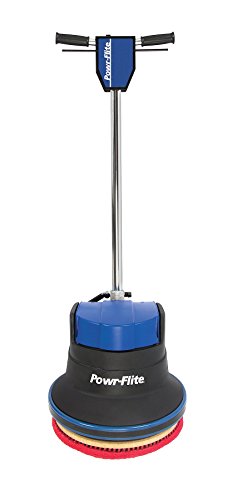
Powr-Flite Millennium Floor Machine
What We Like
- Patented one-piece housing reduces noise and vibration.
- Powerful 1.5 hp motor starts easily with aggressive paper.
- Safety interlock prevents accidental machine start-up.
Trade-offs
- Requires a separate dust extractor
- Uses 17-inch pads, limiting pad size compatibility
A 1.5 hp motor that starts under load with a 17-inch sanding pad is built for serious material removal. This machine is for the professional or dedicated DIYer facing heavily worn floors or thick finish layers, where its industrial-grade steel gearbox and vibration-dampening housing are necessary to handle the stress of aggressive grits. It’s a tool designed to power through a tough job without complaint.
This machine uses 17-inch sanding pads, creating a wide working path for efficient coverage. Unlike the Onfloor 16 Inch Wood Floor Sander, it lacks a built-in vacuum, requiring a separate dust extraction system. The thumb-activated safety interlock switch prevents accidental startups, an important feature for a powerful tool.
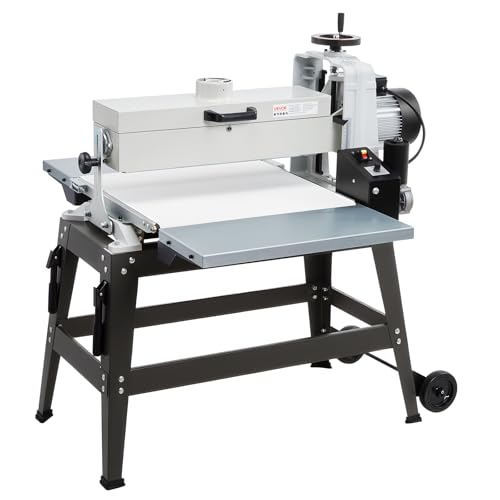
VEVOR 22" Drum Sander
What We Like
- Independent dual motors for power and precision.
- Extension tables stabilize long or oversized boards.
- Variable feed rate suits different wood types.
- Integrated stand and wheels aid mobility.
Trade-offs
- 48.8-inch length demands a sizable workshop.
A 22-inch wide drum and a 1.75HP motor allow you to flatten and finish large boards in a single, consistent pass. It handles stock up to four inches thick with the help of its extension tables, which provide stable support for long workpieces. This capability matches the needs of woodworking tasks involving wide panels or slabs.
That capacity comes with a substantial footprint. At 230.2 pounds and nearly four feet long, this isn’t a tool you’ll tuck into a corner. The open stand and mobile wheels provide stable support and allow for movement, but its size demands dedicated floor space in a workshop.
Product photos
How We Evaluated Floor Sanders
Our evaluation focused on detailed manufacturer specifications and expert round-ups from professional rental and supply companies. We prioritized three key criteria: sanding action and finish quality, dust control and maneuverability, and motor power and build durability. Understanding the differences between a drum vs orbital sander was fundamental, as this choice dictates the final surface texture and the user’s required skill level.
We also placed significant weight on the practical realities of using these machines. This includes whether an integrated vacuum system was included or if a separate extractor was needed, as this impacts both cleanup time and air quality.
What To Look For In Floor Sanders
Selecting the right floor sander depends on your project’s scope, the floor’s condition, and your own comfort with powerful tools. A machine that’s perfect for a wide-open living room can be a burden in a hallway, and a finish suitable for a final polish is useless for stripping thick old finish.
Focus on the sander’s type (drum or orbital), its dust collection method, and its physical footprint. Drum sanders remove material quickly but can dig in, while orbital sanders provide a swirl-free finish. An integrated vacuum saves immense cleanup time, and a machine’s weight and width determine how easily you can maneuver it.
Sanding Action and Finish
The fundamental choice is between a drum sander and an orbital sander. A drum sander uses a rotating cylinder covered in abrasive paper and is the tool for aggressive stock removal, ideal for leveling uneven boards or stripping old finish down to bare wood. In contrast, an orbital or random orbital sander moves in small, random circles, which prevents the tell-tale swirl marks and is used for final smoothing or for light sanding on floors in good condition.
For a comprehensive project, you often start with a drum sander and finish with an orbital, though some multi-purpose machines attempt to handle both stages.
Dust Control and Maneuverability
Dust management is critical for both your health and the cleanliness of your workspace. Look for machines with a built-in dust collection bag or, better yet, a port for connecting a shop vacuum. The Onfloor model in our guide combines the sander and vacuum into one system.
Maneuverability involves the machine’s weight, its wheel design, and its sanding path width. A 16-inch sander covers more area per pass but is harder to turn in tight spaces, while a lighter 10-inch model is easier to handle but will take longer on a large floor.
A long power cord, like the 39-foot cord on the XtremepowerUS model, is a major convenience that reduces outlet hunting.
Power and Durability
The motor’s horsepower and starting torque determine how well the sander performs under load, especially when tackling tough finishes or dense hardwoods. A more powerful motor, like the 1.5 hp unit in the Powr-Flite, will maintain speed and not bog down. Durability is reflected in the warranty length and the construction of the housing; a one-piece housing can reduce noise and vibration.
For contractors or those facing frequent, demanding projects, investing in a robust sander for hardwood floors built for commercial use is wise. For DIYers, a machine with a forgiving control system may be more valuable than raw power.
- Check the machine’s weight if you need to carry it up stairs.
- Verify what sanding pads or paper sizes are included, as they are often sold separately.
- Ensure you have adequate electrical circuits; some powerful motors may require a dedicated circuit.
Match the sander’s aggression to your floor’s starting condition: use a drum for major removal and an orbital for fine finishing.
Floor Sanders For Hardwood Floors Compared
The table below summarizes the key specifications and best-use cases for our five selected floor sanders to help you compare them at a glance.
| Product | Motor Power | Sanding Width | Sanding System |
|---|---|---|---|
| Onfloor 16 Inch Wood Floor Sander | 1.5 HP | 16 Inches | 3-Head Planetary |
| XtremepowerUS 10" Commercial Floor Polisher | N/A | 10 inches | Random orbital pattern |
| HHQ Commercial Orbital Floor Scrubber | 1.5 HP (1100 Watts) | N/A | N/A |
| Powr-Flite Millennium Floor Machine | 1.5 hp | 17 inch | All steel triple planetary gear box |
| VEVOR 22" Drum Sander | 1.75HP at 1440 RPM | 22 inches | Drum |
Frequently Asked Questions
What is the best type of sander to use on hardwood floors?
The best type depends on the job stage. For initial, aggressive sanding to remove old finish or level boards, a drum sander is most effective. For final smoothing and achieving a swirl-free finish ready for stain or polyurethane, a random orbital sander is the preferred tool. Many professionals use both in sequence.
What is the best way to sand a hardwood floor?
The best method is a multi-step process. First, use a drum sander with coarse-grit paper along the wood grain to remove the old surface. Then, use progressively finer grits. Follow this with an orbital sander for the final smooth pass. Always use an edging sander for the perimeter that the large machines cannot reach.
What tools are best for sanding hardwood floors?
A complete sanding setup requires a primary floor sander (drum or orbital), an edger for corners and edges, and a detail sander for tight spots like stair risers. You also need an effective dust extraction system, either built-in or as a separate vacuum, to manage the large amount of fine dust generated during sanding.
What is the best floor sander to buy?
The “best” sander to buy is the one that fits your specific project. For most homeowners tackling a large, open area, a model with excellent dust control like our best overall Onfloor sander is a strong choice. For those needing to polish or scrub floors as well, a versatile orbital machine like the HHQ Commercial Orbital Floor Scrubber may be more practical.
Can I use a floor sander on stairs or in closets?
Standard drum or large orbital floor sanders are too big and unwieldy for stairs or tiny closets. For these areas, you need specialized tools. A handheld detail sander is essential for corners and edges, while for full stair treads, you should look into specific stair sanders designed for that angled, confined work.
The Bottom Line
For most DIYers and contractors refinishing large hardwood floor areas, the Onfloor 16 Inch Wood Floor Sander is the best overall choice. It tackles the two biggest headaches, dust and uneven sanding, with its integrated vacuum and forgiving pivot system.
If you’re on a tighter budget or need a machine for multiple tasks like polishing, the XtremepowerUS 10″ model offers great versatility with its long cord. For the singular job of sanding wide boards in a workshop, the VEVOR 22″ Drum Sander is the dedicated tool.
Ultimately, your decision should hinge on matching the sander’s primary action, aggressive drum or gentle orbital, to the current condition of your floors. Getting this fundamental match right is more important than any single feature.
