
10 Best Drywall Sanders in 2026
This post contains affiliate links. As an Amazon Associate, we earn from qualifying purchases.
For whole-room projects, the WEN Variable Speed Drywall Sander is our best overall for its balanced power and effective dust collection. The Festool PLANEX LHS 2 is best with integrated lighting for flawless finishes, while the DEWALT 20V MAX is the top cordless system for mobile contractors.
Drywall sanding is physically demanding and creates a pervasive dust cloud. The right tool turns a grueling chore into an efficient, clean process. This guide was built from manufacturer specifications, expert round-up reviews, and patterns in owner feedback to help you choose the right sander for your next project.
Top 10 Drywall Sanders in the Market
Certain content that appears on this site comes from Amazon. This content is provided "as is" and is subject to change or removal at any time.
The Best Drywall Sanders, Reviewed
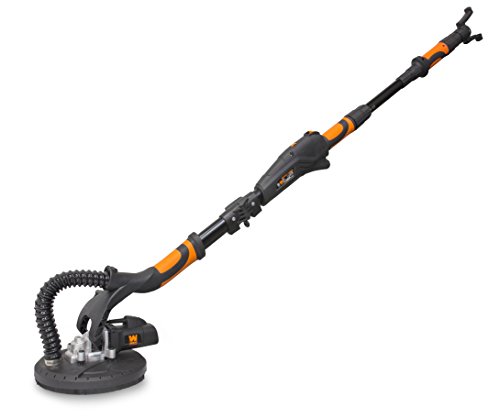
WEN Variable Speed Drywall Sander
What We Like
- Variable speed for controlled material removal
- Lightweight body reduces user fatigue
- Hook-and-loop base simplifies disc changes
- Long dust hose minimizes cleanup
Trade-offs
- Corded design limits mobility away from outlets
- Requires a separate vacuum for dust collection
The variable speed adjustment from 600 to 1500 RPM is the key here, letting you dial in the perfect aggression for skim coats or final passes without gouging the paper. Combined with a five-foot telescoping reach, this sander is built for the DIYer or pro who needs to tackle walls and ceilings on a single job site. Its 5-amp motor provides enough torque to keep the disc spinning under pressure, and the included assortment of grits means you can go from shaping to finishing without a trip to the store.
Managing both a power cord and a 15-foot vacuum hose can feel cumbersome compared to a cordless model like the DEWALT DCE800B. With a body weight of nine pounds, your arms will feel it after a full day of ceiling work. However, the variable speed adjustment from 600 to 1500 RPM provides control for different tasks, and the automatic dust removal system minimizes cleanup.
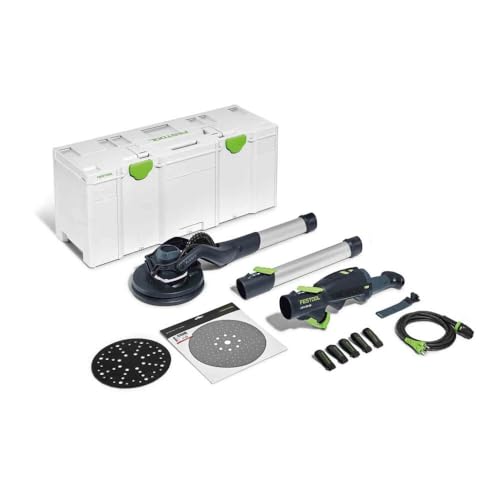
Festool PLANEX LHS 2 Drywall Sander
What We Like
- Integrated LED light ring reveals imperfections
- Self-supporting on walls and ceilings
- Maintenance-free brushless EC motor
- Ergonomic T-handle for extended reach
Trade-offs
- At 22.1 pounds, it's heavier than cordless pole sanders
- Requires a compatible dust extractor for full function
An all-round LED light ring mounted on the sanding head makes every flaw in the drywall surface instantly visible, so you don’t miss spots or over-sand. This, combined with its ability to hold its own weight against walls and ceilings, makes it the tool for professionals and serious renovators who tackle large, demanding jobs where finish quality is paramount. The variable working length and ergonomic T-handle mean you can work comfortably from floor to ceiling without constant repositioning.
Weighing 22.1 pounds, the Festool PLANEX LHS 2 is heavier than many cordless sanders, including the 8.6-pound DEWALT DCE800B. Its design uses adjustable suction power to help support its own weight against walls and ceilings, reducing strain on the user’s arms and back. For extensive drywall or ceiling projects, this self-supporting feature can offset the tool’s heft, though the weight remains a consideration during transport and setup.
DEWALT 20V MAX Cordless Drywall Sander

What We Like
- Brushless motor for improved runtime and durability
- Telescoping shaft for access to confined spaces
- Wireless ON/OFF control with compatible dust extractor
- Tool-free AirLock connection to DEWALT extractors
Trade-offs
- Tool only: requires separate battery and charger purchase
- Dependent on cordless platform for full functionality
A brushless motor and cordless 20V MAX platform make this sander a liberating choice for finishing work free from outlet hunting. Its 8.6-pound weight and telescoping shaft let you maneuver from floor to ceiling without wrestling a heavy cord. That wireless tool control is a genuine convenience when paired with a DEWALT dust extractor, letting you start and stop sanding from the pole. This is the tool for contractors already invested in DEWALT’s battery system who need to move quickly between rooms or tackle remodels where power isn’t yet live.
The trade-off for that cordless freedom is reach. At just under four feet long, you’ll need a ladder or scaffold for standard ceilings more often than with longer models like the 66.9-inch BOSCH. Remember, this is a tool-only listing, so factor in the cost of a compatible battery and charger if you’re not already on the DEWALT 20V system. For a pro with the batteries on hand, it’s a premium, no-compromise cordless solution. For someone needing maximum reach on a single purchase, a corded pole sander might be the more pragmatic buy.
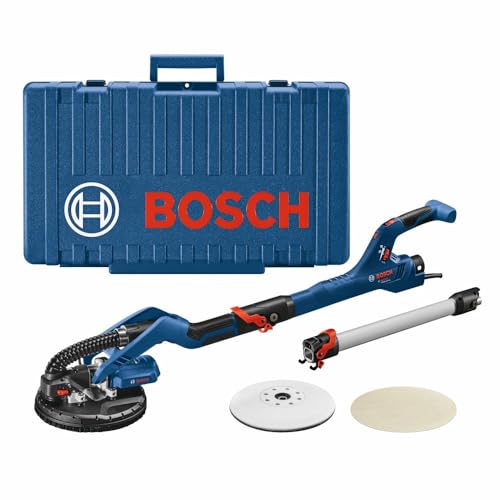
BOSCH GTR55-85 Drywall Sander Kit
What We Like
- Ceiling-suction mode reduces weight overhead
- T-handle grip for adaptable, low-strain control
- Easy-to-reach controls without removing hand
- Quick-release pole adapts length for walls/ceilings
Trade-offs
- Some owner feedback reports mixed results with finer 220-grit paper
- At 66.9 inches long, it requires significant storage space
The Bosch GTR55-85’s ceiling-suction mode is the concrete feature that changes the game for overhead sanding, actively pulling the 9-pound tool up to fight gravity and lessen fatigue. This makes it the logical pick for anyone facing a large ceiling job or extensive high-wall work, where arm strain is the primary enemy. The T-handle and quick-release pole further adapt the tool to the task, letting you switch between surfaces without compromising on a secure grip.
The Bosch GTR55-85 is built for ceilings and walls, with a mode that reduces its weight overhead to lessen strain and fatigue. Its ultra-flexible head helps prevent surface damage while moving across drywall mud and plaster. A quick-release pole adapts the length for different tasks, and the T-handle grip is designed to reduce arm strain during extended use.
WEN 20V Max Cordless Drywall Sander

What We Like
- Brushless motor provides consistent torque
- Long dust hose minimizes cleanup
- Battery gauge shows charge level
Trade-offs
- Sanding discs require DW series paper only
A 20-volt cordless system and a reach that extends past five feet make this sander a serious option for anyone tired of tripping over cords on a jobsite. It’s built for the contractor or dedicated DIYer who needs to move quickly between rooms or tackle a whole-house project without hunting for outlets. The variable speed control and brushless motor give you the finesse for final passes and the muscle for feathering edges, all from a battery platform that can run other tools.
For a purely cordless workflow, the WEN 20V Max Cordless Drywall Sander stands as an alternative to the tool-only DEWALT DCE800B. The trade-off is in the proprietary sandpaper, locking you into DW series discs, which can be a hassle if a local supplier doesn’t carry them.
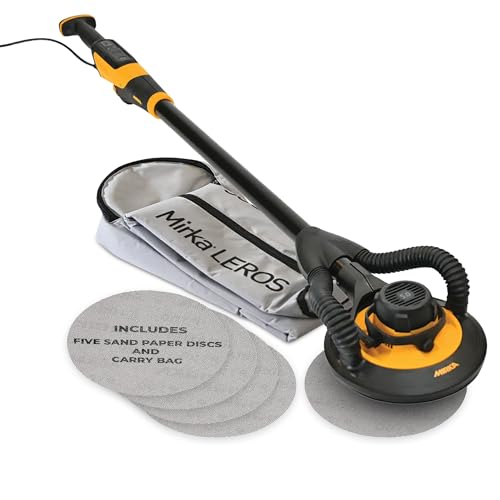
Mirka LEROS Random Orbital Disc Sander
What We Like
- Brushless motor provides consistent power for tough tasks
- 180° rotating head reaches tight corners and edges
- Effective dust capture with dual vacuum ports
Trade-offs
- Electric cord requires an outlet, unlike cordless models
- Tool-only package lacks sanding discs beyond test samples
Weighing just 7.7 pounds, the Mirka LEROS is built to dramatically reduce arm and shoulder strain during overhead or extended sessions. That lightweight design, paired with a 350W brushless motor, makes it a standout for professionals or dedicated DIYers tackling multi-room renovations or popcorn ceiling removal. The 180° rotating 9-inch head lets you pivot into corners and along edges without switching tools, while the dual dust ports keep the mess contained when hooked to a vacuum.
The trade-off for that featherweight feel is reach; its 58-inch pole is shorter than models like the BOSCH GTR55-85, so you might still need a ladder for very high ceilings. For all-day sanding on walls and standard-height ceilings where fatigue is the real enemy, the LEROS is hard to beat. If your primary need is cordless freedom for quick patches, a model like the DEWALT 20V MAX would be a more logical comparison.
Product photos
DEWALT DWE7800 Electric Drywall Sander
What We Like
- Articulating head for multi-angle contact
- Variable speed dial for control
- Tool-free dust extractor connection
- Dual-action trigger for versatility
Trade-offs
- Length of 65 inches requires significant storage space
- Corded design limits mobility compared to cordless models
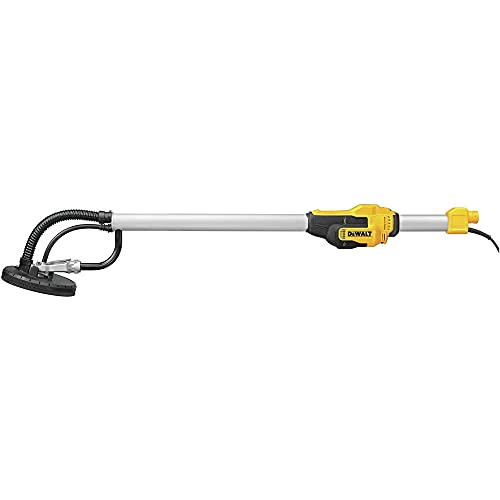
The articulating head pivots to maintain contact at multiple angles, which helps the sanding pad follow inside corners and wall-ceiling joints. A variable speed dial and a dual-action trigger that allows momentary or locked-on usage provide control for a range of applications. These features support a methodical approach to finishing work.
You trade some maneuverability for that capability, however. The 15-pound weight and 65-inch length make it a bit more of a handful to manage overhead compared to a lighter pole sander like the Mirka LEROS. It’s also a dedicated corded tool, so if your job site lacks outlets, the cordless DEWALT DCE800B becomes a more practical comparison. For controlled, dust-extracted finishing on complex walls, this sander’s design excels.
Product photos
Hyde Dust-Free Drywall Vacuum Sander
What We Like
- Attaches to any wet/dry vacuum for dust-free sanding
- EasyClamp system allows quick screen replacement
- Protects lungs and workspace from invasive drywall dust
- Lightweight manual design for tight spots and touch-ups
Trade-offs
- Requires manual effort compared to powered sanders
- Tool only: requires a separate vacuum to function
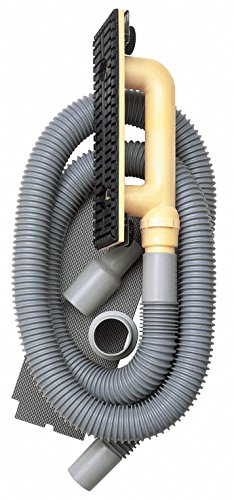
A six-foot hose that connects to any shop vacuum turns this simple hand sander into a remarkably clean-working tool. It strikes an excellent balance between affordable and user-friendly for anyone tired of drywall dust coating every surface in the room. This makes it a natural fit for the DIYer or pro tackling smaller repairs, final touch-ups, or working in corners where a bulky electric sander is impractical. The included adapter fits most vacuum hoses, so you can likely use equipment you already own.
The trade-off is all in the elbow grease. You supply the sanding motion, which is fine for patches but becomes a real workout on larger walls or ceilings. For those bigger jobs, a tool like the WEN Variable Speed Drywall Sander offers powered efficiency. Still, for its specific niche of contained, precision sanding, this Hyde sander delivers a straightforward solution that traditional pole sanders simply can’t match.
Product photos
HOOMESUN Drywall Pole Sander Kit
What We Like
- Three specialized heads cover walls, corners, and angles
- 58-inch pole reaches ceilings and high walls comfortably
- Includes 50 self-adhesive sheets across five grits
- Locking screw on square head reduces wobble
Trade-offs
- Manual operation requires significant physical effort
- Locking screw for stability is only on the square head
- No integrated dust collection system
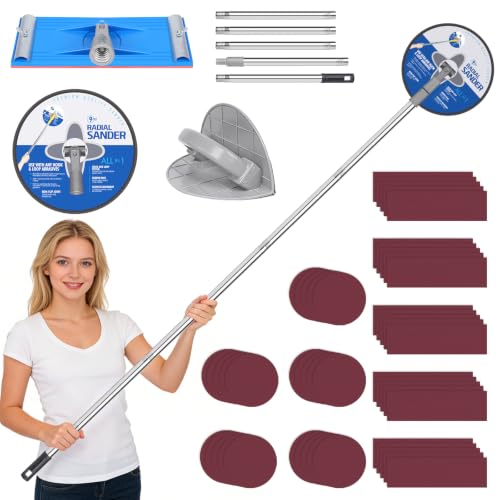
A 58-inch adjustable pole paired with three dedicated sanding heads means you can tackle an entire room, walls, corners, and ceilings, without swapping out for a different tool. The kit comes ready with fifty sheets of sandpaper, so you can move through a multi-stage finishing process from rough to fine without a supply run. This is the definitive choice for the DIYer or small-scale contractor who values a comprehensive, manual setup over power and speed. It delivers professional results through thoroughness, not horsepower.
The HOOMESUN kit is a manual system, requiring the user to supply all the motion and pressure. This means sanding a large ceiling or wall involves significant physical effort. While the included locking screw on the square head helps reduce wobble for a consistent finish, the work pace is set by the operator’s stamina. For context, the DEWALT DCE800B is a 20V MAX cordless sander that provides its own power.
Product photos
Festool PLANEX Easy LHS-E

What We Like
- Integrated dust extraction for a clean workspace
- Lightweight, balanced design reduces user fatigue
- Flexible head eases movement on walls and ceilings
- Powerful brushless motor eliminates a heavy power cable
Trade-offs
- At 66.9 inches long, it requires significant storage space
- Weighs 17.5 lb, heavier than many cordless pole sanders
Expert round-ups call the Festool PLANEX Easy LHS-E the best performer overall, with a brushless motor that drives the sanding head directly for consistent power. Its integrated dust extraction creates a system that keeps the work area clean. The flexible random orbit head handles aggressive texture removal and leaves a ready-to-paint finish.
Its size is a trade-off for its performance. At 66.9 inches long, it is a dedicated tool that needs room to store and transport. For a more compact, self-contained option, the DEWALT 20V MAX Cordless Drywall Sander is much shorter at 47.9 inches and offers cordless freedom.
Product photos
How We Evaluated Drywall Sanders
Our evaluation started with a thorough review of manufacturer specifications and documentation to understand each tool’s core capabilities, from motor power to dust collection design. We then cross-referenced this with professional expert round-ups from trade publications and patterns in verified owner feedback, focusing on real-world performance in key areas.
The most important criteria were effective dust control to protect health and ease cleanup, power and speed control for handling different tasks, and ergonomic design to reduce user fatigue over long sessions. A research-based evaluation cannot replicate years of on-site wear, so we note where owner reports diverge from manufacturer claims on durability or accessory compatibility.
What To Look For In Drywall Sanders
Choosing a drywall sander means balancing power, control, and cleanup. Your project size, work environment, and budget will steer you toward the right type of tool.
Look for effective dust collection, adjustable speed for different tasks, and a design that minimizes physical strain. Consider whether corded power or cordless convenience better suits your workspace.
Dust Collection
Drywall dust is fine, pervasive, and a health hazard. Effective collection is non-negotiable. Integrated systems, like those on the Festool PLANEX Easy LHS-E, offer the cleanest operation but at a premium.
Most models rely on a hose connecting to a separate shop vacuum; look for a secure, tool-free connection and a long hose, like the 15-foot one included with the WEN, to maximize mobility. For serious work, pairing your sander with the right shop vac for drywall dust is crucial.
Manual options like the Hyde Dust-Free model also attach to a vacuum, providing a clean, budget-friendly solution for small repairs.
Power & Speed Control
Motor power determines how well a sander handles aggressive material removal versus delicate finishing. A 5-amp motor is adequate for most DIY work, while professionals may seek more powerful 7-amp models. Variable speed control, typically ranging from five hundred to two thousand RPM, is invaluable.
It lets you dial down for fine finish sanding on joints and speed up for flattening seams or removing texture. Our research into the best electric drywall sanders confirms that this control is a key differentiator between basic and versatile tools. Cordless models like the DEWALT offer brushless motors for better battery life but depend on your existing cordless tool platform.
Ergonomics & Design
A sander’s weight, balance, and grip directly impact user fatigue, especially on ceilings. Lightweight tools under 10 pounds, like the WEN, are easier to manage overhead. Pole sanders with quick-adjust lengths, like the BOSCH GTR55-85, adapt from walls to ceilings. An articulating or rotating head, as on the DEWALT DWE7800 or Mirka LEROS, helps maintain flat contact on corners and angles. For confined areas, a dedicated detail sander is a wise companion for drywall joints. Consider storage needs too; some pole sanders extend beyond 65 inches.
- Test the grip and trigger placement to ensure comfortable, one-handed operation.
- Check if the pole length is adjustable for your ceiling height.
- For overhead work, look for features like a ceiling-suction mode to counterbalance weight.
The best sander feels like an extension of your arm, not a burden you have to fight.
Drywall Sanders Compared
The comparison table below summarizes the key specifications and features of our top picks to help you see the differences at a glance.
| Product | Weight | Motor Type | Max Length |
|---|---|---|---|
| WEN Variable Speed Drywall Sander | 9.2 pounds | 5-Amp head-mounted | Telescopes to five feet |
| Festool PLANEX LHS 2 Drywall Sander | 22.1 pounds | Brushless EC motor | Add up to two extensions |
| DEWALT 20V MAX Cordless Drywall Sander | 8.6 pounds | Brushless | 47.9 inches |
| BOSCH GTR55-85 Drywall Sander Kit | 9.0 pounds | N/A | 66.9 inches |
| WEN 20V Max Cordless Drywall Sander | N/A | Brushless | 63 inches |
| Mirka LEROS Random Orbital Disc Sander | 7.7 pounds | 350W brushless | 58.0 inches |
| DEWALT DWE7800 Electric Drywall Sander | 15.0 pounds | 4.7 Amp | 65.0 inches |
| Hyde Dust-Free Drywall Vacuum Sander | 0.2 Pounds | N/A | N/A |
| HOOMESUN Drywall Pole Sander Kit | N/A | N/A | 58 inches |
| Festool PLANEX Easy LHS-E | 17.5 Pounds | Brushless EC TEC | 66.9 inches |
Frequently Asked Questions
What is the best sander to use for drywall?
For most users tackling entire walls or ceilings, a powered pole sander with a vacuum hookup is best. Our top pick, the WEN Variable Speed Drywall Sander, offers this combination of reach, adjustable power, and dust control effectively. For small patches or touch-ups, a manual vacuum sander like the Hyde model is a perfectly capable and more affordable choice.
Are drywall sanders worth it?
Yes, for any project larger than a few small patches. A dedicated drywall sander saves immense time and physical effort compared to hand-sanding. More importantly, when paired with a vacuum, it contains the harmful dust cloud, protecting your lungs and making cleanup trivial. The productivity and health benefits justify the investment for serious DIYers and are essential for professionals.
What is best for sanding drywall?
A smooth finish requires the right technique and grit progression. Start with a coarser grit to flatten high spots and seams, then move to a finer grit for a polish. Always use a sanding screen or hook-and-loop discs designed for drywall, as they resist clogging. Our guide on how to use a drywall sander covers the full process.
Which brand of sander is considered the best?
No single brand is best for everyone; it depends on your needs and existing tools. Festool is highly regarded by professionals for performance and dust extraction but commands a premium price. Brands like WEN and DEWALT offer strong value and capable performance for contractors and advanced DIYers. The “best” brand is the one whose ecosystem, including batteries, dust extractors, and support, fits your workflow.
Can I use a regular orbital sander on drywall?
You can for very small areas, but it’s not ideal for whole walls. Standard orbital sanders have smaller pads, lack effective dust collection for fine drywall dust, and can create swirl marks if not used carefully. For larger areas, a dedicated drywall sander with a vacuum is far faster, cleaner, and produces a more uniform finish.
The Bottom Line
For its versatile variable speed, lightweight design, and effective dust collection system, the WEN Variable Speed Drywall Sander is our best overall pick for DIYers and contractors tackling whole-room projects. If your priority is cordless convenience and you’re already invested in a 20V platform, choose the DEWALT 20V MAX Cordless Drywall Sander. For professionals who demand the ultimate in dust control and finish quality, the Festool PLANEX Easy LHS-E with integrated extraction is the benchmark.
Regardless of your choice, never underestimate the importance of connecting your sander to a proper dust collection system. It’s the single most important factor for your health and a clean workspace.
