
10 Best Hand Sanders in 2026
This post contains affiliate links. As an Amazon Associate, we earn from qualifying purchases.
The SKIL 5-Inch Random Orbital Sander is our best overall hand sander, balancing compact size for tight spaces with effective dust collection and a low-vibration grip. For flawless finishing, consider the BOSCH ROS20VSC, while the SKIL Multi-Function Detail Sander excels at versatile detail work.
Choosing the wrong sander can turn a simple project into a frustrating chore, leaving swirl marks or failing to reach corners. The right tool removes material efficiently and leaves a surface ready for stain or paint.
Our picks are based on a review of specifications, manufacturer data, expert round-ups, and patterns in owner feedback. We’ve matched each sander to the job it does best, from heavy-duty removal to intricate detail work.
Top 10 Hand Sanders in the Market
Certain content that appears on this site comes from Amazon. This content is provided "as is" and is subject to change or removal at any time.
The Best Hand Sanders, Reviewed
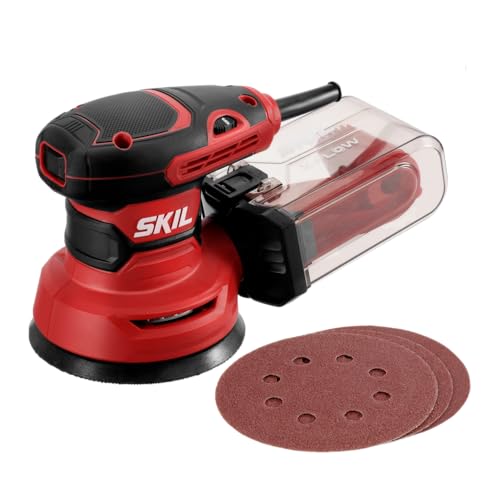
SKIL 5-Inch Random Orbital Sander
What We Like
- Compact size for tight spaces
- Low vibration ergonomic grip
- Easy-empty transparent dust container
- Sealed on/off switch for hassle-free use
Trade-offs
- Corded design limits mobility versus cordless models
- At 3.4 lb, it's slightly heavier than some palm sanders
A 2.8 amp motor spinning at 13,000 orbits per minute provides enough power for a variety of sanding applications without stalling. This capability, combined with a compact size and a soft rubber grip, helps reduce hand fatigue from vibration during longer jobs. The variable speed control and an easy-to-empty dust container add to the tool’s functionality.
While corded power requires an outlet, the sander’s ergonomic design and 3.4-pound weight help it get into tight spaces more easily than some bulkier models. Its counterweight balance and grip are designed to keep your hand comfortable, which can be helpful for extended use. The dust-sealed on/off switch simplifies operation during application.
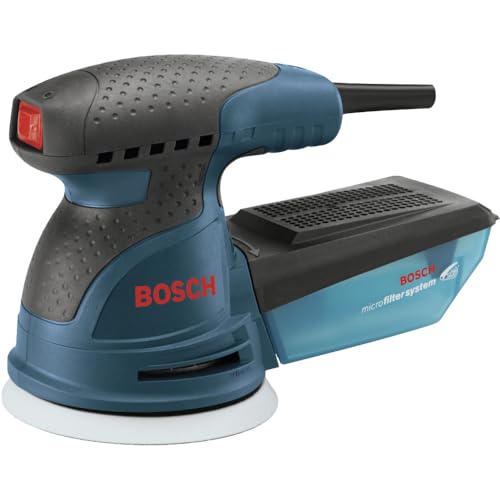
BOSCH ROS20VSC Random Orbital Sander
What We Like
- Pad dampening system minimizes swirl marks
- Excellent hard-case dust collection
- Includes vacuum adapter for shop vacs
Trade-offs
- Corded design limits mobility
- Kit only includes one sanding disc
In expert testing, the Bosch ROS20VSC measured 84 dB, making it the quietest by a large margin among the models evaluated. That low noise level, combined with its pad dampening system designed to minimize swirl marks, allows for significantly less fatigue during long sessions. Its airtight dust canister and micro-filter system trap particles as small as half a micron, which reviewers report keeps the abrasive pad cleaner longer and the workspace air much clearer. This design is noted as an ideal choice for extended indoor tasks like refinishing furniture.
The trade-off for that smooth, quiet performance is the corded power supply. A cordless model offers more freedom for locations without an outlet. However, the research mentions the corded design provides unlimited runtime for extended sanding tasks. When combined with its superior dust collection, this makes the sander a strong recommendation for indoor finish work where dust control is critical.
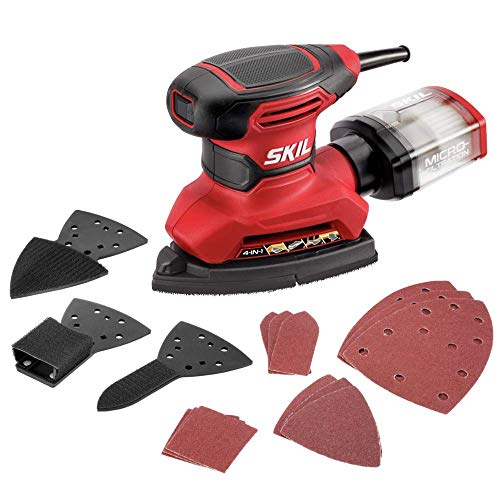
SKIL Multi-Function Detail Sander
What We Like
- Tool-free 4-in-1 attachment system
- Hook and loop sanding sheet changes
- Micro-filtration and vacuum port dust control
- Ergonomic soft grip and low vibration design
Trade-offs
- 1.2 amp motor is less powerful than many 5-inch sanders
- Corded design limits mobility compared to battery models
The ability to quickly swap between three detail attachments without tools makes this sander a specialist for tricky spots. That 4-in-1 versatility is its core strength, letting you tackle large surfaces, tight corners, and contoured edges with one compact, 2.6-pound tool. Its 13,500 OPM speed and low-vibration counterweight are tuned for control over raw power, making it a natural fit for finish work, furniture repair, or intricate DIY projects where precision matters more than speed.
With a 1.2 amp motor and 13,500 orbits per minute, this sander is built for smooth finishing rather than aggressive stock removal. It’s a corded tool, so you’ll need an outlet nearby, unlike the battery-powered freedom of a DEWALT 20V MAX. Consider it your final-step tool for detail work and fine smoothing after a larger sander handles the bulk material.
Product photos
DEWALT Variable Speed Random Orbital Sander

What We Like
- Separate counterweight drastically reduces vibration
- Ergonomic rubber overmold grip in critical areas
- Dust-sealed switch for longer component life
- Direct fit for DeWalt dust collectors
Trade-offs
- Corded design limits mobility compared to battery models
- Requires universal adapter for non-DeWalt vacuum hoses
A separate counterweight design reduces vibration, making this sander easier on your hands and arms during long sanding sessions. Its 3-amp motor spins the pad at speeds from 8,000 to 12,000 OPM. The shorter height allows you to get closer to the workpiece for better control, and rubber overmold in critical areas improves grip.
You are tethered to an outlet, so it won’t follow you around a jobsite like the DEWALT 20V MAX Cordless Orbital Sander. For shop-based work or serious DIY projects where comfort is paramount, however, the trade-off is worthwhile. The dust collection works well with its dedicated bag, and the sealed switch is a smart touch for longevity. It’s a refined, purpose-built machine that prioritizes user comfort over ultimate portability.
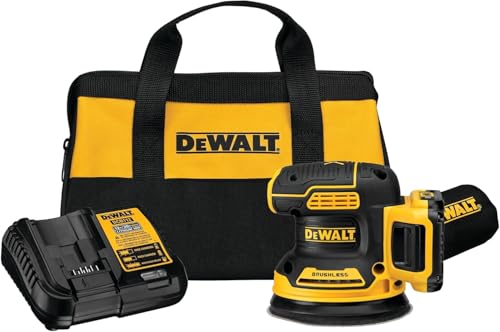
DEWALT 20V MAX Cordless Orbital Sander
What We Like
- Brushless motor for long runtime and efficiency
- Variable speed dial for application-specific control
- Ergonomic shape allows multiple secure grip options
- Dust-sealed switch for durability in dusty conditions
Trade-offs
- At 4.3 lb, it's heavier than corded models like the 3.4 lb DEWALT DWE6423
- The oblong handle shape may feel bulky for users with smaller hands
This cordless sander uses a brushless motor and a variable speed dial to adjust from 8,000 to 12,000 orbits per minute. That high speed and power output allowed it to remove material and achieve a stain-ready smoothness in reviews, making it comparable to more expensive DeWalt and Milwaukee models. Its low-profile height lets you work close to surfaces, and the oblong shape offers a choice of holding the top handle or gripping the base for control.
The cordless design adds some weight, with the tool at 4.3 pounds compared to the 3.4-pound corded DeWalt DWE6423. For shop work with outlets, the lighter corded model provides similar sanding without a battery. When sanding away from power sources, this sander’s balance of runtime and finish quality becomes a practical choice.
Makita BO5030K Random Orbit Sander

What We Like
- Rubberized grip improves comfort and control
- Includes a durable plastic storage case
- Runs quieter at 86 decibels for pleasant use
- Pad control system for smooth startup
Trade-offs
- Lacks variable speed control for delicate tasks
- Small dust port requires an adapter for a vacuum
- Dust collection uses a soft bag that is hard to clean
A 12,000-OPM motor and a large 1/8-inch orbit deliver smooth, fast stock removal, making it a solid performer for general finishing work. The tool is notably quiet at 86 decibels, which reduces fatigue on longer projects. This sander suits the budget-conscious user who wants reliable Makita performance and appreciates the included hard case for secure tool storage, a feature often missing from competitors.
The trade-off is the fixed speed, which can make it tougher to avoid burning through veneers or when working with softer woods. For those tasks, you’d want a model like the BOSCH ROS20VSC with its variable speed dial. Dust collection is functional with the included bag, but the small port means you’ll need an adapter to connect it to a shop vacuum for serious cleanup.
BOSCH GET75-6N Orbital Sander
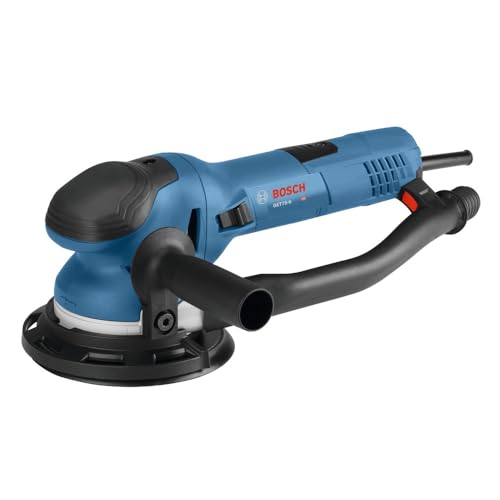
What We Like
- Turbo mode for aggressive stock removal
- Powerful 7.5 amp motor for demanding tasks
- Passive dust collection with included hose adapters
- Multi-hole pad accepts wide variety of abrasives
Trade-offs
- At 5.7 lb, it's heavier than most palm sanders
- Requires a separate vacuum for dust collection
- Larger 6-inch size can be cumbersome for detail work
With a 7.5-amp motor and a dedicated turbo mode, this sander is built for aggressive material removal. The direct-drive rotation in turbo mode delivers three times the stock removal of the standard orbital setting, offering an alternative to a belt sander for leveling or stripping. Its 5.7-pound weight and full-size design require more arm strength for extended use compared to lighter palm sanders.
That power comes in a larger package, measuring 15 inches long and weighing 5.7 pounds. This makes it less suited for detailed finish work or overhead tasks where a more compact tool would be easier to handle. The passive dust collection system requires connection to a vacuum cleaner, using included adapters for Bosch hoses or a shop vac.
Product photos
Makita BO4556K Finishing Sander

What We Like
- High 14,000 OPM speed for fast material removal
- Light 2.5 lb weight reduces user fatigue
- Rubberized grip and ball bearings minimize vibration
- Large clamping lever simplifies paper changes
Trade-offs
- No variable speed control for delicate work
- Fixed high speed can be aggressive for fine finishes
The Makita BO4556K runs at 14,000 orbits per minute, a speed that lets you strip old finishes or level wood grain far quicker than slower sanders. That pace, combined with its remarkably light 2.5-pound build and a contoured rubber grip, makes it a natural choice for anyone facing large, flat surfaces like decks, furniture panels, or doors where time and comfort are priorities. Its efficient dust collection hooks directly into Makita’s system, helping keep your workspace clean during those big jobs.
The trade-off for that speed is a lack of variable control. You can’t dial it down for more delicate tasks like smoothing a primer coat or working on softwoods without risk. If you need that flexibility for finer work, the Bosch ROS20VSC offers a variable-speed random orbital action, though it comes in a bit heavier. For pure, rapid stock removal on forgiving surfaces, this Makita finishing sander is a hardworking and comfortable tool.
Product photos
BLACK+DECKER 1/4 Sheet Orbit Sander

What We Like
- Paddle switch allows easy one-handed on/off control.
- Flush sanding on three sides for tight spaces.
- Quick-change paper clamps for fast sandpaper swaps.
- Tri-layer dust bag helps keep the work area clear.
Trade-offs
- Corded design limits mobility around a workspace.
- Sheet-based paper system requires cutting and fitting.
A 2.0 Amp motor driving 16,000 orbits per minute delivers enough power for efficient material removal on wood, metal, and plastic, making it a capable workhorse for general finish work and prep. This sander suits the DIYer who needs reliable, corded performance for weekend projects without a complex setup, offering straightforward features like a locking paddle switch and a decent dust bag that get the job done.
This sander uses a traditional 1/4 sheet format, so you’ll need to cut standard sandpaper sheets to fit it. The design provides flush sanding on three sides, which allows you to work right up against edges and into corners. Compared to the pre-cut discs used on models like the 5-inch DEWALT DWE6423, the sheet format is a trade-off for its edge-sanding capability.
Product photos
BLACK+DECKER Detail Sander

What We Like
- Compact design for navigating cramped corners.
- Ergonomic comfort grip reduces user fatigue.
- Detail finger attachment for hard-to-reach spots.
- Corded design provides unlimited runtime.
Trade-offs
- Corded power limits mobility compared to cordless models.
- Specialized detail pad is less suited for large, flat surfaces.
A 16,000 OPM motor and a compact footprint are the core of this sander. That combination is built for one thing: getting into places bigger tools can’t. The three-position grip and the included detail finger attachment let you work comfortably on intricate edges, corners, and odd angles where a standard orbital sander would just be in the way. This is a tool for the finish work, think window sashes, furniture repair, or trim sanding, where precision trumps raw power.
This corded sander provides unlimited runtime and continuous power for extended sanding tasks. Its compact design allows it to navigate cramped corners and tight spaces for detailed work. A 1.2 Amp motor drives the sanding pad at 16,000 orbits per minute for fast material removal.
Product photos
How We Evaluated Hand Sanders
Our research focused on comparing core specifications, manufacturer documentation, and insights from expert tool reviews. We analyzed patterns in user feedback to identify consistent strengths and common pain points across different brands and models.
The most critical criteria were sanding performance, user comfort, dust collection, and versatility. Performance includes material removal rate and finish quality. Comfort covers vibration levels and ergonomic grip design, which are crucial for extended use. Effective dust collection keeps your workspace clean and your lungs safe, while versatility determines how well a tool adapts to different tasks, from large surfaces to tight corners.
This is a research-based evaluation. We did not physically test these tools, so our assessment relies on the documented experiences of experts and owners rather than hands-on comparative data.
What To Look For In Hand Sanders
With so many types available, from orbital to detail sanders, knowing your primary project needs is the first step to a smart purchase. The right choice saves time and delivers a professional-looking finish.
Prioritize a sander that matches your most common tasks. For general woodworking, a 5-inch random orbital sander is often the best starting point. Look for variable speed control for delicate work, a low-vibration design for comfort, and a reliable dust collection system.
Sanding Action and Performance
The tool’s motion defines its job. Random orbital sanders combine rotation and oscillation to remove material quickly without leaving circular swirl marks, making them excellent for most finish work. For rapid stock removal on large, flat areas, a heavier-duty orbital sander or a handheld belt sander is more appropriate. Conversely, a detail sander with a small, triangular pad is designed solely for navigating tight corners and intricate moldings where larger tools can’t fit.
Power Source and Runtime
Corded sanders provide unlimited, consistent power, ideal for long sessions in a workshop or on a single large project. Cordless models offer complete mobility, perfect for working on ladders, decks, or sites without easy power access. If you choose cordless, consider the battery platform you already own; a sander is often a secondary tool in a cordless drill ecosystem. Runtime depends on the battery’s amp-hour rating and the efficiency of the sander’s brushless motor.
Ergonomics and Dust Management
User comfort is vital for any task longer than a few minutes. Look for sanders with rubberized overmold grips and designs that specifically counter vibration, which can cause hand fatigue. A sealed on/off switch also protects the motor from dust ingress. For dust collection, a transparent, easy-empty canister is convenient, but the best systems connect directly to a shop vacuum via an adapter. Effective dust control isn’t just about cleanliness; it keeps abrasive particles from getting between the paper and your workpiece, improving sanding efficiency.
-Fit the sander in your hand before buying, if possible, to check the grip comfort and control placement.
-Ensure the dust port is a standard size or includes adapters to connect to your existing shop vacuum hose.
-Check if the sanding pad uses a hook-and-loop system for quick paper changes or a less convenient clamped-sheet design.
A good dust collection system is a non-negotiable feature for indoor work, protecting both your project and your health.
Hand Sanders Compared
The table below summarizes the key features and best uses for our top picks to help you compare them at a glance.
| Product | Motor Power | Speed (OPM) | Weight | Dust Collection |
|---|---|---|---|---|
| SKIL 5-Inch Random Orbital Sander | 2.8 amp | 13,000 OPM | 3.4 pounds | Cyclonic box |
| BOSCH ROS20VSC Random Orbital Sander | 2.5 AMP | 7,500-12,000 OPM | 3.5 Pounds | 1/2-micron particles |
| SKIL Multi-Function Detail Sander | 1. 2 amp | 13,500 orbits per minute | 2.6 pounds | micro-filtration system |
| DEWALT Variable Speed Random Orbital Sander | 3-Amp | 8,000 – 12,000 OPM | 3.4 pounds | One-handed locking bag |
| DEWALT 20V MAX Cordless Orbital Sander | Brushless | 8,000-12,000 OPM | 4.3 pounds | N/A |
| Makita BO5030K Random Orbit Sander | 3.0 AMP | 12,000 OPM | 2.9 pounds | through-the-pad dust collection |
| BOSCH GET75-6N Orbital Sander | 7.5 Amp | 3300 to 7300 OPM | 5.7 Pounds | vacuum dust collector |
| Makita BO4556K Finishing Sander | N/A | 14,000 OPM | 2.5 pounds | Through-the-pad with port |
| BLACK+DECKER 1/4 Sheet Orbit Sander | 2.0 Amp | 16,000 orbits per minute | 3.0 Pounds | Dust Collection Bag |
| BLACK+DECKER Detail Sander | 1.2 Amp | 16,000 OPM | N/A | Includes canister |
Frequently Asked Questions
Which handheld sander is the best?
The best handheld sander depends on your project. For most all-around woodworking and DIY tasks, a 5-inch random orbital sander like our best overall, the SKIL 5-Inch model, offers a great balance of speed, finish quality, and control. It’s a versatile starting point before considering specialized tools for detail or heavy-duty work.
What is the best handheld wood sander?
For a smooth, swirl-free finish that’s ready for staining, a sander with a pad dampening system and excellent dust collection is key. The BOSCH ROS20VSC earns its Best For Smooth Finishing award for these very features, which are critical for fine woodworking. You can explore more dedicated options in our guide to the best hand sanders for wood.
What is the best type of palm sander?
The term “palm sander” often refers to a random orbital sander, which is generally the best type for finish sanding. Its dual motion prevents swirl marks and allows for efficient material removal. For a deeper comparison of styles, see our analysis of random orbital vs palm sander differences.
What is the best brand for sanders?
There is no single “best” brand, as different manufacturers excel in different areas. Brands like Bosch and DeWalt are praised for low-vibration, professional-grade designs, while SKIL and Makita often offer strong value. The best brand for you is one that reliably meets your specific needs for performance, comfort, and price within your existing tool ecosystem.
What should I look for in a sander for furniture?
For furniture refinishing, prioritize a sander with variable speed control to avoid damaging veneers, a low-vibration design for comfort during long sessions, and superior dust collection to keep the work area clean. A detail sander is also essential for reaching into corners and crevices common on furniture pieces.
The Bottom Line
For most users starting a project, the SKIL 5-Inch Random Orbital Sander is the best overall choice. It’s a compact, user-friendly tool that effectively handles a wide range of sanding tasks with good dust management.
If you’re on a tight budget, the BLACK+DECKER 1/4 Sheet Orbit Sander provides core functionality for occasional use. For tradespeople needing cordless freedom, the DEWALT 20V MAX Cordless Orbital Sander is the pro-grade solution.
Regardless of your pick, never underestimate the importance of a comfortable, low-vibration grip and a reliable dust collection system, your hands and lungs will thank you after the first hour of sanding.
