
10 Best Miter Saws in 2026
This post contains affiliate links. As an Amazon Associate, we earn from qualifying purchases.
Our best overall miter saw is the DeWalt DWS780 12-Inch Sliding Compound Miter Saw, which wins for its precise XPS shadow-line system and high capacity for large moldings. For tight workshops, the Bosch CM10GD is the best for tight spaces, and woodworkers needing pinpoint accuracy should consider the Makita LS1019L for precision woodworking.
Choosing the wrong saw can mean frustrating inaccuracy or a tool that’s too large for your workspace. You need a saw that matches your most common cuts, your available space, and whether you need corded power or cordless freedom. We built this guide by analyzing specifications, manufacturer data, and patterns in expert and owner feedback to identify the standout tools in ten key categories.
Top 10 Miter Saws in the Market

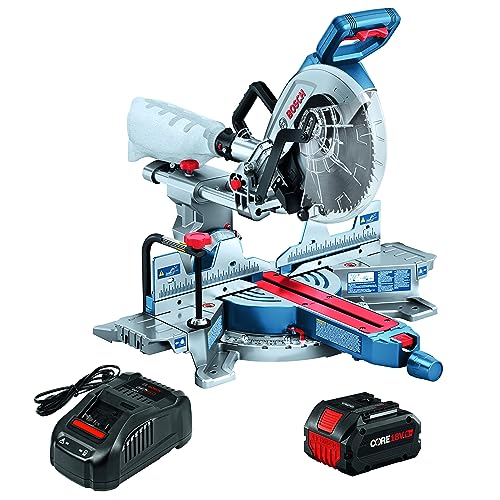
Certain content that appears on this site comes from Amazon. This content is provided "as is" and is subject to change or removal at any time.
The Best Miter Saws, Reviewed
DeWalt DWS780 12-Inch Sliding Compound Miter Saw

What We Like
- XPS LED shadow line for precise alignment
- Tall sliding fences support large crown molding
- Integrated cutline system needs no adjustment
- Positive miter detent plate for accuracy
Trade-offs
- Weighs 54.7 lb, making it a substantial stationary tool
- Large footprint at 48 inches tall needs dedicated space
- No laser guide, relies solely on the shadow system
With a capacity for 2×14 dimensional lumber at 90 degrees, this saw handles the thick stock common in framing and large trim projects. Its design as the best miter saw tested by experts stems from outstanding usability, supported by an adjustment-free XPS LED shadow line for precise alignment. Research notes it arrived perfectly calibrated out of the box, which means setup time is minimal before starting accurate cuts.
You pay for that capacity and rock-solid performance with size and heft. For that kind of portability, you’d look at a cordless model like the DeWalt DCS361B. But if your workbench or shop stand is its home, the DWS780’s sliding fence design and powerful motor deliver the consistent, heavy-duty results that build a reputation.
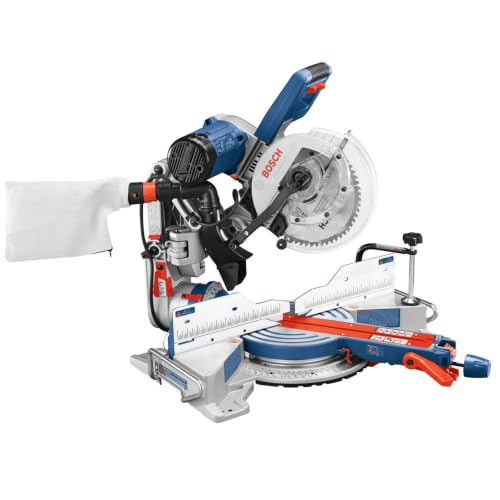
Bosch CM10GD 10-Inch Dual-Bevel Glide Miter Saw
What We Like
- Compact axial-glide design saves space
- Front-mounted bevel lock for easy adjustments
- Tall sliding fences support wide molding
- Powerful motor handles demanding cuts
Trade-offs
- Limited vertical cut vs. larger sliding saws
The Bosch CM10GD’s articulated arms reduce its front-to-back footprint to just over 12 inches, which is a concrete advantage if you’re working against a wall in a garage or a crowded job site trailer. That compact design doesn’t sacrifice professional capacity, thanks to a 15-amp motor and a system that delivers a full 12-inch horizontal crosscut. This saw suits the contractor or serious DIYer who needs sliding saw performance but has run out of room for a traditional rear-rail slider.
With its articulated hinge arms, the Bosch CM10GD reduces its front-to-back footprint by up to 10 inches compared to slide saws of similar capacity. This is a major advantage for users with cramped workshops or mobile job sites. The space-saving design comes from the Axial-Glide System, which is noted for offering more durable precision than traditional side rail systems. You do trade some vertical cutting capacity compared to a 12-inch sliding saw like the DeWalt DWS780, so very tall crown molding might require a flip. The advanced mechanism also typically comes at a higher cost than basic slide models.
Makita LS1019L 10-Inch Sliding Compound Miter Saw
What We Like
- Linear ball bearings for dead-on accuracy
- Most compact design in its class
- Flush-to-wall sliding operation
- 12-inch saw capacity in 10-inch form
Trade-offs
- Weighs 57.9 pounds for transport
- Direct drive limits vertical cut to 5-1/4 inches
The Makita LS1019L packs the crown molding capacity of a 12-inch saw into a 10-inch footprint. That single fact means you can handle complex trim jobs in tight spaces where a larger saw simply won’t fit. Its linear ball bearing slide system is engineered for one thing: repeatable, dead-on accurate cuts. This is the saw for the craftsman who measures to a 64th of an inch and expects the cut to match.
Makita’s LS1019L uses a unique two-steel rail sliding system that allows the saw to operate flush against a wall, saving valuable space in a tight workshop or jobsite. Its direct-drive gearbox and guard system contribute to a vertical cutting capacity of 5-1/4 inches, which is useful for taller moldings. At 57.9 pounds, it is designed to be the most compact and one of the lighter options in its class, aiding in portability between jobs.
Makita XSL06PT Cordless 10-Inch Sliding Miter Saw

What We Like
- Cordless operation with high-capacity battery system
- Brushless motor for cooler running and longer life
- Automatic speed change for optimized cutting
Trade-offs
- At 80.5 lb, it's heavy for frequent job-site relocation
- Large footprint (32.7" W) demands a sturdy, spacious stand
Powered by two 18V batteries, this saw delivers cordless freedom without sacrificing cutting muscle. That makes it a prime choice for framers and finish carpenters who need to move around a site or work in a yard without hunting for an outlet. The ability to make hundreds of cuts on a single charge means you can run a full day’s trim or decking job without stopping to swap packs.
The tool’s cordless capability comes with considerable weight and bulk, as it tips the scales at 80.5 pounds. This heft means it requires a solid, stationary stand rather than frequent carrying. A contractor who works primarily near an outlet might prefer the corded Makita LS1019L, which is more compact and over seven pounds lighter, sacrificing battery convenience for easier portability.
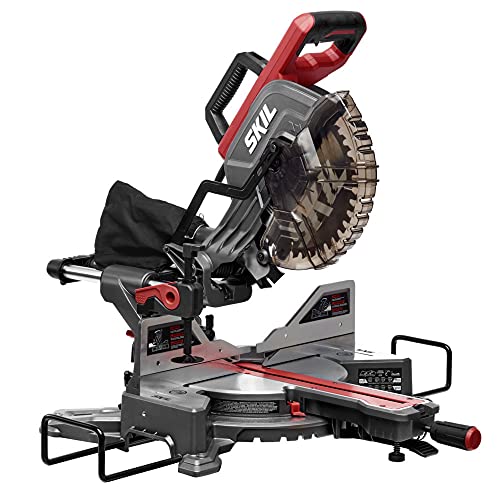
SKIL MS6305-00 10-Inch Sliding Compound Miter Saw
What We Like
- Powerful 15-amp motor for quick cuts
- Dual-bevel design with four positive stops
- LED shadow line for accurate alignment
- Cuts common angles with 11 positive stops
Trade-offs
- Weighs 39.4 lb, so it's less portable than a 24-lb saw like the Metabo HPT
- 35.4-inch length requires a substantial workbench
This saw delivers the core features of a professional sliding compound miter saw, a 15-amp motor, dual-bevel cuts, and a 2×12 crosscut capacity, at a fraction of the cost. That combination makes it a serious contender for the DIYer or contractor who needs to handle trim, framing, and decking but can’t justify a premium investment.
That capability comes with a substantial footprint. Weighing 39.4 pounds and with a length of 35.4 inches, this saw is better suited for a stationary workshop bench than frequent transport. Compared to other models like the Bosch CM10GD, its dimensions require more planning for permanent placement. For a user setting up a dedicated station, however, the SKIL delivers the core features needed for precise cuts at a value price.
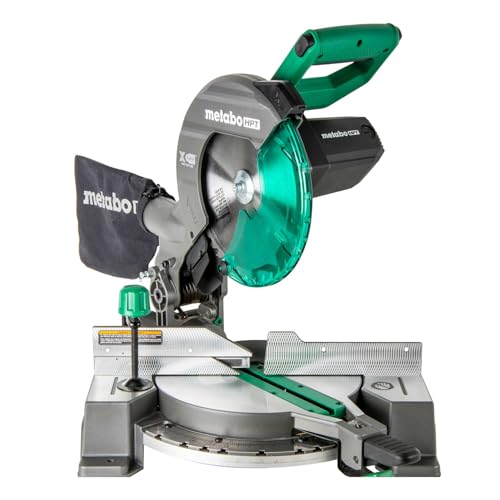
Metabo HPT C10FCG2 10-Inch Compound Miter Saw
What We Like
- Lightweight at 24.2 pounds for easy transport
- Powerful 15-Amp motor for demanding cuts
- Large table provides better material support
- Includes a vice clamping system for safety
Trade-offs
- Single-bevel design limits compound cutting flexibility
- No sliding mechanism reduces crosscut capacity
Weighing 24.2 pounds, this saw is easy to lift onto a workbench or carry to a job site. Its 15-Amp motor generates a no-load speed up to 5,000 RPM for what the brand calls effortless cuts. An improved miter scale and large table provide better material support, while the vice clamping system secures the workpiece.
The trade-off for that portability is the single-bevel, non-sliding design. You can’t tilt the blade to the right for complex crown molding setups, and you’re limited to the blade’s 10-inch diameter for crosscuts. For stationary shop work requiring wider boards or dual-bevel convenience, a model like the Bosch CM10GD with its dual-bevel glide system is the more capable, though much heavier, alternative. This Metabo HPT model excels where its light weight and straightforward operation are the top priorities.
Product photos
Bosch GCM18V-10SDN Cordless 10-Inch Sliding Miter Saw
What We Like
- Large crosscut capacity for wide boards
- Dual-bevel design for compound cuts
- Tall fence supports taller material
- Lightweight design with a carry handle
Trade-offs
- Tool-only kit requires separate battery purchase
- Large 37.5-inch length demands ample workspace
A cut capacity of 11-1/2 inches wide means you can handle a 2×12 board in a single pass without flipping it, which is serious capability for a cordless saw. That dual-bevel design and tall fence make it a proper shop saw, but one you can unbolt from the bench and carry to a job site. This saw is built for the pro who needs cordless freedom without giving up the capacity for large trim or decking work. The Biturbo brushless motor is engineered to fully exploit Bosch’s high-power batteries, delivering the muscle you’d expect from a corded model.
The trade-off is that you’re buying into a system. The saw arrives as a bare tool, so you must already own or purchase the high-power battery and charger separately. That’s a significant additional investment. For a contractor already deep in the Bosch 18V ecosystem, this is a logical and powerful addition. When comparing it to a dedicated corded model like the Bosch CM10GD, you’re trading the consistent power of a cord for ultimate portability. You’ll need to factor in the cost of the battery pack to make it run.
Product photos
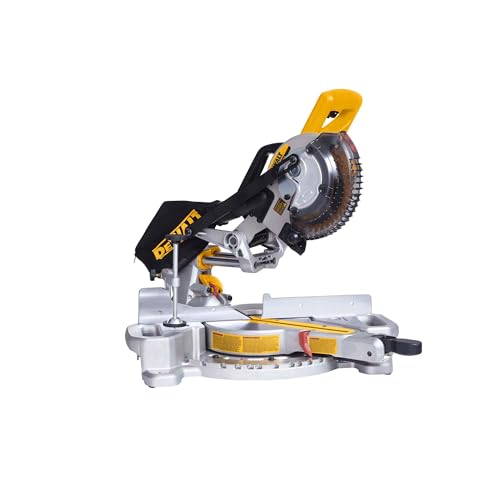
DeWalt DCS361B 7-1/4-Inch Cordless Miter Saw
What We Like
- Integrated cut line system for adjustment-free accuracy
- Compact, 30 lb design for easy transport
- Oversized bevel scale for easy angle adjustments
- Cam lock miter handle for quick angle setting
Trade-offs
- Tool only: requires separate battery and charger purchase.
- 7-1/4 inch blade limits maximum cut depth.
- Single-bevel design cannot tilt in both directions.
At 30 pounds, this cordless miter saw is light enough to carry from a truck to a workbench without strain. Its compact size suits finish carpenters moving between job sites or DIYers with limited garage space where a large stationary saw won’t fit. An integrated shadow line indicator provides adjustment-free cut line visibility for accurate positioning. This design serves users who need a capable saw that is also easy to transport and store.
The trade-off for that portability is capacity. You can’t tackle large crown or wide baseboards like you could with a 10-inch or 12-inch saw. For full-sized framing or heavy trim jobs, you’d want the stationary power and larger cut of a model like the DeWalt DWS780. But for its intended role, precision crosscuts and common trim on the go, this saw delivers the core DeWalt performance in a package that’s genuinely easy to carry.
Product photos
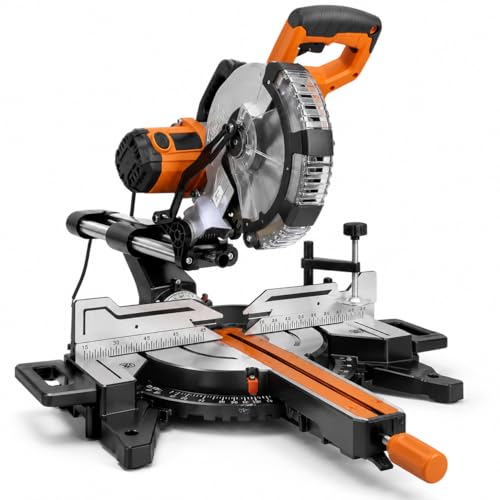
Diggtek 10-Inch Dual-Bevel Sliding Miter Saw
What We Like
- LED shadow line for precise cut alignment
- Dual-bevel design for compound-angle cuts
- Two-speed motor for material-specific control
- Sliding rail for wide 13-inch crosscuts
Trade-offs
- Large 33.6-inch length requires a spacious workbench
- Single 48-tooth blade included; no blade variety
A 3.5 x 13-inch crosscut capacity means this saw can handle wide crown molding and deck boards in a single pass, a step up from basic chop saws. The dual-bevel design and LED shadow line make it a versatile and user-friendly choice for DIYers tackling trim, flooring, and furniture projects where precise angles matter. It packs the core features needed for serious home workshop tasks without unnecessary complexity.
This saw’s 33.6-inch length requires a dedicated bench space, a trade-off for its sliding rail capacity. That traditional rail design extends its footprint compared to other models in the category, so plan your workshop layout accordingly.
Product photos
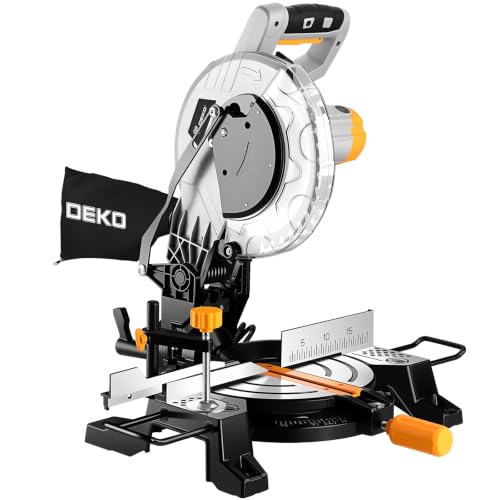
DEKOPRO 10-Inch Compound Miter Saw
What We Like
- Lightweight and portable at 20.5 lbs
- Transparent blade guard for clear view
- Secure clamp and large work table
- Locking head for compact storage
Trade-offs
- Single-bevel design limits complex crown molding
- Non-sliding 10-inch blade restricts cut width
Weighing just 20.5 pounds, this saw is easy to haul from your garage to a backyard project without straining your back. That single-bevel 0-45° range and miter stops handle most trim work and basic framing angles just fine. The 13-Amp motor spins the included blade at 5,000 RPM, which is enough grunt for clean cuts in pine, laminate, and common boards. For a DIYer setting up on a sawhorse for the afternoon, it’s a straightforward, manageable tool that gets the fundamentals right.
The 10-inch blade does not slide, limiting the width of material that can be cut in a single pass compared to sliding models. As a single-bevel saw, it requires flipping the workpiece for compound cuts on opposite sides, unlike dual-bevel alternatives. Features like the large work table and clamp system are designed for stability, while the transparent blade guard aims to provide a clearer view of the cut line during operation.
Product photos
How We Evaluated Miter Saws
Our evaluation is research-based, focusing on specifications, manufacturer documentation, expert round-ups, and consistent patterns in owner feedback. We prioritized cutting capacity, accuracy systems, portability, and power source to distinguish tools for different users. Key criteria included crosscut and vertical cut dimensions, the design of miter and bevel detents for repeatable angles, and whether a saw’s sliding mechanism allowed a flush-to-wall placement to save shop space.
A limit of this approach is that we cannot verify long-term durability claims or personal ergonomic preferences, which can vary significantly between users. For a deeper dive into models suited for fine craftsmanship, read our guide on the best miter saws for woodworking.
What To Look For In Miter Saws
Your ideal miter saw balances the cut capacity you need with the space you have. A sliding mechanism expands width capacity, while blade size dictates maximum depth. Consider where you’ll use it most, a permanent shop station can handle a heavier 12-inch saw, while frequent transport demands a lighter, more compact model.
Key factors are cutting capacity (blade size and slide), accuracy features (detents and guides), and form factor (weight and footprint). Match the saw’s strengths to your typical projects, whether that’s fine trim work or framing large lumber.
Cutting Capacity and Blade Size
Cutting capacity is determined by blade diameter and whether the saw slides. A standard 10-inch compound miter saw can typically cut a 2×6 at 90 degrees, while a 10-inch sliding model can handle a 2×12 or a 4×4. A 12-inch sliding saw offers even greater depth and width.
Blade tooth count also matters; a 40-tooth blade is good for framing, while an 80-tooth blade leaves a smoother finish for trim. Our research on choosing miter saw size can help you decide between a 10-inch or 12-inch model based on your material.
Accuracy and Adjustability
Precision hinges on a saw’s adjustment systems. Look for positive miter detents at common angles like 22.5 and 45 degrees for repeatable cuts. A dual-bevel design allows the saw head to tilt both left and right, which is essential for complex crown molding without flipping the workpiece. For alignment, an integrated LED shadow line system, like DeWalt’s XPS, projects the cut path onto the material and requires no manual adjustment, unlike some laser guides that can drift. A front-mounted bevel lock is a major ergonomic advantage over rear-mounted controls.
Portability and Power Source
Weight and footprint define portability. A lightweight saw like the Metabo HPT C10FCG2 at 24 pounds is easy to carry to a jobsite, while a heavier sliding saw is meant for a stationary stand. Cordless models offer mobility but add the cost of a battery system; they are ideal for framers and finish carpenters working without easy outlet access.
For stationary shop use, a powerful corded motor provides consistent, unlimited runtime. When considering a cordless model, ensure it’s part of a battery platform you already own or are willing to invest in.
- Check the saw’s length to ensure it fits on your workbench or stand.
- Verify the weight if you plan to move it regularly.
- For cordless models, confirm the battery voltage and amp-hour rating for sufficient runtime.
- Consider if the sliding mechanism extends behind the saw, requiring extra wall clearance.
- Look for a built-in carry handle if transport is a priority.
The most important rule: buy for your most common task, not a rare, extreme project.
Miter Saws Compared
The following table compares the key specifications of our top picks to help you see the differences at a glance.
| Product | Motor | Weight | Bevel Range |
|---|---|---|---|
| DeWalt DWS780 12-Inch Sliding Compound Miter Saw | 15 amp, 3800 rpm | 54.7 pounds | Double Bevel |
| Bosch CM10GD 10-Inch Dual-Bevel Glide Miter Saw | 15 Amp, 4800 RPM | 64.0 pounds | 47° left and right |
| Makita LS1019L 10-Inch Sliding Compound Miter Saw | N/A | 57.9 pounds | Dual-Bevel |
| Makita XSL06PT Cordless 10-Inch Sliding Miter Saw | Brushless | 80.5 pounds | Dual-Bevel |
| SKIL MS6305-00 10-Inch Sliding Compound Miter Saw | 15 Amp, 4,800 RPM | 39.4 pounds | 48° left to 45° right |
| Metabo HPT C10FCG2 10-Inch Compound Miter Saw | 15 Amp | 24.2 pounds | 0-45° left |
| Bosch GCM18V-10SDN Cordless 10-Inch Sliding Miter Saw | Biturbo brushless motor | 40.2 lb | Dual-bevel |
| DeWalt DCS361B 7-1/4-Inch Cordless Miter Saw | N/A | 30.0 pounds | N/A |
| Diggtek 10-Inch Dual-Bevel Sliding Miter Saw | 15 Amp | N/A | 0-45° dual bevel |
| DEKOPRO 10-Inch Compound Miter Saw | 13-Amp | 20.5 lbs | 0° to 45° |
Frequently Asked Questions
What is the best brand of mitre saw?
There isn’t a single “best” brand, as top manufacturers excel in different areas. DeWalt is renowned for durable, high-capacity saws with excellent alignment systems, Bosch innovates with space-saving glide mechanisms, and Makita is favored for precision and smooth operation. The best brand for you depends on whether you prioritize cutting capacity, workshop footprint, or fine woodworking accuracy.
Which mitre saw is considered the best quality?
Quality in miter saws is demonstrated through precise, repeatable cuts, durable construction, and thoughtful ergonomics. Saws like the DeWalt DWS780 and Makita LS1019L are consistently highlighted for their build quality, accurate detent systems, and smooth sliding action. High-quality saws maintain alignment over time and have controls placed for easy access, reducing setup errors.
What is the most accurate miter saw?
The most accurate miter saws feature systems that eliminate guesswork. The DeWalt DWS780 uses an XPS LED shadow line that projects directly from the blade housing, requiring no calibration. The Makita LS1019L employs linear ball bearings in its slide for exceptional smoothness and consistency. Accuracy is also ensured by positive miter detents and solid, easy-to-reach locking levers.
Should I buy a 10 or 12 miter saw?
Choose a 10-inch saw if you primarily work with standard dimensional lumber and need a more portable or compact tool. Opt for a 12-inch sliding compound miter saw if you regularly cut wider boards, like a 2×12, or need greater vertical capacity for tall crown molding. The 12-inch saw is larger, heavier, and often more expensive, so it’s best for a dedicated workshop. Our miter saw size comparison details this trade-off.
What is the difference between compound and sliding miter saws?
A compound miter saw can tilt its blade to make bevel cuts in addition to miter angles. A sliding miter saw has a mechanism that allows the blade to slide forward, greatly increasing its crosscut width capacity. Many saws, called sliding compound miter saws, combine both features. You can learn the fundamentals of using a miter saw to understand how these functions work together.
The Bottom Line
The best overall choice for professionals and serious DIYers is the DeWalt DWS780 12-Inch Sliding Compound Miter Saw, which delivers uncompromising accuracy and maximum cutting capacity for a shop setting. If budget is the primary concern, the SKIL MS6305-00 provides excellent sliding capability and a shadow line at a much lower price. Mobile users should consider the lightweight Metabo HPT C10FCG2 or cordless options like the Makita XSL06PT. Ultimately, the most important factor is matching the saw’s capacity and form factor to your available space and the cuts you make most often.
