
10 Best Oscillating Sanders in 2026
This post contains affiliate links. As an Amazon Associate, we earn from qualifying purchases.
Our best overall pick is the SKIL 5-Inch Random Orbital Sander, which combines effective dust collection with a low-vibration design for comfortable, clean work. The DEWALT 20V MAX Orbital Sander is our best low-weight cordless choice, and the BOSCH ROS20VSC Palm Sander excels at delivering smooth, swirl-free finishes.
Choosing the right oscillating sander means matching its strengths to your specific tasks and workspace. A heavy-duty floor sander is overkill for delicate trim, while a tiny detail sander will frustrate you on a large tabletop. We researched specifications, manufacturer data, expert round-ups, and patterns in owner feedback to compile this list of ten top tools.
Our goal is to help you find a sander that feels right in your hand and delivers the finish you need.
Top 10 Oscillating Sanders in the Market
Certain content that appears on this site comes from Amazon. This content is provided "as is" and is subject to change or removal at any time.
The Best Oscillating Sanders, Reviewed
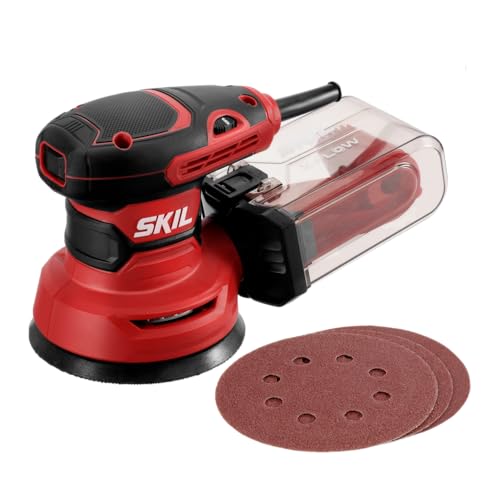
SKIL 5-Inch Random Orbital Sander
What We Like
- Cyclonic dust container is easy to empty
- Low vibration design reduces hand fatigue
- Compact, ergonomic shape for tight spaces
- Dust-sealed on/off switch for simple operation
Trade-offs
- Corded design limits mobility compared to battery models
- Requires a power outlet, not for remote job sites
A 2.8-amp motor spinning at 13,000 orbits per minute provides plenty of power for aggressive stock removal while still finishing smoothly, which is the hallmark of a true all-rounder. Its cyclonic dust box keeps the work area cleaner and the variable speed dial lets you match the pace to the material, from soft pine to hard maple. This combination of core performance and thoughtful features makes it a ready choice for the workshop where you need one sander to handle most tasks.
Weighing 3.4 pounds, the SKIL sander is lighter than several other corded models, which helps reduce fatigue during extended use. Its corded design provides consistent power without the need to monitor battery levels. The integrated cyclonic dust collector keeps the work area cleaner by trapping debris in a transparent, easy-to-empty container.
DEWALT 20V MAX Orbital Sander

What We Like
- Exceptionally light weight at only 2.5 pounds.
- Variable speed control for different applications.
- Low-profile design for sanding close to surfaces.
- Dust-sealed switch for improved durability.
Trade-offs
- Tool only: requires separate purchase of battery and charger.
- Dust collectors and sanding pad are sold separately.
The DEWALT DCW210B is a cordless orbital sander that uses a 20V MAX battery, sold separately. Its brushless motor is designed for runtime and efficiency. Variable speed control adjusts from 8,000 to 12,000 orbits per minute, allowing you to select the right pace for different materials.
At 2.5 pounds, the tool has a low-profile height designed to let users get close to the work surface. A texturized rubber overmold grip aims for comfortable handling. The one-handed locking dust bag and a dust port compatible with DEWALT dust collectors are included, though those extractors are sold separately.
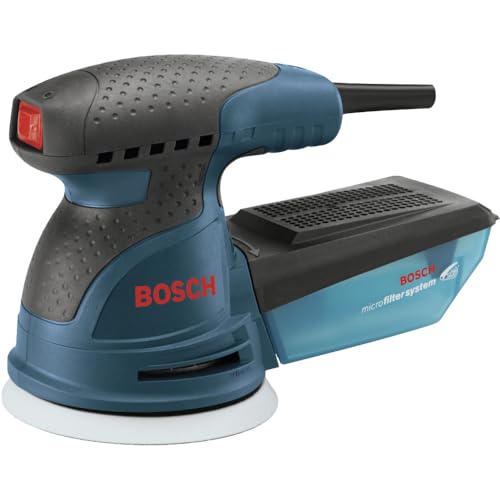
BOSCH ROS20VSC Palm Sander
What We Like
- Pad dampening system minimizes swirl marks
- Variable speed control for different materials
- Excellent microfiltration dust collection
- Twist-off canister shows dust level
Trade-offs
- At 3.5 lb, it's heavier than the cordless DEWALT
A pad dampening system designed to minimize swirl marks is the core reason this sander excels at final finish work. That specific feature, combined with a variable speed motor and a fine microfiltration dust collector, makes it a deliberate choice for anyone sanding down to a ready-to-stain or paint surface. It’s built for the woodworker who values a flawless final pass over raw material removal speed, prioritizing control and a clean workspace.
The trade-off is in its heft and cord. At 3.5 pounds, it carries more weight than some competitors like the DEWALT 20V MAX, and you’re always tethered to an outlet. That makes it less suited for quick, mobile touch-ups or overhead work. For a dedicated bench sander focused on flat panels and contoured furniture, however, those are concessions worth making for the smooth results it delivers.
Proxxon Super Oscillating Detail Sander

What We Like
- Die-cast zinc housing ensures stability and longevity.
- Oscillating motion eliminates vibration and kickback.
- Hook & loop system allows for quick pad changes.
- Comes with a stable, well-organized storage case.
Trade-offs
- Sanding area is only 65 x 65 mm.
- No dust collection system is specified.
The Proxxon 38520’s triangular sanding pad measures 2 1/2 inches on each side, a size that allows it to work in tight corners and on intricate trim where larger tools cannot fit. Its oscillating motion is described as outperforming conventional orbital motion, operating without vibration or kickback for precise control on delicate surfaces. A die-cast zinc housing provides a stable base for the moving parts, which is intended to ensure longevity during detailed finishing work.
The sander’s 2 1/2-inch triangular pad is specialized for detail work, not for sanding large, flat areas efficiently. For broader surfaces, other products in the category like the SKIL 5-Inch Random Orbital Sander or the DEWALT 20V MAX Orbital Sander have larger physical dimensions, suggesting a different use case. This tool is supplied in a high-quality PP storage case designed for easy repacking, keeping it organized for specific, detailed tasks.
Makita BO5030K Random Orbit Sander

What We Like
- Rubberized grip for comfort and control
- Large orbit action for fast, smooth finish
- Pad control system prevents initial jerk
- Includes case, dust bag, and abrasive disc
Trade-offs
- Corded design limits mobility
- 15-inch length requires ample storage
A 3.0 AMP motor delivers 12,000 orbits per minute, providing speed for material removal. Its 1/8-inch random orbit action is designed for a super smooth finish, according to the manufacturer. The tool ships with a plastic case, which helps keep the sander, dust bag, and included abrasive disc organized and protected during storage or transport.
The included case means the tool needs more space in your toolbox or on a shelf than compact palm sanders like the Bosch ROS20VSC, as it is 15 inches long. It’s a corded machine, so you’re tethered to an outlet, but that also means you never have to wait for a battery to charge. For sustained sanding sessions on furniture or cabinetry where dust collection and a smooth finish are priorities, this Makita is a reliable choice.
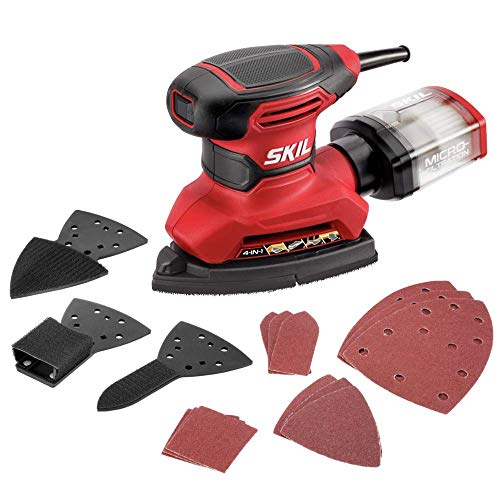
SKIL Multi-Function Detail Sander
What We Like
- Four-in-one versatility with three detail attachments.
- Hook and loop system for quick sanding sheet changes.
- Low-vibration design with counterweight balance.
- Micro-filtration dust box and vacuum port for dust control.
Trade-offs
- Corded design limits mobility compared to battery models.
- Fixed orbit speed lacks variable speed control.
Skil’s SR232301 detail sander delivers 13,500 orbits per minute from its 1.2 amp motor, which is ample power for its intended fine finishing tasks. The tool’s four-in-one versatility comes from three attachments that change without tools, letting you switch between sanding large surfaces, corners, edges, and contoured shapes.
This sander is corded and operates at a single speed, providing consistent power while requiring an outlet. Compared to the variable-speed BOSCH ROS20VSC palm sander, the Skil model offers less speed control for different materials. However, it bundles multiple sanding capabilities into a compact body weighing 2.6 pounds.
Product photos
BLACK+DECKER Detail Sander

What We Like
- Compact design for tight corners and spaces
- Corded for unlimited runtime and continuous power
- Ergonomic comfort grip reduces user fatigue
- Dust-sealed switch protects internal mechanisms
Trade-offs
- Corded design limits portability and range of motion
A 1.2 Amp motor driving 16,000 orbits per minute delivers consistent power for thorough material removal. This BLACK+DECKER sander is built for the detail-oriented DIYer who needs to tackle extended sessions on trim, furniture, or awkward angles. Its compact footprint and three-position grip let you work comfortably in cramped spaces, while the dedicated detail finger and pad attachments are designed to reach spots a palm sander can’t. The included dust collector helps keep your workspace somewhat cleaner, a genuine benefit for indoor projects.
A corded design offers unlimited runtime and continuous power, so you can sand for hours without stopping. Being tethered to an outlet reduces mobility, which can be a hassle when working on a large piece away from a workshop. For a dedicated bench setup or frequent, long sanding tasks where an outlet is always nearby, the cord is a minor concession for the reliability it provides.
Product photos
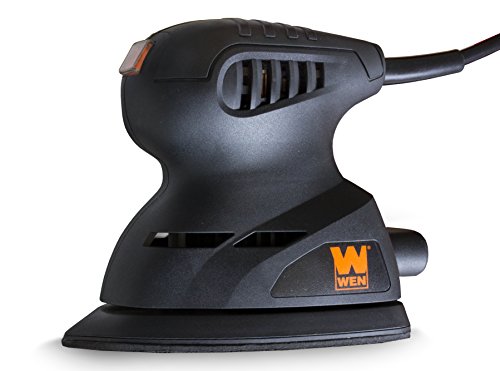
WEN 6301 Electric Detailing Palm Sander
What We Like
- Exceptionally light at just two pounds.
- Angled pad tip for precision sanding in corners.
- Velcro base allows for quick sandpaper changes.
- Integrated dust port helps contain the mess.
Trade-offs
- Smaller pad than full-size sheet sanders.
At just two pounds, the WEN 6301 is light enough for extended use without causing arm fatigue. Its compact, angled pad measures 3.75 by 5.5 inches for precision work in tight corners and on detailed trim. A Velcro base pad allows for simple sandpaper changes to maintain workflow.
That lightweight design comes with a smaller pad and a fixed speed of 13,500 orbits per minute. Compared to full-size sheet sanders like the Makita BO3710, the WEN covers less area per pass. Its focused size is an advantage for intricate tasks where larger tools cannot fit.
Product photos
Makita BO3710 Sheet Finishing Sander
What We Like
- Built-in counterbalance system reduces vibration
- Large trigger with lock-on for continuous use
- Efficient dust collection for cleaner work
- Ergonomic rubberized grip adds comfort
Trade-offs
- Weighs 4.9 pounds, heavier than many palm sanders
- Corded design limits mobility versus battery models
- Larger footprint than compact detail sanders
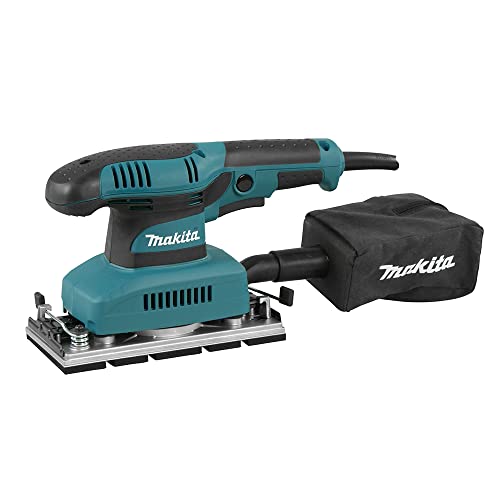
Makita’s BO3710 sheet finishing sander uses a built-in counterbalance system engineered to reduce vibration, which makes long sanding sessions far less fatiguing. Its 11,000 orbits per minute provide a smooth finish, and the through-the-pad dust collection system helps maintain a cleaner work environment by pulling debris away from the surface.
The sander’s 4.9-pound weight gives it a solid feel on the workbench, though this heft is more noticeable than on lighter palm sanders like the 3.5-pound BOSCH ROS20VSC. Its ergonomic rubberized grip and large trigger with a lock-on button are designed for added comfort during continuous use on flat or gently contoured pieces.
Product photos
DEWALT DWE6411 Sheet Sander

What We Like
- Rubber overmold for comfortable, controlled grip.
- Reduced height design gets closer to the workpiece.
- Locking dust-port system secures vacuum hose.
- Separate counterweight design minimizes vibration.
Trade-offs
- Corded design limits mobility compared to battery models.
- At 3.7 lb, it's heavier than most palm sanders.
A reduced overall height gets the user closer to their work, which allows for direct pressure application over the sanding pad. This design, combined with a 14,000 OPM motor, suits detailed finishing tasks. The rubber overmold texture provides smooth and comfortable control during operation.
Weighing 3.7 pounds, this sander is heavier than some cordless orbital models like the 2.5-pound DEWALT 20V MAX. Its locking dust-port system is designed for shop use with a vacuum hose. The tool is corded and uses a 1/4 sheet sanding profile, differing from the orbital action of many compact sanders.
Product photos
How We Evaluated Oscillating Sanders
Our evaluation was research-based. It focused on specifications from manufacturers, insights from expert tool round-ups, and consistent patterns in verified owner feedback. We prioritized criteria that directly impact performance and user comfort. These include vibration control for reducing hand fatigue, effective dust collection for a cleaner workspace, and the tool’s form factor for accessing tight spaces or covering large areas efficiently. We also considered the power source, as cordless models offer mobility while corded ones provide unlimited runtime.
This research approach allows us to compare features and reported experiences across many models, but it has limits. We cannot replicate long-term durability testing or measure precise sanding speed differences. Our recommendations are based on the collective evidence available, helping you narrow your search to models that are well-regarded for the jobs you do most often.
What To Look For In Oscillating Sanders
The right oscillating sander makes finish work faster and more comfortable. Your choice should balance power, precision, and how you plan to use it.
Key criteria are vibration control for comfort, dust collection for a clean shop, and the tool’s size and pad type for your project scale. Cordless models offer freedom, while corded ones provide consistent power.
Vibration Control
Excessive vibration is the primary cause of hand fatigue during extended sanding sessions. Look for models with built-in counterbalance systems or low-vibration motor designs. For example, some sanders use a separate counterweight, while others rely on a balanced orbital motion. A lighter tool isn’t always the most comfortable if it vibrates excessively; a slightly heavier model with excellent damping can be less tiring over hours of work.
Dust Collection
Good dust collection keeps your workspace clean, improves visibility of your work line, and protects the sander’s internal switch and motor. Systems vary from simple dust bags and cyclonic canisters to ports designed for shop vacuum hookup. A sealed on/off switch is a valuable feature that prevents abrasive dust from causing premature switch failure. When researching best sanders, pay close attention to how each model manages dust.
Form Factor & Pad Type
The sander’s physical design determines what jobs it can handle. Full-size random orbital sanders with five- or six-inch pads are efficient for smoothing large, flat surfaces. Compact palm sanders and detail sanders with smaller, often triangular pads are essential for working in corners, on edges, and on intricate moldings.
Some detail sanders offer multi-function attachments for even greater versatility in tight spaces. The choice between a stationary benchtop machine and a handheld tool is fundamental; a benchtop oscillating spindle sander is ideal for perfecting curved edges, while a handheld tool is for broader surface finishing.
- Match the pad size and shape to your most common projects.
- Consider the tool’s weight and grip comfort for overhead or vertical sanding.
- Check if the sander’s profile is low enough to sand flush against adjacent surfaces.
A good rule of thumb: if you mostly work on large panels, choose a random orbital sander; if you focus on furniture details and trim, a detail or palm sander is likely better.
Oscillating Sanders Compared
The table below provides a side-by-side comparison of key features to help you see the differences at a glance.
| Product | Motor Power | Orbit Speed (OPM) | Weight | Dust Collection |
|---|---|---|---|---|
| SKIL 5-Inch Random Orbital Sander | 2.8 amp | 13,000 orbits per minute | 3.4 pounds | Cyclonic dust box |
| DEWALT 20V MAX Orbital Sander | Brushless motor | 8,000 to 12,000 OPM | 2.5 Pounds | Fits DWV010/DWV012 collectors |
| BOSCH ROS20VSC Palm Sander | 2.5 AMP | 7,500-12,000 OPM | 3.5 pounds | 1/2-micron particles filter |
| Proxxon Super Oscillating Detail Sander | N/A | N/A | N/A | N/A |
| Makita BO5030K Random Orbit Sander | 3.0 AMP | 12,000 OPM | 2.9 pounds | Through-the-pad system |
| SKIL Multi-Function Detail Sander | N/A | 13,500 orbits per minute | 2.6 pounds | 1-1/4 inch for vacuum |
| BLACK+DECKER Detail Sander | 1.2 Amp | 16,000 OPM | N/A | Includes canister |
| WEN 6301 Electric Detailing Palm Sander | 1-amp | 13,500 OPM | 2 pounds | Dust port |
| Makita BO3710 Sheet Finishing Sander | 1.7 A | 11,000 OPM | 4.9 pounds | Through-the-pad system |
| DEWALT DWE6411 Sheet Sander | 2.3 AMP | 14,000 OPM | 3.7 Pounds | DWV010 or DWV012 collectors |
Frequently Asked Questions
Who makes the best oscillating spindle sander?
For benchtop oscillating spindle sanders, a research-based evaluation points to models that offer a solid, flat table, good dust collection, and a range of drum sizes for different curve radii. While we don’t test specific brands here, our research into oscillating spindle sander models shows that well-regarded options often include features like tool-free spindle changes and built-in storage for accessories.
What is the best multi-purpose sander?
A multi-purpose sander typically combines different functions in one tool. For handheld work, a multi-function detail sander with interchangeable pads for corners, flat surfaces, and curves offers great versatility for DIY projects. In a benchtop format, a combination machine that functions as both an oscillating belt and spindle sander provides two distinct sanding actions in one unit, which is valuable for a small shop.
What company makes the best sanders?
There is no single “best” company across all sander types, as brands often specialize. Some brands are renowned for their powerful stationary oscillating belt sanders, while others excel in ergonomic handheld random orbital sanders. The best approach is to identify the specific type of sander you need first. Consider whether it’s a detail sander, palm sander, or benchtop oscillating drum sander. Then, research which brands are consistently praised for performance and reliability in that category.
What orbital sander has the least vibration?
Orbital sanders with dedicated counterbalance systems are engineered specifically to minimize vibration. Our research indicates that models highlighting a “low-vibration design” or a “built-in counterbalance” in their specifications and owner feedback typically perform best in this regard. This feature is crucial for reducing fatigue during long sanding sessions on large projects.
Can I use my oscillating multi-tool for sanding?
Yes, with the right accessory pad, an oscillating multi-tool can sand in tight spots where larger sanders won’t fit. It’s excellent for detail work, scraping off old finish, or feathering edges. However, its small sanding surface and aggressive action make it less ideal for achieving a smooth, even finish on large areas compared to a dedicated random orbital or sheet sander. For proper technique, you can explore guides on sanding with an oscillating multi-tool.
The Bottom Line
The SKIL 5-Inch Random Orbital Sander is our best overall pick for the DIYer or pro who wants a dependable, corded workhorse with excellent dust control and reduced vibration for general workshop tasks. If your priority is cordless mobility and minimal weight, choose the DEWALT 20V MAX Orbital Sander; for the absolute smoothest finish on fine woodworking, the BOSCH ROS20VSC Palm Sander is the clear winner.
Budget-conscious shoppers should look at the BLACK+DECKER Detail Sander, while those needing pinpoint accuracy on moldings will find the Proxxon Super Oscillating Detail Sander unmatched. Ultimately, let your most common project size and need for cordless freedom guide your final choice.
