
10 Best Oscillating Drum Sanders in 2026
This post contains affiliate links. As an Amazon Associate, we earn from qualifying purchases.
Our top choice is the Jet Benchtop Oscillating Spindle Sander, a durable benchtop workhorse with a stable cast iron table that minimizes vibration for precise contour work. Our budget pick, the WEN Oscillating Spindle Sander, offers onboard storage and dust collection, while the Powermatic model wins for its large digital display and massive cast iron table. This guide helps you find the right machine for your shop’s space and workload.
Shopping for an oscillating drum sander means balancing power, footprint, and precision. You need a machine that fits your bench or floor space while offering the stability to tackle detailed curves or wide panels. The right choice saves hours of hand-sanding and produces a consistently smooth, ready-to-finish surface.
We built this list by comparing manufacturer specifications, studying expert recommendations, and analyzing patterns in owner feedback across brands. You’ll find ten picks, from premium cast-iron floor models to compact benchtop units, each suited to a different workspace and budget.
Top 10 Oscillating Drum Sanders in the Market
Certain content that appears on this site comes from Amazon. This content is provided "as is" and is subject to change or removal at any time.
The Best Oscillating Drum Sanders, Reviewed
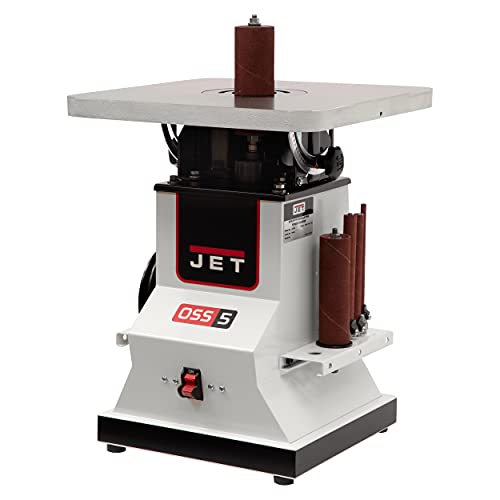
Jet Benchtop Oscillating Spindle Sander
What We Like
- Cast iron table provides a stable, vibration-dampening work surface.
- Sealed, lubricated gearbox for long-term durability and consistent oscillation.
- Built-in storage for spindles and table inserts keeps accessories organized.
- Includes four table inserts to minimize dust ingress into the motor.
Trade-offs
- Does not include variable speed control as a feature.
- Fixed 1/2 HP motor offers less power than some 1 HP cabinet models.
The 1-inch oscillating action reduces friction heat, which protects wood from burning and helps sanding sleeves last longer. Jet builds this into a benchtop sander with a heavy-duty worm and gear mechanism for consistent performance, all anchored by a 14-1/2 inch cast iron table that tilts to 45 degrees for bevels. This combination suits a serious hobbyist or small shop needing reliable results on contours and inside curves. Five spindle assemblies from 1/4 inch to 2 inch are included, covering most common sanding tasks.
Its weight of 75.6 pounds means it needs a dedicated, sturdy benchtop, trading portability for a stable, industrial-grade foundation. This heft contributes to smooth operation for a stationary setup. Compared to a lighter model like the 30.2-pound WEN 6510T, the Jet is a more permanent workshop fixture. The design prioritizes long-term reliability and a solid work surface over easy movability.
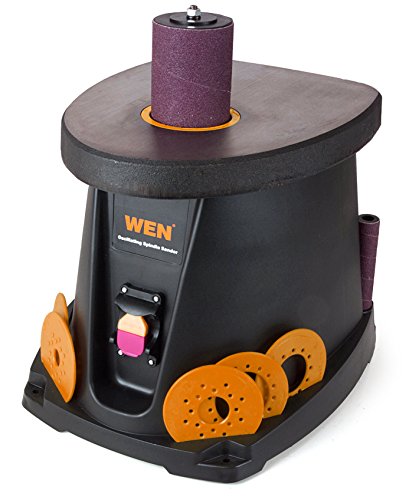
WEN Oscillating Spindle Sander
What We Like
- Includes onboard storage for all accessories
- Dust collection port for a cleaner workspace
- Relatively compact 30.2 lb benchtop footprint
Trade-offs
- 58 OPM oscillation is slower than some premium models
- No variable speed control listed in specifications
The WEN 6510T’s 3.5 amp motor provides 58 OPM and 2000 RPM. Onboard storage keeps its accessories organized, and a dust collection port allows connection to an extractor to reduce cleanup.
The trade-off for that simplicity is in refinement; the oscillation speed is modest, which can affect finish quality on some materials compared to faster models like the Powermatic OSS10. Its lighter weight also means it might benefit from being firmly bolted down during heavier use to minimize chatter. For someone stepping up from hand-sanding or a smaller portable unit, however, the WEN 6510T represents a capable and sensible entry point into stationary spindle sanders.
Powermatic Oscillating Spindle Sander

What We Like
- Large, clear digital display for speed and angle
- Massive, stable cast iron work table
- Wide 0 to 45-degree table tilt range
- Variable speed and high oscillation for clean finish
Trade-offs
- At 335 pounds, it requires a permanent, heavy-duty shop floor space
- Its 39.8-inch height demands significant vertical clearance
With an oscillation distance of 1.5 inches and a rate of up to 60 oscillations per minute, the machine is designed for a cleaner, scratch-free finish. Its 24.5-inch square cast iron table is engineered to stay flat, providing a stable surface for detailed work on curves and inside cuts. A large digital display allows for precise monitoring of spindle speed and sanding angle, which supports repeatable setup.
The sander’s dimensions and weight of 335 pounds give it a substantial footprint, meaning it requires a permanent, sturdy location in a workshop. When compared to the 75.6-pound Jet JBOS-5 benchtop model, the Powermatic OSS10 demands significantly more floor space. This design prioritizes a stable, stationary installation over any form of portability.
Triton Cast Iron Oscillating Spindle Sander

What We Like
- Cast iron table provides superior stability for precision work.
- On-board storage keeps all six included sleeves and drums handy.
- Rotating and oscillating action delivers a smooth, efficient finish.
- Powerful 450W motor handles demanding sanding tasks.
Trade-offs
- At 20.5 inches tall, it requires significant vertical clearance on a bench.
With a 3.5-amp motor driving both rotation and oscillation, the Triton TSPS450 provides the power needed for sanding contours, arcs, and curves. Its cast iron top contributes to a stable work surface. This makes it a suitable choice for woodworkers seeking a precision finish on irregular shapes with a tool that feels solid on the bench.
You do pay for that stability in footprint and heft. It’s a sizable machine, so make sure you have the real estate for it. If your projects demand the absolute smoothest finish on intricate work, the Triton’s cast iron foundation is a compelling advantage. For more general shop use where space is tight, a more compact model like the WEN 6510T might be a better fit, though you’ll sacrifice that unwavering table surface.
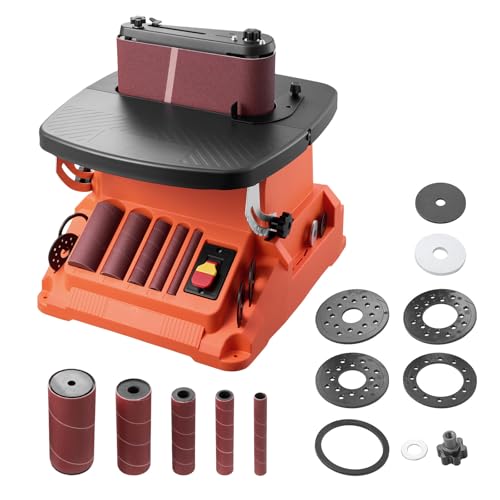
VEVOR Oscillating Belt and Spindle Sander
What We Like
- Combines belt and spindle sanding in one unit
- Comes with a complete kit of five sleeves and inserts
- Worktable tilts from 0 to 45 degrees for bevels
- Integrated storage for sleeves and table inserts
Trade-offs
- Single speed motor lacks the flexibility of a variable-speed unit.
- Requires shop vacuum connection for effective dust control.
This oscillating belt and spindle sander combines two tools in one benchtop footprint, a major space-saver for a crowded workshop. Its 2400 RPM speed is intended for efficient sanding on both flat and contoured surfaces, a logical fit for DIYers or small shops needing versatility. The kit includes five sanding sleeves and a belt, covering a wide range of common furniture and craft tasks.
Weighing 37.5 pounds, the sander is lighter than many dedicated spindle sanders, which may affect stability during continuous heavy-duty use. This manageable weight does simplify bench mounting for general woodworking projects. Having both spindle and belt functions in one unit remains a compelling practical advantage for most hobbyist applications.
Product photos
Woodskil Variable Speed Oscillating Spindle Sander

What We Like
- Variable speed control for delicate and tough work
- Six sanding sleeves cover a wide range of tasks
- Effective dust collection with included port
- Compact 26-pound design for easy storage
Trade-offs
- Motor power may be less than heavier-duty stationary models
- Sleeves stop at 3", limiting sanding of larger interior curves
A variable speed range of 1000 to 1800 RPM gives you direct control over the sander’s aggression, a feature missing from fixed-speed models. That means you can dial down the speed for softwoods or intricate curves to avoid burning, then crank it up to power through hardwoods and flat edges. It’s the right fit for a woodworker who tackles a diverse mix of projects and needs a single benchtop machine to handle everything from fine furniture details to smoothing larger components. The 2/3HP motor provides enough grunt for most tasks without demanding a permanent spot on your workbench.
You do trade some raw power for that compact 26-pound footprint. It’s significantly lighter than a pro-grade unit like the Powermatic OSS10, which means it’s easier to move around the shop but also less massive for damping vibration on the heaviest cuts. Think of it as a capable all-rounder for the serious hobbyist or small professional shop, rather than a production-floor workhorse. When compared to a simpler, fixed-speed model like the WEN 6510T, the Woodskil’s speed control is the clear upgrade for anyone who values finish quality over sheer simplicity.
Product photos
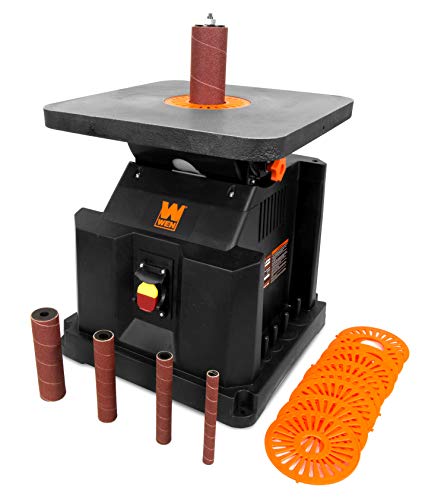
WEN Benchtop Oscillating Spindle Sander
What We Like
- Five spindle sizes for detailed to broad curves
- Large beveling table for angled workpiece support
- Onboard storage for accessories and sandpaper
- Compact 33.2 lb footprint fits small benches
Trade-offs
- Single 2000 RPM speed limits material versatility
A 14-1/2 inch square table that tilts to 45 degrees gives you a solid, sizable platform for sanding complex edges and miters. This sander is built for the space-conscious workshop where every square inch counts. Its five spindle sizes handle everything from tight guitar curves to gentle cabinet arcs, and the whole unit stows its own sanding sleeves. That makes it a logical fit for a hobbyist or a small pro shop needing a dedicated, always-ready station for finish work without dedicating a full cabinet to it.
Its 2000 RPM motor operates at a single speed, which handles most wood sanding tasks but cannot be adjusted for delicate veneers or more aggressive composites. At 33.2 pounds, this WEN sander is less than half the weight of the 75.6-pound Jet JBOS-5, making it easier to move around a workshop. The design focuses on core benchtop sanding with a defined set of five spindle sizes, trading variable control and heavy-duty mass for a more manageable footprint.
RIKON Power Tools 50-300 Oscillating Drum Sander
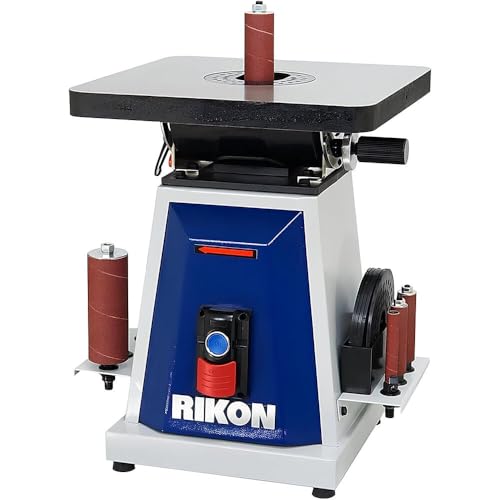
What We Like
- All-steel and cast iron construction for durability.
- Five spindle diameters from 1/2" to 2".
- Ample cast iron tilting table for stability.
- Includes six table inserts for different spindles.
Trade-offs
- Its 23.5-inch length requires more bench space than many benchtop models.
- Tool-only package lacks a stand or mobile base.
Built from all steel and cast iron, this sander weighs 80 pounds, giving it a solid foundation that dampens vibration. Its 1/2 HP motor and all-steel gearing provide power and durability. This heavy-duty construction suits a workshop where the tool can stay in one place on a sturdy bench.
That heft comes with a footprint. You’ll need a dedicated, sturdy work surface for its 80-pound mass. Compared to a more portable option like the Triton TSPSP650, this is a shop anchor, not a tool you’ll move around often. For a permanent installation where durability trumps portability, this Rikon’s construction is a clear advantage.
Product photos
Triton TSPSP650 Portable Spindle Sander

What We Like
- Tool-free quick-change spindle system
- Includes bench-mounting set and edge guide
- Dual-action rotating and oscillating spindle
- Compact and portable at 4.8 pounds
Trade-offs
- Limited to handheld or small bench-top use
- No built-in dust collection, requires adapter
A 650W motor paired with variable speed control from 1800 to 3200 rpm gives you the finesse to tackle curved cabinetry work without burning the wood. It also provides the muscle for quicker stock removal on sink openings. This is the sander you grab when the job moves around the shop or heads to the site, thanks to its handheld design and sub-5-pound weight. The included bench-mount kit adds stability for longer sessions, making it a versatile choice for the woodworker who values adaptability over a permanent footprint.
Portability requires a trade-off in scale. The Triton TSPSP650 weighs 4.8 pounds, so it won’t anchor a bench like a dedicated 75.6-pound model. Its included sanding sleeves reach a maximum of 1 1/2 inches in diameter, which suits detail work rather than large surfaces. For a stationary shop setup, a heavier benchtop machine may be the typical choice, but this tool’s dual nature is an advantage for projects that move between locations.
Product photos
JET JBOS-5 Benchtop Sander Kit

What We Like
- Table bevels up to 45 degrees for angled work
- Quick-change threaded spindles for fast swaps
- Flip-top design with handles for easy machine changes
Trade-offs
- Requires a separate benchtop machine for operation.
The kit includes a universal table with a 20″ x 29″ work surface, offering a stable platform that fits many benchtop machines. This sander’s table tilts up to 45° for beveling work. Threaded spindle ends allow for quick changes, which helps maintain an efficient workflow during detailed projects.
Its 1/2 HP motor and 1″ oscillating action are designed to reduce friction heat, protecting wood and prolonging sleeve life. The bottom frame has holes for adding custom storage shelves. Ergonomic handles on the flip-top design facilitate easy machine changes on the shared work surface.
How We Evaluated Oscillating Drum Sanders
Our research focused on comparing manufacturer specifications for motor power, table dimensions, and included accessories. We studied expert round-ups and cross-referenced them with the consensus from hundreds of owner reviews to identify which features delivered the most value and durability in a workshop setting.
We prioritized machines with stable, vibration-dampening tables (like cast iron), effective dust collection ports, and flexible sanding options such as variable speed or multiple spindle sizes. We also weighed the trade-offs between portability and power, noting that compact benchtop models often sacrifice motor horsepower compared to permanent floor-standing units.
This is a research-led evaluation, so we cannot report on long-term durability from personal testing. However, by focusing on build quality specifications and consistent themes in owner experiences, we can steer you toward reliable tools. If you’re considering a larger sanding system, you can explore the differences between a drum sander and a wide-belt sander.
What To Look For In Oscillating Drum Sanders
Your choice depends on your shop’s space, the scale of your projects, and your desired finish quality. Consider these key factors to find a sander that matches your workflow.
Prioritize a stable, vibration-dampening work table for precision, effective dust collection for a clean shop, and a motor with enough power for your typical materials.
Table Stability & Construction
The work table is the foundation of a precise sanding operation. A cast iron table provides superior mass to dampen vibration, allowing for more controlled, detailed work on contours and curves. Benchtop models with stamped steel tables can be adequate for lighter duty but may transmit more vibration. Table tilt is also valuable; a range of 0 to 45 degrees enables precise bevel sanding on edges. For users who primarily need a stable benchtop work surface, comparing the features of a dedicated benchtop sander can be helpful.
Sanding Capacity & Flexibility
Capacity is defined by the maximum spindle diameter and the vertical clearance under the spindle arm. Most benchtop models include spindles from 1/2-inch up to 3 inches for sanding a variety of interior curve sizes. Machines with larger capacity, often floor-standing models, can handle bigger projects but require permanent shop space.
Flexibility also comes from variable speed control, which lets you adjust the spindle’s RPM to suit different materials, from delicate hardwoods to abrasive composites. For those interested in a machine that offers both sanding types, the versatility of a belt and spindle sander is a strong consideration.
Dust Collection & Footprint
These sanders generate significant fine dust, so an effective collection port is essential for workshop air quality. Look for a standard port size (often 2 1/2 inches) that can connect to a shop vacuum or dust collector. The machine’s footprint is equally critical.
Benchtop models are ideal for small shops, with some weighing under 35 pounds for easy storage, while floor-standing models offer more power at the cost of permanent floor space. If your primary need is compactness, exploring the best drum sanders for small shops is a good next step.
- Check that the dust port location doesn’t interfere with your workpiece or bench placement.
- Measure your available bench depth and weight capacity if choosing a benchtop model.
- Confirm the tool includes the specific spindle sizes you use most often.
- Ensure the power cord and any speed control knobs are accessible in your planned setup.
- Look for onboard storage for spindles and table inserts to keep accessories organized.
A stable, well-built sander with a dust port will deliver better results and a cleaner, safer shop than a lighter, less capable machine.
Oscillating Drum Sanders Compared
The comparison table below summarizes the key specifications for all ten oscillating drum sanders to help you weigh their strengths at a glance.
| Product | Motor Power | Oscillation Rate | Included Spindle/Sleeve Sizes |
|---|---|---|---|
| Jet Benchtop Oscillating Spindle Sander | 1/2 HP | 1 in. stroke | 1/4 in. to 2 in. |
| WEN Oscillating Spindle Sander | 3.5 Amp, 1/2 HP | 58 OPM | N/A |
| Powermatic Oscillating Spindle Sander | 1 HP | 60 per minute | 1/4" to 4" |
| Triton Cast Iron Oscillating Spindle Sander | 3.5A (450W) | 58 OPM | 1/2 – 3 inches |
| VEVOR Oscillating Belt and Spindle Sander | N/A | 5/8 inch stroke | 1/2" to 2" |
| Woodskil Variable Speed Oscillating Spindle Sander | 2/3HP 4A | N/A | 1/2" to 3" |
| WEN Benchtop Oscillating Spindle Sander | 3.5-Amp | 58 times per minute | 1/2 inch to 2 inches |
| RIKON Power Tools 50-300 Oscillating Drum Sander | ½ HP | 29 times per minute | ½" – 2" |
| Triton TSPSP650 Portable Spindle Sander | 650W | 50-90 opm | 1/2" to 1 1/2" |
| JET JBOS-5 Benchtop Sander Kit | 1/2 HP | 1" stroke | N/A |
Frequently Asked Questions
Who makes the best oscillating spindle sander?
The “best” depends on your needs. For a durable, feature-rich benchtop model, the Jet Benchtop Oscillating Spindle Sander is an excellent choice. For a premium floor-standing machine with a digital readout, consider the Powermatic model. Budget-conscious buyers should look at the capable WEN Oscillating Spindle Sander.
What company makes the best drum sanders?
Several manufacturers are highly regarded for different strengths. Jet and Powermatic are known for premium, durable construction with features like cast iron tables. Triton and RIKON offer well-built models at various price points. For budget-friendly options, WEN and Woodskil provide solid performance in compact packages.
Is an oscillating drum sander better?
For sanding curves and intricate shapes, an oscillating drum sander is often the better choice. Its oscillating action combines an up-and-down motion with rotation. This prevents the abrasive from loading up with material and creates a smoother finish. It also reduces the chance of creating flat spots on curved surfaces compared to a purely rotating drum. For an overview of other designs, you can learn more about different oscillating sander types.
How do you use an oscillating drum sander?
Secure the correct size spindle, install the sanding sleeve, and adjust the work table height and angle. Power on the machine and gently guide your workpiece against the spinning drum, moving it steadily to avoid burning or creating divots. Let the tool’s oscillation do the work, applying only light pressure. For more detailed techniques, reading a guide on using an oscillating spindle sander is recommended.
What’s the difference between a drum sander and a spindle sander?
A drum sander is typically a larger machine designed for thickness sanding or smoothing wide, flat panels using a wide, cylindrical drum. A spindle sander, which these tools are, is for contour work, using narrower, interchangeable cylindrical spindles to sand inside curves, outside edges, and complex shapes. Understanding these differences is key when choosing among spindle sanders.
The Bottom Line
The Jet Benchtop Oscillating Spindle Sander is our best overall pick for the woodworker who values a solid, stable benchtop tool for frequent contour sanding. Its cast iron table dampens vibration, and its sealed gearbox promises long-term durability.
If you’re on a budget, the WEN Oscillating Spindle Sander provides essential features like dust collection and onboard storage. For those needing digital precision and a massive work surface, the award-winning Powermatic model is worth the investment in shop space.
Regardless of your choice, prioritize a sander with a stable table construction and effective dust collection. These two factors have the biggest impact on the quality of your finish and the cleanliness of your workshop.
