
10 Best Reciprocating Saw Blades For Trees in 2026
This post contains affiliate links. As an Amazon Associate, we earn from qualifying purchases.
Our best overall pick for cutting trees is the EZARC Arc Edge Reciprocating Saw Blades for its smooth, fast cutting action and long blade life from its specialized design. We also highlight a premium blade for extreme durability and a comprehensive kit for the versatile DIYer.
The wrong blade will bind, burn out, or break, turning a simple pruning job into a frustrating struggle. We researched specifications, manufacturer data, and owner feedback to find the blades that handle green wood, thick limbs, and nail-embedded lumber effectively. This guide helps you match a blade to your specific trees and tasks.
Top 10 Reciprocating Saw Blades For Trees in the Market
Certain content that appears on this site comes from Amazon. This content is provided "as is" and is subject to change or removal at any time.
The Best Reciprocating Saw Blades For Trees, Reviewed
EZARC Arc Edge Reciprocating Saw Blades

What We Like
- Arc edge design reduces friction for smoother cuts
- Fleam-ground teeth promise a 3x longer blade life
- Aggressive Japanese tooth profile for fast cutting
Trade-offs
- Currently not compatible with Ryobi saws
- Currently not compatible with Ryobi reciprocating saws
A 15-inch blade that can power through a 300mm-thick branch is the main event here. That extra length and the aggressive Japanese tooth profile mean you can tackle serious pruning and firewood processing without constantly binding up. It’s the right tool for someone who needs to clear fallen limbs or cut large firewood logs, where speed and power trump a polished finish. The arc edge design and triple-ground teeth aren’t just marketing, they genuinely help the blade pull through green, wet wood with less effort from you and your saw.
This blade is a specialist, so its length makes it cumbersome for delicate trimming or working in a crowded canopy. For general yard cleanup of smaller branches, a shorter, more maneuverable blade like the 9-inch Milwaukee The Ax might be a better fit. When you’re facing a big, green log, however, the EZARC’s design and reach let you stand back and let the tool do the heavy lifting. That specific capability is why it stands out for demanding tree work.
Diablo Demo Demon Carbide Reciprocating Saw Blades

What We Like
- TiCo carbide teeth for extreme wear resistance.
- Perma-SHIELD coating reduces heat and gumming.
- Oversized blade body for stability in tough cuts.
- Large gullets for fast chip removal.
Trade-offs
- Length is 14.6 inches
- Pack contains 3 blades
With a claim of up to 50 times longer cutting life than standard pruning blades, this Diablo blade is built to handle demanding jobs without frequent replacement. Its TiCo Hi-Density Carbide teeth and Perma-SHIELD coating resist heat and abrasion from tough materials like nail-embedded wood. This design suits users tackling projects like clearing multiple trees or demolition work where blade longevity is critical.
The 14.6-inch length is shorter than some other pruning blades, such as the 15.3-inch EZARC model. Its feature set, including the carbide teeth and oversized blade body for clean cuts, is oriented toward demanding applications. The construction prioritizes durability across repeated uses in challenging conditions.
Product photos
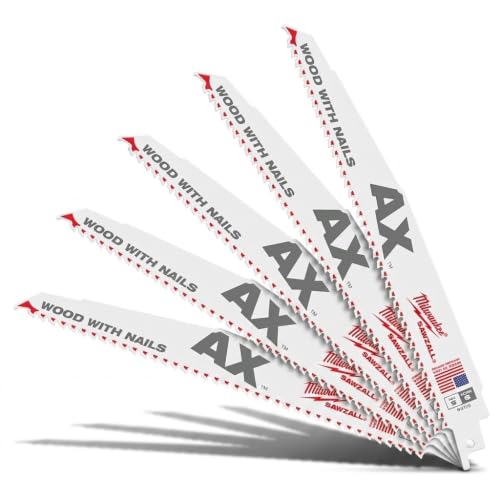
Milwaukee The Ax Reciprocating Saw Blades
What We Like
- Extra thick blade body for maximum robustness.
- Unique heat-treating process for incredible durability.
- 5 TPI geometry for faster cutting in demolition.
- Ideal for cutting wood with nails and bolts.
Trade-offs
- 9-inch length limits reach in deep cuts.
- 5 TPI geometry is not for fine finish work.
A blade body that is .062 inches thick and built from shatter-resistant bi-metal is designed for the abuse of hitting hidden nails and bolts during demolition. This makes it a reliable choice for tearing down decks or sheds where embedded metal would destroy a standard blade. It suits contractors or serious DIYers who need a tool that can power through the unknown.
The 5 TPI geometry removes more material per stroke for faster cutting, which prioritizes speed over a smooth finish. For tasks like pruning where a longer blade is beneficial, products like the EZARC Arc Edge offer a 15-inch length. This Milwaukee blade excels in heavy demolition work, trading refinement for resilience against metal.
HORUSDY Japanese Teeth Arc Edge Saw Blades

What We Like
- Arc edge design reduces binding on round wood
- Deep gullets clear sawdust efficiently
- Heat-treated CR-V steel for wear resistance
- Complete five-blade set with storage case
Trade-offs
- Arc edge is specialized for pruning, not demolition
A five-pack of 12-inch blades with a storage case means you have spares ready to go when one dulls, keeping your project moving. The Japanese-style 6 TPI teeth and arc edge are built for one job: chewing through green wood and thick branches with minimal deflection. For the homeowner or landscaper who faces regular pruning tasks, this set delivers focused performance without the premium price tag.
These blades are designed specifically for pruning and wood cutting, with a coarse six-teeth-per-inch profile that powers through branches quickly. Their arc edge helps manage round wood with less binding, but the twelve-inch length is shorter than some fifteen-inch pruning blades available, which can affect reach on larger trees. You get five of these purpose-built blades, which is practical for extended outdoor work.
Product photos
ANGELSWORD Arc Edge Reciprocating Saw Blades

What We Like
- 15-inch length for deep, overhead cuts.
- Arc edge design reduces binding and deflection.
- HRC 60 hardness maintains sharpness longer.
- Universal shank fits most major saw brands.
Trade-offs
- Long blade can be unwieldy in tight spaces.
- Three-blade pack offers fewer spares than larger sets.
With a 15-inch length, these blades can cut through branches up to 14 inches in diameter, giving you the reach for thick limbs from the ground. The arc edge design prevents binding and reduces cutting resistance, which helps avoid the blade getting stuck in live or springy wood. For pruning trees or clearing storm debris, this combination of length and anti-bind design leads to more efficient cutting.
This length requires a bit more room to maneuver, making it less ideal for delicate, close-quarters work near structures. You trade some finesse for maximum reach and leverage compared to a more compact option like the Milwaukee The Ax. These blades are built for a specific, demanding job. Their high hardness rating and triple-ground teeth suggest they’re engineered to see it through without dulling quickly.
Product photos
GRENPRO Reciprocating Saw Blade Set

What We Like
- Includes a specialized 9-inch pruning blade for branches
- Organized pouch protects and separates all 34 blades
- Bimetal construction extends lifespan on metal cuts
- Universal shank fits all major reciprocating saw brands
Trade-offs
- No blade longer than 9 inches for very thick limbs
- Comprehensive kit is bulkier than a simple 5-pack
- Pruning blade's 5 TPI is coarse for finish cuts
A 34-piece set with a storage pouch offers broad utility for mixed-material projects. You get a specialized 9-inch pruning blade for fresh branches and wet wood, plus a range of wood and metal blades for demolition, firewood, and cutting pipe or sheet metal. The organized pouch keeps blades sorted for quick selection on job sites, which the brand suggests makes it ideal for landscapers, metalworkers, and DIYers.
Its 9-inch pruning blade is designed for general branch work, while other products like the 15-inch EZARC blade offer greater length. The set’s variety supports many tasks, but jobs requiring longer blades would need a separate purchase. For property maintenance and cutting both wood and metal, the GRENPRO set provides multiple blade types in one organized kit.
Product photos
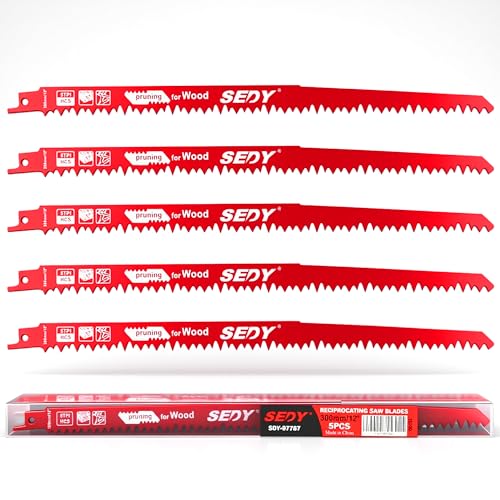
SEDY Wood Pruning Reciprocating Saw Blades
What We Like
- 12-inch length for deep reach on branches
- 5 TPI tooth design for fast aggressive cuts
- Includes a secure, latching storage case
- Compatible with all major saw brands
Trade-offs
- 5 TPI is coarse, leaving rougher cut surfaces
- Blade length requires a saw with sufficient stroke for efficiency
The 12-inch length and 5 TPI tooth design are built for speed, letting you power through thick branches and green wood with aggressive, rapid strokes. This blade is for the user who needs to clear a lot of material quickly and isn’t concerned with a polished finish. The high carbon steel construction contributes to that raw cutting speed, and the five-pack means you can keep a fresh blade handy when working through a big pile of brush or a fallen limb.
With 5 teeth per inch, these blades are built for aggressive, fast cutting through wood, which translates to quick work on big pruning jobs or clearing fallen branches. Their high-carbon steel construction aims for durability during this kind of outdoor rough cutting. The included locking storage box keeps unused blades secure and organized in a tool bag.
Lenox Bi-Metal Wood Cutting Saw Blade

What We Like
- Bi-metal construction for long life
- Power Blast Technology reduces blade breaks
- Cuts nail-embedded wood
- T2 Tech for wide material range
Trade-offs
- Shorter 9-inch length limits thicker limbs
- Five-blade pack may be less for big projects
- Standard straight design lacks arc-edge pruning curve
Bi-metal construction provides a durable blade that resists breaking, especially when hitting nails in wood. Lenox’s T2 Technology also supports efficient cutting across a wide range of materials. The blade’s 6 teeth-per-inch pattern is designed for cutting wood and nail-embedded wood, making it a versatile choice for many cutting tasks.
The blade’s 9-inch length means it may not cut through material thicker than its stroke in one pass. For cutting thicker branches, a longer blade like the 15.3-inch EZARC model is available. However, for general wood cutting where versatility is key, this Lenox pack offers a practical balance of length and durability.
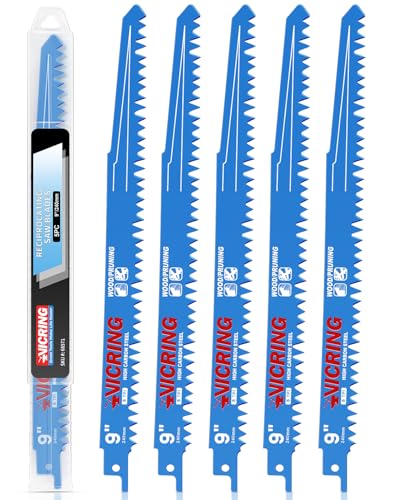
VICRING Wood Pruning Reciprocating Saw Blades
What We Like
- High carbon steel construction for wear resistance.
- 5 TPI tooth geometry cuts wood quickly.
- Universal shank fits all reciprocating saw brands.
- Includes a 6-month warranty from the manufacturer.
Trade-offs
- 9.5-inch length limits cut depth to under 6.7 inches.
- Straight blade design lacks the reach of longer, curved competitors.
With a 9.5-inch length and a 5-tooth-per-inch design, this blade is built for speed on soft, green wood. It’s a straightforward choice for anyone needing to clear a lot of small-diameter branches and yard debris in a hurry. The high carbon steel stays sharp for a decent run, and the five-pack means you can burn through a job without stopping to change a single worn blade. It’s a practical, no-fuss solution for the gardener or homeowner tackling seasonal pruning where the cuts are clean and the wood is forgiving.
You sacrifice reach and durability for tougher tasks with a shorter blade. A 9.5-inch blade simply won’t get through a thick limb, and high carbon steel, while hard, can be brittle if you hit a nail or twist in the cut. For pruning bigger branches, you’d want a longer blade with more specialized teeth, like the 15-inch EZARC Arc Edge. Think of this set as your go-to for the light and medium work that makes up most yard clean-up, saving the premium blades for the occasional monster job.
Product photos
SEDY Japanese Teeth Arc Edge Saw Blades

What We Like
- Arc edge with triple-ground teeth reduces friction
- Aggressive Japanese tooth design for fast cutting
- Chrome vanadium steel resists bending and wear
- Universal shank fits most reciprocating saws
Trade-offs
- 9-inch length limits reach on very thick limbs
- Three-blade pack offers fewer spares than some 5-packs
- No included storage case for blade organization
The arc edge design with its triple-ground tooth structure creates three distinct cutting angles to reduce friction. This delivers smoother and more controlled cutting performance when trimming larger branches and limbs, according to the product description. Its aggressive Japanese-style teeth and deep gullets are designed for fast cutting and efficient chip removal in green timber and wet wood.
These nine-inch blades provide a balance of length and the control benefits of the arc edge design. For applications requiring greater reach, such as deeper cuts on large limbs, a longer blade like the 12-inch HORUSDY model is listed among other available products. The SEDY blade’s described efficiency and clean cut are aimed at tree trimming, branch cutting, and pruning compared to standard pruning blades.
Product photos
How We Evaluated Reciprocating Saw Blades For Trees
Our evaluation compared specifications and documented performance across major brands. We examined blade length, TPI (teeth per inch), tooth geometry, and core construction materials from manufacturer guides. We then looked for patterns in expert round-ups and owner feedback regarding cutting speed, resistance to binding in green wood, and overall durability in woody materials.
The key criteria were cutting efficiency for tree work, blade life and toughness, and practical features like pack size and universal fit. Since this is a research-led evaluation, we cannot report on long-term wear over hundreds of cuts, but we focused on specs and user reports that predict real-world performance for pruning with a reciprocating saw.
What To Look For In Reciprocating Saw Blades For Trees
Choosing the right blade transforms a rough demolition tool into a precise pruning partner. The goal is a blade that cuts quickly without binding, lasts through multiple projects, and fits your saw and the limbs you’re tackling.
For cutting trees, prioritize a blade with a low TPI (3-6) for fast, aggressive cuts in green wood. Look for an arc edge or specialized pruning design to reduce binding on round branches. Consider blade length for reach and material (bi-metal or carbide) for longevity.
Cutting Efficiency & Tooth Design
For fast cutting in green wood and branches, a low TPI (teeth per inch) is essential. Blades in the 3 to 6 TPI range grab large chips for rapid removal, which is why many dedicated blades for landscaping use this geometry. The tooth profile also matters; aggressive Japanese-style teeth or fleam-ground designs are engineered for speed.
A curved “arc edge” blade body helps the blade glide through round limbs without pinching, a common problem with standard straight blades. This design is a key feature for efficient pruning trees and is why it appears on several top picks.
Blade Life & Toughness
Tree work can involve dirt, grit, and unexpected nails, which quickly destroy a weak blade. Bi-metal construction, featuring a flexible steel back welded to a high-speed steel cutting edge, offers a great balance of durability and value for most users. For maximum life in abrasive conditions or when cutting roots, carbide-tipped teeth are the premium choice. Coatings like Perma-SHIELD also reduce friction and heat buildup, extending the blade’s working life. If your project involves cutting tree roots or soil contact, prioritizing toughness is non-negotiable.
Length, Shank & Practical Features
Blade length determines your cutting depth and reach. A 9-inch blade can handle limbs up to about 6 inches thick, while 12-inch or longer blades are needed for larger trunks or overhead work from the ground. Ensure the blade’s universal shank fits your specific saw model. Finally, consider practicalities: multi-blade packs offer good value and spares, while organized kits with a case protect your investment and keep blades sorted for different cutting wood.
- Match the blade length to your saw’s stroke length for optimal power transfer.
- Check manufacturer compatibility lists if you use a less common saw brand.
- A storage case prevents blade damage and keeps your workspace safer.
A good rule of thumb: your blade should be at least 2 inches longer than the diameter of the branch you need to cut through.
Reciprocating Saw Blades For Trees Compared
Use the table below to quickly compare the key specifications and intended uses of our top picks.
| Product | Blade Length | Teeth Per Inch (TPI) | Material / Construction | Pack Count |
|---|---|---|---|---|
| EZARC Arc Edge Reciprocating Saw Blades | 15.3 inches | 6 TPI | N/A | 3 blades |
| Diablo Demo Demon Carbide Reciprocating Saw Blades | 14.6 inches | N/A | TiCo Hi-Density Carbide | 3-Pack |
| Milwaukee The Ax Reciprocating Saw Blades | 9 inches | 5 | Shatter-resistant bi-metal | 5 blades |
| HORUSDY Japanese Teeth Arc Edge Saw Blades | 12 inches | 6 TPI | CR-V steel | 5-pack with case |
| ANGELSWORD Arc Edge Reciprocating Saw Blades | 15 inches | 6 | CR-V steel | 3-pack |
| GRENPRO Reciprocating Saw Blade Set | 9 inches | 5 TPI | 58CRV steel | 34 pieces |
| SEDY Wood Pruning Reciprocating Saw Blades | 12 inches | 5 TPI | High speed carbon steel | 5 blades |
| Lenox Bi-Metal Wood Cutting Saw Blade | 9 inches | 6 TPI | Bi-metal | 5 blades |
| VICRING Wood Pruning Reciprocating Saw Blades | 9.5 inches | 5 | High Carbon Steel | 5 blades |
| SEDY Japanese Teeth Arc Edge Saw Blades | 9 inch | 6 TPI | Chrome vanadium steel | 3 blades |
Frequently Asked Questions
What is the best reciprocating saw blade for cutting tree branches?
For most homeowners, a blade with an arc edge design and 5-6 TPI is ideal for branches. This combination reduces binding on round wood and provides a fast, aggressive cut. Our best overall pick, the EZARC Arc Edge, uses this specific geometry for smoother, more controlled pruning of green wood.
Are reciprocating saws good for cutting trees?
Yes, with the correct blade, a reciprocating saw is an excellent tool for pruning limbs, cutting fallen branches, and even removing small tree trunks. It offers more control and reach in tight spaces than a chainsaw for smaller-diameter wood. For larger trunks, you may need one of the best saws for trees with more power.
What is the best power tool for cutting tree branches?
The best tool depends on the branch size and location. For precision pruning of small branches, hand pruners or a pruning saw are best. For limbs up to several inches thick, a reciprocating saw with a pruning blade is highly effective. For large, high, or numerous branches, a pole saw or chainsaw is often the right choice.
What are the strongest reciprocating saw blades?
The strongest blades feature carbide-tipped teeth or extra-thick, heat-treated bi-metal bodies. Carbide teeth resist abrasion from dirt and last significantly longer, making them a solid choice for demanding tasks like cutting roots in dirt. The Diablo Demo Demon uses this carbide construction, earning it the award for Best For Maximum Durability.
Can I use the same blade for trees and demolition?
You can, but it’s not ideal. A general-purpose demolition blade (often 6-8 TPI) will cut wood with nails, but it may bind in green branches. A specialized pruning blade cuts green wood faster but can dull quickly on nails. For mixed jobs, a versatile bi-metal blade designed for nail-embedded wood offers a good compromise.
The Bottom Line
For most tree cutting and pruning tasks, the EZARC Arc Edge Reciprocating Saw Blades provide the best blend of smooth cutting, long life, and value. Its specialized arc edge and tooth design tackle green wood efficiently. If your budget is tight, the HORUSDY Value Pack delivers reliable performance in a complete set.
For professionals facing roots, nails, or the toughest wood, invest in the extreme durability of the Diablo Demo Demon carbide blade. Ultimately, matching the blade’s length and tooth design to your specific tree work is the single most important factor for a successful, frustration-free cut.
