
10 Best Ro Sanders in 2026
This post contains affiliate links. As an Amazon Associate, we earn from qualifying purchases.
Our best overall random orbit sander is the DEWALT DWE6423 for its smooth, durable design that excels in daily workshop use. The DEWALT DCW210D1 is our best low-profile pick for cordless access, and the Bosch ROS20VSC stands out for fine dust collection. Choosing the right sander makes the difference between a chore and an efficient step toward a smooth finish.
We researched specifications, manufacturer data, expert round-ups, and owner feedback patterns to find the ten best models for different needs. This guide will help you match a sander’s strengths to your projects.
Top 10 Random Orbit Sanders in the Market
Certain content that appears on this site comes from Amazon. This content is provided "as is" and is subject to change or removal at any time.
The Best Random Orbit Sanders, Reviewed
DEWALT DWE6423 Random Orbit Sander

What We Like
- Separate counterweight design reduces vibration
- Improved dust-sealed switch for longer life
- Rubber overmold improves grip in critical areas
- One-handed locking dust bag for easier use
Trade-offs
- Dust port requires an adapter for most shop vacuums
- Corded design limits mobility compared to battery models
A 3-amp motor spins the pad from 8,000 to 12,000 OPM, providing the speed range needed for both rough material removal and final finish work. Its separate counterweight design reduces vibration, and a rubber overmold improves grip, which together make longer sanding sessions less fatiguing. The dust-sealed switch is protected against dust ingestion for longer life, a feature that addresses a common point of failure in other sanders.
The dust port is designed to fit directly to DeWalt’s DWV010 or DWV012 dust collectors, requiring their universal quick connector for other vacuum systems. At 3.4 pounds, it is lighter than DeWalt’s own cordless model and matches the weight of the Bosch ROS20VSC, though the Mirka DEROS II is a full pound lighter. Its shorter height allows the user to get closer to the workpiece, and the one-handed locking dust bag improves collection.
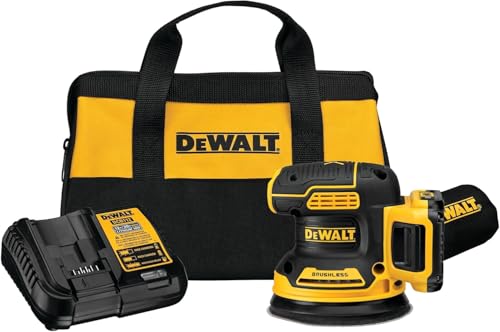
DEWALT DCW210D1 Cordless Orbital Sander
What We Like
- Brushless motor for runtime and efficiency.
- Variable speed dial matches speed to the task.
- Dust-sealed switch protects against dust ingestion.
Trade-offs
- Weighs 4.3 pounds, heavier than many corded sanders.
- Cordless design adds bulk compared to low-profile air sanders.
- Battery and charger inclusion is unspecified.
DeWalt’s cordless orbital sander has a low-profile height that allows it to get close to the work surface for precise sanding. Its variable-speed control operates from 8,000 to 12,000 orbits per minute to match the application. The sander uses a replaceable 8-hole hook-and-loop sanding pad for quick paper changes.
The trade-off for that cordless convenience and low stance is some added heft. At 4.3 pounds, it feels more substantial in hand than lighter corded models like the Bosch ROS20VSC. That weight can be noticeable during long sanding sessions on vertical panels. For confined overhead work or all-day use, a dedicated corded or pneumatic sander might be easier to maneuver. This DeWalt excels when its specific blend of cordless operation and slim design solves an access problem your current tools can’t.
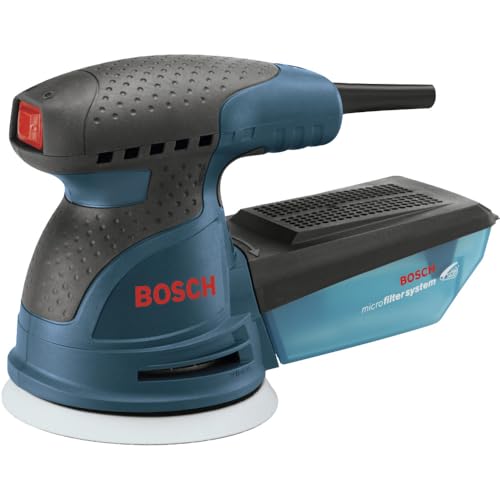
Bosch ROS20VSC Random Orbital Sander
What We Like
- Excellent fine dust collection with microfilter system
- Hard plastic dust canister is easy to clean
- Quiet operation at 84 dB per research
- Hook-and-loop pad provides a firm disc grip
Trade-offs
- Corded design limits mobility compared to cordless models
- Dust canister capacity is finite, requires periodic emptying
Expert testing found the Bosch ROS20VSC to be the quietest and smoothest sander in its group, which significantly reduces fatigue during long sanding sessions. Its vacuum dust collector and microfilter system trap particles as small as half a micron, keeping your workspace cleaner. The hard plastic dust canister is easier to empty and maintain than soft bags used by many other models.
The trade-off is the power cord, which can feel restrictive if you’re used to the freedom of a cordless tool. For jobs away from an outlet or in tight, awkward spaces, that’s a genuine consideration. If ultimate portability is your goal, you’d look at a cordless option like the DEWALT DCW210D1. But for shop-based work where dust control and user comfort are paramount, the Bosch ROS20VSC’s collection system and smooth operation are hard to beat.
Makita BO5041 Random Orbit Sander

What We Like
- Variable speed dial for precise application matching
- Ergonomic rubberized palm grip for comfort
- Lock-on button for continuous use comfort
Trade-offs
- Dust collection uses a soft bag that is hard to clean
- Small dust port requires an adapter for vacuum hookup
With a variable speed dial that adjusts from 4,000 to 12,000 OPM, this sander provides control for tasks from delicate veneer work to aggressive stock removal. That flexibility makes it suitable for multiple stages of a project. An ergonomic rubberized grip and a lock-on button are designed to reduce fatigue during long sessions.
Where it stumbles is in dust collection. The included soft bag is a hassle to clean, and the port is too small for a standard vacuum hose without an adapter. For shop use where dust management is critical, you’ll need to factor in that extra step. It’s a trade-off that makes the BO5041 a fantastic tool in the hand, but if a self-contained, high-end dust system is your priority, the Festool RO 150 FEQ-Plus operates in a different league.
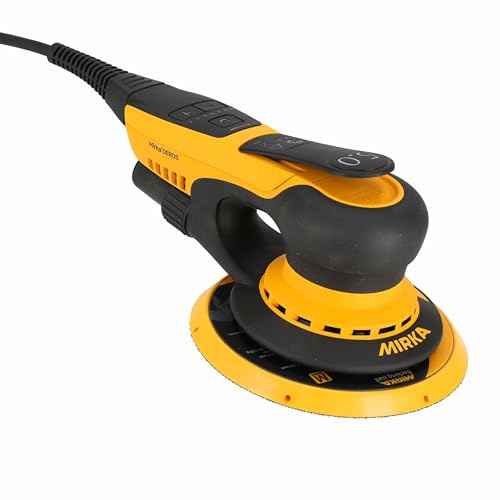
Mirka DEROS II 550X Orbital Sander
What We Like
- Extremely lightweight at just 2.2 pounds.
- Brushless motor for consistent, smooth power.
- Integrated dust extraction keeps the workspace clean.
- Bluetooth connectivity for app-based tool settings.
Trade-offs
- Tool only: battery and charger sold separately.
- App features may be unnecessary for straightforward tasks.
- Lower weight may feel less substantial on heavy material.
Weighing 2.2 pounds, the Mirka DEROS II 550X is among the lightest sanders in this category, a design that significantly reduces arm fatigue during extended projects. Its low vibration operation and ergonomic build further enhance user comfort, allowing for improved control across various applications. The brushless motor is engineered to deliver consistent power for tasks in woodworking, automotive, and surface preparation.
This sander is sold as a bare tool, so a compatible battery and charger are separate purchases. For users already within the Mirka ecosystem, this is a minor consideration. The tool’s Bluetooth connectivity and app functions provide access to additional settings for a more customized sanding experience, while its integrated dust extraction system helps maintain a cleaner workspace.
Product photos
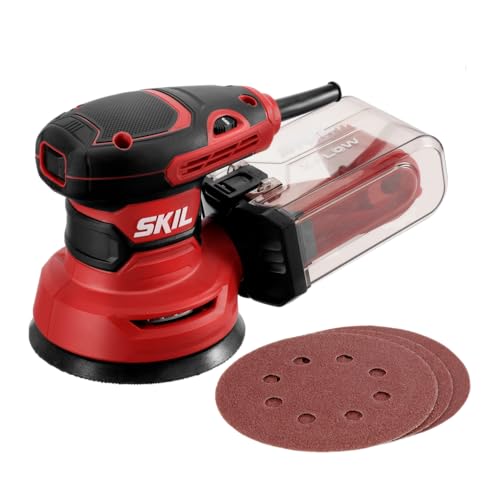
SKIL SR211601 Random Orbital Sander
What We Like
- Cyclonic dust container is easy to empty
- Variable speed control for different materials
- Compact, ergonomic design for tight spaces
- Low-vibration design reduces hand fatigue
Trade-offs
- Corded operation lacks cordless freedom
- Dust box requires manual emptying, unlike bagless shop vac systems
A 2.8 amp motor spinning at 13,000 orbits per minute gives you enough grunt to tackle most common sanding tasks without bogging down. This sander is built for the cost-conscious DIYer who needs reliable performance for weekend projects. Its standout cyclonic dust box keeps your workspace cleaner than a basic bag, and the compact shape lets you maneuver into corners where bulkier sanders can’t fit.
Its 2.8 amp motor runs at 13,000 orbits per minute for smooth performance across many sanding tasks, making it a capable choice for general workshop use. You do have to manage a corded power source and dust manually. Being tethered to an outlet limits mobility, and while the cyclonic dust box is easy to empty, you must stop periodically instead of connecting to a shop vac for continuous extraction. For pure sanding speed on a budget, it holds its own against other corded models.
Ingersoll Rand 5152-6 Air Sander

What We Like
- Extremely lightweight at 1.8 pounds
- High 12000 RPM for fast material removal
- Vacuum-ready for clean dust extraction
Trade-offs
- Requires a dedicated air compressor system
- Single-speed operation lacks variable control
- Tool only, no battery or power source included
Weighing 1.8 pounds, this air sander is designed to reduce arm fatigue during extended use. It runs at 12,000 RPM, a speed the manufacturer states matches optimal material removal rates. The tool is listed as working on surfaces like wood, composites, and fiberglass. Its vacuum-ready port allows connection to dust extraction systems, which helps maintain a cleaner workspace for finish tasks. This sander requires a shop with an air compressor capable of running it.
This model relies entirely on compressed air, so you can’t just plug it into a wall. That makes it impractical for job sites without a compressor or for casual DIYers. Compared to a corded workhorse like the DEWALT DWE6423, the Ingersoll Rand is significantly lighter and simpler, but you sacrifice variable speed control. Your decision hinges entirely on your shop’s infrastructure and whether you prioritize raw speed and reduced weight over flexibility.
Product photos
Makita BO5030K Random Orbit Sander

What We Like
- Rubberized grip improves comfort and control
- Large 1/8 inch orbit for fast, smooth finish
- Pad control system prevents aggressive start-up
- Includes a durable hard case for storage
Trade-offs
- No variable speed control for delicate work
- Dust bag is difficult to clean effectively
- Small dust port requires an adapter for shop vacs
The Makita BO5030K comes with a hard plastic case, which helps keep the sander organized and protected during transport or storage. It uses a 12,000 OPM random orbit motion for fast and smooth sanding, and the rubberized grip improves comfort during extended use. Research mentions note it is a bit quieter than most sanders at 86 dB, which some users may find more pleasant.
This sander lacks variable speed, which can make it less versatile for fine finishing tasks compared to models like the Makita BO5041. Its dust collection system is adequate with the included bag, but connecting to a vacuum requires an adapter. For straightforward sanding where a consistent, smooth finish is the goal and storage is a priority, reviewers report this Makita delivers reliable performance right out of the box.
Product photos
Festool RO 150 FEQ-Plus Sander

What We Like
- Tool-less FastFix pad changes speed up workflow
- Exceptional scratch-free finish even at coarse grits
- Brushless motor delivers smooth operation with low vibration
- Ergonomic grip positions reduce user fatigue
Trade-offs
- No onboard dust collection container included
- Weight of 11.5 pounds demands more user stamina
The tool-less FastFix sanding pad system means you can switch abrasives in seconds without fumbling for a wrench, a huge advantage when moving between aggressive material removal and fine finishing. This Festool excels because its dual-mode operation lets you tackle heavy stock removal with its ROTEX rotary motion, then switch to an eccentric orbit for a flawless surface. It’s built for the serious woodworker or tradesperson who demands a versatile, finish-ready result straight from the sander, as research notes it produced scratch-free surfaces at 180 grit where others could not.
That capability does come with trade-offs, primarily its 11.5-pound heft, which can be taxing on overhead work or during long sessions. Compared to a more compact option like the Bosch ROS20VSC, this is a workshop anchor, not a one-handed detail sander. It also relies entirely on a shop vacuum for dust control, as it ships without a collection canister. For the craftsman who values a single tool that can both shape and finish, its performance justifies the investment, but for lighter-duty tasks, a simpler orbital sander might be more practical.
Product photos
Bosch GET75-6N Dual-Mode Sander
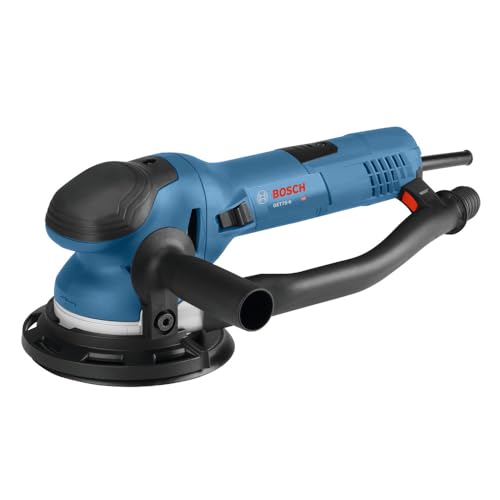
What We Like
- Powerful 7.5 amp variable-speed motor
- Multi-hole pad fits many abrasive discs
- Includes two vacuum hose adapters
Trade-offs
- Requires a separate vacuum for dust collection
- At 5.7 lb, it's heavier than most 5-inch palm sanders
That’s the kind of muscle you reach for when a project calls for serious material removal, not just fine finishing. With a 7.5-amp motor and a 6-inch pad, it’s built for the user who needs to aggressively level wood, strip old finishes, or flatten surfaces quickly without switching to a bulkier belt sander. It’s a specialist tool for the heavy phases of a job.
Its capability comes with a trade-off in size and weight. At 5.7 pounds, it is heavier than many 5-inch palm sanders, such as the 3.5-pound Bosch ROS20VSC. The sander also requires a shop vacuum for its dust collection system, using included adapters for Bosch hoses or a separate adapter.
Product photos
How We Evaluated Random Orbit Sanders
This guide is based on a review of manufacturer specifications and technical details, comparing motor power, orbit size, and included features. It also considers patterns in expert reviews and feedback from user communities.
Key criteria included vibration control, as a smooth-running sander significantly reduces hand fatigue during extended use. We prioritized dust collection effectiveness, both with onboard containers and when connected to a vacuum, for a cleaner workspace and better finish quality. Finally, we assessed ergonomics and control, considering grip comfort, weight, and the utility of features like variable speed.
A research-based approach has limits; we cannot measure the precise feel or long-term durability of these tools through data alone. Our goal is to give you a well-researched starting point for your purchase.
What To Look For In Random Orbit Sanders
A random orbit sander combines a spinning and orbiting motion to remove material quickly while minimizing visible swirl marks. The right model balances power, comfort, and dust control for your specific tasks.
Look for a sander with low vibration to reduce fatigue, effective dust collection to keep your workspace clean, and an ergonomic grip that fits your hand comfortably. Consider whether you need variable speed for different materials or a cordless design for mobility.
Vibration And Ergonomics
Vibration is a primary cause of hand fatigue. Sanders with separate counterweight designs or brushless motors, like those found in our premium picks, typically run smoother. Weight also matters; a heavier sander can dampen vibration but may be tiring for overhead work, while a very light one might feel less stable on heavy stock. Rubberized palm grips and balanced body shapes improve control during long sessions, a key factor in many reviews of the best random orbital sanders.
Dust Collection
Effective dust collection protects your health and yields a better finish by keeping the abrasive surface clean. Systems vary from simple cloth bags to hard plastic canisters with microfilters, like the one on our top pick for fine dust collection. Connecting to a shop vacuum dramatically improves performance, but port size and the need for adapters can be a hassle. For serious woodworking, a sander that excels with a vacuum is a wise choice, as noted in many reviews.
Power And Speed
Motor amperage for corded models or voltage for cordless ones indicates power, while the orbit size, often one-eighth of an inch, also affects material removal rate. Variable speed control allows matching the sander’s pace to the task, which is useful for delicate finishes or stubborn coatings. Some experts suggest running at full speed for most wood sanding. For heavy removal, a dedicated tool like a high-RPM pneumatic sander may be needed, while a standard five-inch model suits many woodworking projects.
.### Practical Checks
- Check the dust port compatibility with your shop vacuum; many require an adapter.
- Examine the pad mounting system; hook-and-loop is standard, but adhesion quality varies.
- Consider if the tool includes a case or if you’ll need separate storage.
A good rule of thumb: prioritize smooth operation and dust collection over maximum power for most finishing work.
Random Orbit Sanders Compared
The table below compares key specifications across our ten picks to help you see the differences at a glance.
| Product | Power Source | Orbit Speed (OPM) | Weight | Dust Collection |
|---|---|---|---|---|
| DEWALT DWE6423 Random Orbit Sander | Corded Electric | 8,000 – 12,000 | 3.4 Pounds | Fits DWV010/DWV012 collectors |
| DEWALT DCW210D1 Cordless Orbital Sander | 20V MAX Cordless | 8,000-12,000 | 4.3 pounds | Dust-sealed switch |
| Bosch ROS20VSC Random Orbital Sander | Corded Electric | 7,500-12,000 | 3.5 Pounds | Hard plastic, detachable canister |
| Makita BO5041 Random Orbit Sander | Corded Electric | 4,000-12,000 | 3.1 Pounds | N/A |
| Mirka DEROS II 550X Orbital Sander | Corded electric | N/A | 2.2 pounds | Integrated dust extraction system |
| SKIL SR211601 Random Orbital Sander | Corded Electric | 13,000 orbits per minute | 3.4 Pounds | Cyclonic dust box |
| Ingersoll Rand 5152-6 Air Sander | Pneumatic (Air) | 12000 RPM | 1.8 Pounds | Vacuum port ready |
| Makita BO5030K Random Orbit Sander | Corded Electric | 12,000 OPM | 2.9 pounds | Through-the-pad system |
| Festool RO 150 FEQ-Plus Sander | N/A | N/A | 11.5 pounds | Vacuum port only |
| Bosch GET75-6N Dual-Mode Sander | Corded Electric | 3300 to 7300 OPM | 5.7 pounds | Passive dust collection system |
Frequently Asked Questions
Which brand is the best sander?
There is no single “best” brand, as different manufacturers excel in different areas. Our research shows DEWALT and Bosch offer excellent balance in corded models for general use, while Festool and Mirka lead in premium, low-vibration performance. The best brand for you depends on your specific needs for power, dust collection, and ergonomic design.
What’s the best sander to buy?
The best sander to buy is the one that matches your most frequent tasks. For a versatile, dependable corded sander, the DEWALT DWE6423 is an excellent overall choice. If you need cordless freedom for job sites or detailed work, consider the DEWALT DCW210D1. For those focused on a clean shop and smooth operation, the Bosch ROS20VSC is a standout.
Which is better, a Makita or a DeWalt orbital sander?
Both Makita and DeWalt make highly capable orbital sanders. Information indicates DeWalt models often feature vibration control designs, while Makita frequently offers precise variable speed control and comfortable ergonomics. The choice depends on whether you value reduced vibration or finer speed adjustment for different materials.
Are sheet sanders or orbital sanders better?
For most woodworking, a random orbital sander is superior to a sheet sander. Orbital sanders use round discs with a random motion that prevents swirl marks and sands more aggressively. Sheet sanders move in a straight line and are better for veneer work or situations where you must sand with the grain, but they are less common in modern workshops.
What is the advantage of a brushless motor in a sander?
A brushless motor provides smoother, more consistent power and typically runs cooler and quieter than a brushed motor. It also has fewer wearing parts, which can contribute to longer tool life. This technology is a key feature in premium and cordless models, such as our best premium lightweight pick, where reduced vibration and efficiency are paramount.
The Bottom Line
The DEWALT DWE6423 is our best overall random orbit sander, ideal for the woodworker who needs one reliable, corded tool for daily projects. Its smooth operation and durable design make it a dependable workshop staple.
Budget-conscious DIYers should look at the SKIL SR211601 for solid value, while professionals seeking ultimate comfort and control will appreciate the lightweight design of the Mirka DEROS II 550X. Remember, the most important factor is matching the sander’s strengths, be it dust collection, smooth operation, or raw power, to the sanding you do most often.
