
10 Best Sanders To Remove Paint in 2026
This post contains affiliate links. As an Amazon Associate, we earn from qualifying purchases.
Our best overall pick for removing paint is the Bosch GET75-6N Electric Orbital Sander, thanks to its turbo mode for aggressive stripping and variable speed for control. For dedicated paint removal, the Wagner PaintEater excels, while the DEWALT 20V MAX Belt Sander is ideal for large jobs. Stripping paint demands a tool that balances raw power with finesse to avoid damaging the surface underneath. We researched specifications, expert recommendations, and owner feedback to find the best sanders for different stripping projects, detailed below.
Top 10 Sanders To Remove Paint in the Market
Certain content that appears on this site comes from Amazon. This content is provided "as is" and is subject to change or removal at any time.
The Best Sanders To Remove Paint, Reviewed
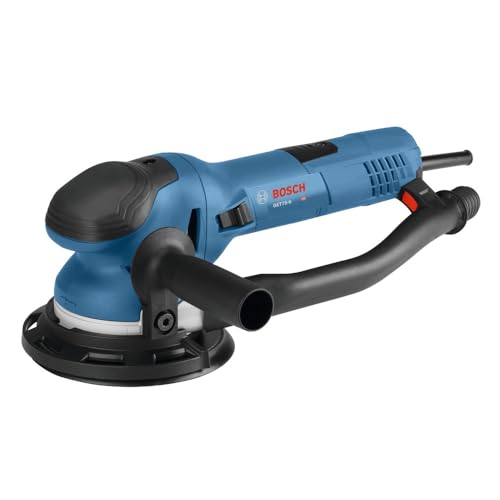
Bosch GET75-6N Electric Orbital Sander
What We Like
- Turbo mode for aggressive paint removal
- Variable speed for control on different surfaces
- Multi-hole pad accepts wide disc variety
- Includes vacuum adapter for dust management
Trade-offs
- Requires separate vacuum for dust collection
- At 5.7 lb, it's heavier than many palm sanders
- Front handle is removable, not built-in
A powerful 7.5-amp motor and a turbo mode that dramatically increases stock removal set this sander apart. This combination provides a versatile tool that can handle standard finishing work and switch to a much more aggressive mode for demanding material removal, offering an alternative to a belt sander for some tasks. It suits users who need one machine capable of both fine finishing and heavier-duty sanding without changing tools.
The trade-off is its heft and the need for a shop vacuum. At nearly six pounds, it demands more arm stamina than a lightweight sander like the Bosch ROS20VSC for overhead work. You’ll also need to hook it up to a vacuum to control the immense dust it creates, though the included adapter makes that connection straightforward. For dedicated, all-day paint stripping on large, flat surfaces like floors or doors, its power and dual-mode flexibility are unmatched in its class.
Wagner PaintEater Electric Paint Remover

What We Like
- Palm-grip design for user control
- Open-web disc minimizes paint loading
- Flex-Disc conforms to uneven surfaces
- Can operate on edge or flat
Trade-offs
- Fixed 2,600 RPM speed lacks adjustability
- Corded design limits mobility
The 3.2 Amp motor paired with a 4-1/2 inch 3M spun-fiber disc delivers focused abrasion, making it a specialist for scraping off old paint without gouging the substrate. Its palm-grip form factor and 3.4-pound weight provide the handling needed for detailed work on trim or furniture. This sander is built for the renovator who needs to clean up paint chips and feather edges before a fresh coat, not for heavy stock removal or finishing.
The tool provides a fixed operating speed of 2,600 RPM. For tasks requiring adjustable speed settings or a random orbital action, other sanders like the Bosch ROS20VSC palm sander are designed with that versatility.
DEWALT 20V MAX Belt Sander

What We Like
- Variable speed trigger with 25-position dial.
- Tool-free, quick-release sanding belt system.
- Compatible with wireless vacuum control.
Trade-offs
- Tool only: requires separate battery and charger purchase.
- Dust collection system (Airlock) sold separately.
If you’re facing down a deck, a floor, or a large piece of furniture, this cordless belt sander is built to chew through old paint and level surfaces with speed. The variable speed trigger and dial provide the finesse to avoid gouging, while the lightweight, two-handed design helps manage the tool’s power over long sessions. It’s the right pick when the job’s scale demands runtime and raw sanding capacity over portability.
This is a tool-only listing, so a compatible DEWALT 20V MAX battery and charger must be purchased separately. Its dust collection system is designed for use with the DEWALT airlock, which is also sold separately, to achieve up to 95% dust collection efficiency. The cordless, brushless design provides flexibility away from outlets, while the Bosch GET75-6N orbital sander includes a power cord and does not require a separate battery.
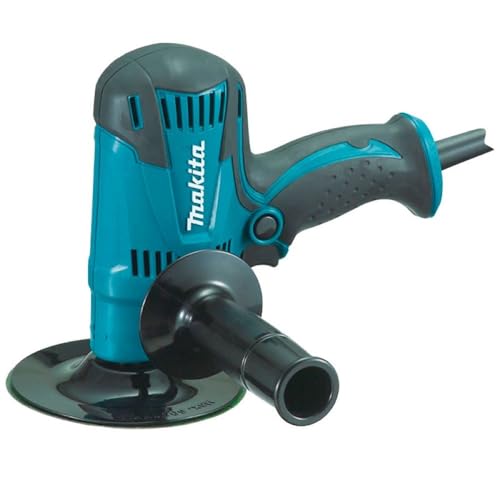
Makita GV5010 Disc Sander
What We Like
- High 5,000 RPM speed for aggressive material removal.
- Lightweight and compact for easy maneuverability and control.
- Rubberized grips and housing enhance precision during use.
- Trigger lock-on button reduces operator fatigue on large jobs.
Trade-offs
- Lacks variable speed control for delicate or finishing work.
A 3.9 AMP motor spinning at 5,000 RPM is built for one thing: taking off material fast. That makes the GV5010 a brute-force option for stripping paint down to bare wood or metal without fuss. Its compact size and light 2.4-pound frame let you get into corners and work overhead without your arm giving out, while the rubberized grips keep it planted in your hand. This is the tool you grab when you have a large, flat surface covered in old paint and patience is not part of the plan.
With a motor spinning its 5-inch disc at 5,000 RPM, the Makita GV5010 Disc Sander is built for aggressive stock removal. That speed makes it effective for stripping paint or leveling wood, but it lacks the finesse needed for final surface preparation. Users typically follow its work with an orbital sander, such as the Bosch ROS20VSC, to smooth the surface before applying a new finish.
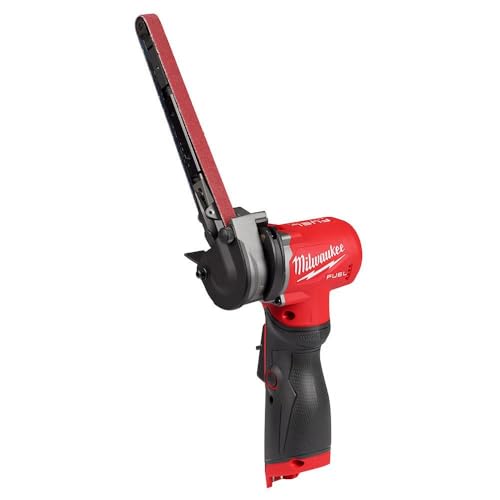
Milwaukee 2482-20 Sander To Remove Paint
What We Like
- 360-degree rotating arm for difficult angles
- Two-speed settings plus variable trigger
- Toolless belt change and adjustment
- Forward and reverse rotation functions
Trade-offs
- Battery and charger not included in listing
The 360-degree rotating arm is the key here, letting you pivot the belt into corners, along edges, and into spaces where a standard sander just won’t fit. That maneuverability, combined with forward and reverse operation, makes this Milwaukee the pick for detailed paint stripping on furniture, trim, or metalwork with complex angles. It’s a specialist for getting into spots other tools can’t.
This cordless sander is designed for control and access, not brute force, with a 360-degree rotating arm that reaches tight spots. Its two-speed settings and variable trigger allow careful work on materials from soft wood to spot solder. Compared to larger cordless belt sanders like the DEWALT 20V MAX, it uses a smaller half-inch by 18-inch belt, making it better for detailed paint removal than big, flat surfaces.
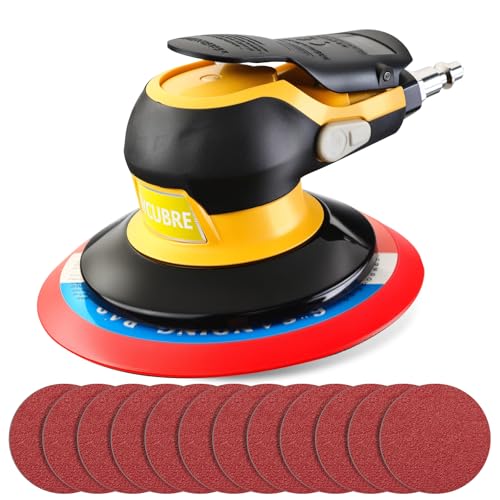
RYCUBRE Low Noise DA Air Sander
What We Like
- Exclusive noise-reduction technology for quieter operation
- Lightweight 2.4-pound design reduces user fatigue
- Adjustable speed switch for material-specific control
- High 13,000 RPM speed enables fast material removal
Trade-offs
- Requires a 15-gallon-plus air compressor to operate
- Pneumatic design needs an air hose, limiting mobility
An unloaded working speed up to 13,000 RPM enables fast material removal for auto body and general DIY tasks. Its exclusive noise-reduction technology creates a quieter working environment than many air sanders. The lightweight, ergonomic body reduces operator fatigue, allowing for extended use on vertical or overhead surfaces.
The pneumatic design requires a 15-gallon-plus air compressor, which ties it to a workshop and adds to the initial setup. Compared to cordless or electric models in its category, it offers a different balance of power source and runtime. For controlled, low-noise sanding on contoured surfaces like automotive panels, its specific combination of speed and sound design is its core function.
Product photos
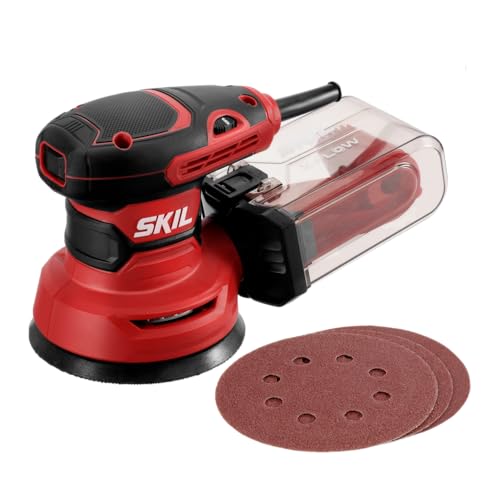
SKIL 5-Inch Random Orbital Sander
What We Like
- Compact size for tight spaces
- Low-vibration ergonomic grip
- Effective cyclonic dust container
- Sealed on/off switch for convenience
Trade-offs
- 2.8 amp motor is less powerful than the 7.5 amp Bosch GET75-6N
A 13,000 orbits-per-minute motor provides smooth performance across a variety of sanding applications. Weighing 3.4 pounds and featuring a soft rubber grip, its ergonomic design reduces hand fatigue, so longer sessions are more comfortable. Variable speed control lets you match the tool’s aggression to different materials, and the easy-to-empty dust container helps manage the mess.
The trade-off for that approachable design is raw power. When you’re facing layers of hardened enamel or a large, flat surface like a door, the Skil’s motor can feel outmatched by a more sturdy tool like the Bosch GET75-6N. It’s a workhorse for standard jobs, not a brute-force stripper. For someone who needs to remove paint frequently or on a professional scale, stepping up to a more powerful sander would be a better long-term investment.
Product photos
LDHTHOPI Rotary Buffer Polisher

What We Like
- High-power 1600W motor for aggressive material removal
- Seven variable speeds offer precise control for different tasks
- Comes with seven different pads for sanding and polishing
- Three handle configurations improve comfort and control
Trade-offs
- Mandatory 5-minute cooldown after every 15 minutes of use limits continuous work
- Requires careful pressure control to avoid motor overload
- At 16.5 inches tall, its profile can be awkward in tight spaces
A 1600W motor and a speed range up to 3500 RPM give this rotary polisher the sheer muscle to strip paint and level surfaces fast. It’s built for the hands-on user who needs to tackle oxidation on a boat hull or prep a car panel for repaint. You get the control of seven speeds and a pad kit for the whole job. The three handle options mean you can find a comfortable grip for those extended sessions, though you’ll have to manage those sessions carefully.
A key operational limit is its duty cycle, requiring a five-minute cool-down after every fifteen minutes of use, which can interrupt workflow on extensive detailing jobs. The powerful 1600-watt motor and rotary polishing action deliver fast cutting power on flat surfaces, yet that same focused rotation lacks the random orbit of a dedicated dual-action sander, making it less forgiving for beginners. This polisher provides substantial capability for removing oxidation and deep scratches, but it expects the user to manage its power and thermal limits carefully.
Product photos
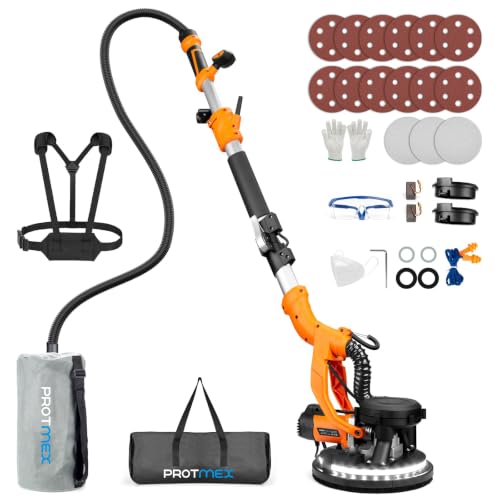
Protmex Automatic Drywall Sander
What We Like
- Built-in vacuum system for near dustless work
- Extendable pole reaches ceilings without a ladder
- 360° LED light illuminates work in dark areas
- Pivoting head and removable edge for corners
Trade-offs
- Designed for drywall, not for detailed trim or contours
- Heavier and bulkier than a handheld palm sander
A 6.2-foot extendable pole and a 1000W motor make this sander the clear choice for tackling walls and ceilings. You can stand comfortably on the floor to sand an entire popcorn ceiling, and the integrated vacuum captures most of the resulting dust. That combination of reach and contained mess is perfect for renovators facing large, flat interior surfaces like drywall or plaster walls. It’s built for coverage, not finesse.
The trade-off is size and specialization. This is a dedicated drywall tool, not a general-purpose sander for furniture or trim. For removing paint from smaller, more intricate projects, something like the Bosch ROS20VSC palm sander would be far more maneuverable. But if your job is defined by square footage overhead, the Protmex’s design handles the ergonomic and cleanup challenges that slow other tools down.
Product photos
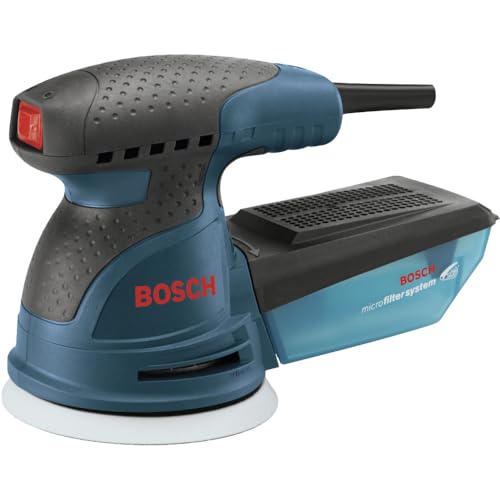
Bosch ROS20VSC Palm Sander
What We Like
- Variable speed control for different tasks
- Pad dampening system minimizes swirl marks
- Effective microfilter dust collection system
- Compact and lightweight palm-sized design
Trade-offs
- Dust canister requires regular emptying
- Weighs 3.5 pounds, which is heavier than some palm sanders
The variable speed control, ranging from 7,500 to 12,000 orbits per minute, gives you the precision to adjust aggression for final passes after the bulk paint is gone. That 2.5-amp motor in a 3.5-pound body is built for control, not brute force, making it a fit for the DIYer or refinisher who prioritizes a flawless surface over raw stripping speed. Its pad dampening system is engineered specifically to fight swirl marks, which is why it shines when you’re working on visible furniture or trim where the finish matters.
Its microfilter and canister capture particles as fine as half a micron, which significantly reduces airborne dust during detail work. This Bosch sander is designed for finishing, with a pad dampening system that helps minimize swirl marks on flat and contoured surfaces. The variable speed control, from 7,500 to 12,000 orbits per minute, allows adjustment for different sanding tasks.
Product photos
How We Evaluated Sanders To Remove Paint
Our evaluation is research-based, analyzing manufacturer specifications and documented expert round-ups to understand how different sander types perform for paint removal. Key criteria were power and speed for stripping efficiency, dust management for a cleaner work environment, and ergonomics for control during long sessions. We also considered design features like variable speed and pad compatibility for adapting to different surfaces.
A limitation of this research method is that we cannot verify firsthand how long a specific sander’s paper lasts before loading with paint, a common complaint in online owner feedback for paint stripping sanders.
What To Look For In Sanders To Remove Paint
Choosing the right sander means matching the tool’s action and power to your specific project. A belt sander strips a flat deck rapidly, while a detail sander feathers paint in a window corner.
For paint removal, prioritize power (measured in amps or RPMs) and aggressive sanding action. Effective dust collection is crucial for visibility and health. Variable speed adds control for transitioning from stripping to smoothing.
Type and Sanding Action
The sander’s movement determines its stripping speed and final finish. Belt sanders and high-RPM disc sanders are the fastest for flat areas but can leave deep marks. Random orbital and orbital sanders are slower but leave a smoother surface, better for projects where you’ll apply new paint or stain directly. For intricate trim and corners, a detail sander or a model with a specialized head, like a rotating arm, is essential. Our research on paint removal from wood highlights the importance of matching the tool’s action to the wooden surface’s contours.
Power and Speed
Higher power translates to faster paint removal. Look for a motor rated at least 5 amps in corded electric models or high no-load RPMs. Variable speed control is a valuable feature, allowing you to dial down the aggression for delicate veneers or to prevent burning the wood. For cordless models, a 20V battery platform provides the necessary sustained power for serious work. The fastest sanders for removing paint often trade finesse for sheer speed.
Dust Management
Sanding paint creates fine, potentially toxic dust. A built-in dust canister or a port for connecting a shop vacuum is non-negotiable for indoor work. Some systems, like micro-filters or cyclonic action, are more effective than basic bags. Good dust collection also keeps your sandpaper from clogging prematurely, maintaining its stripping efficiency. This is a key factor when evaluating recommended paint removal sanders.
- Check for a standard vacuum hose adapter size.
- Consider the capacity of any integrated dust canister.
- Note if a dust collection accessory is included or sold separately.
Always wear a respirator, even with dust collection.
Sanders To Remove Paint Compared
The following table compares key features of our top picks to help you see the differences at a glance.
| Product | Motor Power | Weight | Speed |
|---|---|---|---|
| Bosch GET75-6N Electric Orbital Sander | 7.5 Amp | 5.7 pounds | 3300 to 7300 OPM |
| Wagner PaintEater Electric Paint Remover | 3.2 Amp | 3.4 Pounds | 2,600 RPM |
| DEWALT 20V MAX Belt Sander | 20V MAX* | 1.0 Pounds | N/A |
| Makita GV5010 Disc Sander | 3.9 AMP | 2.4 Pounds | 5,000 RPM |
| Milwaukee 2482-20 Sander To Remove Paint | N/A | 0.0 pounds | 3600 SFM high, 1800 SFM low |
| RYCUBRE Low Noise DA Air Sander | Pneumatic | 2.4 pounds | 12000-13000 RPM |
| SKIL 5-Inch Random Orbital Sander | 2.8 amp | 3.4 pounds | 13,000 OPM |
| LDHTHOPI Rotary Buffer Polisher | 1600W | 4.6 pounds | 1000-3500 RPM |
| Protmex Automatic Drywall Sander | 1000W pure copper | N/A | 800-2200RPM, 6 speeds |
| Bosch ROS20VSC Palm Sander | 2.5 AMP | 3.5 pounds | 7,500-12,000 OPM |
Frequently Asked Questions
What kind of sander is best for removing paint?
For most DIY projects involving furniture or trim, a random orbital sander offers a good balance of speed and a relatively smooth finish. For rapid stripping of large, flat surfaces like floors, a belt sander is most effective. Always start with a coarse sandpaper grit, like 60 or 80, to break through the paint layers.
What type of sander is best for removing paint from walls?
For drywall and plaster walls, a drywall sander with a built-in vacuum and extendable pole is ideal, as it creates minimal dust and reaches ceilings. For painted wood paneling or trim on walls, a palm-grip detail sander or a random orbital sander is better suited for sanding tight spaces.
What is the best tool for removing old paint?
The fastest tool is often a dedicated paint stripper, like the Wagner PaintEater, which uses an open-web disc designed to resist clogging. For the utmost power on flat surfaces, a high-speed disc sander or belt sander will strip material fastest, though it may require follow-up sanding with a finer tool.
Can I use a sander to take off paint?
Yes, electric and pneumatic sanders are common tools for paint removal. The key is using a coarse-grit abrasive and a sander with enough power to avoid bogging down. Be cautious on older surfaces that may contain lead paint, which requires specialized containment procedures and safety equipment.
How do I prevent swirl marks when sanding off paint?
To minimize swirl marks, use a random orbital sander instead of a standard orbital sander, as its dual-motion pattern helps avoid circular scratches. Keep the sander moving constantly and avoid pressing down; let the tool’s weight and the abrasive do the work. Finish by hand-sanding with the grain or using progressively finer grits.
The Bottom Line
The Bosch GET75-6N Electric Orbital Sander is a top choice because its turbo mode and variable speed handle both aggressive paint stripping and fine finishing, making it a versatile single-tool solution for most users. If your budget is tight, the SKIL 5-Inch Random Orbital Sander provides capable variable-speed performance, and for detailed work on furniture corners, the Milwaukee 2482-20 is a strong option. Regardless of your choice, pairing your sander with an effective dust collection system is an important step for a safe, clean, and efficient paint removal project.
