
10 Best Small Sanders in 2026
This post contains affiliate links. As an Amazon Associate, we earn from qualifying purchases.
Our top pick for the best small sander is the HYCHIKA MS200W, a compact, corded tool ideal for detailed finish work in corners and on edges. For a low-vibration palm sander, the Bosch GSS20-40 excels, while the HOZO NeoSander is perfect for precision crafts. Choosing the right small sander means balancing power, size, and control to get into tight spaces without sacrificing finish quality.
Selecting a small sander involves more than just picking the smallest tool. You need to match the sander’s action, size, and features to the specific tasks at hand. This could be smoothing a contoured edge, finishing a small flat surface, or reaching into a tight corner on a piece of furniture.
This guide is based on research into manufacturer specifications, expert round-ups, and patterns in owner feedback. We’ll help you understand the key differences between small sanders so you can confidently choose the right tool for your workshop.
Top 10 Small Sanders in the Market
Certain content that appears on this site comes from Amazon. This content is provided "as is" and is subject to change or removal at any time.
The Best Small Sanders, Reviewed
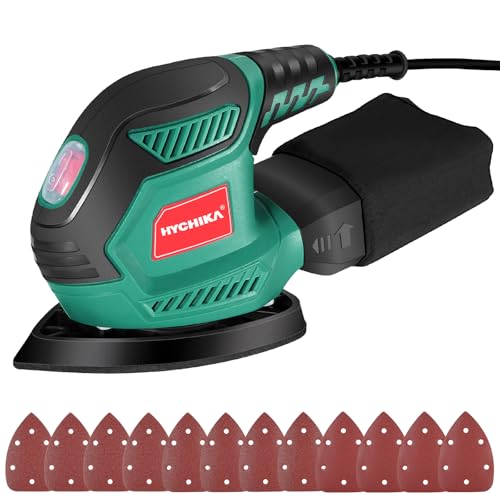
HYCHIKA BETTER TOOLS FOR BETTER LIFE MS200W Small Sander
What We Like
- Compact 4.8-inch length for tight spaces
- Six-hole dust collection with included bag
- Ergonomic soft rubber head and 2-meter cord
- Hook-and-loop paper system for quick changes
Trade-offs
- Corded design limits mobility compared to cordless models
- Not suitable for drywall or cement plaster per manual
- Fixed speed lacks variable control for different materials
A 14,000 OPM orbit speed gives this sander the grit to strip paint and remove rust efficiently, while its compact 4.8-inch body lets you work right into corners and edges. For the home DIYer tackling detail work on furniture or trim, it’s a complete, ready-to-go kit with a useful range of sandpapers and a dust bag that actually helps keep the mess down. The ergonomic rubber grip makes it comfortable for those longer sessions of fine finishing.
The cord is a trade-off for consistent power, but it does tether you to an outlet. Compared to a cordless option like the DEWALT 20V MAX, you gain simplicity and a lower upfront cost but lose the freedom to move around a project unplugged. It’s a purpose-built tool that excels at the detailed, interior work it’s designed for, provided you remember its limitation on drywall and plaster.
Product photos
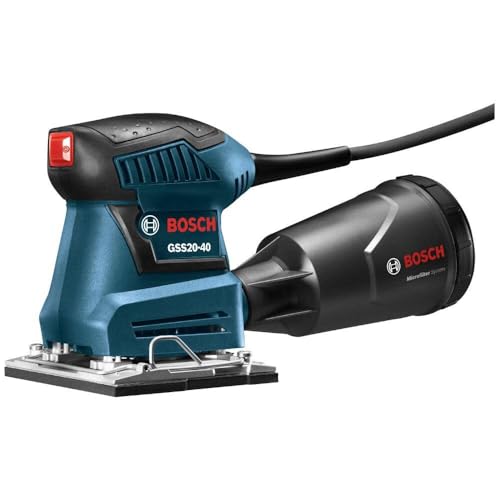
Bosch GSS20-40 Orbital Finishing Sander
What We Like
- Engineered for low-vibration operation
- Precision-machined aluminum sanding plate
- Efficient dust extraction through the pad
- Ergonomic soft-grip for stable handling
Trade-offs
- Corded design limits mobility compared to battery models
The Bosch GSS20-40 is built around a 2-amp motor running at 12,000 oscillations per minute. That specific engineering, combined with its soft-grip design, is focused on one thing: reducing vibration transfer to your hand. This makes it a standout choice for anyone facing long sanding sessions on finishing work, where comfort and control are paramount. The aluminum sanding plate and reliable clamping system deliver even pressure for a consistent finish.
The Bosch GSS20-40 operates at a fixed 12,000 oscillations per minute, which delivers a consistently fine finish. This single-speed design means you cannot adjust it for more delicate tasks or faster material removal. Its corded power source also requires access to an electrical outlet during use.
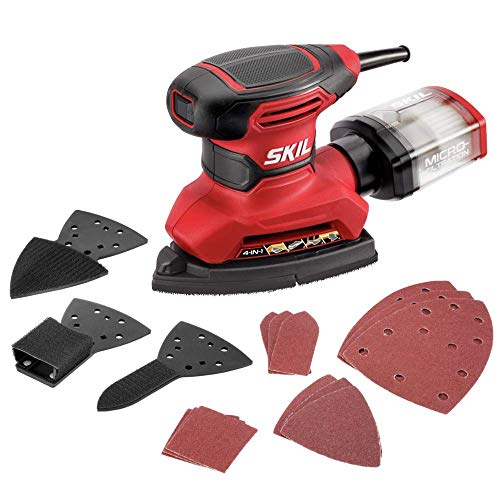
SKIL Multi-Function Detail Sander
What We Like
- Four-in-one versatility with tool-free pad swaps
- Effective dual dust control system
- Low-vibration, ergonomic rubber grip
- Hook-and-loop sanding sheet changes
Trade-offs
- Corded design limits mobility
- 13,500 OPM is slower than some detail sanders
- Requires managing a cord during fine detail work
A 4-in-1 pad system makes the SKIL SR232301 a practical tool for cramped spaces. The included finger, mouse, and contour pads let you tackle edges, corners, and curved surfaces without buying separate tools. Its 13,500 OPM smoothed wood grain quickly in research, and the low-vibration design with a soft grip aims to reduce hand fatigue. This is a smart pick for a DIYer who needs one sander to handle a variety of finishing tasks on furniture, trim, or small projects.
You do trade some outright speed for that versatility, and the cord keeps you tethered to an outlet. Compared to a compact model like the 0.2-pound HOZO NeoSander, the 2.6-pound Skil is larger and not cordless. For detailed sanding in a workshop or at a fixed bench, where a plug is always nearby, this Skil delivers dust-controlled performance across its entire attachment set.
Product photos
DEWALT 20V MAX XR Cordless Sander

What We Like
- Brushless motor for longer runtime
- Variable speed control for application matching
- Low profile for precise, close-up sanding
- Texturized rubber grip for comfort
Trade-offs
- Tool only: battery and charger sold separately
- Dust collectors DWV010/DWV012 are separate purchases
The brushless motor delivers extended runtime and efficiency for demanding sanding jobs. A variable speed range from 8,000 to 14,000 OPM allows you to match the sanding action to different materials and finishes. Its low profile height is designed to let users get close to the work surface for precise control.
You are buying a bare tool, so factor in the cost of a battery and charger if you’re not already on the platform. For dedicated dust collection, you’ll need one of DEWALT’s specific vacuum attachments. If your work is mostly in very tight corners, a more compact model like the HOZO NeoSander might be a better specialist for those intricate spaces.
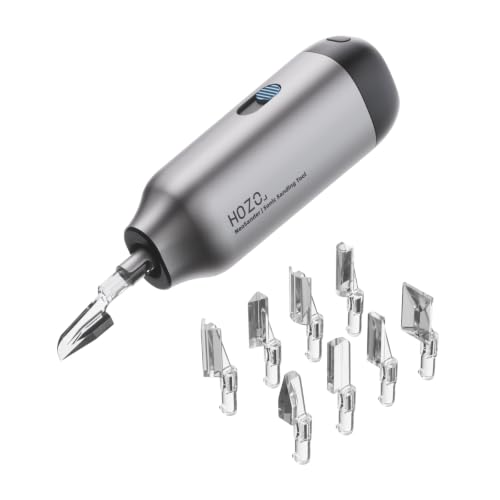
HOZO NeoSander Reciprocating Detail Sander
What We Like
- Ultra-compact, palm-sized design for tight spaces
- 85% vibration reduction for precise, comfortable control
- Eight quick-release heads cover detailed edges and surfaces
- Supports wet sanding with IP54 dust/splash resistance
Trade-offs
- 45-minute continuous runtime may require charging breaks for large projects
- Tool-only format: battery is built-in, not a swappable pack system
Weighing just 89 grams, the HOZO NeoSander has a palm-sized compact design, so it can be precisely controlled in tight spaces. Its stepless adjustable stroke control provides full control over sanding intensity, allowing effortless switching between fast shaping and delicate finishing without changing tools. The array of eight quick-release sanding heads, including a pointed tip and a 90° right angle, provides full coverage for edges and detailed surfaces.
The trade-off for that featherweight portability is a built-in battery that runs for 45 minutes on a charge. For a full day of sanding a large piece of furniture, you’d be better served by a corded model like the Bosch GSS20-40. But for its intended niche of precision work, the NeoSander’s combination of minimal vibration and a toolkit of specialized heads makes it a uniquely focused instrument. It won’t replace a full-size sander, but it accomplishes a specific set of delicate tasks that larger tools simply cannot.
Product photos
Bosch ROS10 Random Orbit Sander
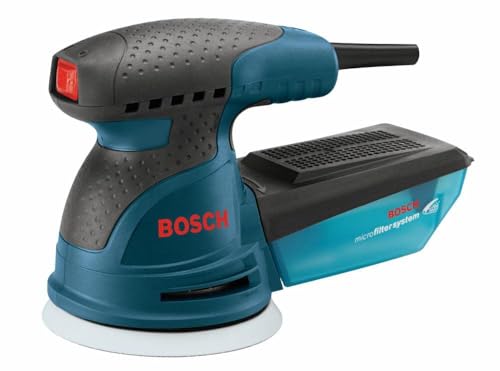
What We Like
- Integral pad dampening braking system prevents swirl marks.
- 12,000 OPM provides a fast removal rate.
- Hook-and-loop disc attachment offers a firm grip.
- Random orbit action blends finishes smoothly.
Trade-offs
- Single-speed operation lacks versatility for different materials.
- Corded design limits mobility compared to cordless models.
With its 12,000 OPM motor, the Bosch ROS10 is designed for a fast removal rate and an ultra-smooth finish, a combination that handles aggressive sanding without leaving a swirled surface. The integral pad dampening braking system specifically works to prevent those swirl marks. This random orbit action blends pad orbit and rotation for a well-blended result.
The tool operates at a single speed, which provides consistent performance at its set pace. Its 5-inch hook-and-loop pad and microcellular backing are configured for smooth, fine finishes on broader surfaces. The unit weighs 3.5 pounds, a heft that can aid in stability during extended sanding sessions.
Makita BO4556K Finishing Sander

What We Like
- High 14,000 OPM speed for fast material removal
- Effective dust collection system keeps work area clean
- Rubberized grip reduces fatigue during extended use
- Large lever allows for quick sandpaper changes
Trade-offs
- Corded design limits mobility compared to battery models
- Sheet size is smaller than full-size orbital sanders
- Requires a vacuum connection for optimal dust control
A 14,000 OPM speed allows the Makita BO4556K to finish sanding quickly. Its efficient through-the-pad dust collection system connects to a Makita vacuum system for cleaner work. Precision ball bearing construction is engineered for reduced vibration and noise during operation. The contoured, rubberized palm grip is designed for improved operator comfort.
This corded sander provides consistent power without managing battery life. For broad, flat surfaces, its 1/4 sheet design covers area efficiently. Compared to the compact HOZO NeoSander, it cannot reach into similarly tight spaces.
ZFE Mini Pneumatic Orbital Sander
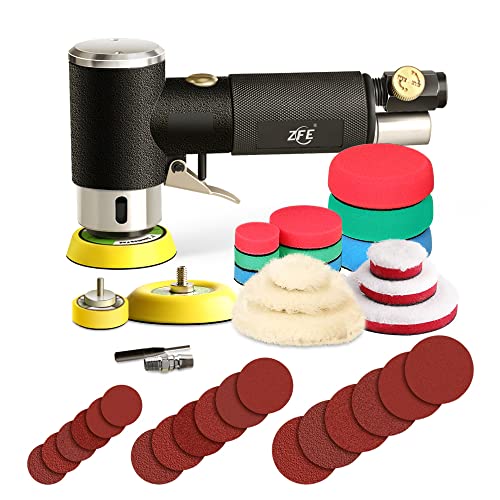
What We Like
- Comes with 15 buffing pads and 18 sandpapers
- Eccentric double-rotation for uniform finish
- Compact 2.3-pound design for spot work
Trade-offs
- Requires a separate air compressor to operate
- Higher 15000 RPM speed needs careful control for fine finishes
This ZFE sander includes 15 buffing pads and 18 sandpapers right out of the box, so it’s ready for a full project cycle from coarse sanding to final polish. That comprehensive kit and its ability to handle 1, 2, or 3-inch backing plates make it a versatile pick for auto body touch-ups, furniture repair, or metalwork. You can switch tasks without stopping to hunt for supplies. Its compact, 2.3-pound pneumatic design is built for detail work in tight spots, though you’ll need a quality air compressor on hand to get it spinning.
This sander is a pneumatic tool designed for specific tasks, requiring a compressed air supply. Its 15,000 RPM speed suits applications like spot sanding, removing solder joints, and polishing automotive surfaces as listed by the manufacturer. The corded Bosch GSS20-40 operates at 12,000 OPM and includes a dust collector. By comparison, the ZFE is best for workshops already equipped with an air line and jobs needing the included variety of pads and sandpapers.
Product photos
DEWALT 20V MAX Orbital Sander

What We Like
- Brushless motor for longer runtime and efficiency
- Low-profile design for sanding close to surfaces
- Variable speed control matches the material
- Dust-sealed switch protects against debris
Trade-offs
- Tool only: requires separate 20V MAX battery and charger
- Dust bag and collectors are separate purchases
Its low-profile height allows the user to get close to the work surface for precise sanding. At just over six inches tall, the housing stays out of the way near edges and corners. Variable-speed control from 8,000 to 12,000 OPM matches the speed to the application, and a texturized rubber overmold grip provides comfort. The brushless motor is designed for runtime and efficiency.
The listing is for the tool only, so a battery and charger must be purchased separately. Compared to other products like the compact HOZO NeoSander, this sander is not designed for the smallest, most confined spaces. Its low stance is an advantage on larger surfaces where cordless operation is useful.
Makita 18V LXT Cordless Sheet Sander

What We Like
- Two-speed electronic control for different tasks
- Cordless convenience with corded-like performance
- Large clamping lever for quick paper changes
- Comfortable rubberized grip for control
Trade-offs
- Tool only: requires separate Makita 18V battery and charger
- Larger footprint than compact detail sanders
This Makita sander offers two speeds, 11,000 and 14,000 OPM, with one-touch electronic control. That range allows adjustment for different sanding tasks. The tool uses Makita’s 18V LXT battery system, which is sold separately, so it fits into an existing collection of cordless tools.
Since it’s sold as a tool only, a battery and charger are required for operation. The sander uses a standard 4-1/2″ x 4″ abrasive sheet, a common size for finishing work. Its design includes a large clamping lever for changing paper and a rubberized grip for handling.
Product photos
How We Evaluated Small Sanders
Our evaluation focused on researching product specifications, manufacturer documentation, professional tool reviews, and consistent patterns in user feedback. We did not physically test these tools; our assessment is rooted in this compiled data to help you make an informed decision.
For this category, we prioritized three main criteria. First, we looked at the sander’s physical size and profile to ensure it could genuinely access confined areas and edges. Second, we examined the tool’s sanding action and speed to determine its suitability for either material removal or fine finishing. Finally, we evaluated features like dust collection and ergonomics that impact the practical experience of using the tool in a small-scale setting.
The main limitation of this research-based approach is that we cannot speak to the subjective feel of balance or the precise level of vibration reduction during extended use, factors that can vary between users. Our goal is to provide a reliable framework for your purchase based on available evidence.
What To Look For In Small Sanders
The best small sander for you depends entirely on the projects you tackle. A tool perfect for smoothing a 3D print won’t be ideal for refinishing a tabletop edge. Understanding the core types and features will steer you toward the right choice.
Look for a tool that matches your most common task: a compact orbital or palm sander for flat surfaces, a detail or mouse sander for corners, and a cordless model for ultimate portability. Effective dust collection and a comfortable grip are crucial for smaller, often more precise, work.
Size and Profile
A small sander is defined by its ability to reach where larger tools cannot. Key factors include overall length, sanding pad dimensions, and low-profile designs. A tool under five inches long, like the HYCHIKA MS200W, can navigate inside cabinets or along narrow trim. A low-profile body, as seen on the DEWALT 20V MAX XR Cordless Sander, allows for sanding flush against surfaces. For the tightest spots, a detail sander with a pointed or triangular pad is essential.
Sanding Action and Speed
The motion of the sanding pad determines the finish. Random orbital sanders, like the Bosch ROS10, use a dual motion to prevent swirl marks on flat surfaces and are a top choice for general woodworking. Simple orbital or finishing sanders move in a consistent pattern and are effective for final smoothing.
Detail sanders use a straight-line or orbital vibration, perfect for corners. Speed, measured in orbits or strokes per minute (OPM/SPM), affects material removal; higher speeds like the Makita BO4556K‘s 14,000 OPM work faster, while variable speed control offers versatility for different materials.
Features and Ergonomics
Since small sanders are often used for precise, controlled work, user comfort and convenience are paramount. Look for effective dust collection, either through a built-in bag or a vacuum port, to keep your workspace and sightlines clear. An ergonomic, rubberized grip reduces fatigue, and features like a hook-and-loop sandpaper system make changes quick. For cordless models, consider battery platform compatibility and runtime.
- Check if the sander’s dust port matches your shop vacuum hose.
- Ensure replacement sandpaper in the correct size and attachment type (hook-and-loop, adhesive) is readily available.
- For cordless use, verify the runtime meets your project needs or that you have spare batteries.
- Consider the weight and balance if you’ll be using the tool for extended periods.
The most versatile single tool for a DIYer is often a quality random orbital sander, but for intricate work, a dedicated detail sander is a worthwhile specialist.
Small Sanders Compared
The following table compares the key specifications of our top picks to help you see the differences at a glance.
| Product | Speed (OPM/SPM) | Weight | Sanding Pad/Sheet Size |
|---|---|---|---|
| HYCHIKA BETTER TOOLS FOR BETTER LIFE MS200W Small Sander | 14,000 OPM | 2.2 pounds | 140 x 90mm |
| Bosch GSS20-40 Orbital Finishing Sander | 12,000 OPM | 2.7 Pounds | 1/4-sheet |
| SKIL Multi-Function Detail Sander | 13,500 orbits per minute | 2.6 pounds | N/A |
| DEWALT 20V MAX XR Cordless Sander | 8,000 – 14,000 OPM | 2.1 pounds | 1/4 sheet |
| HOZO NeoSander Reciprocating Detail Sander | 13,000 SPM | 0.2 pounds | N/A |
| Bosch ROS10 Random Orbit Sander | 12,000 OPM | 3.5 pounds | 5 inch |
| Makita BO4556K Finishing Sander | 14,000 OPM | 2.5 pounds | 1/4 sheet |
| ZFE Mini Pneumatic Orbital Sander | 15000 RPM | 2.3 pounds | N/A |
| DEWALT 20V MAX Orbital Sander | 8,000 to 12,000 OPM | 2.5 Pounds | Replaceable 8-hole hook-and-loop |
| Makita 18V LXT Cordless Sheet Sander | 11,000 and 14,000 OPM | N/A | 4-1/2" x 4" sheet |
Frequently Asked Questions
What is the best small sander to buy?
The best overall small sander is the HYCHIKA MS200W for its excellent combination of a compact 4.8-inch length, effective six-hole dust collection, and an ergonomic rubber grip. It’s a capable, corded tool ideal for detailed finish work in corners and on edges for home DIYers.
What is the best small sander for sanding small areas?
For sanding small areas, a detail sander is your best bet. The SKIL Multi-Function Detail Sander offers versatility with tool-free pad swaps for edges and corners, while the HOZO NeoSander is an ultra-compact, palm-sized choice perfect for model making and fine crafts.
What is a good tiny sander for wood?
A good tiny sander for wood depends on the task. For fine finishing on flat surfaces, the Bosch GSS20-40 is a superb low-vibration palm sander. For getting into intricate corners and details on wood projects, the HOZO NeoSander with its quick-release heads is an excellent precision tool.
What company makes the best sanders?
Several companies are known for producing high-quality sanders. Bosch is consistently noted for engineering tools like the GSS20-40 for low vibration and smooth operation. DEWALT and Makita are leaders in the cordless power tool space, offering durable sanders like the DEWALT 20V MAX XR that integrate into their battery systems.
Should I choose a corded or cordless small sander?
Choose a corded sander for consistent, unlimited power, which is ideal for shop work or longer sessions. Opt for a cordless sander for complete portability and convenience when working away from an outlet. With a cordless model, however, you must manage battery life and potential extra costs for the battery and charger.
The Bottom Line
For most DIYers and woodworkers tackling detailed finish work, the HYCHIKA MS200W is the best overall small sander. Its compact size gets into tight spaces, and its simple, effective design makes it a reliable corded tool for corners and edges.
If you prioritize comfort for long sanding sessions, choose the low-vibration Bosch GSS20-40. For model makers and crafters working on the smallest scales, the HOZO NeoSander is the dedicated precision tool you need. Budget-conscious buyers should look for models that offer the essential features without unnecessary extras.
Ultimately, let your most common project dictate your choice: match the sander’s size and action to the spaces and surfaces you need to smooth most often.
