
10 Best Thickness Planers in 2026
This post contains affiliate links. As an Amazon Associate, we earn from qualifying purchases.
The best benchtop thickness planer offers reliable power and minimizes wasted wood from snipe. Our top pick is the DEWALT Benchtop Planer DW734, which balances professional-grade features and manageable size. We also like the JET 13-Inch Helical Planer for superior surface finish and the Makita 2012NB for easy job-site portability.
For many woodworkers, a thickness planer is the crucial link between rough lumber and finished projects. The right model flattens stock to a consistent thickness, saving you money and ensuring build accuracy.
Our recommendations are based on researching specifications, manufacturer data, and patterns in professional and owner feedback. This guide identifies the best planer for your primary need, from heavy-duty milling to compact portability.
Top 10 Thickness Planers in the Market
Certain content that appears on this site comes from Amazon. This content is provided "as is" and is subject to change or removal at any time.
The Best Thickness Planers, Reviewed
DEWALT Benchtop Planer DW734

What We Like
- Three-knife cutter head delivers a fine 96 cuts per inch
- Four-column carriage lock drastically reduces snipe movement
- Disposable, reversible knives for easy changes and longer life
- Material removal gauge aids in accurate first passes
Trade-offs
- At 80 pounds, it's a substantial lift for a benchtop tool
- Extra-long tables help, but snipe can still require sanding to remove
A 15-amp motor paired with a three-knife cutterhead spinning at 10,000 rpm gives this planer the muscle and finesse for serious work. It handles deep cuts in hardwoods while still providing one of the finest finishes available in a portable machine. The four-column carriage lock and long infeed tables are built to combat snipe, a common plague for shorter-bed planers. For the woodworker who needs reliable, daily performance on a variety of stock, this is the dependable workhorse that gets the job done without fuss.
A four-column carriage lock on this planer drastically reduces the movement that causes snipe. Reviewers note such locks offer mixed results and won’t eliminate it entirely, but with proper dial-in, snipe can be minimized to a level quickly sanded away. While a helical cutterhead is considered superior for cutting operations, upgrading this model to one requires a significant additional investment and voids the warranty. That sum could instead go toward a planer that includes that feature from the start.
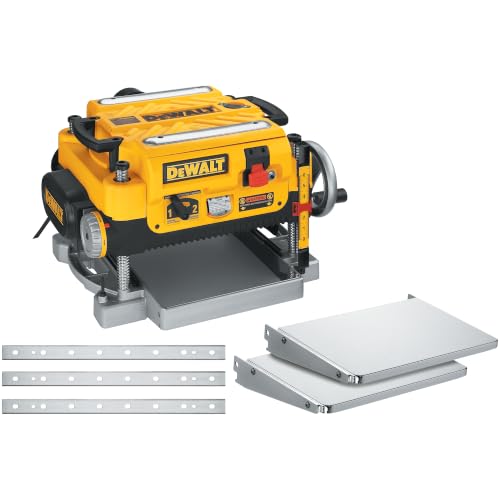
DEWALT Thickness Planer DW735X
What We Like
- Two-speed gearbox optimizes finish or speed
- Fan-assisted chip ejection keeps work area clean
- Automatic carriage lock helps reduce snipe
- Three-knife head offers longer blade life
Trade-offs
- At 102 pounds, it is heavy for a benchtop model
- Stock three-knife head is less smooth than a helical head
- Bed length under 30 inches can contribute to snipe
With a 15-amp motor and a 10,000 rpm cutterhead, this planer has the muscle to handle deep, full-width cuts in hardwoods where others stall. The two-speed gearbox lets you choose between a finer 179 cuts-per-inch finish or a faster 96 CPI for rough stock. It’s built for the serious woodworker who processes a lot of lumber and needs a machine that won’t bog down. The rigid cast aluminum base and automatic carriage lock provide stability and help control snipe, though, like most planers with shorter beds, some fine-tuning is needed to minimize it completely.
This planer delivers more muscle than most benchtop models, handling deep cuts in hardwoods where some competitors stall. Its three-knife cutterhead lasts longer than common two-knife designs and is quicker to change. While the straight knives provide ample power, a helical cutterhead like the one on the Cutech 40700H is considered far superior for finish quality. You can upgrade the DW735X with a Shelix helical head, but that voids the warranty and significantly increases the total cost.
Cutech 40700H Spiral Cutterhead Planer

What We Like
- Spiral cutterhead for smoother, quieter cuts
- Two-sided inserts resist skewing during planing
- Built-in snipe minimizer eliminates extra lock
- Board return rollers add convenience
Trade-offs
- Single-speed motor lacks versatility for varied materials
- At 22" long, it requires a sizable bench footprint
A 12½-inch spiral cutterhead lined with two-sided carbide inserts delivers a noticeably smoother finish with less tear-out and noise than traditional straight knives. That makes this planer a solid bridge for the hobbyist ready to step up from a basic model, offering professional-grade surface quality without the steep learning curve. The integrated snipe minimizer and board return rollers are thoughtful touches that streamline the workflow, letting you focus on the cut rather than wrestling the machine.
This planer’s spiral cutterhead with two-sided tungsten carbide inserts produces a smooth finish directly from the machine, which can reduce sanding time for woodworkers. The design is noted for reduced noise and a lower amp draw compared to others. Its features, like the snipe minimizer and board return rollers, focus on ease of use and consistent results.
Product photos
JET 13-Inch Helical Planer

What We Like
- Helical cutterhead shears wood for a smoother, quieter cut
- Rotatable carbide inserts dramatically reduce long-term blade costs
- Four-post support and fine-adjustment dial provide stable, precise depth control
- Folding tables and upright storage option save valuable shop space
Trade-offs
- At 66 pounds, moving it requires two people or a dedicated bench
- Cannot plane material shorter than 14 inches, 3/16" thick, or 3/4" wide
- Not for plywood, painted lumber, or end grain, limiting material versatility
The 13-inch helical cutterhead with 30 carbide inserts is what sets this planer apart. It shears the wood instead of chopping it, which means a noticeably smoother surface straight off the machine and less sanding later. When an insert dulls, you just rotate it to a fresh edge instead of replacing an entire set of knives. For a serious hobbyist or small-shop woodworker who planes a lot of solid hardwood, that translates directly to a better finish and significantly lower long-term running costs. The 2 HP motor and four-post construction give it the rigidity to handle the full 13-inch width reliably.
The JET 13-Inch Helical Planer is built for solid wood in small shops, which means it’s made for serious hobbyists and woodworkers who need a full 13-inch capacity without a stationary machine. It planes solid hardwood and softwood only, so it is not suitable for plywood, painted lumber, or reclaimed wood. At 66 pounds, it’s a bench anchor with carrying handles, but you’ll want two people to unbox it and it’s not designed for regular jobsite hauling.
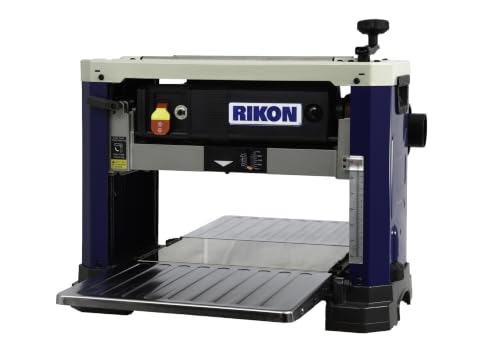
RIKON Power Tools 25-135H Thickness Planer
What We Like
- Two feed speeds for control over finish and speed
- Helical cutterhead with rotatable HSS inserts for easy maintenance
- Four-post threaded head support for stable, repeatable cuts
Trade-offs
- At 67.9 pounds, it's heavier than some portable models like the Makita 2012NB.
- The 13-inch width is narrower than some 15-inch stationary planers.
A two-speed feed system lets you choose between 16 or 26 surface feet per minute, which provides flexibility for different planing tasks. This allows you to balance the rate of material removal against the smoothness of the final surface. That dual control, combined with a helical-style cutterhead using 26 rotatable HSS inserts for easier maintenance, makes this a versatile planer for varied workshop projects.
You get that versatility in a portable but substantial package. At 67.9 pounds, it has the weight to stay steady on the bench during use. While the heavier DEWALT DW735X is another two-speed option for high-volume work, the RIKON’s design offers a practical balance for a home shop handling mixed materials.
Product photos
Makita 2012NB Portable Planer

What We Like
- Compact and lightweight at 61.9 lb for transport
- Quiet 83dB operation for comfortable use
- Fast, easy disposable blade change system
- Stable 4-post design with diagonal bracing
Trade-offs
- 12-inch width limits wider stock compared to 13-inch models
- Double-edge blades require more frequent replacement than helical heads
At 61.9 pounds, the Makita 2012NB is a planer you can carry from a truck to the jobsite. That portability, combined with its 83dB noise level for operator comfort, makes it a choice for work on cabinets or staircases in occupied homes. The four-post design and diagonal cross supports provide stability on a benchtop, while the system allows for faster, easier blade changes. This tool suits projects at a client’s location where reliable thicknessing is needed without the bulk of a heavier machine.
You trade some capacity for the compact, lightweight form. The design is engineered for transporting to the jobsite. Its double-edge blades are disposable, which differs from the spiral or helical cutterheads found on other benchtop models. For a dedicated shop where the planer never moves, a larger, heavier unit often makes more sense. For the mobile professional who values easy transport and low noise, this Makita’s compromises are logical.
CRAFTSMAN CMEW320 Benchtop Planer

What We Like
- 15-amp motor handles hard and soft woods
- Quick-change, reversible knives for long life
- Includes dust collection vacuum port
- Poly-V drive for maximum stock removal
Trade-offs
- Prone to snipe out of the box, requires adjustment
With a 15-amp motor, this planer provides power for both hard and soft wood material removal, offering core capability for a range of projects. Its two-knife, quick-change, solid steel cutter head is mounted on ball bearings, which assures smooth operation and long life. The CRAFTSMAN CMEW320 also comes with a three-year limited warranty for added buyer protection.
A common issue noted by an owner was snipe right out of the box, where the first several inches of a board can be lost. The same feedback indicated this is often correctable by adjusting the bolts under the infeed and outfeed tables to be slightly higher than the center table. This adjustment process is a typical step for many benchtop planers to achieve optimal performance.
Powermatic 15BHH Helical Planer

What We Like
- Solid cast iron tables reduce vibration for consistent results.
- True helical cutterhead for quieter operation and improved finish.
- Oversized emergency stop improves operator safety and visibility.
- Cutterhead access simplifies insert rotation and replacement.
Trade-offs
- At 411 pounds, this is a permanent shop fixture, not portable.
- Requires a dedicated 230-volt single-phase electrical circuit.
With a 15-inch width and a 3 HP motor, the Powermatic 15BHH handles wide boards with substantial power. Its solid cast iron infeed and outfeed tables provide stability and reduce vibration, which supports long stock for consistent planing. The true helical cutterhead is designed for quieter operation and an improved surface finish.
That capacity requires a large footprint, as the machine weighs 411 pounds and is 48 inches long, needing a dedicated stand and floor space. Unlike the 102-pound DEWALT DW735X, this is a stationary machine. Cutterhead access is included to simplify maintenance when rotating or replacing inserts.
Product photos
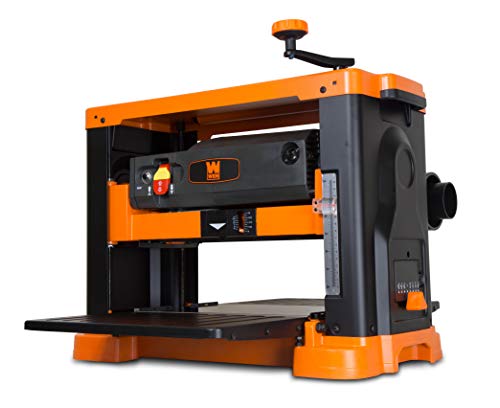
WEN PL1326 Spiral Planer
What We Like
- High 26 FPM feed rate saves time
- Spiral cutterhead provides a smooth finish
- Onboard depth gauge for precise control
- Handles wide 13-inch boards
Trade-offs
- At 81 pounds, requires a sturdy bench for support
- Standard HSS blades require sharpening, not quick replacement
- Lacks the carbide inserts found on some helical competitors
Its 15-amp motor drives a spiral cutterhead with 26 staggered blades, which is designed to produce a clean, smooth finish directly from the planer. This tool can handle boards up to 13 inches wide and 6 inches thick, covering many common project sizes. An onboard material removal gauge helps users monitor the cutting depth for each pass.
The trade-off for that speed and clean cut is the tool’s substantial 81-pound weight, you’ll want a dedicated, solid workbench for it, not a temporary setup. The high-speed steel blades will eventually need sharpening, unlike the indexable carbide inserts on a planer like the JET 13-Inch Helical model. For the woodworker prioritizing throughput over the ultimate in chip-by-chip cutter longevity, this WEN delivers where it counts.
Product photos
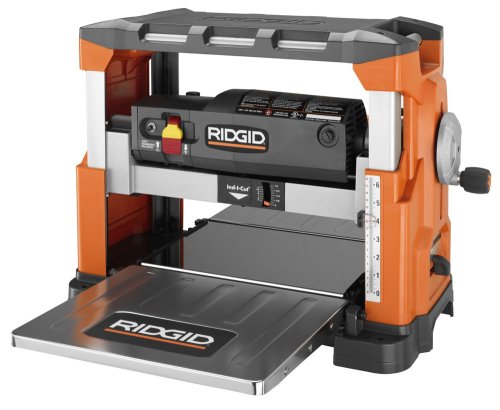
Ridgid R4330 Thickness Planer
What We Like
- Large infeed/outfeed tables for snipe reduction
- Precision lead-screw ensures consistent cut thickness
- On-board storage for blades and tools
Trade-offs
- Bed length under 30 inches can still allow some snipe
- Weighs 72.9 pounds, making it less portable for some
The Ridgid R4330’s precision lead-screw system and large infeed/outfeed table extensions are engineered to tackle a workshop’s persistent headache: snipe. Research indicates that when dialed in, this planer and four others could limit snipe to .0015 inches, a depth that requires only light sanding to remove. This design makes it a solid choice for woodworkers who value a smooth, ready-to-finish surface right off the planer, minimizing tedious post-processing.
You’re getting a focused tool here. That effective snipe-fighting design comes on a 72.9-pound frame, so you’ll want a dedicated benchtop for it. While its depth gauge is praised for setting initial cuts, you won’t find handy preset stops for common thicknesses like on some models. Compared to the feature-packed DeWalt DW735X, the Ridgid offers a more straightforward approach, excelling in one core area rather than trying to do everything.
How We Evaluated Thickness Planers
Our evaluation focused on research from expert round-ups, technical specifications, and consistent patterns in user feedback. We prioritized performance factors that directly impact a woodworker’s results and workflow.
Key criteria included cutting quality (measured by cuts per inch and cutterhead type), snipe reduction mechanisms, and power versus portability. We also assessed practical features like cutterhead maintenance and depth control aids. These factors separate models built for a busy shop from those suited for occasional DIY use.
A research-led evaluation cannot replicate years of shop wear or individual preferences for materials like highly figured wood. We recommend reviewing professional planer reviews for deeper dives into long-term durability and performance on specific tasks.
What To Look For In Thickness Planers
Choosing the right planer means matching its core strengths to your typical projects. Consider your most common stock, required finish quality, and where the tool will live in your shop.
Key buying points include cutterhead type (straight knife vs. Helical/spiral), snipe-reduction features, motor power, and the machine’s size and weight. Budget options often make smart trade-offs in finish quality and blade life.
Cutterhead Type & Cut Quality
Straight knife cutterheads, typically with two or three blades, are standard on many benchtop planers. They provide good performance at a lower cost but can tear figured grain and require more frequent sharpening or replacement. Models like the DEWALT DW734 achieve a fine 96 cuts per inch for a quality surface.
Helical or spiral cutterheads, like those on the JET 13-Inch Helical Planer or Cutech 40700H, use small, staggered carbide or HSS inserts. They shear the wood, resulting in a smoother finish with less tear-out and noise, though they often come at a higher initial price.
Power, Capacity & Snipe Control
A 15-amp motor, found on models like the CRAFTSMAN CMEW320 and DEWALT DW735X, provides ample power for hardwoods. Capacity refers to the maximum board width (commonly 12 or 13 inches) and thickness (often around 6 inches) the planer can handle. Snipe, a deeper cut at the board’s ends, wastes material. Look for features designed to combat it: long infeed/outfeed tables (Ridgid R4330), automatic or manual carriage locks (DEWALT DW735X), and four-post construction for carriage stability. Even with these, some final sanding is often needed.
Portability & Features
Shop-based woodworkers can handle heavier, more permanent tools, while contractors need lighter models like the 61.9-pound Makita 2012NB. Useful features include a material removal gauge for estimating your first pass, two-speed feed for balancing speed and finish (RIKON 25-135H), and easy blade change systems. A clear depth scale and reliable thickness stops prevent costly mistakes.
–
- Check cutterhead access: How easy is it to change or rotate blades and inserts?
- Assess dust collection: A standard port is essential; fan-assisted ejection, like on the DW735X, is a bonus.
- Measure your space: Benchtop footprints vary; some, like the JET planer, offer folding tables for storage.
- Consider electrical needs: Most run on standard 120V, but heavy-duty stationary models like the Powermatic 15BHH may require 230V.
- Review noise levels: All planers are loud, but some, like the Makita 2012NB, are noted for quieter operation.
A quality depth gauge and solid feel during operation are reliable indicators of a well-built machine.
Thickness Planers Compared
The following table compares key specifications across our top picks to help you see the differences at a glance.
| Product | Max cut width | Cutterhead type | Weight |
|---|---|---|---|
| DEWALT Benchtop Planer DW734 | 12-1/2 inches | 3-knife | 80.0 pounds |
| DEWALT Thickness Planer DW735X | N/A | Three knife | 102.0 pounds |
| Cutech 40700H Spiral Cutterhead Planer | 12½ inches | Spiral with 6 rows | N/A |
| JET 13-Inch Helical Planer | 13" wide | Helical, 30 carbide inserts | 66 pounds |
| RIKON Power Tools 25-135H Thickness Planer | 13 inches | 26 HSS helical inserts | 67.9 pounds |
| Makita 2012NB Portable Planer | 12 inches | Disposable double edge | 61.9 pounds |
| CRAFTSMAN CMEW320 Benchtop Planer | 12.25 In. | Two knife | 61.1 Pounds |
| Powermatic 15BHH Helical Planer | 15 inches | True Helical Cutterhead | 411.0 Pounds |
| WEN PL1326 Spiral Planer | 13 inches | Spiral with 26 HSS blades | 81.0 Pounds |
| Ridgid R4330 Thickness Planer | 13-Inch | Three-blade, dual-edge | 72.9 pounds |
Frequently Asked Questions
What is the best thickness planer on the market?
For most woodworkers, the best overall benchtop planer is the DEWALT DW734. It combines a powerful three-knife cutterhead, effective snipe reduction via a four-column carriage lock, and a reputation for durability. It delivers professional results without the premium cost of a helical-head machine, making it a versatile choice for general shop work.
Which thicknesser is the best value for money?
Value depends on your needs. The CRAFTSMAN CMEW320 is a capable budget pick for DIYers. For those wanting a smoother helical-style cut without a premium price, the Cutech 40700H Spiral Cutterhead Planer offers excellent value. It provides the tear-out resistance and quieter operation of a spiral head at a mid-range cost.
Is the Harbor Freight planer any good?
While not featured in our current list, Harbor Freight’s planers are known as entry-level tools. Owner feedback suggests they can handle basic tasks but may require more adjustment for snipe and generally lack the refined performance, power, or durability of established brands. They suit very casual use where a flawless finish isn’t critical.
What is the best budget planer thicknesser?
Our designated Best Budget Pick is the CRAFTSMAN CMEW320 Benchtop Planer. It features a 15-amp motor, reversible knives, and a dust port, offering reliable thicknessing for its price. As a trade-off, it is more prone to snipe out of the box and may not deliver the finish quality required for fine woodworking without subsequent sanding.
Should I buy a planer or a jointer-planer combo?
A dedicated thickness planer is simpler and often more powerful for its size. A jointer planer combo saves significant space by combining two machines into one footprint, which is ideal for small shops. The trade-off is typically a reduction in maximum board width or thickness capacity on each function compared to standalone tools.
The Bottom Line
The DEWALT Benchtop Planer DW734 earns our best overall recommendation for its solid construction, effective snipe control, and ability to produce a fine finish straight from its three-knife head. It’s the right tool for a woodworker who mills a variety of stock and values consistent, reliable performance.
If budget is your primary concern, start with the CRAFTSMAN CMEW320. For the ultimate in surface quality straight from the machine, choose a model with a helical or spiral cutterhead, like the JET 13-Inch Helical Planer or the value-priced Cutech 40700H. Contractors should look directly to the compact Makita 2012NB.
Ultimately, matching the planer’s cutterhead type and power to your most common materials is the single most important factor. Whether you choose straight knives or a helical head, proper planer operation and setup are just as crucial to achieving excellent results.
