
10 Best Wood Thickness Planers in 2026
This post contains affiliate links. As an Amazon Associate, we earn from qualifying purchases.
Our best overall benchtop planer is the DEWALT DW735X Thickness Planer for its powerful motor and two-speed gearbox. For a smooth, spiral-cutter finish on a budget, the WEN PL1326 offers strong value, while the Cutech 40700H excels at minimizing snipe. Choosing the right tool transforms rough lumber into dimensioned stock for furniture and cabinetry.
This requires balancing power, finish quality, and shop space. We researched specifications, expert round-ups, and patterns in owner feedback to identify the top 10 models. Our guide highlights each planer’s strengths and best use case to help you invest confidently.
Top 10 Wood Thickness Planers in the Market
Certain content that appears on this site comes from Amazon. This content is provided "as is" and is subject to change or removal at any time.
The Best Wood Thickness Planers, Reviewed
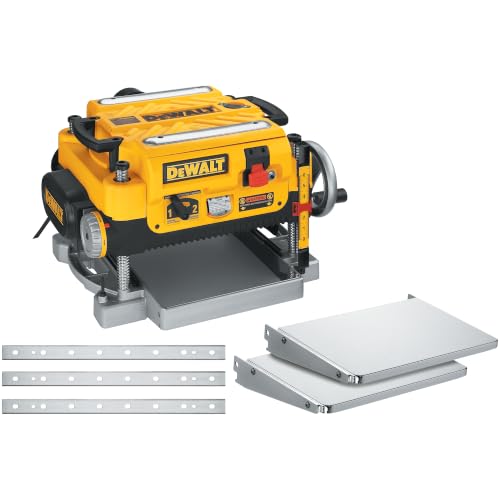
DEWALT DW735X Thickness Planer
What We Like
- Powerful motor handles larger, wider cuts
- Two-speed gearbox optimizes finish vs. speed
- Automatic carriage lock helps reduce snipe
- Fan-assisted chip ejection keeps work area clean
Trade-offs
- At 102 pounds, it's a serious lift for a benchtop model
- Standard three-knife head is louder and leaves a different finish than a helical head
This planer possesses the most muscle among the tested benchtop models when challenged with deep cuts on dense hardwoods, a decisive advantage for efficiently processing a lot of material. Its rigid cast aluminum base, which is twice as rigid as a standard base, provides the stable foundation needed to harness that power. A two-speed gearbox allows you to optimize the feed rate, making it a heavy-duty workhorse that still fits on a workbench.
The trade-off is its heft and the character of its cut. Research confirms it requires dialing in to control snipe, though its automatic carriage lock helps reduce the movement that causes it. The three-knife cutterhead delivers longer knife life and faster changes. For a different cutting operation, the research mentions the Byrd Shelix helical head as a far superior but costly upgrade that voids the warranty, while other products come with a helical head from the factory.
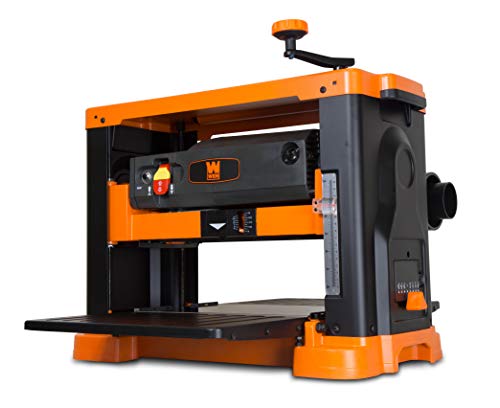
WEN PL1326 Spiral Thickness Planer
What We Like
- Spiral cutterhead with 26 rotatable HSS blades
- 15-amp motor for demanding material removal
- Onboard cutting depth gauge for precision
- Handles wide 13-inch boards
Trade-offs
- Heavy at 81 pounds for a benchtop unit
- HSS blades require sharpening, not indexable inserts
With a 13-inch width capacity, the WEN PL1326 can handle wider boards that many benchtop models cannot. Its spiral cutterhead uses 26 staggered and rotatable HSS blades, which produce a clean, smooth finish and allow individual blades to be turned to spread wear. This design offers the surface quality of a spiral head at a lower upfront cost than models with carbide inserts.
Weighing 81 pounds, this planer requires a sturdy, semi-permanent stand rather than frequent lifting. The cutterhead spins at 10,000 RPM with a feed rate of 26 feet per minute, a pace that prioritizes finish over speed. For woodworkers, this means the tool is a stationary asset best suited for a dedicated shop space.
Cutech 40700H Spiral Cutterhead Planer

What We Like
- Spiral cutterhead for smooth, quiet finish.
- Patented 4-lead-screw snipe minimizer design.
- Two-sided inserts for precise alignment.
- Board return rollers for easier workflow.
Trade-offs
- Single-speed operation limits feed rate options.
The Cutech 40700H’s patented four-lead-screw system automatically minimizes snipe, a major frustration when flattening boards. This makes it a strong candidate for woodworkers who value a clean, ready-to-use surface right off the planer. Its spiral cutterhead with staggered carbide inserts produces a notably smooth cut with less noise and motor strain, which is a welcome feature in a home shop. The addition of board return rollers is a thoughtful touch that streamlines the process when you’re working alone.
That snipe-fighting design does come with a physical trade-off. For those with space, it’s a capable benchtop machine.
Product photos
JET 13-Inch Helical Thickness Planer

What We Like
- Helical cutterhead shears wood for a smoother, quieter cut
- Rotatable carbide inserts drastically reduce long-term blade costs
- Four-post support and fine-adjustment dial for precise thickness control
- Folding tables and upright storage save valuable shop space
Trade-offs
- Weighs 66 lb, requiring two people for safe unboxing
- Cannot plane plywood, painted lumber, or end grain
- Minimum board length of 14 inches excludes shorter stock
A 13-inch helical cutterhead with 30 carbide inserts is the core of this planer’s premium proposition. It shears wood fibers instead of chopping them, leaving a surface that often needs little sanding and does so at a quieter 91 dB. That, combined with the ability to simply rotate a dull insert rather than replace an entire knife set, makes it a machine built for volume and quality in a small shop. It’s tailored for the serious hobbyist or trade-school shop that processes solid hardwoods and needs a benchtop footprint without sacrificing professional-grade results.
Its 66-pound weight makes this a substantial benchtop tool, so you’ll need a dedicated stand or a sturdy workbench to support it. The four-post head support provides a solid foundation for controlled planing. Jet specifies it is for planing solid hardwood and softwood only, and it must not be used on plywood, painted lumber, or reclaimed wood.
Makita 2012NB Portable Planer

What We Like
- Compact and lightweight for job site transport
- Low 83dB noise level for operator comfort
- Fast and easy disposable blade change system
- Stable 4-post design with cross supports
Trade-offs
- Has a 12-inch width, limiting it versus wider models
- Uses disposable knives instead of a spiral cutterhead
- Weighs 61.9 lb, which is substantial for its compact size
Makita’s 2012NB is the quietest planer in its class at 83dB, a measured advantage for work in shared or residential spaces. Its compact design and 61.9-pound weight make for easy transport between a job site and a workbench. A four-post design with diagonal cross supports creates a stable foundation, and the blade change system is engineered for speed to reduce downtime.
The planer has a 12-inch width, while models like the DEWALT DW735X are listed with larger dimensions. It uses a system of disposable double-edge blades, whereas other products like the Cutech 40700H or JET 13-Inch planer are listed with spiral or helical cutterheads.
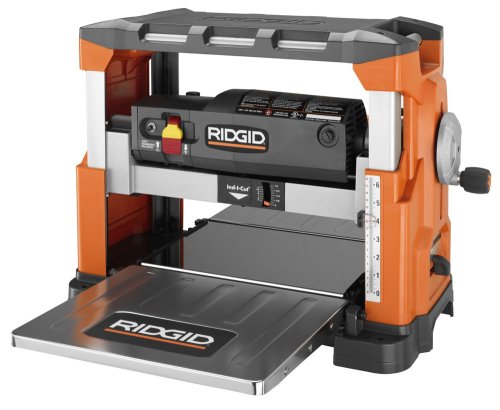
Ridgid R4330 Thickness Planer
What We Like
- Dual-edge, self-indexing blades for easy changes
- Large infeed/outfeed tables help reduce snipe
- On-board storage for blades and tools
Trade-offs
- At 72.9 lb, it's a substantial bench fixture to move
- Requires initial calibration to minimize snipe
A precision lead-screw depth system is the key feature here, providing consistent cut thickness across the full 13-inch width of your workpiece. This makes the R4330 a solid choice for woodworkers who need repeatable accuracy for projects like cabinetry or tabletops, where uniform stock is non-negotiable. It’s built for the shop, with a 15-amp motor that doesn’t bog down.
Like most benchtop planers, this one requires some initial setup to perform its best. Expert research confirms that while it can snipe out of the box, it can be dialed in to leave a minimal mark. That’s a trade-off for its capable performance at a mid-range point. If you prioritize a nearly snipe-free experience right from the start and are willing to pay a premium for a helical cutterhead, you’d look at a model like the JET 13-Inch Helical planer. The Ridgid delivers reliable thickness consistency once it’s tuned.
CRAFTSMAN CMEW320 Thickness Planer

What We Like
- 15-amp motor handles hard and soft woods
- Poly-V drive for maximum stock removal
- Quick-change, double-edged knives for long life
- Built-in dust collection port
Trade-offs
- Exhibits snipe without careful table adjustment
- At 61.1 lb, it's a substantial lift for a benchtop unit
A 15-amp motor and a 12.25-inch width give this Craftsman planer the core capability to handle serious material removal for a shop on a tight budget. It’s a straightforward, two-knife machine that gets the job done, backed by a solid three-year warranty. For the hobbyist or occasional user who needs to dimension a lot of rough stock without frills, this planer delivers essential power and capacity. You’re getting a workhorse that prioritizes function over refinement.
The two-knife, high-carbon steel cutterhead is double-edged and reversible for long cutting life. Research mentions indicate the planer can suffer from snipe right out of the box, but owners report this is often correctable by adjusting the infeed and outfeed tables. It uses straight knives, unlike the spiral cutterheads on the WEN PL1326 or Cutech 40700H, which are known for a different finish.
Product photos
Triton TPT125 Benchtop Planer

What We Like
- 17,500 cuts per minute for a smooth finish
- Easy depth setting in 1/16-inch increments
- Circuit breaker for electrical safety
- Reversible dust chute for efficient extraction
Trade-offs
- At 65 pounds, it's not the lightest benchtop model to move.
- Lacks a spiral cutterhead for quieter operation and longer edge life.
A 17,500 cuts per minute cutting speed delivers a consistently smooth surface, minimizing the need for extensive sanding after planing. This Triton model exhibits serious muscle, handling a full-width 1/16-inch cut in dense red oak where some competitors stalled. For the woodworker prioritizing a fine finish and reliable power in a benchtop footprint, it’s a strong contender. Its reversible dust chute and safety breaker are thoughtful touches for a cleaner, safer shop.
You trade some portability for that performance, as its 65-pound heft demands a solid bench. Compared to a model like the DeWalt DW735X, which also aced the deep cut test, the Triton uses a traditional two-knife cutterhead. That means you’ll be changing or sharpening high-speed steel blades more often than you would with a spiral carbide insert head, a trade-off for its more accessible price point in the powerful planer category.
Product photos
WEN PL1337 Planer and Jointer Bundle

What We Like
- Two-speed planer for fast work and fine finishes
- Jointer fence bevels to 45 degrees for angled cuts
- Spiral cutterheads on both machines reduce tearout
- Jointer removes up to 1/8 inch per pass
Trade-offs
- Bundle requires dedicated shop space for two machines
- Planer's maximum width is 13 inches
A 13-inch planer paired with a 6-inch jointer creates a foundational dimensioning station for the home shop. This bundle is for the woodworker ready to move beyond rough lumber, offering the two core machines for flattening and thicknessing in one purchase. The spiral cutterheads on both units promise smoother surfaces right out of the gate, while the jointer’s sizable table and beveling fence handle face jointing and chamfers. It suits someone setting up a first serious workshop who values a matched set from a single brand.
This bundle combines two fundamental milling machines, letting you flatten boards on the jointer and then plane them to a consistent thickness without switching tools. The trade-off is that you must accommodate two separate benchtop units, each needing its own dedicated space and setup. Your decision rests on whether to establish both jointing and planing capabilities at once or to start with a single thickness planer.
Product photos
DEWALT DW734 Thickness Planer

What We Like
- High 96 cuts per inch for fine finish
- Four-column carriage lock reduces snipe movement
- Extra-long tables provide stable material support
- Turret stop for quick return to common depths
Trade-offs
- 80-pound weight makes it a heavy benchtop unit
- Factory setup often requires snipe adjustment
A 10,000 rpm cutter head delivering 96 cuts per inch gives you one of the smoothest finishes available in a portable planer, straight off the knives. That high cut count is the core reason this model stands out for finish quality. Its 15-amp motor and four-column locking system provide the solid, predictable performance that woodworkers need when dimensioning furniture stock or cabinetry parts, even if the initial setup requires dialing in to minimize snipe.
DeWalt’s four-column carriage lock drastically reduces the movement that causes snipe, though experts found carriage locks deliver mixed results across planers and don’t eliminate the issue entirely. Planers with beds shorter than 30 inches, like this one, tend to produce deeper snipe, but the DW734 can be dialed in to leave a minimal gouge that sands away quickly. Its three-knife cutter head spins at 10,000 rpm for 96 cuts per inch, which is noted as one of the finest finishes available on a portable planer.
Product photos
How We Evaluated Wood Thickness Planers
Our research focused on manufacturer specifications and documented performance in expert round-ups. We prioritized criteria that affect real-world shop use: motor power and cutting capacity for handling hardwoods, cutterhead type for finish quality and longevity, and features that combat snipe for material savings. We also considered physical footprint and weight, as a benchtop tool must fit your space.
A research-based evaluation like this relies on published data and aggregated user experiences; it cannot replicate the feel of adjusting a specific machine in your own shop. For hands-on guidance, our article on thickness planer techniques covers setup and operation.
What To Look For In Wood Thickness Planers
Selecting a planer means matching its capabilities to your typical projects and shop constraints. The right choice saves time, material, and frustration.
Key criteria include motor power (15 amps is common for hardwoods), cutterhead type (spiral/helical for smoothness, straight knives for cost), and width capacity (12 to 13 inches handles most boards). Also assess snipe-reduction features and the machine’s physical weight.
Power & Cutting Capacity
A planer’s motor must provide consistent torque to pull wide, hard boards through the cutterhead. Many models feature a 15-amp motor, which is sufficient for most hardwoods in a home shop. The maximum cutting depth per pass, typically one-eighth of an inch, determines how quickly you can remove material. Models like the DEWALT DW735X are noted for exceptional power, allowing deeper cuts in dense wood without stalling. Consider your typical stock; if you often work with rough-sawn oak, strong motor performance is a priority.
Cutterhead Type & Finish Quality
The cutterhead defines the planer’s cut quality, noise level, and long-term cost. Traditional straight-knife heads (two or three blades) are common and cut quickly but are louder and more prone to tear-out. Spiral or helical heads, like those on the JET 13-Inch model, use many small, staggered carbide inserts. They shear the wood, producing a smoother, quieter cut with less tear-out. While more expensive upfront, their rotatable inserts last far longer than disposable knives, offering better long-term value for high-volume users.
Features For Precision & Workflow
Look for design elements that enhance accuracy and ease of use. A two-speed gearbox lets you switch between a fast feed rate for stock removal and a slow rate for a finer finish. Features aimed at reducing snipe, the dreaded dip at the board’s ends, are critical. These include automatic carriage locks, extended infeed/outfeed tables, and specialized designs like the Cutech’s four-lead-screw system. A clear, accurate depth gauge and preset thickness stops help prevent costly mistakes.
- Check the feed rate, measured in feet per minute or cuts per inch, which affects finish smoothness.
- Ensure the dust collection port matches your shop vacuum or dust collector hose size.
- Consider the machine’s weight; a heavier planer like the DEWALT DW735X is more stable but harder to move.
- Verify the minimum board length the planer can accept, which can exclude short offcuts.
- Look for onboard storage for blades or wrenches to keep accessories organized.
For most home workshops, a 13-inch wide planer with a 15-amp motor provides the best balance of capability and footprint.
Wood Thickness Planers Compared
The table below compares key specifications across our top picks to help you see the differences at a glance.
| Product | Cutting Width | Cutterhead Type | Weight |
|---|---|---|---|
| DEWALT DW735X Thickness Planer | 19-3/4 in. | Three knife | 102.0 Pounds |
| WEN PL1326 Spiral Thickness Planer | 13 inches | 26 HSS spiral blades | 81.0 pounds |
| Cutech 40700H Spiral Cutterhead Planer | 12½ inches | Spiral with carbide inserts | N/A |
| JET 13-Inch Helical Thickness Planer | 13 inches | Helical, 30 carbide inserts | 66.0 pounds |
| Makita 2012NB Portable Planer | 12 inches | Disposable double-edge | 61.9 pounds |
| Ridgid R4330 Thickness Planer | 13 inches | Three-blade | 72.9 pounds |
| CRAFTSMAN CMEW320 Thickness Planer | 12.25 in. | Two-knife, quick-change | 61.1 lb |
| Triton TPT125 Benchtop Planer | 12-1/2 inches | N/A | 65.0 pounds |
| WEN PL1337 Planer and Jointer Bundle | 13 inches | Spiral with HSS blades | N/A |
| DEWALT DW734 Thickness Planer | 12-1/2-Inch | 3-knife | 80 pounds |
Frequently Asked Questions
What is the best thickness planer for woodworkers?
The best planer depends on your primary need. For overall power and high-production capability, the DEWALT DW735X is a top choice. If you prioritize a smooth, tear-out-free finish, a model with a spiral or helical cutterhead, like the JET 13-Inch Helical Thickness Planer, is superior. Budget-conscious woodworkers should consider the CRAFTSMAN CMEW320.
What’s the best thickness planer for a beginner?
Beginners should look for a planer that is straightforward to set up and use. The Makita 2012NB is compact, relatively quiet, and has an easy blade-change system. Alternatively, the Ridgid R4330 offers good thickness consistency and onboard storage for its tools, helping new users stay organized.
Is the Harbor Freight planer any good?
While not featured in our current ranking, general feedback on affordable planers indicates they can perform basic tasks. However, they may require more frequent adjustments to minimize snipe and often lack the power and durable construction of established brands. For occasional use on softwoods, they can be a starting point.
What are people saying about the Ridgid thickness planer?
Owner reports on the Ridgid R4330 frequently praise its dual-edge, self-indexing blades for easy changes and its large tables that help support boards. A common note is that it may require initial calibration to minimize snipe, but once set, it provides reliable and consistent thickness accuracy for furniture projects.
Should I buy a separate planer and jointer or a combo machine?
This depends on your shop space and workflow. A dedicated planer, like our top picks, often offers more power and features. A jointer and planer combo, like the WEN PL1337 bundle, saves space and is ideal for starting a first shop. Separate machines allow simultaneous operation, which is more efficient for larger projects.
The Bottom Line
For the serious hobbyist or professional needing a heavy-duty, high-production benchtop planer, the DEWALT DW735X Thickness Planer is our best overall pick. Its powerful motor, two-speed gearbox, and effective chip ejection handle demanding workloads. If budget is the main concern, the CRAFTSMAN CMEW320 offers capable performance, while those seeking the ultimate finish should look to the JET 13-Inch Helical model. When evaluating any planer, prioritize features that actively combat snipe; saving those first and last few inches of every board adds up to significant material savings over time.
