
10 Best Vertical Air Compressors in 2026
This post contains affiliate links. As an Amazon Associate, we earn from qualifying purchases.
Our best overall vertical air compressor is the DEWALT 30-Gallon for its powerful 175 PSI output and job-site-ready mobility. For high-capacity workshops, the Campbell Hausfeld 60-Gallon excels, and the Stealth 20-Gallon offers the quietest operation. Each serves a distinct need in a home shop or on the go.
Choosing a vertical model saves valuable floor space, but you must still match its power to your tools. A mismatch leads to frustrating pauses or a permanent installation that’s overkill for your actual tasks.
Our recommendations are based on comparing specifications, manufacturer data, and patterns in owner feedback across dozens of models. We’ll help you find the right balance of air supply, pressure, and portability.
Top 10 Vertical Air Compressors in the Market
Certain content that appears on this site comes from Amazon. This content is provided "as is" and is subject to change or removal at any time.
The Best Vertical Air Compressors, Reviewed
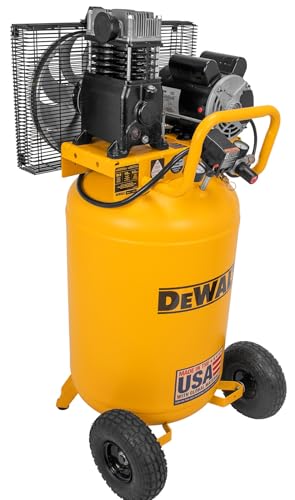
DEWALT 30-Gallon Vertical Portable Air Compressor
What We Like
- High 175 psi max working pressure
- Long 2.5X air tool run time
- 23% quieter than a key competitor
- High-flow regulator for more usable air
Trade-offs
- At 196 lb, it's a two-person lift for loading
- Not a stationary unit like the 60-gallon Porter-Cable
A 175 psi max pressure and 6.2 SCFM at 90 psi give this compressor the muscle to run framing nailers and impact wrenches without constant cycling. The 30-gallon tank and a high-flow regulator deliver a solid, steady stream of air, so you can work longer between pauses. For a contractor or serious DIYer who needs reliable power that can follow the job from the garage to the driveway, this DEWALT hits a practical sweet spot of capacity and output.
At 196 pounds, this compressor’s heavy-duty pneumatic wheels are essential for moving it around a shop or across a job site. You won’t casually toss it into a truck, but the wheels provide the portability its weight demands. For a setup that stays in one place, other large-capacity models like the Campbell Hausfeld 60-Gallon Two-Stage Air Compressor exist, but their mobility isn’t specified.
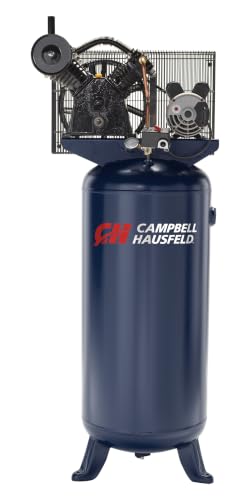
Campbell Hausfeld 60-Gallon Two-Stage Air Compressor
What We Like
- Large 60-gallon tank for extended tool runtime
- Two-stage cast iron pump built for 10,000-hour life
- 175 PSI max pressure supports demanding pneumatic tools
- Vertical 23×23-inch footprint saves valuable floor space
Trade-offs
- Requires a dedicated 230/240V electrical circuit
- At 255 pounds, it is a permanent stationary installation
A 60-gallon tank paired with a two-stage pump delivering 7.6 SCFM at 90 PSI means you can run demanding air tools like sanders and grinders for extended periods without frequent pauses. This large-capacity stationary unit is engineered for demanding garage and workshop applications. The research mentions that Campbell Hausfeld presents a value in this category, offering performance for the pragmatic buyer.
The trade-off is its substantial footprint and power requirements. You’ll need to commit a permanent spot in your garage and have a dedicated 230V outlet installed. Compared to a portable option like the DEWALT 30-Gallon, this is a stationary machine, not something you’ll move around. For the dedicated home workshop with the space and wiring, however, it delivers the air supply needed to handle back-to-back tasks.
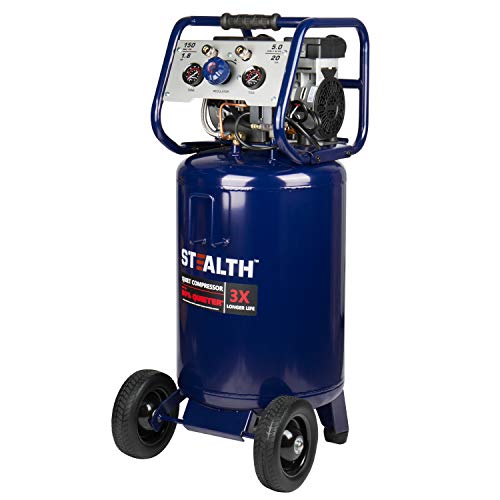
Stealth 20-Gallon Ultra Quiet Air Compressor
What We Like
- Ultra-quiet 68-decibel operation
- Oil-free, maintenance-free motor
- Heavy-duty steel tank with wheels for mobility
- Two quick couplers for easy tool switching
Trade-offs
- 5 CFM at 90 PSI limits sustained use of high-demand tools
The Stealth 20-Gallon Ultra Quiet Air Compressor operates at 68 decibels, which is its defining advantage. Its oil-free motor eliminates a maintenance chore, and the 20-gallon tank provides solid capacity for common tasks. This unit is built for the DIYer or light shop user who values quiet operation above raw power and needs a stable, mobile compressor.
You pay for that quiet operation with a trade-off in air volume. The 5 CFM at 90 PSI is a lower output compared to many larger stationary compressors. It’s a specialist for quiet environments, not a high-production unit.
DEWALT 25-Gallon Vertical Oil-Lubed Compressor

What We Like
- High 200 PSI capacity for demanding tools
- Belt-drive motor for consistent performance
- Large 10-inch wheels for job site portability
- Oil-lubed pump design for enhanced longevity
Trade-offs
- At 49 inches tall, it requires significant vertical space
- Heavier weight than smaller portable compressors
- Oil maintenance required versus oil-free models
With a maximum pressure of 200 PSI, this compressor is built to handle demanding tasks. Its 2 hp belt-drive motor and 25-gallon tank are common specifications for workshop duty. The vertical shape and 10-inch pneumatic wheels allow it to be stored compactly and rolled across a job site.
The oil-lubed pump design is intended to enhance longevity, which means it requires periodic maintenance unlike oil-free models. Weighing less than the 255-pound Campbell Hausfeld 60-gallon model, its size is more compatible with a standard garage’s space and electrical system.
CRAFTSMAN 33-Gallon Vertical Portable Air Compressor

What We Like
- Oil-free pump for zero maintenance
- Two quick couplers support simultaneous use
- Vertical design saves floor space
Trade-offs
- At 154 lb, portability requires its built-in wheels
- 5.1 CFM limits continuous use with high-demand tools
The dual quick couplers are the headline here. They let two people run tools from one compressor without a manifold, which is a genuine shop efficiency boost for teams or busy DIYers juggling tasks. Combined with a 33-gallon tank and an oil-free pump, this Craftsman is built for users who want to set it and forget it. It avoids maintenance while providing reliable air for framing nailers, impacts, or filling tires. This makes it a solid fit for an active home garage or small professional crew where shared air is more valuable than maximum CFM.
Choosing this compressor means prioritizing dual-user convenience over maximum air power for a single tool. Its 5.1 CFM at 90 PSI output can run a range of pneumatic tools, but a high-demand sander or grinder will need pauses for the tank to refill. The design supports two people working at once with its pair of quick couplers, a trade-off that makes it efficient for a busy shop but less ideal for uninterrupted, heavy solo work.
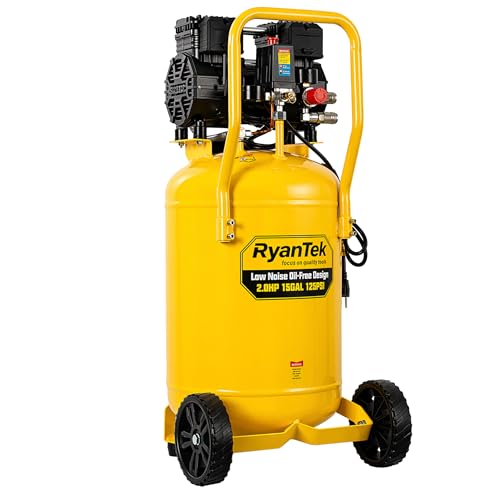
RyanTek 15-Gallon Quiet Air Compressor
What We Like
- Quiet 66 dBa operation for indoor use
- Vertical, wheeled design for easy mobility
- Oil-free pump provides clean air output
- Upward-facing gauge and dual outlets for convenience
Trade-offs
- 15-gallon tank is smaller than many workshop verticals
- 4.5 CFM may require pauses with high-demand tools
- At 68.3 lb, it's heavier than some compact portables
A 66 dBa noise level means you can run this compressor in an attached garage without disturbing the whole house, which is a genuine luxury for weekend projects. The 15-gallon vertical tank and integrated wheels strike a clever balance, offering more air than a portable pancake while keeping a footprint small enough for a crowded shop. It’s built for the DIYer who needs reliable air for nail guns, inflation, or light spraying but values peace and floor space. The oil-free twin-cylinder design eliminates maintenance and keeps the air clean for finishing tasks.
Capacity is the main compromise. The 4.5 CFM at 90 PSI will handle most intermittent work, but you’ll wait for the tank to refill during continuous sanding or heavy grinding. Compared to the larger CRAFTSMAN 33-Gallon model, it holds less air, which means the motor cycles on more often during sustained use. For a dedicated workshop running tools non-stop, a bigger tank is better. But if your priority is a neighbor-friendly compressor that you can easily wheel into a corner, this one’s design is thoughtfully executed.
Product photos
Ingersoll Rand Type 30 Two-Stage Air Compressor

What We Like
- Cast iron design for 100% continuous duty
- Large 60-gallon vertical air reservoir
- Individually cast cylinders for serviceability
- Built for high-volume, high-pressure operation
Trade-offs
- Weighs 430 pounds, requiring a permanent installation
- Requires a dedicated 230V single-phase circuit
- A 69-inch height needs significant vertical clearance
A 100% continuous duty rating means this compressor can run all day without a cooldown period, making it a true shop fixture. The 5 HP motor and two-stage pump are built for high-volume, high-pressure tasks like running multiple sanders or a heavy-duty impact wrench. This Ingersoll Rand is for the serious hobbyist or professional whose work demands uninterrupted air. Its cast iron construction is designed for that kind of relentless use, where a lighter-duty unit would quickly overheat.
The trade-off for that stamina is a substantial footprint and a 430-pound weight, so plan its placement carefully. This isn’t a tool you’ll move around. Compared to a lighter two-stage option like the Campbell Hausfeld, the Ingersoll Rand’s heavier build and overhung crankshaft design signal a focus on long-term serviceability and durability over any semblance of mobility. It’s a buy-once, cry-once machine for a permanent workshop corner.
Product photos
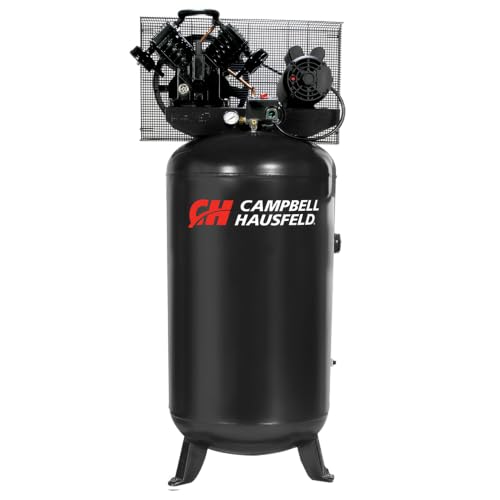
Campbell Hausfeld 80-Gallon Air Compressor
What We Like
- Large 80-gallon tank for extended work periods
- High 16.0 CFM air delivery powers demanding tools
- Durable cast-iron pump for long service life
Trade-offs
- Weighs 460 pounds and requires permanent installation
- Needs a dedicated 208-230V single-phase electrical circuit
- Large 84-inch height needs significant vertical clearance
An 80-gallon vertical tank stores a large volume of compressed air, allowing for longer work periods with demanding pneumatic tools before the pump needs to cycle on. This Campbell Hausfeld model delivers 16.0 CFM at 90 PSI, a flow rate intended to support continuous operation of tools for sanding, grinding, or paint spraying. Its oil-lubricated, cast-iron pump runs at 950 RPM for extended service life, and the unit is assembled in Leitchfield, Kentucky from global materials.
The commitment is substantial. At 460 pounds and standing over seven feet tall, this isn’t a tool you move around. It needs a dedicated corner with proper electrical service. For a busy two-bay garage, that’s a fair trade for the air supply. But if your projects are more intermittent, a model like the DEWALT 30-Gallon Vertical Portable Air Compressor offers far more mobility at less than half the weight, though with a corresponding drop in continuous air volume.
Product photos
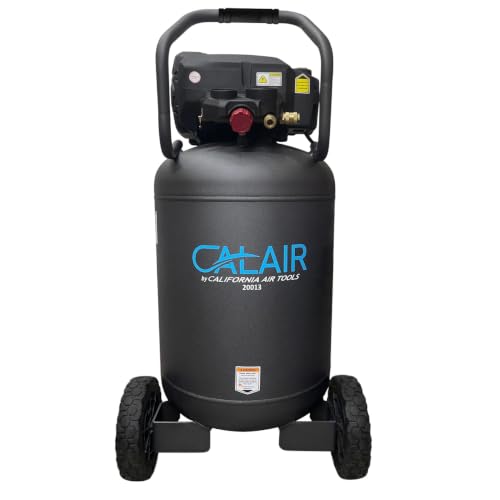
California Air Tools 20-Gallon Quiet Compressor
What We Like
- Remarkably light at just 82 pounds
- Oil-free pump for cold starts and uneven terrain
- Includes a wheel kit for easy mobility
- High working pressure for demanding tools
Trade-offs
- 1.3 HP motor offers less power than many 20-gallon rivals
Weighing 82 pounds, this compressor is among the easiest 20-gallon models to move around a jobsite. That manageable weight, combined with its integrated wheel kit, means you can roll its full tank capacity into position without strain. The oil-free pump is a practical feature for cold starts in an unheated space or use on uneven terrain, since there’s no oil to tip or leak. It’s designed for the person needing high pressure to drive tooling, valuing portability over maximum continuous air volume.
The trade-off for that easy mobility is motor power. Its 1.3 HP motor offers less power than many 20-gallon rivals, which suggests it is not intended for the highest-demand applications. For a home workshop or a contractor moving between sites, however, this compressor strikes a specific balance. You get a full-size tank that’s genuinely portable, backed by a pump designed for a life cycle before wear of 1000 plus hours without oil maintenance.
Product photos
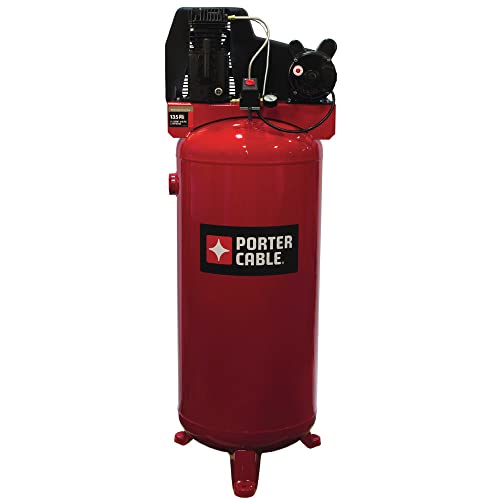
Porter-Cable 60-Gallon Stationary Air Compressor
What We Like
- High 13.4 CFM output for demanding tools
- Large 60-gallon tank for sustained use
- Includes synthetic oil for long pump life
- Comes with pressure gauge and on/off switch
Trade-offs
- Stationary 247-pound weight requires permanent floor space
- Oil-lube design requires periodic maintenance
With an output of 13.4 CFM at 40 psi, the Porter-Cable 60-Gallon Stationary Air Compressor provides enough continuous air to operate tools like framing nailers. Its 3.7 running horsepower drives this airflow, and the large tank stores a significant volume of air. The unit is shipped with synthetic oil, which is intended for long component life.
Its substantial footprint is the main consideration. At 68 inches tall and 247 pounds, this is a permanent shop fixture. You’ll need to plan its location carefully, as moving it isn’t an option. For similar capacity with even higher pressure for industrial tools, look at a two-stage 60-gallon model, but expect a larger physical size.
How We Evaluated Vertical Air Compressors
Our research focused on comparing specifications from manufacturers and analyzing expert round-ups and owner feedback. We looked for clear patterns regarding performance, durability, and real-world usability to identify which models consistently meet specific user needs.
The key criteria were tank capacity for sustained tool run time, CFM (Cubic Feet per Minute) output to match air-hungry tools, and physical design for mobility or stationary use. We also weighed noise levels for home shops and pressure ratings for demanding applications like impact wrenches.
Because this is a research-led evaluation, we cannot verify long-term reliability claims, only report the stated specifications and common experiences shared by owners. Our goal is to provide a clear, evidence-based starting point for your purchase decision.
What To Look For In Vertical Air Compressors
A vertical air compressor’s tall, space-saving tank design is a popular choice, but the right model requires balancing several technical factors. Your tool selection and workspace ultimately dictate the best fit.
Key buying criteria include tank size (gallons) for air reserve, CFM output to match your tools’ air consumption, and whether you need a portable wheeled model or a permanent stationary installation. Don’t overlook noise level and required electrical power.
Match CFM to Your Tools
CFM, or Cubic Feet per Minute, is the compressor’s air delivery rate. It must meet or exceed the highest CFM requirement of any tool you plan to run continuously. A framing nailer may need only 2-3 CFM, but a die grinder can require 4-6 CFM. If your CFM is too low, the compressor will run constantly to refill the tank, causing excessive wear and work pauses. For running two tools at once, add their CFM requirements together.
Understand Tank Capacity and Duty Cycle
Tank capacity in gallons determines your air reserve. A larger tank lets you use air tools longer before the pump kicks on to refill it. For intermittent use with nailers or for inflating tires, a 20-30 gallon tank is often sufficient. For sustained sanding or painting, a 60 or 80 gallon tank is better. Also, consider the duty cycle: a 100% continuous duty pump, like those on some two stage air compressors, can run non-stop, while others need regular cool-down periods.
Decide Between Portable and Stationary
This is a fundamental choice. Portable vertical air compressors have wheels and handles, often weigh under 200 pounds, and plug into a standard 120V outlet. They’re ideal for contractors or DIYers moving between sites. Stationary models, like many 60 gallon air compressors, require a permanent spot, a 230V circuit, and often two people to install. They’re for dedicated workshops. Understanding whether you need a portable or stationary model prevents a costly mismatch.
Oil-Lubed vs. Oil-Free Pumps
Oil-lubed pumps generally run cooler and last longer, making them standard in heavy-duty and industrial rotary screw compressors. They require periodic oil changes. Oil-free pumps are virtually maintenance-free and provide clean air, crucial for painting, but can run hotter and have a shorter lifespan. For a home garage running tools occasionally, an oil-free model is a convenient choice.
- Check the unit’s decibel rating if noise is a concern; models under 70 dB are significantly quieter. Verify the electrical requirements; many large stationary compressors need a dedicated 230V circuit.
- Consider the physical dimensions, especially height, to ensure it fits in your planned space.
Your most important tool’s required CFM and PSI are the non-negotiable starting points for choosing any compressor.
Vertical Air Compressors Compared
The comparison table below details the critical specifications, like tank size, CFM, and weight, for all ten of our selected vertical air compressors at a glance.
| Product | Tank Size | Max Pressure | Weight |
|---|---|---|---|
| DEWALT 30-Gallon Vertical Portable Air Compressor | 30 gallon | 175 psi | 196 pounds |
| Campbell Hausfeld 60-Gallon Two-Stage Air Compressor | 60-gallon vertical | 175 PSI | 255.0 pounds |
| Stealth 20-Gallon Ultra Quiet Air Compressor | 20 gallons | 150 PSI | 121.4 pounds |
| DEWALT 25-Gallon Vertical Oil-Lubed Compressor | 25 gallons | 200 PSI | N/A |
| CRAFTSMAN 33-Gallon Vertical Portable Air Compressor | 33 gallons | 175 PSI | 154 pounds |
| RyanTek 15-Gallon Quiet Air Compressor | 15 gallons | 125 PSI | 68.3 pounds |
| Ingersoll Rand Type 30 Two-Stage Air Compressor | 60 gallon vertical | N/A | 430.0 Pounds |
| Campbell Hausfeld 80-Gallon Air Compressor | 80-gallon vertical | 140 PSI | 460.0 pounds |
| California Air Tools 20-Gallon Quiet Compressor | 20 Gallon Steel | 165-195 PSI | 82.0 pounds |
| Porter-Cable 60-Gallon Stationary Air Compressor | 60 gallons | N/A | 247 pounds |
Frequently Asked Questions
What are the best-rated vertical air compressors?
Based on our research into specifications and owner feedback patterns, several models are highly regarded. The DEWALT 30-Gallon stands out for overall power and mobility, while the Campbell Hausfeld 60-Gallon is noted for its workshop capacity. Models like the Stealth are favored for quiet operation. The best choice depends entirely on your specific need for air volume, pressure, and noise level.
Are vertical air compressors better?
Vertical air compressors have a smaller floor footprint than horizontal tanks of the same gallon capacity, making them excellent for a space-constrained garage. Their vertical tank design also helps drain moisture away from the air outlet. However, they can be taller and have a higher center of gravity, which is a trade-off for the space savings.
What is the most reliable brand of air compressor?
Reliability is often tied to pump design and construction. Brands like Ingersoll Rand and Campbell Hausfeld are known for their durable cast-iron pumps in stationary models, which are built for long service life. For portable units, DEWALT and California Air Tools receive consistent praise from owners for holding up under job-site conditions.
Which brand of air compressor is the best?
There is no single “best” brand, as it depends on your application. DEWALT and CRAFTSMAN offer strong portable vertical models for contractors. For large, stationary workshop compressors, Campbell Hausfeld and Ingersoll Rand are prominent. For ultra-quiet operation, Stealth and California Air Tools specialize in that niche. The best brand is the one whose model specs align with your air tool requirements.
How do I choose a vertical air compressor?
Start by listing the air tools you use or plan to buy. Identify the tool with the highest CFM (at the PSI you’ll run it) and ensure the compressor’s CFM rating meets or exceeds it. Then, decide if you need portability or a stationary installation, which dictates tank size and weight. Finally, consider your workspace noise limits and available electrical power to narrow down your options.
The Bottom Line
The DEWALT 30-Gallon Vertical Portable Air Compressor is the best overall choice for the contractor or serious DIYer who needs a powerful, mobile air source. Its high pressure, extended run time, and wheeled design make it versatile for both shop and site work.
For budget-conscious users or those with minimal air needs, consider the compact and quiet RyanTek 15-Gallon. If you’re setting up a permanent home workshop and need maximum air supply, the 80-gallon models category, represented by the Campbell Hausfeld 80-Gallon, is where your research should focus.
Always let your most air-hungry tool’s CFM requirement guide your purchase. Buying a compressor that can’t keep up with your tools is the most common and costly mistake.
