
10 Best Water Separators For Air Compressor in 2026
This post contains affiliate links. As an Amazon Associate, we earn from qualifying purchases.
Our best overall water separator is the NANPU 3/4 NPT Industrial Air Compressor Filter Dryer Regulator for its three-stage filtration and high flow. The RVMARINEPAT 3-Stage Air Compressor Water Separator System is our best complete kit, and the Campbell Hausfeld Mini Air Filter is the best compact pick.
Moisture in your air lines ruins paint jobs, corrodes tools, and compromises pneumatic control systems. You need a separator that matches your compressor’s output and your shop’s specific demands. We built this guide by comparing specifications, studying manufacturer data, and analyzing patterns in owner feedback to help you find the right fit.
Top 10 Water Separators For Air Compressor in the Market


Certain content that appears on this site comes from Amazon. This content is provided "as is" and is subject to change or removal at any time.
The Best Water Separators For Air Compressor, Reviewed
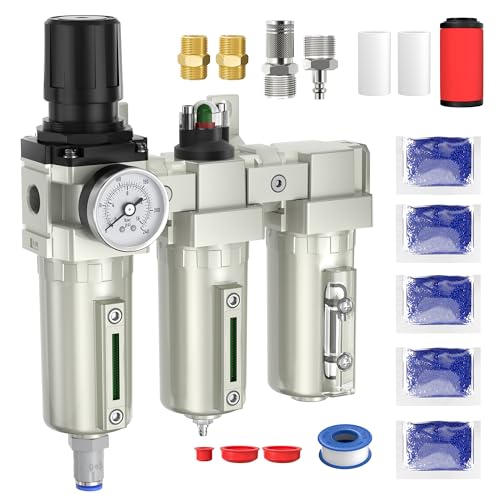
NANPU 3/4 NPT Industrial Air Compressor Filter Dryer Regulator

What We Like
- Three-stage filtration strips water, oil, and particulates
- High 141 CFM flow suits demanding shop tools
- Desiccant dryer provides truly dry air with no drain
- Includes spare filters and desiccant for maintenance
Trade-offs
- Desiccant beads require refilling or regeneration when spent
- Industrial 3/4" NPT size is overkill for small compressors
A 141 CFM flow rating means this unit won’t choke your air supply when running a sandblaster or multiple tools at once, which is critical for a busy shop. The three-stage design is what makes it the complete package. It starts with a 5-micron filter for bulk liquid, follows with a 0.01-micron coalescer to catch oily aerosols, and finishes with a desiccant bed to absorb the last traces of vapor. You get air dry enough for flawless paint jobs and clean plasma cuts without needing a separate dryer. This is built for the pro or serious hobbyist who needs reliable, dry air for finishing work and can’t afford contamination.
Maintenance involves watching the desiccant beads, which change from blue to pink when spent and must be refilled or regenerated. While the coalescing filter has a pop-up indicator for element changes, the beads require manual monitoring. This differs from systems with automatic drains, but the NANPU’s desiccant stage aims to remove the last water vapor without any liquid to drain.
Product photos
RVMARINEPAT 3-Stage Air Compressor Water Separator System
What We Like
- Integrated 0-240 PSI regulator with safety lock
- Visual maintenance indicators on coalescing and desiccant stages
- Industrial-grade metal bowl construction
Trade-offs
- Auto drain requires vertical mounting to function correctly
- Desiccant beads require monitoring and periodic replacement
- 1/2" NPT size may be overkill for smaller, low-CFM compressors
This air drying system combines three stages into one unit, so you can address moisture issues immediately without assembling separate components. Its integrated 0-240 PSI regulator with a safety lock provides precise pressure control, which is necessary for protecting air tools and achieving consistent paint finishes. The product’s construction includes a high-strength metal bowl and visible sight glasses for safety monitoring.
Proper installation and maintenance are required for this system to function as described. The auto drain only works when the filter is vertically mounted, and the color-changing desiccant beads provide a visual signal for maintenance. This unit incorporates a regulator, multiple filter stages, and a desiccant dryer. That stands in contrast to a basic inline filter, such as the Campbell Hausfeld Mini Air Filter, which is listed at 1/4-inch NPT and under 3 inches in height.
Product photos
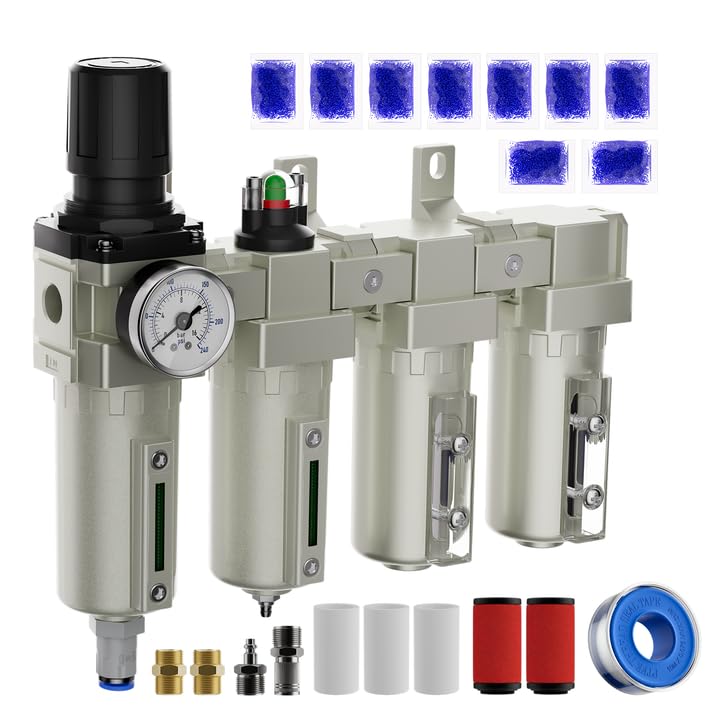
RVMARINEPAT 4-Stage High Flow Air Drying System
What We Like
- Four-stage design for industrial-grade air quality
- 0.01-micron coalescing filter removes fine oil mists
- Integrated auto drain eliminates manual maintenance
- Complete plug-and-play kit with all necessary spares
Trade-offs
- Large 3/4" NPT ports require compatible piping and tools
- Multi-stage design adds bulk compared to single filters
- Desiccant beads require periodic monitoring and replacement
A 3/4″ NPT port size is the key spec here, signaling this unit is built for serious air volume with minimal restriction. That makes it a natural fit for workshops running multiple high-CFM tools like sandblasters or large spray guns simultaneously. The four-stage progression, from a particulate filter through a regulator, a 0.01-micron coalescer, and finally a desiccant dryer, is a comprehensive approach. It delivers the ultra-dry, oil-free air demanded by sensitive tasks such as automotive painting or plasma cutting, where any moisture or contaminant ruins the finish or the cut.
The trade-off is physical size and complexity. This isn’t a compact in-line filter; it’s a substantial system. For a single air tool on a small compressor, this level of filtration may be more than needed. However, if your operation needs to support several pneumatic tools from one air source, this system consolidates multiple components into one package, justifying its footprint on the shop wall.
Product photos
THB Heavy Duty Industrial High Flow Particulate Filter
What We Like
- High 140 CFM flow rate for demanding tools
- Durable 5 oz metal bowl construction
- Visible sight glass for quick moisture checks
- Includes wall mounting bracket for easy installation
Trade-offs
- Manual drain requires regular user intervention
- 5-micron filter is less fine than coalescing models
A 140 CFM flow rate handles the air volume of high-demand tools without restriction. This industrial-rated unit uses a 5-micron filter and a 5-ounce metal bowl to remove 95% of moisture and debris from compressed air lines. It includes a visible sight glass to view moisture levels and a wall mounting bracket for installation.
The trade-off for simplicity is the manual push-button drain. You have to remember to empty the bowl, which is a step down from the auto-drain features on more advanced units like the RVMARINEPAT systems. Its 5-micron filtration is also considerably coarser than a dedicated coalescing filter, so it won’t capture fine oil aerosols or ultrafine particles. For protecting paint sprayers or sensitive pneumatic instruments, you’d need a finer filter downstream.
Product photos
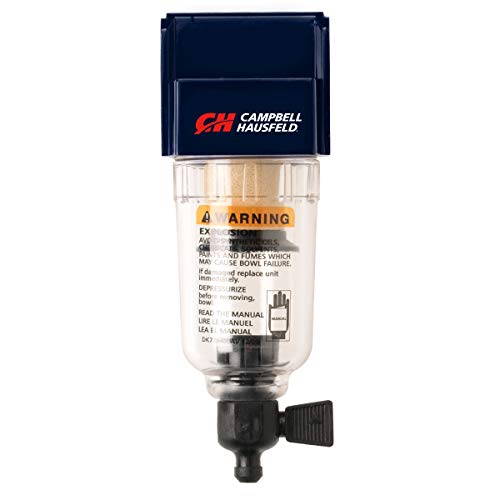
Campbell Hausfeld Mini Air Filter
What We Like
- Sintered brass element captures fine dirt particles.
- Separates bulk moisture from the air stream.
- High 21 SCFM flow for a compact unit.
- Tiny footprint fits into tight spaces.
Trade-offs
- Manual drain requires periodic maintenance to empty.
- 1/4-inch NPT ports limit it to smaller air systems.
- 5-micron filtration is coarse compared to coalescing filters.
A published flow capacity of 21 SCFM at 90 PSI allows this filter to support many small to mid-size pneumatic tools without significantly restricting air supply. Its 5-micron sintered brass element captures fine dirt particles, while the design separates bulk moisture from the compressed air stream, helping to protect connected tools. The unit’s compact dimensions and 1/4-inch NPT female ports facilitate installation in tight spaces within a compressed air line.
The manual-drain polycarbonate bowl requires periodic emptying during routine maintenance, and the 5-micron filtration will not capture oil vapor or ultra-fine mist. For applications needing that level of air quality, a dedicated coalescing filter like the Motor Guard CO4515 would be required. The Campbell Hausfeld filter provides a high-flow, condensed-water removal function in a package with a small footprint.
Product photos
Ingersoll Rand FA40IG Compressed Air In-Line Filter
What We Like
- Patented dual indicator for pressure drop and efficiency.
- Coalesces water and oil down to 0.1 ppm.
- Smooth bore insert minimizes turbulence and pressure loss.
- Engineered for low pressure drop to reduce energy costs.
Trade-offs
- No regulator, lubricator, or desiccant dryer included.
- Single-stage filtration versus multi-stage systems.
- Larger and heavier than basic particulate filters.
With a maximum remaining oil aerosol content of 0.1 ppm, the Ingersoll Rand FA40IG provides air clean enough for sensitive pneumatic tools and finishing applications. Its patented dual indicator shows both differential pressure drop and operating efficiency, letting you see maintenance needs at a glance instead of guessing. This makes it a straightforward component for serious compressed air systems.
This product has a singular focus. Unlike a multi-stage system, this is strictly a filter; it won’t regulate pressure or provide desiccant drying. You’re paying for the brand’s engineering in a dedicated coalescing unit. That makes it an excellent upgrade or replacement within an existing, well-planned system, but it means you’ll need to source other components separately if your setup lacks them.
Product photos
Motor Guard CO4515 Compressed Air Coalescing Filter
What We Like
- Removes the finest oil aerosols (0.01 micron).
- Pop-up filter change indicator for easy maintenance.
- Built with durable, all-metal construction.
- Includes a manual drain valve.
Trade-offs
- Compact 50 CFM flow rate limits high-demand setups.
- No built-in regulator, unlike multi-stage systems.
- Manual drain requires user intervention.
A 0.01 micron filtration rating means this coalescing filter removes the finest traces of oil from compressed air, which is necessary for protecting sensitive equipment like paint sprayers. The Motor Guard CO4515 has a port size of 1/2 NPT and a nominal airflow of 50 CFM. It features all-metal construction, a pop-up filter change indicator, and a manual drain valve, and it is made in the USA.
That focus on ultra-fine filtration comes with a trade-off in airflow capacity at 50 CFM. It’s perfect for dedicated lines or lower-CFM applications, but for sandblasting or running multiple high-consumption tools simultaneously, a high-flow system with multiple stages would be a better fit. Compared to a basic particulate filter like the THB model, this unit excels at oil removal but lacks the bulk water separation stage of a more complex system.
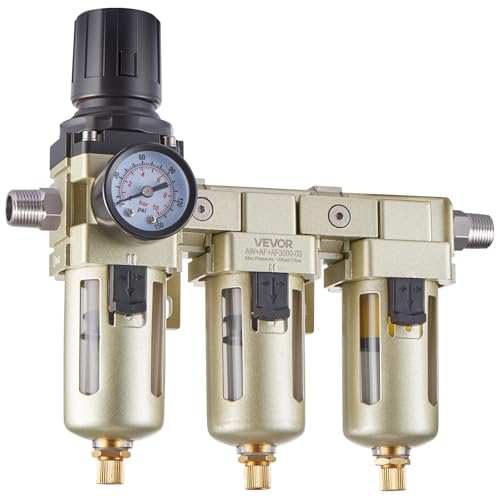
VEVOR 3-Stage Air Compressor Filter Regulator
What We Like
- Three-stage filtration down to 0.01μm.
- Semi-auto drain prevents water buildup.
- Poly bowl with metal guard for durability.
- Standard 3/8" NPT fits most compressors.
Trade-offs
- Bulkier than basic in-line filters like the Campbell Hausfeld.
A final 0.01-micron sponge element completes this unit’s three-stage filtration, setting it apart by targeting the finest particles. It removes liquid, impurities, and particles from your air line, which is essential for sensitive work like spray painting. For mid-range compressors with 3/8″ lines, this combination delivers the clean air needed to protect tool investment and finish quality.
Consider its pressure capacity and physical size. With a 145 PSI maximum, it isn’t suited for systems requiring higher pressure, like the NANPU 3/4″ model rated for 175 PSI. The poly bowl resists impact, but for a compact workshop where space is critical, a simpler unit like the Ingersoll Rand FA40IG filter might be a more space-efficient choice for less demanding tasks.
NANPU Air Filter Regulator Lubricator Combo
What We Like
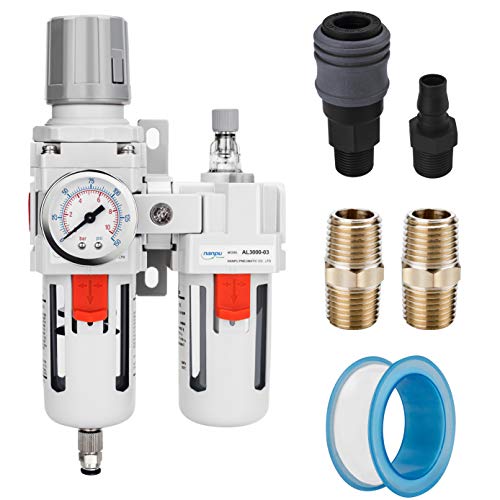
- Combines filtration, regulation, and lubrication in one compact unit.
- Reusable 5-micron brass filter element for moisture and contaminants.
- Includes installation bracket, couplers, and fittings for straightforward setup.
- Semi-auto drain and protected bowl simplify routine maintenance checks.
Trade-offs
- 60 SCFM flow rate may limit support for multiple high-demand tools.
- Polycarbonate bowl, even with a guard, is less durable than all-metal bowls.
Combining a filter, regulator, and lubricator in one compact unit means you can condition your air and protect your tools without piecing together three separate components. This makes it a good choice for a home shop or a mobile service cart where space is tight, but you still need complete air prep for common shop air tools. The included bracket, fittings, and thread seal tape help get it mounted and plumbed in quickly, letting you focus on the work instead of the setup.
This design prioritizes convenience over ultimate performance. Its 60 SCFM flow is sufficient for common single tools, but if you’re planning to run a sandblaster or multiple tools simultaneously, a dedicated high-flow unit with multiple stages is a better fit. Similarly, the polycarbonate bowl is fine for general use, but for an environment with high impact risk, a filter with a full metal bowl like the THB Heavy Duty model offers more brute-force protection.
Product photos
PneumaticPlus Coalescing Filter
What We Like
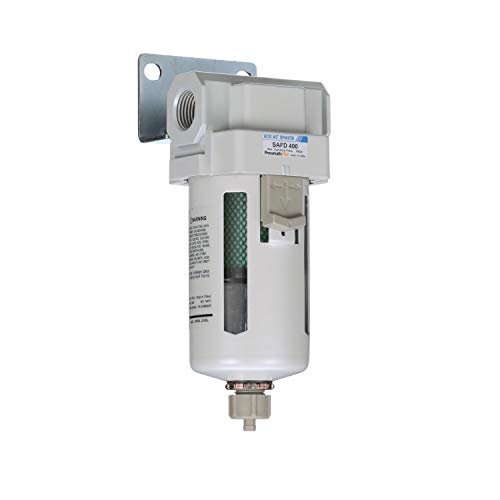
- Removes oil aerosols down to 0.1 micron.
- Transparent bowl for easy fluid monitoring.
- Low pressure drop under 10 PSI.
- Includes mounting bracket, ready for install.
Trade-offs
- Polycarbonate bowl limited to 150 PSI supply pressure.
- Requires a pre-filter for optimal element life.
- Manual drain, not automatic.
A 0.1 micron filter is the key spec here, and it means you’re getting air clean enough for finishing work without oil specks. The PneumaticPlus filter is built for the shop that needs reliable, oil-free air for spray guns or sensitive pneumatic equipment. Its transparent polycarbonate bowl lets you see contamination buildup at a glance, so you know exactly when to twist the manual drain. This unit suits a dedicated spot in your system where fine filtration is non-negotiable.
The clear bowl has a maximum supply pressure of 150 PSI, so for systems above that or with solvent exposure, the manufacturer’s metal-bowl version is required. This unit removes contaminants down to 0.1 micron, a finer level of filtration than particulate filters designed for larger debris. It is a complete, ready-to-install component with 1/2″ NPT ports and an included mounting bracket, intended for vertical installation in a compressed air line.
Product photos
How We Evaluated Water Separators For Air Compressor
Our evaluation focused on technical specifications, manufacturer documentation, and consistent patterns in expert round-ups and owner experiences. We didn’t physically test these units, but we scrutinized their design, construction, and real-world application notes to understand their capabilities and limitations.
We prioritized filtration type (particulate, coalescing, or desiccant), flow rate (CFM), and port size (NPT). These factors dictate whether a separator can handle your compressor’s volume, fit your existing piping, and remove contaminants at the level your tools require. For example, a high-CFM unit is useless if its 3/4″ ports won’t connect to your 1/2″ lines.
A research-based approach has clear limits. We can’t verify long-term durability claims or quantify the exact moisture removal efficiency in your unique shop environment. Our goal is to give you a clear, comparative framework based on published data and widespread user consensus, helping you narrow your search to the most promising candidates for your needs.
What To Look For In Water Separators For Air Compressor
Selecting the appropriate water separator involves matching its specifications to your compressor’s output and the requirements of your most demanding tool. The objective is to achieve clean, dry air to protect equipment and ensure quality outcomes for tasks like painting or sandblasting.
Focus on filtration stages, flow capacity (CFM), and port size. Coalescing filters remove fine oil mist, while desiccant beds deliver bone-dry air. Your separator’s CFM must exceed your compressor’s output, and its ports must match your air lines.
Filtration Type & Stages
Basic particulate filters, like the THB Heavy Duty model, use a porous element to catch dirt and separate bulk water, often down to 5 microns. For finer oil aerosols and moisture, coalescing filters like the Ingersoll Rand FA40IG force contaminants to merge into droplets that fall out of the air stream, achieving purity down to 0.1 ppm.
For the driest air possible, a desiccant dryer stage, as found in the NANPU 3/4 NPT unit, adsorbs water vapor. Multi-stage systems combine these methods for comprehensive protection, but they add complexity and maintenance, like refilling desiccant beads. Understanding how to remove water from compressed air lines is key to selecting the right stage for your job.
Flow Rate & Port Size
A separator’s rated Cubic Feet per Minute (CFM) must meet or exceed your compressor’s output and the combined demand of your tools. A high-flow unit like the RVMARINEPAT 4-Stage system supports multiple tools, while the compact Campbell Hausfeld is sized for smaller setups. Port size, given as National Pipe Thread (NPT), must match your air lines.
Using a reducer on a large 3/4″ port for a 1/4″ line will create a bottleneck and defeat the purpose. Always check both the CFM and NPT specifications against your existing system. For high-volume systems, pairing your separator with dedicated air dryers may be necessary for complete moisture control.
Maintenance & Installation
Consider how you’ll install the unit and keep it working. Manual drain bowls, common on budget picks, require you to remember to empty them. Auto or semi-auto drains, like on the VEVOR 3-Stage, prevent overflow but may need vertical mounting.
Bowl material matters: polycarbonate is impact-resistant but has lower pressure limits, while metal bowls are more durable. Also, factor in the ease of replacing filter elements or refilling desiccant. Forgetting maintenance leads to water passing through, which can be as damaging as having no separator at all. Installing automatic drain valves downstream can add a layer of protection against tank corrosion.
- Check for an included mounting bracket for secure installation.
- Prefer units with a sight glass or indicator to see moisture levels.
- Ensure the drain valve type (manual, semi-auto, auto) fits your routine.
- Verify if spare filters or desiccant are included in the kit.
- Confirm the bowl’s pressure rating exceeds your system’s working pressure.
Your separator is only as good as your maintenance habit. Choose a drain system you’ll actually use.
Water Separators For Air Compressor Compared
The table below compares key specs for all ten water separators at a glance, helping you quickly see differences in flow, filtration, and features.
| Product | Port Size | Max Pressure | Finest Filtration |
|---|---|---|---|
| NANPU 3/4 NPT Industrial Air Compressor Filter Dryer Regulator | 3/4" NPT | 175 PSI | 0.01-micron coalescing |
| RVMARINEPAT 3-Stage Air Compressor Water Separator System | 1/2" NPT | 0-240 PSI | 0.01 micron |
| RVMARINEPAT 4-Stage High Flow Air Drying System | 3/4" NPT | 0-240 PSI | 0.01-micron element |
| THB Heavy Duty Industrial High Flow Particulate Filter | 1/2" NPT | 225 PSI | 5 micron |
| Campbell Hausfeld Mini Air Filter | 1/4-inch NPT | N/A | 5-MICRON |
| Ingersoll Rand FA40IG Compressed Air In-Line Filter | N/A | N/A | 1 micron |
| Motor Guard CO4515 Compressed Air Coalescing Filter | 1/2 NPT | 250 PSI | .01 Micron |
| VEVOR 3-Stage Air Compressor Filter Regulator | 3/8" NPT | 145 PSI | 0.01μm |
| NANPU Air Filter Regulator Lubricator Combo | 3/8" NPT | 0-125 PSI | 5-micron |
| PneumaticPlus Coalescing Filter | 1/2" NPT | 250 PSI | 0.1 micron |
Frequently Asked Questions
What is the best water separator for an air compressor?
The best separator depends on your compressor size and air quality needs. For most workshops needing very dry, oil-free air, a three-stage unit with a desiccant dryer like our best overall, the NANPU 3/4 NPT, is a top performer. For simpler needs, a basic particulate filter or a compact coalescing model may be sufficient.
Do I need a water separator for my air compressor?
Yes, if you use air tools for painting, sandblasting, or any application where moisture causes problems. Compressing air concentrates atmospheric humidity, which condenses into liquid water that rusts tanks, ruins paint finishes, and damages pneumatic tools. A separator is essential protection.
How do I make a DIY water separator for my air compressor?
You can create a basic moisture trap by plumbing a large volume of pipe or a secondary tank with a drain at the bottom, forcing air to cool and drop its water. However, a commercial separator with centrifugal or coalescing action is far more efficient and reliable for protecting valuable tools and achieving consistent results.
Where to put a water separator on an air compressor?
Install the separator as close to the point of use as possible, after the compressor’s tank and pressure regulator but before any sensitive tools. For whole-shop protection, a primary separator at the compressor outlet is wise, with additional point-of-use filters for critical applications like spray painting.
What’s the difference between a water separator and an air dryer?
A water separator removes liquid water and aerosols. An air dryer, like refrigerated or desiccant types, removes water vapor from the air stream itself, delivering lower dew points. They are often used together: a separator handles the bulk liquid, protecting the dryer, which then removes the remaining vapor.
The Bottom Line
For workshops demanding oil-free, bone-dry air for finishing work, the NANPU 3/4 NPT Industrial Air Compressor Filter Dryer Regulator is our best overall choice. Its three-stage design tackles particulates, oil, and vapor in one unit.
If you’re on a budget or have a small compressor, look at the Campbell Hausfeld Mini Air Filter for basic protection. For a comprehensive, out-of-the-box solution, the RVMARINEPAT 3-Stage Air Compressor Water Separator System is an excellent kit. Remember, using the correct air compressor lubricant in your compressor also minimizes oil carryover that your separator must handle. The single most important factor is matching the separator’s flow rate and port size to your compressor, anything less compromises performance.
