
CNC Router vs CNC Mill: Which Should You Buy?
This post contains affiliate links. As an Amazon Associate, we earn from qualifying purchases.
A CNC router runs a high-speed spindle (18,000–24,000 RPM) over a large, flat table to quickly cut sheet goods like wood and plastic. A CNC mill uses a slower, high-torque spindle (3,000–8,000 RPM) inside a heavy cast-iron frame to make precise cuts in solid metal blocks. For most home shops cutting sheet materials, a router is the right tool. For making precise metal parts, you need a mill.
The frame design isn’t just a difference in shape, it’s the entire reason one machine can handle steel and the other can’t. A router’s moving gantry is built for speed across a 4×8 foot sheet. A mill’s fixed column is built to absorb the vibration of a 0.250″ deep cut in steel without flinching. That rigidity gap decides everything from the materials you can cut to the surface finish you’ll get, which is a core part of the cnc router vs cnc mill distinction.
What follows is a breakdown of the three specs that actually matter in the cnc router vs cnc mill question, a head-to-head comparison by material, and a simple checklist to stop you from buying the wrong $10,000 machine for your shop.
Key Takeaways
- Choose a CNC router for sheet goods, its large bed and high-speed spindle excel at cutting wood, plastic, and thin aluminum sheets.
- Choose a CNC mill for solid metal, its cast-iron frame and high-torque spindle are built for precision in steel, stainless, and titanium.
- Router accuracy is about ±0.005 inches; mill accuracy is about ±0.0005 inches. That 10x difference matters for bearing fits and threads.
- The biggest cost isn’t the machine, factor in dust collection for routers, flood coolant for mills, and higher tooling costs for metalwork.
- Hybrid machines exist but involve compromise; they can do light metal but won’t match a dedicated mill’s precision or a router’s speed on wood.
The Frame, Spindle, and Accuracy Breakdown
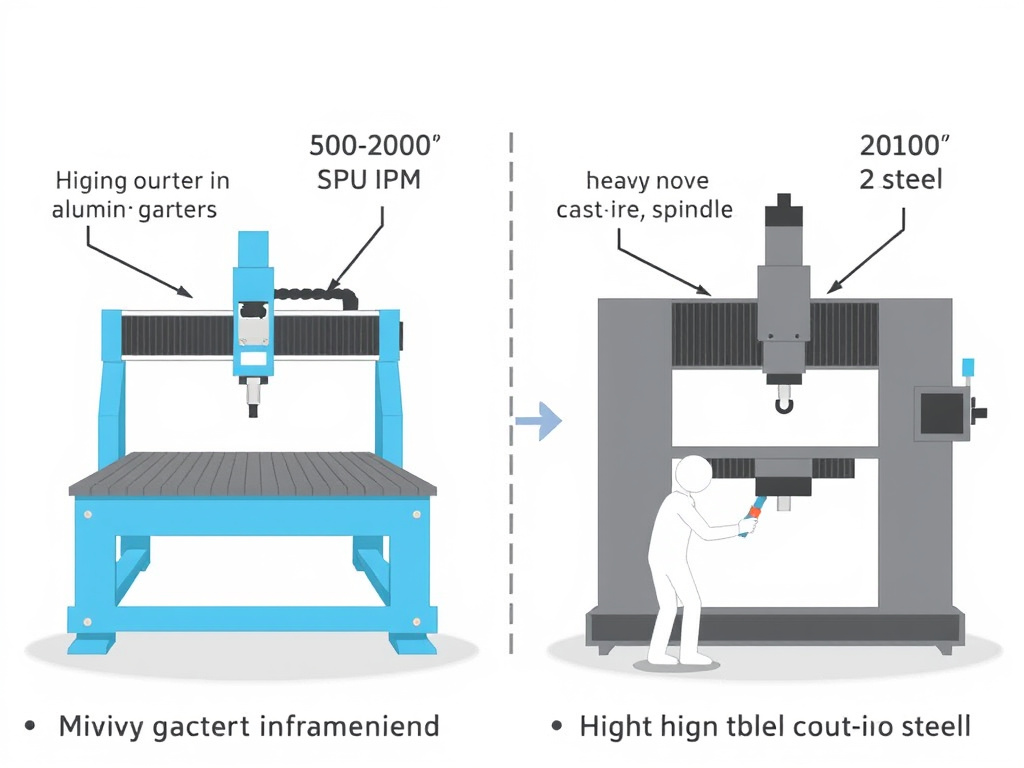
This is where most buyers get the cnc router vs cnc mill decision wrong. You can’t judge these machines by their work area alone. The construction, the motor, and the precision standards are built for completely different jobs.
CNC routers utilize a moving-gantry design with aluminum or steel rails, prioritizing rapid movement (600–2,000 IPM) over mass. CNC mills employ a fixed-spindle, heavy cast-iron column design, with mass (1,500–25,000 lbs) to dampen vibration for precise metal cutting.
The Frame: Speed vs. Mass
Look at the base. A CNC router uses a moving gantry, a bridge that travels on rails over a stationary table. This design, often made from aluminum extrusion, is light. This design allows for high speed, achieving rapid traverse rates of 2,000 inches per minute (IPM). But push a 0.125″ end mill into aluminum too hard, and the whole structure can flex. You’ll hear chatter, a telltale buzzing sound, and the cut quality goes to pieces.
A CNC mill uses a C-frame or box-way construction. The spindle is fixed to a massive cast-iron or welded steel column, and the table moves underneath it. A small benchtop model still weighs 500–1,500 lbs; a production Vertical Machining Center (VMC) hits 1,500–25,000 lbs. That weight isn’t for show. It absorbs energy, letting you take a 0.250″ deep cut in steel without the machine arguing with you. The trade-off is speed, rapid traverses typically max out around 300–800 IPM.
The Spindle: RPM vs. Torque
The spindle tells you what the machine wants to eat. A router spindle screams. Standard models spin at 18,000–24,000 RPM, with high-speed versions reaching 60,000 RPM. This is perfect for small-diameter tools in soft materials, where a high surface speed creates a clean cut.
A mill spindle rumbles. Standard speeds are 3,000–8,000 RPM, with high-speed options topping out around 12,000 RPM. The focus is on torque, not max RPM. This torque enables an end mill to cut forcefully through metal rather than gliding across its surface.
Tool Holding: ER Collets vs. Real Tapers
How the tool is held is a dead giveaway. Routers almost exclusively use ER collets (like ER-20, ER-32). They’re simple, cheap, and work well for the lighter forces in wood and plastic. Some routers with automatic tool changers use an ISO/BT30 taper.
Mills use industrial-grade tapers designed for heavy pull-out forces. Common types include:
- R8: Common on older manual mills and some entry-level CNC.
- CAT40 / CAT50: The North American standard for mid-sized VMCs.
- ISO/BT30/40/50: The metric equivalent, common globally.
- HSK: A high-speed, high-accuracy taper for advanced machining.
A real taper like CAT40 has a larger contact area and a retention knob that screws into the spindle, locking the tool in place against immense cutting pressure. An ER collet just squeezes the shank.
Accuracy & Repeatability: Close Enough vs. Microns
Here’s the number that separates a part that fits from one that doesn’t. Per the manufacturer StyleCNC, a typical CNC router offers a positional accuracy of ±0.002″ to ±0.005″ (±0.05 to ±0.13 mm). Repeatability, how well it returns to the same spot, is about ±0.001″ to ±0.003″.
For a cabinet door or a sign, that’s excellent. For a metal gear that must mesh with another, it’s not even close. A CNC mill’s positional accuracy is typically ±0.0002″ to ±0.001″ (±0.005 to ±0.025 mm), with repeatability down to ±0.0001″ to ±0.0005″.
That difference is the gap between “looks good” and “functions perfectly.” It’s why mills cost more. The guideways, ball screws, and encoders that achieve that precision are a different class of component.
Material Match-Up: What Can You Actually Cut?
The frame and spindle specs dictate a machine’s diet. Trying to force-feed it the wrong material is how you break tools, scrap parts, and waste a weekend.
| Material | CNC Router Suitability | CNC Mill Suitability | Key Consideration |
|---|---|---|---|
| Hardwood, Plywood, MDF | Excellent – Fast feeds, clean edges. | Possible, but inefficient and messy. | A router’s large bed handles full sheets. Mill would require slow speeds. |
| Plastics (Acrylic, PVC, HDPE) | Excellent – High RPM prevents melting. | Good, but can chip brittle plastics. | Router RPM is ideal. Mill may need special tool geometry. |
| Composites & Foams | Excellent – Handles large, lightweight sheets. | Not ideal – Can crush or delaminate. | Router’s vacuum table is key for hold-down. |
| Aluminum (Sheet & Thin Plate) | Good (with a rigid router) – Use shallow passes. | Excellent – Full-depth cuts, great finish. | For production aluminum parts, a mill or rigid metal-cutting router is best. |
| Steel, Stainless Steel | Not Recommended – Lacks rigidity and torque. | Excellent – Built for this. | Attempting this on a standard router risks broken tools and a damaged machine. |
| Titanium, Tool Steels | No – Will damage machine. | Excellent (with capable mill) – Requires rigid machine and correct tooling. | The domain of serious CNC mills with high-pressure coolant. |
Router Territory: Sheet Goods and Soft Materials
If your work starts as a 4×8 sheet, a router is your machine. Its natural domain is anything you can cut quickly with sharp, small-diameter tools. This includes:
- Wood & Derivatives: Solid lumber, plywood, MDF, particleboard.
- Plastics: Acrylic (for signs), PVC, HDPE, polycarbonate.
- Foams: EPS foam for packaging, polyurethane for prototypes.
- Composites: Carbon fiber sheets (with proper dust control), fiberglass.
- Non-Ferrous Sheet: Thin aluminum (like 6061), brass, copper for decorative work.
The process is fast and relatively loud, you’re removing a lot of material quickly. Dust collection isn’t optional; it’s a critical health and safety system. A 2HP dust collector is a minimum for a hobbyist router.
Mill Territory: Solid Metals and Precision
If your work starts as a block of metal or plastic, you need a mill. Its job is to remove material with control and precision, often to create a part that mates with another. This includes:
- Ferrous Metals: Mild steel, tool steel, stainless steel (304, 316).
- Non-Ferrous Metals: Aluminum blocks (for gears, brackets), brass, copper.
- Exotic Alloys: Titanium, Inconel (for aerospace).
- Engineering Plastics: Delrin (acetal), PEEK, Ultem.
The process is slower, wetter, and more methodical. Flood coolant or a through-spindle mist system is often used to control heat, improve finish, and evacuate chips. The sound is a deeper, consistent whirring of the spindle and the shush of cutting fluid.
The Aluminum Grey Zone
This is the most common point of confusion. Can a router cut aluminum? Yes, but with major caveats. A hobbyist router can manage thin sheets and very light cuts in soft aluminum (like 0.010–0.030″ depth per pass). You must use a single-flute end mill designed for aluminum, slow the feed rate, and secure the material perfectly.
For any serious aluminum work, making a bracket, a fixture, or a prototype part from a block, a mill is the correct tool. A benchtop CNC mill like those from Precision Matthews or a rigid, metal-focused router is the starting point. The latter are heavier, hybrid-style machines that blur the line but are still routers at their core.
A Practical Shop-Floor Guide
Specs on a screen are one thing. Standing in a shop, wondering which machine to buy for the jobs on your bench, is another. We will discuss practical concerns like space, sound, and skill.
Workspace & Environment
A machine’s footprint is more than its table size.
- CNC Router: You need space for the machine and material handling. A 4×4 foot router needs a 6×6 foot floor space minimum for you to load sheets. They are loud, a high-pitched whine from the spindle and the roar of cutting. Dust is a major issue; you need a sealed enclosure or a dedicated, well-ventilated room with a serious dust collector. The air will smell of cut wood or plastic.
- CNC Mill: The footprint is more compact, but you need space for a coolant tank and chip management. The noise is lower in pitch but constant. The big issue is mess. Flood coolant creates a fine mist (require proper ventilation) and chips get everywhere. The shop will smell of cutting oil and metal.
The Learning Curve: Software and Skill
Don’t underestimate the time investment.
- Software: Both need CAD (to design) and CAM (to create toolpaths) software. For routers, programs like VCarve Pro or Fusion 360 (Hobbyist license) are common. They’re geared towards 2.5D carving, profiles, pockets, and v-carving. For mills, especially for 3D contours and complex toolpaths, you often need the full capabilities of Fusion 360, SolidWorks CAM, or Mastercam. The simulation features become critical, a crash in metal costs real money.
- Operator Skill: Running a router is broadly about material hold-down and tool selection. A mistake in wood usually means a scrapped $50 sheet. Running a mill is about understanding speeds, feeds, tool deflection, and workholding. A mistake in steel can mean a shattered $80 end mill, a damaged vise, or a wrecked part. The stakes, and the required foundational knowledge, are higher. Starting with a beginner CNC machine for wood is a far gentler introduction to the concepts.
The Real Cost of Ownership
The price tag is just the entry fee.
| Cost Factor | CNC Router | CNC Mill | Why It Matters |
|---|---|---|---|
| Machine Purchase | $8,000 – $45,000 (mid-range) | $15,000 – $75,000+ (mid-range) | Mill premium is for rigidity, precision components, and spindle power. |
| Dust Collection | Mandatory – $1,500–$5,000+ | Optional for dry cutting, but recommended. | Router creates huge volumes of chips/dust. A shop-vac won’t cut it. |
| Coolant System | Rarely used (mist for aluminum). | Often mandatory – $2,000–$8,000+ | Flood coolant controls heat, improves finish, and extends tool life in metal. |
| Tooling | Lower cost. Carbide bits wear but are inexpensive. | Higher cost. Quality end mills for steel are expensive. | Breaking a 1/2″ carbide end mill in steel is a $80 mistake, not a $15 one. |
| Power Requirements | Often standard 120V/240V single-phase. | Frequently requires 240V three-phase power. | May need an electrician to install a new circuit or a phase converter. |
Making the Decision: A Simple Checklist
Answer these questions. Your answers will point the way.
-
What is your primary material?
- Wood, plastic, foam sheets → CNC Router
- Solid blocks of metal (steel, aluminum) → CNC Mill
-
What size are your parts?
- Larger than 2×2 feet, or full sheets → CNC Router
- Smaller than 2×2 feet, often held in a vise → CNC Mill
-
What precision do you need?
- ±0.005″ is fine (furniture, signs, props) → CNC Router
- ±0.001″ or better (functional parts, mechanical fits) → CNC Mill
-
What’s your shop environment like?
- Can handle noise and dust collection → CNC Router
- Can handle mist/coolant and metal chips → CNC Mill
-
What’s your budget for everything?
- Under $15k all-in → A capable desktop CNC router.
- $25k+ all-in → You can consider entry-level CNC mills or high-end routers.
If you’re still stuck, the rule from TWC Industrial is practical: If 80% of your work is sheet goods, buy a router and outsource the metal. If 80% is metal, buy a mill and outsource the sheets.
Frequently Asked Questions
What’s the difference between a CNC router and a CNC mill?
The core difference is their construction for different tasks. A CNC router uses a light, moving gantry over a large table to cut sheet materials (wood, plastic) quickly. A CNC mill uses a heavy, fixed-spindle column to apply high torque for precise cutting in solid materials, especially metals.
Can a CNC router cut metal?
It can cut thin sheets of soft metals like aluminum, but not efficiently or without risk. It requires a very rigid router, shallow cuts, specific tooling, and patience. For any meaningful metal removal or harder metals like steel, a CNC mill is the correct and safe tool.
Which is easier to learn, a CNC router or mill?
CNC router is generally easier for beginners. The materials (wood, plastic) are more forgiving of feed/speed errors, tooling is cheaper, and the software is often simplified for 2.5D work. Learning on a mill involves mastering metal-specific variables where mistakes are costlier.
Is a “gantry mill” the same as a router?
No, though they look similar. A true gantry mill is built with the mass and rigidity of a mill, often with a box-way construction and a CAT40+ spindle, but uses a gantry design for extremely large work envelopes (e.g., for machining aerospace components). It’s a mill that moves like a router, not a router trying to be a mill.
What about a hybrid “mill-drill” or “router-mill” machine?
These are compromise machines, often benchtop CNC units. They have a more rigid frame than a hobby router and a lower-RPM spindle, allowing them to handle light aluminum and wood. They won’t match a dedicated mill’s precision in steel or a router’s speed on a 4×8 sheet, but they offer versatility for a small shop with diverse needs.
The Bottom Line
Stop looking for one machine to do everything. That path leads to a compromised tool that does nothing well. See the choice for what it is: a commitment to a type of work.
If your projects are born from sheets of plywood and blocks of plastic, a CNC router will be the engine of your shop. Your investment goes into space, dust control, and learning efficient sheet management. If your projects come from blocks of aluminum and steel, a CNC mill is your foundation. Your investment goes into precision tooling, workholding, and mastering the science of metal removal.
For the small shop owner staring down this choice, here’s the one-step test: take your most common, revenue-producing job and ask which machine is built from the ground up to do that job fastest and best. Buy that one. Use a local machine shop or a friend’s tool for the other 20% of work until your business justifies the second machine. That’s how you build a shop that works, instead of a garage full of regret.
