
Cordless vs Corded Drill: Which Should You Buy?
This post contains affiliate links. As an Amazon Associate, we earn from qualifying purchases.
A cordless drill runs on a battery and trades ultimate power for ultimate freedom, while a corded drill plugs into the wall for steady, unlimited force, for most home and DIY jobs, a cordless drill is the better buy.
That’s the quick answer. But the real decision isn’t about power versus portability; it’s about which one matches the specific kind of work you actually do. Here’s how to think about cordless vs corded drill so they last. You’ll find that the winning choice changes once you account for weight, runtime, and the 60% of DIY tasks that involve wood, drywall, or screws where cordless excels.
What follows: a breakdown of the physical differences you’ll notice in your hand, the specific work each tool is rated for, and the five-year ownership story most guides skip.
Key Takeaways
- A cordless drill wins for mobility and quick tasks; a corded drill delivers unmatched power for long sessions.
- Modern brushless motors in cordless tools are 85% efficient, while older brushed motors are 70% efficient, a difference you feel in heat and runtime.
- For woodworking tasks like pocket holes, keep your drill speed at 1,200 RPM to prevent chipping, a setting easily managed on most cordless models.
- Lifespan diverges sharply: a well-maintained cordless drill lasts 5–8 years; a comparable corded drill can run for 8–12.
- For outdoor, overhead, or ladder work, the absence of a cord is a safety feature, not just a convenience.
Power and Runtime: The Core Difference
This isn’t academic. The difference between wall power and battery power shapes every minute you spend using the tool.
A corded drill draws 6–10 amps straight from your outlet, spinning at 0–2,500 RPM without a single dip. That’s the definition of unwavering power. A tool like the Bosch 1006VSR delivers 6.3 amps in a 4 lb package, and it’ll keep that output for as long as your arm holds out. For drilling dozens of holes in thick material, like a deck ledger board into a house rim, this is the tool you want.
Cordless power comes with a timer. A cordless drill’s battery provides limited runtime, which varies based on the task and battery capacity. That’s the trade. You get freedom from the outlet, but you trade the infinite runtime a cord provides.
The cord is a literal tether, and managing an 18-gauge extension cord across a 50-foot jobsite is its own kind of workout in the cordless vs corded drill debate. A cordless drill removes that friction entirely. For a task like assembling furniture or hanging cabinets, where you’re moving every few seconds, the cordless advantage provides speed and eliminates constant snagging and tripping.
Cordless Drills: The Freedom Tool
Cordless drills dominate the modern workshop for a reason. Over 70% of home users prefer them, according to 2026 market data. But not all cordless drills are created equal. The range within the category is vast.
Take the DeWalt DCD771C2. It’s a 20V MAX brushed motor drill with two speed settings (0–450 / 0–1,500 RPM) and a 1/2-inch chuck. It weighs about 3.6 lbs without the battery. For assembling a bookshelf or driving a box of deck screws, it’s perfectly capable. But its brushed motor is less efficient than a brushless model, converting more energy to heat and wearing faster.
Now look at the DeWalt DCD801. This 20V MAX XR brushless drill spins up to 2000 RPM and delivers 1050 MWO. Its bare weight is 2.8 lbs. The brushless motor is 85% efficient versus the brushed motor’s 70%. That means cooler operation, longer battery life, and a longer tool lifespan. For all-day use, this is the clear step up.
| DeWalt Cordless Drill Model | Top Speed (RPM) | Max Power (MWO) | Bare Weight | Best For |
|---|---|---|---|---|
| DCD1007 (Hammer Drill) | 2000 | 1530 | 4.1 lbs | Heavy-duty construction, masonry |
| DCD801 (XR Drill) | 2000 | 1050 | 2.8 lbs | All-day professional use |
| DCD794 (Atomic Drill) | 1650 | 404 | 2.4 lbs | Compact DIY and overhead work |
| DCD777 (Brushless Drill) | 1600 | 340 | 2.6 lbs | Budget-conscious home use |
The noise tells the story. A healthy brushless motor under load has a smooth, high-pitched whine, while a brushed motor may become louder as it heats up.
Where this goes sideways: Using the wrong battery. Slapping a massive 8.0Ah battery on a compact drill like the DCD794 for overhead work defeats the purpose. The working weight increases significantly with a larger battery, turning a nimble tool into a wrist-aching anchor. Match the battery size to the job: use a 2.0Ah pack for lightness, a 5.0Ah for runtime.
For outdoor projects, building a fence, assembling a shed, the cordless drill is the only sensible choice. This choice is for both portability and safety. No extension cord means no trip hazard across wet grass or dirt. Some models, like the Milwaukee M18 series, are designed to hold 80% of their power even at 32°F, a real advantage in early spring or late fall work.
Corded Drills: When You Need Unwavering Power
Forget the battery. Forget the charger. A corded drill is about one thing: relentless, consistent torque until you unplug it. It’s the tool for the job that doesn’t stop.
They retain a 28% market share, favored for continuous high-torque applications in industrial settings. Think of a production shop drilling hundreds of pocket holes for cabinet face frames, or a metalworker drilling pilot holes in angle iron all afternoon. That’s the corded drill’s home.
The DeWalt DWD 115K corded drill weighs just over 4 lbs and has been virtually unchanged since 2008. Its longevity in the market is a testament to a simple, powerful design that just works, year after year.
The power source is the key to the cordless vs corded drill question. Plugged into the wall, a corded drill averages 15% higher torque under load than a comparable cordless model. In woodworking tests, this can translate to 10% stronger joints because the drill yields a tighter, cleaner fit without the power fade that can happen as a battery depletes.
Here are the tasks where a corded drill is essential:
- Mixing concrete or mortar with a paddle attachment.
- Drilling large-diameter holes (over 1 inch) in dense hardwood or beams.
- Any stationary, long-duration task where you’re within 50 feet of an outlet.
The cord is the main drawback, but it’s a manageable one. Use an 18-gauge extension cord and keep it organized with a retractable reel. The drag is real, but it’s the price of infinite power.
Common mistake: Using a corded drill for driving screws. They’re almost too powerful. It’s easy to over-torque and strip the head or sink the screw too deep before you can react. That’s why many workshops keep both, a corded beast for drilling and a gentler cordless driver for fastening.
Head-to-Head: Weight, Design, and Features
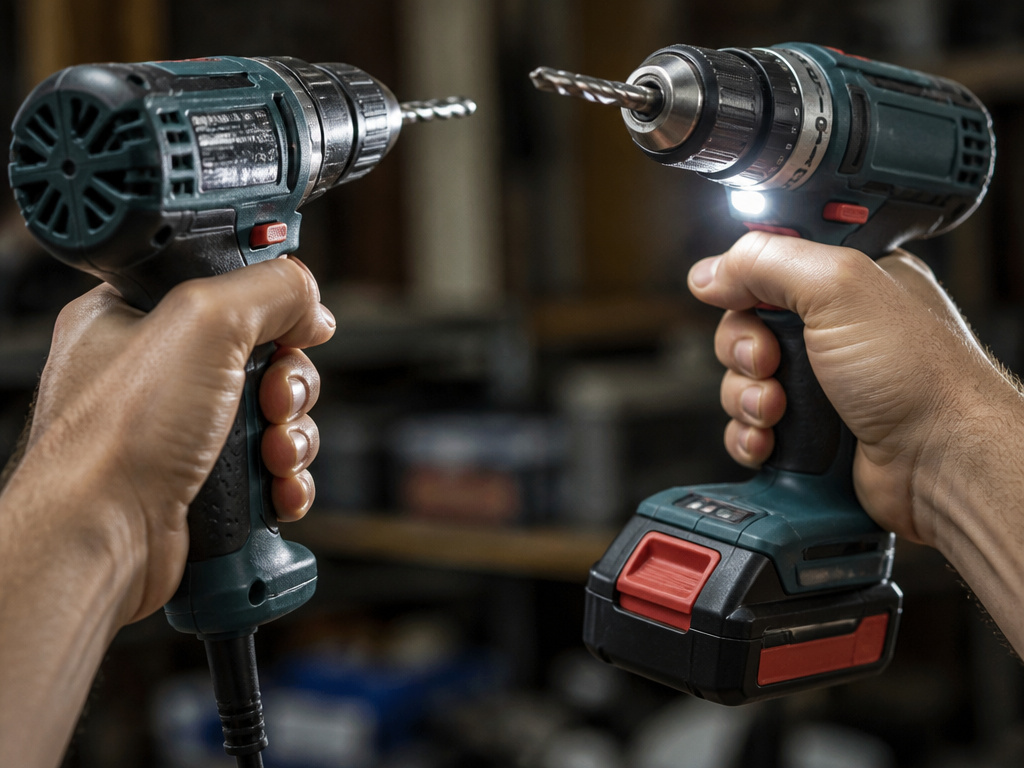
We should clarify something about weight. Sources disagree, and that’s because they’re measuring different things.
A corded drill’s body is often simpler and denser. The DeWalt DWD 115K is just over 4 lbs. But add a typical 4.0Ah battery to a cordless drill, and the working weight can easily surpass that.
The real comparison is working weight versus perceived weight. A 6 lb cordless drill with a well-balanced battery feels lighter in the hand during overhead work than a 4.5 lb corded drill with a stiff, dragging cord. The cord acts as a constant tug, adding fatigue.
Design differences are more than skin deep.
- Chuck: Most cordless drills now have keyless chucks for convenience. Many corded drills, especially older or industrial models, retain a keyed chuck for maximum gripping force on small or worn bits.
- Clutch: Cordless drills almost universally feature a adjustable clutch to prevent over-driving screws. Most corded drills omit this, as their primary role is drilling, not fastening.
- Safety Features: High-end cordless drills like the DeWalt DCD1007 now include kickback control, which shuts the motor off instantly if the bit binds. This is a major safety advancement you won’t find on basic corded models.
- LED Lights: Nearly universal on cordless drills, rare on corded ones. That light makes a big difference for working in dim corners or under cabinets.
Matching the Drill to Your Project
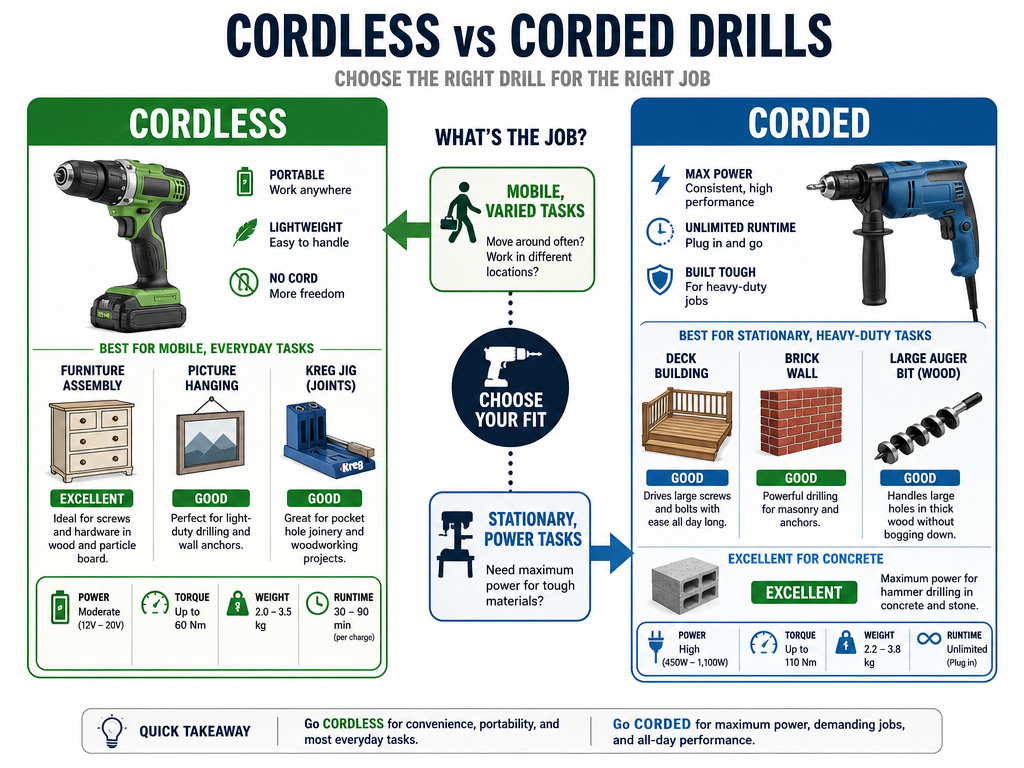
Your project list decides the winner. We will match them.
If your next 12 months look like assembling flat-pack furniture, hanging pictures, building a garden bed, and doing small woodworking projects, a cordless drill is your default. It’s rated “Excellent” for furniture assembly and driving screws. About 60% of DIY projects fit this profile.
If your plans involve building a deck (with lots of large pilot holes), drilling into brick or concrete, or doing any kind of production work in a fixed workshop, you need a corded drill. It’s rated “Excellent” for concrete drilling and long sessions.
For woodworking, the choice gets nuanced.
- Pocket Holes (Kreg jigs): You need a steady 1,200 RPM. A cordless drill with good speed control (like the DeWalt DCD801) excels here. Not having a cord allows you to maneuver the jig easily.
- Mortising or Large Auger Bits: The sustained power of a corded drill wins. A cordless model will bog down and drain the battery rapidly.
- General Drilling & Driving: A cordless drill is faster and less frustrating. You’ll spend less time managing the cord and more time working.
TL;DR: For mobile, varied tasks, cordless. For stationary, power-hungry, long-duration tasks, corded.
Lifespan and Maintenance: The 5-Year Story
This is where the long-term cost of ownership comes into sharp focus. The numbers from our fact sheet tell a clear story: corded drills usually last 8–12 years; modern cordless drills last 5–8 years with proper care.
The corded drill’s advantage is mechanical simplicity. No battery to degrade. No charging circuits to fail. Often, if a corded drill dies, it’s the switch or the motor brushes, and on many models, those are user-replaceable with a screwdriver. A well-made corded drill is a decade-long investment.
The cordless drill’s lifespan is tied to its battery. Lithium-ion batteries have a finite number of charge cycles. Storing them in a hot garage or letting them fully discharge regularly will shorten their life dramatically. The tool itself might be fine, but a $80 battery replacement every few years is part of the equation.
Maintenance is different for each:
- Cordless: Regularly clean the battery contacts and tool vents. Store batteries at 40% charge in a cool, dry place. Avoid deep discharge.
- Corded: Inspect the power cord regularly for cuts or fraying. Keep the chuck clean and lightly lubricated. Blow out the motor vents with compressed air every few months of heavy use.
I made the classic beginner mistake of using the wrong blade for a long cut once. The burn marks were a lesson. That same principle of matching the tool to the task applies here. Forcing a cordless drill to do a corded drill’s job will burn through batteries and burn out motors.
How to Choose: A Decision Framework
Stop thinking about drills. Start thinking about your next three projects. Write them down. Now, run them through this filter.
- Location: Is there a reliable power outlet within 50 feet of where you’ll be working? If not, cordless is your only option.
- Duration: Will you be drilling or driving for more than 30 minutes at a stretch without a natural break? If yes, lean corded.
- Material: Are you mainly working with wood, drywall, and screws? Cordless. Concrete, metal, or thick hardwood? Consider corded.
- Frequency: Will you use the drill once a month or once a week? Infrequent users often find a cordless drill’s battery dead when needed, a point for the always-ready corded drill.
For most people, the 70%, the answer is a cordless drill. Specifically, a brushless model like the DeWalt DCD801 or the compact DCD794. It covers the vast majority of home and shop tasks with a great balance of power and weight.
For the minority doing heavy, stationary work, a corded drill like the DeWalt DWD 115K or the Bosch 1006VSR is a powerhouse that will outlive your interest in the project.
And for anyone who does a real mix? Owning both is the professional’s secret. Use the best cordless drills for 90% of the work, and drag out the best corded drills for the 10% that demand it.
Frequently Asked Questions
Are corded drills more powerful than cordless drills?
Yes, for sustained torque and unlimited runtime, corded drills are more powerful. A typical corded drill draws 6-10 amps directly from the wall, providing consistent high torque. A cordless drill’s power is limited by its battery capacity and motor design, though top-end brushless models like the DeWalt DCD1007 come very close for short bursts.
What are the downsides of using a cordless drill?
The main downsides are limited runtime, battery degradation over time, and generally less sustained torque than a corded model. You must plan around battery charges, and in cold weather, performance can drop. For very long, continuous drilling sessions, a cordless drill will require battery swaps or recharges.
Is a cordless or corded drill better for home use?
For most home use, a cordless drill is better. It’s more convenient, safer without a trailing cord, and perfectly capable for the wood, drywall, and screw-driving tasks that make up about 60% of DIY projects. Its portability outweighs the raw power advantage of a corded drill for typical home jobs.
How long does a cordless drill battery last?
Single battery charge’s runtime varies significantly depending on the task and battery size (measured in Amp-hours, or Ah). The battery pack itself has a finite lifespan and will degrade over time, impacting the overall 5–8 year lifespan of a well-maintained cordless drill.
Can a cordless drill be used as a screwdriver?
Absolutely. In fact, with its adjustable clutch to prevent over-tightening, a cordless drill is often the preferred tool for driving screws. Many models have a dedicated screwdriver setting. Corded drills are less ideal for this as they lack a clutch and can provide too much torque too quickly.
Do I need a hammer drill?
Only if you plan to drill into masonry, brick, or concrete with any regularity. A standard drill will struggle or fail in these materials. Many cordless drills, like the DeWalt DCD1007, include a hammer function. For corded drills, hammer function is also common. If you’re only working with wood and metal, you don’t need it.
The Bottom Line
The debate centers on using cordless drills for mobility and corded drills for marathon power.
If you’re buying one drill for general home use, get a cordless drill. A brushless model in the 20V class will serve you well. It’s the practical choice that fits modern, mobile project work.
But if your work is anchored to a shop and involves materials that fight back, concrete, thick steel, dense hardwood, the relentless power of a corded drill is worth the hassle of the cord. It’s a different kind of tool for a different kind of job.
Most importantly, your first drill shouldn’t be your last. Start with the type that matches your immediate needs. As your skills and projects grow, the other type will become its own compelling purchase. That’s how you build a workshop, one right tool at a time.
